Thursday, October 12, 2023

M.E. Ingalls Left a Heritage in Cobalt


In the days before Prohibition, a few whiskey dealers sought to distinguish their spirits by offering them in ceramic jugs decorated with their names written largein cobalt applied letters.  Among them was M.A. Ingalls, whose wholesale and retail liquor house was a fixture in Little Falls, New York, for more than a quarter century.  Today Ingalls' whiskey jugs, initially given away, can command prices of up to $1,000 or more.


Although the company letterhead indicates a founding date of 1877 the first Little Falls directory reference to Ingalls’ liquor house that I can find is 1893, located at 311 South Second Street.  The proprietor’s first efforts at obtaining whiskey jugs with his name emblazoned on them may not have been completely successful.  Below are two early efforts from Ingalls that are crudely done.  The one at left has blobs of cobalt and a distinctly amateurish look.  The larger jug at right indicates an effort to correct an earlier spelling error by writing over an errant “g” to form the Ingalls name.


Those errors seemed to end when Ingalls discovered the potteries of Ft. Edward, New York, about 90 miles northeast of Little Falls.  That town along the Hudson River had become renowned for its production of stoneware. Beginning in the 1850s several local companies produced a unique type of pottery featuring cobalt-applied lettering or designs on an off-white or brown-glazed body.  Ingalls had found the perfect containers for his whiskey.


Of the several potteries in Ft. Edward, Ingalls seemed to favor the craftsmanship of the Ottman brothers, who operated a pottery from 1872 to 1892. Their company became known for the bright, shiny quality of its cobalt lettering, applied by skilled decorators.  Shown above are two examples of the the Ottman artistry, each holding three gallons of whiskey.  Below are two smaller containers from the Ingalls liquor house, likely created by a different New York potteries.  The jug at right is particularly interesting in that it is not written in cursive script but in print type letters, a somewhat unusual format for whiskey containers of this type.


When the Ingalls jugs reached five gallon size, they were adapted to a two-handle format.  This made them easier to carry and able to be decanted by wholesale customers into smaller size containers.  The jug at left sold at auction in 2020 for just under $1,000, indicating the collector market for these pre-Prohibition vessels, all of which have attained “antique” status.  The jug identifies nearby “Herkimer” as the locality rather than Little Falls, which is in Herkimer County.


The final two five gallon examples from the Little Falls liquor house have a slightly darker outer glaze, indicating to me that they were made in a different, unidentified pottery.  Like others here their contents likely were received by the barrel from Massachusetts and nearby states, coming by rail, and then either “rectified” by the company or poured unblended into the containers exhibited here, then sold at both wholesale and retail. 


Personal details about M.A. Ingalls are hard to come by.  He appears to have avoided the 10-year census throughout his life.  More is known about his older brother, John W. Ingalls, who was involved in the whiskey trade in collaboration his sibling.  John was wed to Mary A. in 1865 and the couple appears to have had one child, Daniel, born late in their marriage. M.E. Ingalls may not have married.  Both brothers lived at 580 Garden Street, the house shown here as it looks today..


In the meantime, because each of them is a singularity given of the nature of its crafting,  the value of these whiskey jugs is sure to increase with the passing years.  Whether he anticipated it or not, M.E. Ingells left later generations a heritage in cobalt.


Notes:  Although Ingalls whiskey jugs are frequently featured on auction and sales sites, the company and its personnel largely have “flown under the radar.”.  I am hopeful that sharp-eyed descendants of the Ingells brothers will see this post and help fill in the blank spots. 


Sunday, October 8, 2023

Detroit’s Olney Cook Motorized Whiskey


With the rapid rise of the automobile during the early 20th Century came a concurrent rush in  the advertising world to insert the motor car into magazine and newspaper ads as symbols of modernity.  Beer companies were quick to align their alcoholic beverages to this idea and over time I have collected dozens of their pre-Prohibition ads featuring motor cars.  Most “whiskey men” by contrast, seemingly were reluctant to identify drinking liquor with driving. A major exception was Olney B. Cook, selling whiskey in (where else) the “Motor City” — Detroit.


The saloon sign below deserves careful scrutiny.  It captures a scene, clearly not in Michigan, with high mountains, perhaps the Alps, a pine forest, a landscape filled with deep snow and a scattering of boulders.  It is a winter scene with an ice and snow-covered road that leads to an Alpine-like inn bearing a sign reading “OLCO Whiskey For Sale Here.”  Taking in the entire panorama, it might be speculated how the automobile was able to reach the tavern at such heights amid the slippery and rutted condition of the roadway. 


Now concentrate on the centerpiece of this artistic gem, the automobile, its passengers, and a waiter with a tray full of drinks.  The occupants appear heedless of the dangerous driving conditions that will face them as they motor down the mountain.  Three are eagerly reaching out for one of the glasses of whiskey being proffered by the young attendant.  Only the operator seems otherwise occupied, holding a rope of ambiguous purpose.   Does it open the driver side door?  Or engage the emergency brake?  No mind, there are four glasses on the serving tray.  The driver will get his liquor soon enough.  Moreover, the boy has brought the whiskey bottle.  Other libations presumably will follow.


Olney Cook, the liquor dealer responsible for commissioning this enthralling scene,  was a descendant of an old Colonial family that dated its coming to Massachusetts in 1643.  According to a biographer:  “A much prized relic in Mr. Cook’s possession is the Cook Coat-of Arms, brought to this country by his ancestor, Walter Cook in the seventeen century.”  Olney also could claim kinship with slain President James Garfield and Gen. Cyrus B. Comstock, senior aide-de-camp to Gen. Ulysses S. Grant. 


One of ten children, Olney Ballou Cook was born in 1837 to Marinda Thayer and Fenner Cook, a farmer.  He received an elite education for the times, first at the local elementary schools in Mendon, Massachussetts, and later attending a secondary boarding school for boys at Westminster, Vermont.  Apparently not attracted to farm life, in 1857 Olney at age 20 took the opportunity offered him by an uncle, Colonel Levi Cook, to come west to Detroit, Michigan, where his kinsman was a well-known figure, shown here, having served in numerous public positions including three terms as mayor of the rapidly growing city.


Levi Cook also owned a general merchandise store in Detroit where he employed his young nephew.  Olney proved to be a quick learner and the importance of liquor sales at Uncle Levi’s establishment particularly caught his fancy.  After 14 years working for others, in 1871 Olney struck out on his own opening a wholesale liquor store on Detroit’s major commercial street, Jefferson Avenue.  He called his enterprise “O.B. Cook & Co.”


Olney’s move may have been triggered by his marriage in August,1866.  His bride was Vashti T. Goldsmith, from a distinguished Detroit family who claimed kinship with New York governor George Clinton and General William Belknap, Secretary of War under President Ulysses S. Grant.   A biographer noted a difference in religious affiliation between the couple.  Vashti was a staunch Presbyterian; Olney an adherent of the more liberal — and non-Prohibitionist —Universalist Church.  The couple would go on to have three children, daughter Alma, and sons Charles and James.


Cook appears to have met with quick success as a liquor dealer.  A wholesaler, he was selling his whiskey in four and five gallon jugs to the saloons, hotels and restaurants in his customer base.  He also was a “rectifier,” blending whiskeys distilled elsewhere to achieve particular characteristics, then bottling and labeling them as proprietary brands.  He was drawing liquor from the warehouses of J. B. Wathen & Brother distillery of Jefferson County, Kentucky, and the R.P. Pepper distillery, Louisville. [See post on Wathen, Aug. 1, 2020.]


The transplanted Yankee sold his own proprietary brands both at wholesale and retail.  They included "Export Brand Whiskey,” "Knickerbocker Whiskey,” “Del Monte Whiskey,” "Vallonia Whiskey,”, and "Yankee Rye.” OLCO Whiskey was his flagship label, obviously standing for OLney COok.  He never bothered to register any of these names for trademark protection.  Cook issued shot glasses for most of his brands, examples to be found throughout this post.  Shown here is his back-of-the-bar bottle for OLCO.


His success rapidly advanced Cook’s reputation in the commercial centers of Detroit.  Noted his biographer:  “Through persistency and a fixed determination to forge ahead Mr. Cook has succeeded in building up a fine business enterprise and he holds prestige as one of the foremost businessman of Detroit….”  Interestingly, nowhere in Cook’s two page profile does the biographer mention the source of his wealth and prestige — selling liquor.


Cook for many years also was secretary-treasurer of  the Allouez Mine in Michigan’s Upper Peninsula, shown here.  This mining operation, extant from 1869 to 1923, was aimed at tapping the riches of the Allouez Conglomerate Lode, porous rocks containing agates, quartz, calcite, and other valuable minerals.  He also was a founding member of the “Old Club,” a boating and country club located on Lake St. Claire, below.


As he aged, Cook brought his son James into the business.  Although the young man, shown here, demonstrated an affinity for the trade, his father into his 70s continued to be active in managing what had become a large liquor house.  Cook died in December 1916 and was buried in Detroit’s Woodmere Cemetery, Section 1A, Lot 765.  His widow, Vashti, joined him there 21 years later having lived to be 96 years old.   Son James guided the fortunes of the liquor house his father had built for the remaining few years until shut down by Prohibition. 


As for Olney Cook, the last word here is left to a biographer writing in 1888:   “He is a fine old man and his life history is certainly worth of commendation and emulation, for along honorable and straightforward lines he has won success which crowns his efforts and which makes him one of the substantial residents of Detroit.”  To which I would add:  A man whose melding of drinking and driving in a saloon sign stands virtually alone in its audacity.


Note:  Key to telling the story of Olney Cook is his extensive biography in the 1888 volume entitled “History and Geneology of the Ballous in America,” compiled and edited by Adin Ballou, available on the Internet. The material there has been augmented by information on ancestry.com, Find a Grave and other websites.


Wednesday, October 4, 2023

Convicted Killer Edward Stokes and His Famous Barroom

In the Winter of 1873, a convicted murderer languished inside New York City’s well named prison, “The Tombs,” contemplating his hanging scheduled for February 28.  Eight years later this same man bought a controlling interest in an elite Manhattan hotel called the Hoffman House, made it famous for its barroom, and thereby generated whiskey brands across America.  His name was Edward S. Stokes and his story is the stuff of novels.

Edward was born in Philadelphia on April 27, 1840, the son of Nancy Stiles and Edward H. Stokes, a wealthy New York cloth manufacturer who retired at an early age and moved to Pennsylvania.  He was able to give his son an excellent education and when the boy showed strong signs of business acumen, a start in business, manufacturing and selling cheese.


Cheese proved to be just an appetizer.  By the time Stokes was 25 he was operating an oil refinery in Brooklyn.  This brought him in close contact with Jim Fisk, the personification of a late 19th Century “robber baron.” Fisk gained wealth and notoriety manipulating gold and railroad stocks on Wall Street. Never shy about broadcasting his money,  As shown here, Fisk strolled Manhattan streets in elaborate uniforms with perfumed hair, waxed mustache, and fingers adorned with diamonds. 


Fisk saw the potential in Stokes and became a “silent partner” in the oil business.  Together they had a secret arrangement to discount refinery freight charges by the Erie Railroad, a line Fisk controlled.  Their collaboration foundered in the late 1860s as the two men vied for the affections of the same woman, femme fatale Helen Josephine “Josie” Mansfield.


Shown here, Josie was living in New York after she divorced her husband.  Impoverished and unable to find work, she frequented the hospitality of a friend who ran a brothel on 34th Street. There she met Fisk, whose young wife is said to have tolerated his extramarital affairs.  Smitten with Josie, Fisk showered her with money and gifts, buying her an elegant brownstone at 18 West 24th Street.  Josie also had attracted the attention of Stokes who, in contrast to the portly middle-aged Fisk, was slender, young, handsome and single.


Catching wind of this competitor, Fisk arranged to have Stokes arrested for allegedly embezzling funds from the refinery. He also seized the refinery and obtained injunctions to prevent Stokes and his mother, who owned the site, from entering the premises. The charges were dismissed and Stokes was later awarded $10,000 compensation, but was still deeply angry.  He threatened to publish Fisk’s love letters to Josie unless he was paid substantially more.  The older man screamed “blackmail,” obtained an injunction to prevent publication, and arranged a New York grand jury indictment of Stokes and Josie. By now thoroughly estranged from Fisk, Josie countersued claiming libel. Stokes, now her lover, was her principal witness.  The case was heard on January 6, 1872.


The date proved to be a fateful one.  That evening as Fisk entered Grand Central Hotel and began to ascend the stairs, he met Stokes coming down.  Stokes later claimed that Fisk drew a pistol and that believing Fisk intended to kill him, he drew his own pistol and shot Fisk twice. One bullet passed through Fisk’s arm and the other penetrated his abdomen, causing a mortal wound.  The tycoon died at 10:45 a. m. the following day.  The killing made front page news all over America.


Three trials ensued.  When a gun was found in Fisk’s vicinity, a first trial ended in a hung jury, seven to five for conviction.  Six months later a second jury found Stokes guilty of first degree murder and he was sentenced to be hanged.  As he waited on death row, upon a petition by his family the New York Court of Appeals granted Stokes a stay of execution and a new trial.  This time, with additional evidence produced by the defense, Stokes was found guilty only of manslaughter in the third degree.  The judge, critical of the jury verdict, said to Stokes:  “The sentence of the Court is that you be imprisoned in the State Prison at Sing Sing at hard labor for the term of four years.”


Stokes was released from prison in 1876 after serving three years.  Still only 36 years old, he embarked on an entirely new career.  Before his incarceration, he had lived in the Hoffman House Hotel, located at the corner of Twenty-fifth Street and Broadway. The proprietor had befriended Stokes during his trial and after his release sold him a controlling interest in the hotel.  For Stokes it was a new beginning. He made the most of it, building a national reputation around the hotel barroom.


Under Stokes guidance, the Hoffman House became famous for its paintings and sculptures, many displaying the nude female body.  Of those the most renowned was a large oil painting entitled “Nymphs and Satyr” by William-Adolphe Bouguereau.  First exhibited at the 1873 Paris Salon, it depicts three starkly nude young females cavorting around a goat-like satyr.  As shown right in the illustration below, Stokes made it the centerpiece of the Hoffman House barroom. 


In June 1877, Bougereau wrote Stokes imploring him to send the painting back  to be shown at the 1878 Paris Exposition as the artist considered it “the most notable feature of my future exhibitions.”  There is no indication Stokes complied. The painting had become a valuable tourist attraction.  According to one account:  “People lined up and crowds gathered to catch a glimpse of the titillating image. Magazines covered the story. The bar room painting set a trend, as hotels and bars in Chicago and San Francisco followed suit, exhibiting their own classical nudes.”


Recognizing that he had hit on a winning strategy, Stokes  surrounded this prize with other European artworks with an emphasis on nudity.  Shown above left is a statue entitled “Pan and Bachanti”  by Schlessinger, a first prize winner at the 1878 Paris show.  It can be glimpsed at the back of the barroom illustration.   Another was a statue  from the 1881 Exposition celebrating “Eve,” obviously before the unpleasantness over an apple.


Stokes included a number of those artworks in an 1885 brochure that bore his name.  The document includes this description of the by now-famous Hoffman House Bar:  “A few steps carry us to the threshold and there for a moment a visitor may pause, as he contemplates the magnificence of an establishment the praises of which have been sung in the Old World and the New.  A place that but for its convivial suggestiveness and atmosphere of good fellowship, might be mistaken for a cabinet of curiousities or a boudoir of art.” 


 The illustration below shows the extent of the barroom, said to be a place of  “gathering of New York’s socialites, actors, businessmen, and other wealthy men.” (Women were not allowed.)  Edward Stokes, a man who once had languished on “death row” had now achieved the pinnacle of recognition in “The Big Apple.”


Not only did Hoffman House set a trend for displaying classical nudes in U.S. drinking establishments, brands of whiskey that referenced the famous hotel proliferated across America. Three were in New York City.  The most prominent was Cook & Bernheimer Co., a New York liquor wholesaler that distributed its whiskey nationally from 1863 until 1917. Boasting branch offices from coast to coast, this firm may have had a licensing agreement with Stokes. Two other Gotham houses marketed their own brands.  Phelan and Duval, founded in 1870 by James J. Phalen and George Duval featured a whiskey they called “The Hoffman Special.”  The I. Solomon Company featured “The Famous Hoffman House Pure Rye.”


In the hinterland other liquor purveyors were quick to assume the Hoffman House mantle.  The most aggressive of these was the Hamburger Company of Chicago.  It not only captured the the hotel name but, as shown below, featured the Bougereau painting in its advertising and labels.


In Cincinnati, H. F. Corbin used the hotel name on its whiskey jugs large and small.  Nearby in Cincinnati, Isaac Michelson & Bro. liquor house featured a whiskey they called “Hoffman House Bouquet.”  An associated company in Austin, Texas, run by a third Michelson brother, advertised the same brand as well as Hoffman House Cigars.  Finally, in Milwaukee, Herman Toser, possibly afraid of trademark infringement, marketed Hoffmann (extra “n”) House Whiskey.


I can find no evidence that Stokes ever challenged the use of the Hoffman House name on any of these products.  He may well have believed that they helped publicize his New York hotel and drew customers to its doors.  For all his success as a hotel owner, Stokes became known for his bad temper.  He often quarreled with business associates and relatives alike, even resorting to court action against individuals who had helped him during and after his incarceration.  


Stokes died in New York City in November 1901 at age 60 and was buried at Greenwood Cemetery in Brooklyn.  Meanwhile Josie Mansfield, having broken off her affair with Stokes,  decamped to Europe, married again and was divorced four years later.  She died of stomach cancer in Paris in 1931 at the age of 83 and is buried in a Parisian cemetery next to her mother.


Notes:  This post was compiled from a number of online sources, including Wikipedia entries on Stokes, Fisk and Mansfield.  A detailed account of Stokes shooting Fisk was provided from a 1910 story by Thomas Duke in his “Celebrated Criminal Cases of America.”  Longer accounts of three whiskey men who issued Hoffman House labels may be found elsewhere on this website:  Cook & Bernheimer, November 7, 2016;  Michelson Bros., April 11, 2015; and Herman Toser, January 1, 2014.


Saturday, September 30, 2023

Risqué Whiskey: North and South Exposure

Noting that a prior post on risqué whiskey advertising has proved popular (May 25, 2023) I am emboldened to present a second post that presents the kind of “naughty” pictures meant to entice pre-Prohibition men to purchase a specific brand of whiskey.  As the title here suggests, such images were produced all over America.

This first is from Richmond, Virginia, the capitol of the Confederacy.  The very young lady shown lifting her skirt advertises “Deep Run Hunt Club Pure Rye” on a deck of playing cards.  This was a brand from E. A. Saunders & Son Company, who provided the Southland with wholesale liquor, tobacco, and grocery items via the elaborate railroad network that linked Richmond to southern states.  Rectifiers of at least four brands of whiskey, the Saunders family sold their liquor interests to Richmond’s Phil G. Kelly in 1905 after 20 years in business and opened a local grocery store.


The second skirt-lifting girl is one of several trade card images from an outfit that featured “Old Maryland Dutch Whiskies.”  My efforts to track down the company behind the brand have proved fruitless.  Particularly intriguing about this advertising were the slogans for Old Maryland Dutch:  “The Purest Stimulant in Existence” and “When not taken immoderately, there will be an entire absence of Nervous Prostration.”   This brand also was “Emphatically ‘The Whiskies of Our Daddies.”  One imagines daddies might well be prone to “nervous prostration” if their daughters ran around like the one shown here.


Dreyfus & Weil, Paducah, Kentucky, distillers provided a somewhat more suggestive trade card of young women, in this case dancers, raising up their skirts while three bonafide “dirty old men” take a long look.  Sam H. Dreyfuss and his partner regularly were excoriated in the press for the sexual images they presented in their merchandising.  Their “Devil’s Island Endurance Gin,” sold with suggestive advertising was accused by critics of having been instrumental in rapes and even one murder.


From lifted skirts to bared bosoms, we head west to San Francisco where Roth & Company had trademarked “Capitol O.K. Whiskey” in 1906.  Its saloon sign depicted an underwater topless beauty.  Joseph Roth founded this firm in 1859, initially located in the old U.S. Courthouse near Oregon Street.   After working with several partners over the years, Roth died in 1891 and the firm in 1906 was bought by Edwin Scheeling and his wife.  The earthquake and fire that year destroyed the premises but the Scheelings rebuilt and the business survived until the arrival of National Prohibition. 


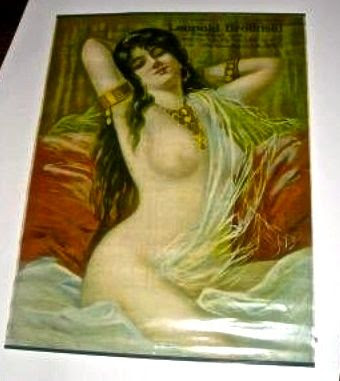
Other popular advertising gimmicks were calendars.  They might be hung up in a drinking establishment or more cautiously in a customer’s “man cave.”  This beauty graced a calendar issued by the Brolinski Saloon of Niagara Falls, New York, likely given out to the boys along the bar.  Brolinski likely bought this image from a catalogue and personalized it by having his name and address attached.  The lady involved was clearly a Middle Eastern harem dweller, a popular exotic image of the pre-Pro era.


Also popular were representations of Greek goddesses in various states of undress.  They are found on a number of whiskey advertising items, including signs, trade cards, celluloid pocket mirrors and, as in this case, paperweights.  The weight above shows Diana, the goddess of the hunt, in a forest setting with her bow in hand and half-clothed in something filmy.  She has just fired an arrow, likely into a deer offstage.  The item was issued by the Fleischmann Company, famous for yeast, but also a major producer of whiskey under a number of brand names. 


Another lass clothed only in gauze is somewhat inexplicably holding onto a horse in this trade card.  She may, however, be what one Milwaukee liquor dealer thought Lady Godiva might look like.  He was A. M. Bloch who founded his enterprise in 1877. Over the thirty years of its existence Bloch’s firm was located at several addresses on the city’s Water Street, where many of its liquor emporiums were located.  Although not mentioned on this ad, Bloch’s flagship brand was “Joker Club.”  


Even staid Boston could spawn a risqué image, this one from Felton & Son, founded by F. L. Felton and located in South Boston.  The company house brands were “Felton Rye,” “Old Felton Rye,” and “Felton’s New England Rum,” the latter the excuse for this tantalizing saloon reverse glass sign.  The Feltons were distillers and known most particularly for their rum, advertised as“…Unsurpassed by any in the market, is warranted copper distilled, perfectly pure….”   Would the Feltons, I wonder, have vouched for the “perfect purity” of the nude on their sign?


.


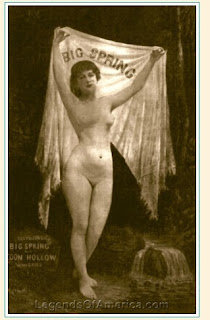
At this point, all modesty has flown away.  Whatever covering this nude may have had is now held above her head, advertising “Big Spring” whiskey.  This sweetie was brought to the public by the infamous “Whiskey Trust,” an attempt to create a monopoly in the whiskey trade in order to drive up prices.  Located in Louisville, the organization officially was known as the Kentucky Distilleries & Warehouse Company.  More successful than other similar attempts at combining distilleries the Kentucky outfit operated from 1902 to 1919, buying or spawning more than a dozen brands, but it never achieved its profit goals. 


The invention of celluloid made possible a variety of liquor-related advertising items that retain their appeal even a century or more later.  The shapely female shown on this match safe is a excellent example of celluloid art, even though it is difficult to understand why light is shining from the palms of her hands.  This interesting image was brought to the drinking public by Herman Frech, a pre-Prohibition Minneapolis liquor dealer, located at 14-16 North Sixth Street.   His logo, unseen here, appears on the opposite side. It presents his name, a whiskey bottle, two glasses and a box of cigars.


If one nude sells whiskey, hey — why not try three?  That may have motivated B.S. Flersheim to issue a trio of nudes on a saloon sign advertising his mercantile company in Kansas City, Missouri.  The sign, that sold in 2019 for $37,000,  displays the unclad ladies visiting a gent sitting in an easy chair and quaffing a brand of whisky aptly named, “Its Tempting.”  That label was trademarked in 1904.  Another B.S. Flersheim & Company brand was “Old Bondage.”  Its use on this sign would have been really kinky.  Founded in 1879, Flersheim’ liquor business survived until 1918, a 37 year run.

There they are risqué whiskey fans.  A dozen females in various stages of dress and undress.  They were issued all over the country, from reputedly stogy places like Boston and Milwaukee to more exciting locales like San Francisco and Niagara Falls.  These images all had the same purpose:  to sell whiskey.  Moreover, they all faced the same fate:  Banishment to the ranks of collectibles once women begin to frequent drinking establishments.


Note:  Longer vignettes on two of the “whiskey men” noted in this post are to be found elsewhere on this website:  David Sachs, October 25, 2011, and Dreyfuss & Weil, March 1, 2013.