Saturday, January 13, 2024

Savagely Stabbed, W.S. Edwards Survived & Flourished

Eli Cobb, a failed saloonkeeper, was waiting for W. S. Edwards on a main street of Salida, Colorado, on the evening of September 1, 1910. Cobb knew  that the whiskey dealer would come looking for payment of Cobb’s large unpaid debt for liquor.  When Edwards approached, Cobb, seemingly unconcerned, was standing cutting his fingernails with a pocket knife.  Suddenly he whirled and sank the blade to the hilt into Edwards’ abdomen, twisting it upwards, puncturing his intestines in six places.  Believed fatally wounded, Edwards nonetheless survived to a future no one could have foreseen.

William Sandy Edwards was born in Tennessee in 1872.  According to early records his parents were  Mary Green and William Van Buren Edwards,  his father an immigrant from Wales.  Of Edwards’ early life, details are scant.  At the age of 28, he appeared in the 1900 census living in Salida, Colorado, working as a miner.  He was married to Margarite Crawmer, a woman seven years older than he. The couple had two children, William Van Buren II, three years old, and Etta, one.  The couple had wed in June 1896 in Colorado Springs.


Shown above, Salida was a “Wild West” town just beginning to settle down.  Founded originally as a stagecoach stop, Salida in its early years could count its share of gunfights and lynchings.  The Denver and Rio Grande Railroad reached there in 1880, bolstering its population and economy. The  downtown burned twice, in 1886 and again in 1888.  It was rebuilt with bricks, making Salida today the site of Colorado’s largest historic district.


The city offered opportunities that stimulated Edwards to action.  Early in the 20th Century he opened a saloon at 151 East First Street.  While apparently quite successful Edwards soon determined that it was more profitable to operate a wholesale liquor business in addition to selling whiskey by the glass over the bar.  The proliferating saloons in Salida proved to be active customers.  By 1905, Edwards had achieved sufficient prosperity to take the additional step of building his own bottling plant.  Shown below, the building also held his saloon and wholesale liquor business.


No longer solely dependent upon liquor and wine sales, Edwards was manufacturing
 and selling soda waters, advertising his ginger ale, cherry phosphate, cider, raspberry julep, and seltzer water.  He also sold beer, cigars, fountain supplies and empty bottles. Shown below are two angles on an Edwards whiskey jug, one that held whiskey or wine.


Like other wholesalers, Edwards also on occasion extended credit to local saloons buying his merchandise.  That is how he came to know Eli Cobb, who had opened a short-lived saloon in Salida, failed at being a publican, closed the drinking establishment, and was unwilling to pay a large bill owed Edwards.  Now working on a nearby ranch, Cobb had been married only about a year.


As recounted in the Salida Mail of September 2, 1910:  “Friends of both men knew there was hard feelings between them because of the failure to settle on Cobb’s part and were suspicious that the two men might come to blows.”  They clearly had not reckoned on Cobb stabbing Edwards “almost unto death.”  There the rest of the story fades into the mists of time.  Edwards received successful medical treatment, unusual for the period and place, surviving for another 42 years.  The fate of Cobb after committing this brutal stabbing is unclear. 


Eventually recovering from his injuries, Edwards remained in Salida churning out his beverages.  Shown above are two Hutchison bottles embossed with the city name.  About 1902, however, the miner-turned-entrepreneur decided to move his operation 380 miles southeast to Amarillo, Texas.  To what extent his stabbing had contributed to that decision is unclear.  Edwards clearly saw opportunities in the larger Texas city not available in Salida.


Edwards’ original management team had been other locals;  in Amarillo, they were relatives. Chief among them was his son, W. Van Edwards, employed as the secretary-treasurer of the Edwards Bottling Company.  Shown here, the young man was described by a friend: “Van was, in fact, one of the most outgoing extroverts, this writer has known.  Jovial, generous and friendly.  Van had no detractors — every acquaintance became a friend.”  Working together, the father and son Edwards built a thriving business in Amarillo working from the spacious building shown below,  strategically located across from the Amarillo railroad station. Initially called the Whistle Bottling Co., the company subsequently was re-named for Edwards. 


As the Prohibition tide began to rise, Edwards Bottling Co. put increasing emphasis on its soft drink trade.  It was one of the first bottlers in America to have a Dr. Pepper franchise.  (And Amarillo in 1960 the first place I tasted Dr. Pepper.)  Among company offerings were Canadian Club Ginger Ale, Pabst Malt Syrup, “Crazy Well Water,” and bottles.  When Texas went dry at the time of National Prohibition, Edwards Bottling was well position to survive.


Just as its Edwards was able to withstand a savage knife attack, the company he founded proved just as resilient.  When Margarite died in 1924, he married again, to a Mississippi-born woman, Corrinne Cage.  Edwards also would outlive this second wife by a year, dying in June 1952 of heart failure.  Despite his grievous wounding, Edwards had lived to be 79.  He was buried in Amarillo’s Llano Cemetery, Section U, Lot 156, Space 5. His gravestone is shown below.


Edwards died not knowing that he had created a bottling dynasty. With his father’s death Van Edwards and a relative, Martin V. B. Edwards, took over management of the bottling company.  With their retirements, Van’s son. James Jackson “Jack” Edwards, inherited the business, to be followed by his wife, Frances Exum Edwards.  She became owner and manager, when few women held such positions in a male dominated industry.  Frances served until the business was sold in 1965.
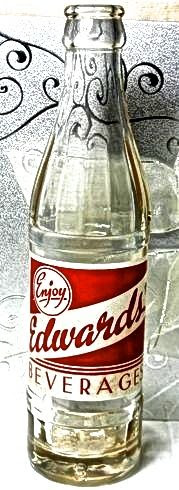

In sum, the Edwards name had dominated the bottling trade in two cities over most of the 20th Century despite the near fatal stabbing of the founding father. In his memory the company later produced a soft drink named “Edwards Beverage.”  W. S. would have been proud. 


Notes:  This story of a stabbing and its aftermath has some notable “holes.”   Chief among them are events immediately following the stabbing.  How was Edwards saved?  What happened to Cobb?  Other details are needed.  I am hoping some sharp eyed reader — perhaps a descendant — will be able to help fill in the blanks. 


Tuesday, January 9, 2024

The Hegners Were 115 Years in Cincinnati Whiskey

 For most of the 19th Century, the center of the American liquor trade was Cincinnati, Ohio.  Close to Kentucky and Pennsylvania, two major distilling states, and a major national hub for river and railroad traffic,  the so-called “Queen City” was home to hundreds of distillers, rectifiers (blenders), wholesale and retail liquor dealers.  Among them was the Hegner clan — three generations encompassing six decades in the whiskey trade.

The Hegner saga began with the arrival of Johan Hegner in the United States in 1843.  Born in Germany in1823, Johan at the age of 20, was said to be “like thousands of ambitious young men of the old country, determined to seek his fortune in America.”  He also may have been trying to avoid being conscripted into the Prussian military.  Johan is shown here as depicted on a Hegner grave monument.


Johan appears to have had some experience in his homeland with the distilling trades.  He early headed to Cincinnati with its strong German population and lively liquor industry. There Johan is credited with being a pioneer distiller and yeast manufacturer.  “He furnished stock yeast to the distilleries of this city and the tributary territory for many years,” noted a Hegner biographer.


In Cincinnati, Johan met and about 1847 married Catherine Kuespert, a child of immigrant parents. She was three years his junior  They would have three children, Anna Barbara, born in 1848; Margaretha, 1854, and Gottfried, 1855. Shown here as depicted on the grave monument, Catherine died in 1879 at the age of 54.  The couple is buried in the Hegner plot in Cincinnati’s Spring Grove Cemetery.


Johan lived until 1904, long enough to help educate his son in the whiskey trade.  Gottfried had attended public schools until reaching 12 years and then went to work in the distilling business, serving apprenticeships in Cincinnati and Terre Haute, Indiana.  In 1875, the young man returned to Cincinnati and gained employment as a bookkeeper with William Fuller & Co., a wholesale dealership and whiskey rectifier.   This was a highly responsible position because of the need to keep careful track of the federal taxes owed.  Federal agents particularly targeted tax cheating on rectified whiskey.  The penalty was stiff and could include jail time.


At William Fuller & Co. Gottfried met Augustus Kayser, Fuller’s junior partner in the liquor house.  Born in Germany, Kayser was seven years older and an established personage in the Cincinnati liquor trade.  The two men became friends and eventually Gottfried introduced him to his older sister, Anna Barbara.  The two fell in love and were married, bringing Kayser firmly into the Hegner family fold.  


In 1878 Fuller dissolved his firm leaving Kayser and Gottfried’s free to organize their own liquor business.  They founded it that same year as Kayser & Hegner Company.  Augustus was president and Gottfried secretary.  Their first address was 86 East Second Street (1878-1883) and subsequent larger quarters over a span of 40 years all were located on East Second.


In February 1879, Gottfried met and in Cincinnati married  Annie E. F. Lachtrop, the daughter of a well known local tavern keeper, the proprietor of Eight Mile House, located on the Lexington and Covington turnpike.  Growing up in the roadhouse atmosphere Annie was well attuned to her husband’s occupation.  The couple would have three children, Harry born 1880 , Fred, 1883, and Pearl, 1886.


Kayser & Hegner featured a number of proprietary “house” brands.  They included “Red Hen,” "Avondale Club,” "Belle of Washington,” "Moscow Rye.” "Selby Run,” "Small Still,” "T. P. A,” and "Yacht Club.”   In 1887 the partners registered Yacht Club, their flagship brand, with the Patent and Trademark Office.  When Congress strengthened copyright laws in 1905, they re-registered the name and added Avondale, Belle of Washington, and Selby Run.  As shown here Kayser & Hegner bottled their whiskey in both ceramic and glass.


From the outset the partner’s exhibited a strong sense of merchandising.  They provided their customers in saloons, hotels and restaurants with well crafted signs advertising their whiskey.  At left is a Kayser & Hegner gifted sign of a smiling boy done in the  Dutch or German realistic genre.  In an era when depictions of female nudity were common in drinking establishments, this picture was suitable for display in finer settings where women were invited.  Below is a second example of the company advertising.  This saloon sign celebrates Yacht Club as well as two other Kayser & Hegner brands.  Although the central focus is on two sailboats, look to the left, very small, is a line of battleships, suggesting a wartime dating.


As was common then in  the liquor trade, the partners also gifted their customers with decorative shot glasses.  Those would be distributed to both wholesale and retail patrons.  Not expensive to make, those glasses were virtually indestructible and capable of being used over and over.  Today advertising shot glasses find an avid collector base willing to spend a high dollar figure for particular pieces. 


Kayser & Hegner did a vigorous business throughout the Middle West by sending salesmen out on the road.  They would be announced by imaginative post cards, often including the proposed date of the visit, as on the card below.  The company tried to make them as interesting as possible with illustrations.  The card at left serves to introduce the third in the line of Hegners in the whiskey trade, Henry Hegner, who began in the business as a traveling salesman for Kayser & Hegner.


As he advanced into his 60s,  Augustus Kayser ’s health faltered.  Earlier he had been highly active, running the liquor house and making a name as an inventor.  He owned patents on “Improvements in Low Water Alarms for Steam-Generators” (1871) and “Improvement in Low Water Alarms for Steam Boilers” (1972).  His wealth allowed him to house his wife Barbara and children, Augustus Jr. and Luella, in a spacious home at 1710 Kinney Avenue in Cincinnati, shown here.


Augustus was living there amid his family when in September 1910, he died and was buried in the Hegner family plot.  Gottfried had taken over the management of Kayser & Hegner a year earlier.  Said a biographer:  “Having early gained thorough knowledge of his business, Mr. Hegner applied himself with great diligence and has won high standing among the distillers and wholesale dealers of the country….Possessing a generous and kindly nature, he is a liberal contributor to worthy causes.…”


With the help of Henry, promoted to management, the Hegners prospered even as the noose of Prohibition tightened around the liquor industry.  The family finally conceded, closing down their establishment in 1918.  Gottfried would live another 12 years, succumbing in August 1930 at the age of 75.  He was buried in the Hegner plot adjacent to the monument to Johann and Catherine and near wife Annie and son Henry, both of whom had preceded him in death.  In Cincinnati, home to a multitude of liquor establishments, the Hegner/Kayser clan had made its mark.


Notes:  This post relies heavily for information from ancestry.com and the biographies of Johann and Gottfried Hegner in the volume, “The Queen City, 1788-1912,”  Vol. III, Clark Publishing, 1912.


Friday, January 5, 2024

Whiskey Men and Divorce

Foreword:  While in past posts I have dealt with “whiskey men” who engaged in multiple marriages,  those stories frequently involved the death of a spouse and remarriages. [See post of May 14, 2019.]  In other instances whiskey men have been involved in marriages that ended in divorces that were “messy” or involved “high society,” some meriting newspaper headlines.  The four short narratives that follow demonstrate a range of circumstances surrounding the breaking of marriage bonds.  Note that in each case it was the wife who sued for divorce.

George Buente:  Booze for Indians, Blows for Wife.  Buente was the owner of a St. Louis shipping company whose principal trade was illicitly selling whiskey on Indian reservations.  Having outraged officials involved in Native American affairs, he ultimately became the government’s “poster boy” for the greed of American citizens prospering from the sale of “firewater.”  In St. Louis Buente made other headlines for wife beating.


In 1874 Buente returned to his native Prussia where he found a bride in 26-year-old Augusta, a women eleven years his junior, and brought her back to the U.S.  In quick succession they had three children.  A clue to Buente’s character may be Augusta’s petition for divorce in 1881 after seven years of marriage.  During the three preceding years, according to her testimony, her husband whipped and maltreated her on many occasions, beating her with his fists, throwing her violently against the wall and striking her while she was pregnant. 


Augusta further alleged that Buente frequently taunted her with a description of his illicit amours.  Her divorce petition stated:  “She bore this treatment until it became intolerable, and was at length compelled to appeal to the court for relief.”  Augusta sought custody of their children and considerable alimony, noting Buente’s lucrative business and real estate holdings.  The judge agreed, granted her the divorce, child custody and alimony.


Buente fared no better in a second court appearance.  Having been caught shipping liquor into Indian Territory,   Buente was arrested and brought before a federal court.  He feigned ignorance of the law but nonetheless pled guilty to the charges.  He was fined $500 (equivalent to more than $12,000 today) and court costs.   Whether this conviction was enough to discourage him from sending liquor again into Indian Territory is unclear.


J. C. Philpot:  While Wife Fed Chickens, Did He “Hen” Hop?  If you chanced to meet Jay George Philpott at one of his Michigan enterprises, he almost certainly would become an instant friend and confidant — and have something to sell you  It might be liquor, oysters, insurance, used cars, or even worthless Russian bonds.  Attractive to women, Philpot, shown here, had all the qualities of a confidence man.


While still in his 20s Philpot established liquor stores in two small Michigan cities: Port Huron, located in the northeastern most part of the state on Lake Huron,  and Adrian, 130 miles south, not far from the Ohio border.  On the outskirts of Adrian Philpot bought a 20 acre spread on which he raised prize poultry.  A biographer noted:  “He is a great fancier of finely bred chickens, and his pens…have won many prizes at different fairs and poultry shows where they have been exhibited.”


In June of 1890 Philpot married 22-year old Gertrude Durham of Romeo, Michigan, and settled her on the farm.  There would be no children. Leaving Gertrude miles away in Adrian to feed and nurture his chickens,  Philpot spent the bulk of his time in Port Huron expanding his liquor trade there. His rapt attention to business may have been explained by a local news report:  “A large number of people are employed…In the labeling department a number of girls find employment.”  After nine years of doling out feed to Philpots' leghorns, houdans, and brahmas, Gertrude called it quits.  Charging him with “extreme cruelty” she obtained a divorce.


Philpott wasted little time in remarrying, having a child, buying a large Port Huron home, and settling there.  When Michigan went “dry” in 1917,  he began to deal in foreign securities, including Russian Imperial bonds, above, issued before the Communist Revolution.  According to press accounts:  “Philpott is said to have disposed of virtually worthless Russian bonds to Michigan investors at a considerable loss to the latter.”  By 1929, the Michigan Securities Commission in Lansing had had enough. The Commission revoked his brokerage license.  A year later Philpot after a brief illness died in Port Huron, age 58.


Fred Hipsh:  The Con Man Cuckolded.  Fred Hipsh was a Hungarian immigrant who spent much of his working life in New York City acting as a “distiller’s agent”  representing whiskey distillers and rectifiers, selling client alcoholic products, and conducting tastings and other promotional events.  But Hipsh had abent toward chicanery, claiming to own a non-existent Kentucky distillery and selling fraudulent bond certificates for whiskey allegedly being aged in a non-existing warehouse. 


While Hipsh was cheating in the whiskey trade and 

Shonts

getting away with it, his wife, Anna, was cheating on their marriage. Fourteen years younger than Hipsh, Anna was attractive and was working as a stenographer when the couple married.  Now her lover was Theodore P. Shonts, one of New York’s richest and most powerful men as president of a New York Interborough Transit Company and an officer in several large railroads. Hipsh sued Shonts for $200,000, (more than $4 million today) for “alienation of affections.”  Known to be in an unhappy marriage, Shonts, shown here, lamely claimed Hipsh’s charges were a case of mistaken identity and that the real culprit was his “double.”


When Hipsh confronted Anna with solid evidence of the adultery, she packed a suitcase and bolted for the train station.  When the New York press caught up with her, Anna was in Reno, Nevada, apparently there for a “quicky” divorce.  Possibly with Shonts’ assistance, she was staying at the posh Riverside Hotel.  Anna acknowledged to reporters that she knew Shonts, saying: “He has always treated me as a gentleman should treat a woman.”  But she denied they were having an affair.


Subsequently Fred and Anna divorced, a settlement was reached with Shonts, and the railroad magnet, who clearly had a roving eye, went on to other women and scandals.  Hipsh, now single, moved to New York’s Marseilles Hotel.  His days in court were not over, convicted in 1913 of welshing on a large debt. Hipsh died the same year.  Anna’s fate is unknown.


Augustus Goodwin:  Rich, But Wife Yearned for Royalty.  Goodwin was a wealthy Boston merchant, CEO of a chain of specialty grocery stores that featured at least thirteen brands of his proprietary whiskeys.  Despite his success, Augustus found his New York socialite wife enamored of European royalty to the point of dumping him for a hereditary count.  Shown here is Frances Thorley Goodwin, subsequently known widely to New York society as “Countess von der Palen-Kar,” a designation as questionable as the origins of her second husband’s title.


Goodwin attempted to keep Frances content by agreeing to a major remodeling of their mansion home at 130 Commonwealth Avenue, in one of Boston’s most elegant neighborhoods. (In 2015 the house sold for $11.6 million.)  Despite her husband’s exertions Frances was not satisfied.  She had developed a yen for royalty in the person of Count Adolphe J. von der Palen-Klar, living in Brooklyn, likely under modest circumstances.  Adolphe’s family is said to have achieved nobility in 1799 when Emperor Paul the First of Russia, for reasons unknown, gave Peter Ludwig von der Pahlen and all of his descendants the rank of count.  The family coat of arms was something of a jumble.


How Adolphe got to Brooklyn and what he did there mattered little to Frances who had enough family money for them both.  She divorced Augustus and  married the Count in November 1927 at the American Church in Paris.   After a honeymoon they returned to live in New York.  Frances quickly appropriated the title of “countess,” however murky its origins.   Adolphe moved out of Brooklyn for lodgings with his new wife at one of upper Manhattan’s swankiest addresses, 920 Fifth Avenue, also home to movie star Gloria Swanson. The New York press paid close attention to the social whirl of Count and Countess von der Palen-Klar.  Clothed in royalty, Frances Thorley had arrived at the pinnacle of Gotham’s social set.


Meanwhile back in Boston, Augustus Goodwin, remarried, was busy running his businesses and indulging his hobby as an owner/breeder of thoroughbred racehorses.  Goodwin’s love for horses was his undoing.  In July 1934, he dressed in his riding outfit and drove to the nearby stables where he kept his steeds, mounted one and rode off.  Somewhere along his journey the horse threw him to the ground.  Goodwin may have died almost instantly.  The cause was recorded as “fracture at base of skull.”  Countess Frances died in 1944 in New York. The Count followed four years later.


Note:  More complete stories of each of these “whiskey men” may be found elsewhere on this website:  George Buente,  January 21, 2018;  J. G. Philpott, December 21, 2022;  Fred Hipsh, April 3, 2019, and Augustus Goodwin, August 9, 2021.