Wednesday, February 14, 2024

Golden Grain Whiskey Goes Sporty

Foreword:  On July 6, 2012, this website featured Gustave Fleischmann of the famous yeast and liquor family, as a partner in a Buffalo, New York, distilling company.  It bore his partner’s name, until Gustave bought E. N. Cook out in 1913 and renamed the liquor house “The Buffalo Distilling Company.”  The single constant across names was their flagship whiskey, “Golden Grain.” Recently I came across several new (to me) pre-Prohibition Golden Grain artifacts, all but one with a sports connection, and decided they deserved resurrecting here. 


Whiskey and hunting were a common theme in pre-Prohibition liquor advertising, often depicted in saloon signs where the audience likely was all male. (See  post of July 12, 2023.)  Rather than a sign, Fleischmann and Cook issued a small booklet. Entitled “4 Golden Grain Sports (Warranted 18 KT) in 8 Smiles” it was the product of the F. Myers Company, a publishing outfit in New York City.


The linking of hunting and whiskey in the booklet clearly is meant to be humorous with each cartoon panel narrated by four lines of verse.  In the first picture the two hunters have met two fishermen, who advise them to bring along some Golden Grain whiskey just in case it rains and spoils the hunting.  As we will later discover, the one in the deerstalker hat is named Smith.


In the second panel, the hunters have taken the anglers’ advice.  They apparently are preparing to climb aboard a train with their shotguns — one assumes unloaded— for their hunting adventure.  In the background a baggage handler struggles with the case of Golden Grain that will be accompanying them. 


Note that the next panel does not mention the whiskey.  It might appear, however, that both hunters have consumed some.  In order to rhyme with “in it,” a hunter apparently has shot a “linnet.”  That is a small finch-like bird of no value as food.  Meanwhile “Old Smith,” is being felled by the kickback of his own gun, or alternatively, possibly shot in the backside by his companion.


The last panel shows the two nimrods in bed, being cared for by friends with doses of Golden Grain.  The injury to “Old Smith” has been explained.  The reason the second hunter similarly is bedridden is not.  Perhaps he would gladly lie two abed just for a drink of whiskey.


The nod of Golden Grain to sportsmen extended to golf.  Shown below is a bar tray depicting an elderly gent carrying a bag full of clubs.  He is gazing at it fondly and commenting “I see this everywhere."


The two Golden Grain medallions below issued in 1917 by Cook and Fleischmann memorialized baseball.  The backside contained the Buffalo Bison’s 1917 schedule in the then International League.  The front bore the slogan, “Help the Herd Grab the Third.”  I take that to mean a third league championship. The Bisons failed.  The team ended the 1917 season with a record of 67 wins and 84 losses, finishing sixth in the league.


The last Golden Grain artifact here may not quite fit the sports motif but ogling attrractive women has been a male pastime for millennia.  This trade card  memorializes that activity and in the process manages to give offense to African-Americans, the sight impaired, feminists, and for good measure the Prohibitionist crowd.  But that was another day and a different sensitivity.


Afterword:  The story of the Buffalo Distilling Company continues in the building shown right at 860 Seneca Street in “Snow City.”  A combination liquor store and drinking establishment, the revived Buffalo Distilling has on display what it claims to be the last two extant bottles of the original whiskey. The company also markets its own Golden Grain whiskey using a Cook and Fleischmann originated nude image on the label.  What was old is new again.


Saturday, February 10, 2024

George Boldrick: “Last Man Standing” at the Belle of Marion Distillery

In 1880, as the story is told, four Kentucky businessmen joined resources to begin a new distillery in Marion County, Kentucky, buying a tract of land on which to construct it five miles south of the city of Lebanon.  The site was located where Arbuckle Creek joins the Rolling Fork River and adjacent to the L&N Railroad.  Two of the prospective owners and were seasoned “whiskey men,”  The others were not, among them George D. Boldrick, a Lebanon local who owned and operated a pharmacy when he join the investors.  Shown here, Boldrick a decade later was the “last man standing” at the helm of the Belle of Marion Distillery.  His place in Kentucky whiskey history, however, remains a conundrum.

Born in October 1842 in Danville, Kentucky, Boldrick had a strong Irish heritage.  His father, James P. Boldrick, was born and raised in Ireland, coming to the United States in his early manhood after a brief sojourn in Canada.  A “merchant tailor” he settled in Danville.  There James met and married Mary Freelove Doneghy, also of Irish immigrant ancestry.  The couple would have four children, three girls and George, the youngest.  The boy was educated in Danville schools where he showed considerable aptitude.


Boldrick’s fortunes took their first turn when he was 18 with the onset of the Civil War.  His ability caught the eye of General George H. Thomas, shown here, who chose him as a commissary clerk for his army.  My research indicates that such a post normally would carry an officer’s commission but I cannot find any rank for Boldrick.  A list of Army commissary clerks shows the young man being allocated $900 for unspecified purposes — a substantial amount for the time.  As depicted below, the commissary officer was a highly important position for maintaining a military force.  To cite a familiar adage: “An army marches on its stomach.”


Following the war Boldrick seems to have minimized his service.  He had fought for the Union while many of his Kentucky friends and perhaps even some of his relatives had cast their lot with the Confederates.  There is no evidence that Boldrick joined any veteran groups, his gravestone makes no reference to his service, and he seems to have sequestered all mention of his role in the war. It might not have been good for business to be identified with the Union cause.


Three years after the war, Boldrick opened his pharmacy, one of three in Lebanon.  This move into the mercantile world may have been a natural progression from his occupation in the commissary.  It also coincided with his marriage to Carrie Spaulding in July 1869.  Carrie may have been a distant cousin. Boldrick’s maternal grandmother was a Spaulding, the daughter of Samuel Spaulding, whose family origins were among Catholic immigrants to Maryland from England.  


Over the next six years George and Carrie would have three sons, Samuel James, Ralph Lancaster, ansd Charles Carter.  Then Carrie died in 1875, leaving her husband to care for and father three minor children.  Three years later Boldrick remarried.  His new wife was Kate Tobin, from Frankfort, Kentucky, also from an Irish immigrant family.  They would add four more Boldricks to the household over the next 17 years:  John Tobin, George Doneghy, Columbus Camron, and Lucy.


By contemporary accounts, Boldrick was a quick success in the druggist trade,attracting a local customer base.  His prosperity apparently allowed him at some point to buy into one of his competing pharmacies.   After a dozen years, however, Boldrick made a decision to get out of selling medicinals and move into the liquor trade.  My surmise is that he already was selling “medicinal” whiskey over the counter and he recognized the profitability of distilling and merchandising it.  


After selling his drug store interests, Boldrick joined — and actually may have initiated — a group of four Kentuckians to build and own a distillery.   The partners included two well-known figures in Kentucky whiskey-making, Richard Wathen and R.B. Lancaster. The participation of both was short-lived. Even before breaking ground for the facility, Richard Wathen died. (See post on the Wathens, August 1, 2020.)  Moreover, before completion of construction, R. B. Lancaster, newly burdened with issues at a family distillery in Bardstown, sold his interest to John Callahan. (See post on Lancasters, Nov. 5, 2023.)


Luckily Callahan was an experienced distiller, having been associated with the Chrystal Springs Distillery in Louisville, a major supplier to Kentucky wholesalers.The third investor was Ralph L. Spaulding, likely Boldrick’s cousin and related to his first wife.  Once the distillery had been completed, Spaulding assumed the presidency of the distillery known as the “Belle of Marion.”  Ralph Spaulding not long after was killed in a machinery accident at the distillery and his brother C. C. Spaulding replaced him.  After several years, C. C. Spaulding retired.  Of the original investors, now only Boldrick and Callahan remained.


Insurance underwriter records suggest that the distillery was brick with a metal or slate roof. The property included four warehouses, all iron-clad with metal or slate roofs. By 1890 Belle of Marion Distillery was mashing 300 bushels of grain a day, producing 30 barrels of whiskey.  The latter were stored in three bonded warehouses with a storage capacity approaching 14,000 barrels.  Within several years the partners had added a fourth warehouse bringing aging capacity to 25,000 barrels.  A shed where cattle were kept and being fed the spent mash was situated 400 feet west of the still.


The distillery employed local Lebanon workers.  A number of them are shown above, lined up in front of the distillery, some of them displaying the tools of their trade.  Two men at the right in the photo, the only ones wearing dress coats and ties, are identified as Boldrick,left, and Callahan.  Enlarged, their pictures also appear right..


Although Involved only tangentially, the partners became embroiled in a trademark dispute.  In return for a large order of whiskey, the Casey & Swasey wholesale liquor house in Fort Worth. Texas, asked permission from them to use “Kentucky Comfort” as a brand name and in their advertising.  With a large sale possibly at stake, the two men readily agreed. Barrels of whiskey with “Kentucky Comfort” burned into them began rolling into Fort Worth, 845 miles distant.  A photo of the Boldrick-Callahan operation shows the workers posing after loading whiskey barrels on a horse-drawn wagon likely headed to the nearby L&N railhead.


The Casey & Swasey purchase in Kentucky seemed to mean little to the Appeals Court of Kentucky when Rosenfield Bros. of Chicago and Louisville claimed an equal right to use “Kentucky Comfort” on their labels.  The Rosenfields alleged that they had widely advertised the brand and its value “has come in large part from the moneys expended in such advertisements.”  They also claimed to sell from three to five thousand barrels a year of “Kentucky Comfort.”   In 1898 the court found for the Rosenfields.  Both companies, however, it  strangely ruled, could use  the brand name.


The Texas whiskey men were not prepared to settle.  They took their appeal to the Federal Commissioner of Patents.  In 1906, he reviewed the record and, in effect, dismissed utterly the decision of the Kentucky judges,  saying that the   “judgment of the court was neither pleaded nor proved.” The Commissioner thereupon denied the claim by the Rosenfields that they had as good a right to the trademark as Casey and Swasey.  He ruled it remained solely the property of the Fort Worth firm.  I assume that throughout this lengthy legal process the Belle of Marion Distillery was providing the whiskey.
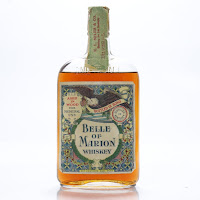

In 1899 John Callahan died and was buried in Louisville’s Cave Hill Cemetery leaving only George Boldrick of the original investors still active in the firm: “The Last Man Standing.”  As Boldrick reviewed the past, he could be justly proud of the record of success the distillery had achieved.  Both the brands “Belle of Marion” and “Callahan” had achieved recognition for quality beyond Lebanon, beyond Kentucky, and, indeed, throughout the United States.  When Boldrick looked ahead, however, he saw prohibitionary laws across the country steadily shrinking whiskey sales as states and counties one by one “went dry.”  With all his original partners now retired or dead, the future had turned bleak. 


 A year after Callahan’s death, Boldrick sold out to the Whiskey Trust.  That monopolistic organization operated and expanded the distillery, making rye as well as bourbon whiskey until shut down in 1919 by National Prohibition.  At the time of the sale the Trust was paying big dollars to own distilleries with distinguished names.  My guess is that Boldrick’s motivation for selling was the large offer made by the Trust.  He apparently used his profits to buy the Hugh Murray Drug Company and became its president.  He also was appointed president of the Lebanon Water Works. 


Early in the 1890s, Boldrick’s health began to fail  and he died in July 1904 at the age of 61.  He was buried in Lebanon’s Saint Augustine Catholic Cemetery in the shadow of a tall monument erected by his family.   In death, however, he received none of the long flowery obituaries accorded many of his fellow Kentucky distillers by the Louisville press,  Has Boldrick unjustly been overlooked in Kentucky whiskey lore.  A case can be made.


In contrast, George Boldrick attracted considerable attention during his lifetime.  A substantial biography appeared in the 1887 book, Kentucky:  A History of the State;  his portrait — the one that opens this post — was included in Notable Men of Kentucky at the Beginning of the 20th Century (1902), and he is referenced in the 1912 History of Kentucky and Kentuckians:  The Leaders and Representative Men in Commerce, Industry and Modern Activities.  While today largely forgotten in Kentucky whiskey history, Boldrick,  the “last man standing” at the Belle of Marion Distillery, deserves recognition, including this post documenting his life and accomplishments as a whiskey man.


Notes:  This post was written from a number of sources, including the references in the paragraph above.  A key source was Robin Preston’s pre-pro.com website.In it he cites “Ftboldrick,” a descendant of George, for providing information.


Tuesday, February 6, 2024

Reverse Glass Saloon Signs — Revisited

Last year on June 28 this website featured a post celebrating the pre-Prohibition saloon signs issued by distillers and liquor dealers that employed reverse glass, a technique known and used from medieval times.  Although these signs were relatively expensive to design and make, they were more durable than lithographs and sent a direct  “buy me” whiskey message to the saloonpatron.  Subsequently I have collected the images of eleven other such signs and am happy to bring them to the attention of my blog viewers.

A word about the reverse glass technique:   These illustrations are painted on the opposite side of the glass (the one not presented to the audience), following an opposite succession of layers of paint, applying the front most layer first and the background layer last.  In those signs, the final result must be well thought out before starting the piece and must be taken into account with each layer applied.  In reverse glass paintings, details and shadows usually are painted first, while backgrounds are painted last. Different colors can be applied one after the other after each layer has dried.  As will be seen below, often black backgrounds of paper or wood were necessary since reverse glass paintings are viewed using reflected light.


The first two signs displayed here were from a liquor house founded in Buffalo, New York, by German immigrant August Baetzhold.  Coming to the United States as a carpenter, Baetzhold in 1862 opened a small liquor store on Main Street in Buffalo.  Proving to be extraordinarily able in the whiskey trade, he grew his business  rapidly and by 1872 he was forced to find a larger venue and purchased the Odd Fellows Hall, remodeling it from the ground up. As the “Old Diamond Wedding Rye,” sign below indicates he was the distributor of a Buffalo-made whiskey.


Baetzhold was devoted to his family.  As his sons matured, one by one he introduced them into the business.  A Buffalo directory for 1893 showed three of them working in his wholesale wine and liquor house — August Jr., Theodore and George.  In 1908, recognizing the family affair his company had become, the father changed its name to “August Baetzold & Sons.”  Under the new organization name, the Baetzolds continued providing attractive give away items, such as the reverse glass saloon sign below that advertises three Baetzold proprietary brands.


The Bernheim brothers, Isaac and Bernard,  were among the first distillers to see the advertising advantages of winning medals at World’s Fairs and other international expositions.  In many such event just showing up with a display was enough to insure a medal.  Their first medal for I. W. Harper came in 1885 at the World’s Industrial and Cotton Exposition in New Orleans.  They subsequently won a gold medal at the famed Chicago Columbian Exposition in 1893.  The Louisville-based distillers gained worldwide recognition for their whiskey and issued the reverse glass sign below to commemorate their awards.


By placing ads for their whiskeys in national publications and using other advertising devices, the Bernheims captured a nationwide clientele for I. W. Harper.  To a degree virtually unheard of in the liquor trade, the Bernheims also emphasized the use of giveaway items.  They included wall signs, including a number on reverse glass.  The I.W. Harper saloon sign below is virtually unique for showing a painterly scene on the glass instead of an outright ad.  This one sold at auction not long ago for $4,300.


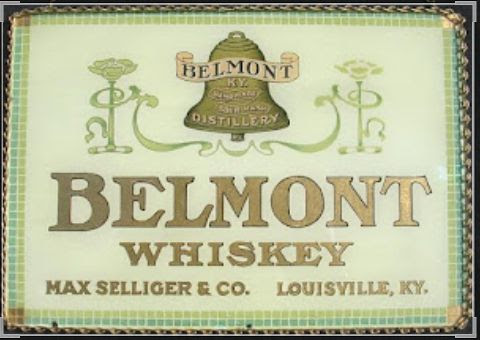
Max Selliger with a partner, George Moore, built two thriving Louisville distilleries.  When Moore unexpectedly died in 1896, Selliger ran both distilleries as the sole proprietor and changed the name to the Max Selliger Company.  In a climb of 26 years at last he had reached the pinnacle of success, recognized as a true Kentucky “whiskey baron.”  For the next 24 years Selliger continued to manage both distilleries, establishing three of his whiskeys as national brands.  After trademark reforms by Congress in 1904, within two years he had registered his Astor, Belmont, and Nutwood brands a second time.


Once in full charge of the whiskey-making Selliger stepped up his merchandising, providing attractive reverse glass sign to saloons and restaurants using his liquor.   As a result of this intense marketing he developed a nationwide market for his whiskey.  Shut down by the advent of National Prohibition in 1920,  Max continued to be listed as a distiller in the federal census of that year.


When Bourbon County Distiller James A. Miller died in 1860 he left several thousand dollars to George G. White, a man who had been a clerk at the distillery.  With partners, White bought the facility, operating it as the Chicken Cock Distillery.  Soon the facility had a mashing capacity of 400 bushels and was turning out some 9,000 barrels annually. About 1880 the name was changed to G.G. White Distillery and the whiskey became “J.A. Miller Chicken Cock.”  By dint of vigorous advertising, Chicken Cock Whiskey was sold nationwide through a wide network of distributors.  These would have been provided with reverse glass signs featuring the image of the cocky rooster.

A German immigrant, Simon Hirsch, after a sojourn in Leadville, Colorado, as a saloonkeeper, arrived in Kansas City, Missouri, in 1885.  There he established a highly successful wholesale liquor house.  Much of his success could be attributed to his gifts to saloonkeepers and other favored customers. They included a label-under-glass saloon sign for his signature brand, “Quaker Made” whiskey.  At the St. Louis World’s Fair of 1904, Quaker Maid won a gold medal, that Hirsch put to extensive use in his advertising. His whiskey also won medals at expositions in Paris, and Portland, Oregon, both in 1905.


William Harrison McBrayer, called Judge McBrayer for much of his life, is credited with being among the handful of Kentucky distillers who raised the quality and image of the state’s whiskey to international renown. One contemporary account says of his “Cedar Creek” brand: “It was the whiskey that made the crowned heads of Europe turn from Scotch to bourbon.”  Whiskey promoter Harry Levy was able to persuade McBrayer to give him exclusive rights to merchandise Cedar Brook nationwide.  Levy was responsible for commissioning the reverse glass sign below.


The next sign below was from a Hudson, New York, wholesale grocer, Col. Charles S. Rogers.  Rogers was a major merchant in the town, with a large liquor emporium and a mansion home, indicating his affluence.  As did many other wholesale grocers Rogers had a proprietary whiskey, “1875 Private Stock.” It was unusual, however for a grocer to advertise through a reverse glass sign. 


M. T. Clarke. a Boston liquor dealer, advertised his “Suffolk Club Whiskey” with a reverse glass sign that indicates one of the drawbacks of the medium.  In time the paint could flake off in multiple areas, leaving a less attractive image.  Clarke made the Boston newspapers by his strong criticism of the city’s Catholic Prohibition advocacy groups.  Clarke said:  “I don’t think it is the province of the church to meddle in this way with a man’s business.  Whenever the church charitable societies want any money the liquor dealers are the very first people they come to see.  And it is a fact we give more to charity and toward church work than any other one class of men in business.”


Notes:  Longer articles on seven of these “whiskey men” may be found elsewhere on this website.  They are:  Baetzhold, March 4, 2015; Bernheim, Dec. 10. 2014;  Selliger, May 18, 2017;  Chicken Cock, April 8, 2015; Hirsch, Dec. 10, 2011; McBrayer, Oct. 2, 2011, and Harry Levy,  Sept. 30, 2021.


Friday, February 2, 2024

Jacob Kozberg: A Refugee’s Refuge in Whiskey

 Against a backdrop of anti-Semitic violence in Russia, some fifty Jewish men, women and children, taking advantage of the opening of previously Indian lands, arrived in the United States beginning in the 1900s to homestead the area around Lead, South Dakota.  Among them was a young adventurer named Jacob Kozberg, shown here, who rejected farming in favor of striking gold, only to find it — not in the ground — but by selling whiskey.


The Jewish refugees included members from the same Russian shtetl (village), many related.  They were headed by a strong but erratic leader named Harry Sinykins, who had suffered brutal beatings during the pogroms.  After gold strikes in South Dakota, the U.S. government had broken Indian treaties to open up reserved lands for sale to white settlers.  After a brief sojourn in Iowa, the Russian Jews, mostly farm families, responded by moving there.


Jacob Kozberg, then in his early 20s, was part of the migration.  I believe the photo above shows him as he prospected for gold, looking like a true Western man, with horse and saddle, wide brimmed hat, cowboy boots, and smoking a cigar.  When the search for gold proved unsatisfactory, Kozberg migrated to Lead, shown below as it looked in 1912.  This city by reason of large gold strikes in the vicinity had grown from 1,400 in 1880 to more than 8,200 by the time the young man arrived. 


The failed prospector quickly befriended a local Irish saloonkeeper and liquor dealer named Chris Crosby, the proprietor of a successful Lead retail establishment called the “Family Liquor Store. “ Crosby advertised his business in a 1914 ad as “Refitted and Restocked with the Finest Lines of Wines, Liquors and Cigars.”  As partners, Crosby and Kozberg opened a combination saloon and liquor store they called “The Lobby Liquor House.”  Below is a photo of the Lobby’s interior with Kozberg standing behind the bar.


The partners packaged their Lobby Liquor House whiskey in gallon jugs for their wholesale trade.  Those containers would have been decanted into smaller ones by customers in Lead’s many saloons and restaurants.   Shown below, the jugs came in white and brown glazes with elaborate labels advertising Crosby & Kozberg as “Wholesale and Retail Dealers in Assorted Liquors and Cigars,” located at 7 North Mill St. in Lead.  The jugs are prized by collectors today as examples of Redwing antique pottery.


Despite his busy life tending to the Lobby Liquor House, Kozberg found time to find a bride.  She was Ruth Sinykin, eight years younger than he.  Shown here, Ruth was the daughter of Harry Sinykin who by then was living in St. Paul, Minnesota.  In a ceremony held in Lead and officiated by two rabbis, the couple enjoyed a “pretty wedding” as reported by the Lead Daily Call:  “The hall where the wedding took place was beautifully decorated in pink and white, while rainbow colored gowns of the attendants completed the picture.”   Three hundreds guests were served dinner indicating the affluence that quickly had accrued to the recent refugees.


The bride’s brother A. T. “Ted” Sinykin was Kozberg’s best man and soon to be partner in operating the Lobby Liquor House, above.  Shown here, Sinykin, in a 1917 sales agreement with Crosby, applied for a transfer of the alcohol license for the saloon and liquor establishment to himself.  As part of his application Sinykin presented a bond  from the American Surety Company of $2,000 (equivalent to $51,000 today).  The bond was accepted by the County Commission and the transfer granted.  The name on the Lobby’s jugs became Sinykin.


Perhaps sensing the immanence of statewide prohibition in South Dakota, Kozberg appears to have become a “silent partner” to his brother-in-law, turning over management to Sinykin while he looked to nearby Minnesota, a state that continued to be reliably “wet.”  There Kozberg came to own and operate a business he called the St. Paul Liquor House, located at 200 East 7th Street in the Minnesota city.


Shown above are two artifacts from that establishment.  The first is a two-inch high shot glass that advertises Kozberg’s enterprise as carrying a  “complete line of wines and liquors.”  A book of matches from the company recommends two two  brands, likely proprietary to the liquor house:  “Golden Age Whiskey,” advertised as “Smooth and Mellow Rich,” and “Kentucky Star Whiskey,” one we are admonished to “Try It - Be Convinced.”


Kozberg had only a few years to sell liquor in St. Paul before the 1920 imposition of National Prohibition.  His liquor house disappeared from city directories only to be replaced by a business called The LaSalle Wholesale Drug Company that Kozberg and another relative of his wife, J. L. Sinykin, established in St. Paul.  Sinykin was manager; Kozberg, secretary.   The principal objective of this enterprise was an elaborate illegal plot to circumvent Prohibition.  


The scheme worked this way:  Kozberg and Sinykin, operating as druggists were allowed to purchase large quantities of denatured alcohol.  This product is ethanol alcohol with additives to make the alcohol poisonous, bad-tasting, foul-smelling, or nauseating and as a result to discourage recreational consumption.  The partners then provided the unpalatable liquid to co-conspirators at the Minneapolis Bluing Company, an outfit that had the capacity to re-distill the alcohol to drinkable form.  The LaSalle outfit then marketed the alcohol, sharing the profits with two blueing company executives.


For a time those profits were enormous, estimated at $75,000 a month, the dollar equivalent today of $1,113,000, more than $13 million a year.  In time federal officials enforcing prohibitionary laws caught up with Kozberg and Sinykin.  They were arrested, tried and convicted.  In addition to paying hefty fines, the two men, by family lore, did some prison time.


Upon his release, Kozberg returned to St. Paul where he resumed his role as a local businessman.  The 1930 federal census found him living there with wife, Ruth, and two young daughters, Pauline 13 and Betty 6.  The family was attended by a young Irish maid.  The census recorded Kozberg as the proprietor of a St. Paul cosmetics factory.  


Apparently the consequences of his efforts to subvert Prohibition having been a life-changing experience,  Kozberg gave up his rowdy ways and settled into the role of a St. Paul businessman, owning and operating the Ideal Leather Manufacturing Company and becoming active in the local Masonic Lodge and Shrine.  When he died at age 74 in October, 1962, at St. Luke’s Hospital in St. Paul, Kozberg was remembered in the press as a “prominent local businessman.”  Prohibition long since had been repealed and his troubles with the law apparently forgotten. His funeral services were held at St. Paul’s Temple of Aaron and burial at the graveyard of that Jewish synagogue.  On his gravestone Jacob Kozberg is remembered as "beloved husband and father."


One Kosberg legacy has continued to stir controversy.  His riches allowed him to be a principal investor in the formation of a 6,000 acre ranch in South Dakota owned and operated by members of the Sinykin family.  This huge spread had once been  Indian country, part of a reservation snatched from Native Americans by white settlers with government approval.


Rebecca Clarren, a Portland-based journalist and descendant of the Sinykins, has sought out the descendants of the Lakota families displaced by the duplicitous federal policies that provided her ancestors with homesteads and ranches.  Clarren’s finding have been published in her 2023 book, “The Cost of Free Land.”  It documents how one persecuted and displaced group aided and abetted in the displacing of another.


Notes:   This post has been gathered from a variety of sources, including Sinykin family photos.  The narrative about these Jewish immigrants in which Jacob Kozberg is featured as a central figure may need amendment.  I hope some descendant will see this post, provide material as necessary and correct any errors.