Saturday, December 7, 2024

Ed Brinkman & Union Distilling — An Addendum

Foreword:   On August 24  of this year, this website featured a post entitled “Ed Brinkman:  From Bookkeeper to Boss and Beyond.”  The item, recounting the   history of Union Distilling of Cincinnati, unfortunately had no photos of Brinkman or other key figures. Fortunately Mike Ashwell, a Cincinnati resident married to a descendant of one of the principals, saw the article and has supplied photos and information that help complete story.  Rather than being added to the earlier post,  I believe Mike’s contribution deserves its own “stand alone” attention,” as shown below.

Edward H. Brinkman spent most of his working life employed by the Union Distilling Company, rising from bookkeeper’s assistant to president of the Cincinnati distillery and liquor house. Demonstrating unique staying power, Brinkman’s imprimatur continued to appear on whiskey even during the years of National Prohibition.  Shown here is his picture as a young “up and comer.”


Mike also has included a photo of the June 18, 1910, laying of the cornerstone for the Union Distilling Company in Cincinnati.  Seen there, the man with the generous mustache to the right of the figure with a mallet is the then President of the United States, William Howard Taft, a Cincinnati native and friend to the distilling industry.  Standing to his immediate left, face obscured, is believed to be Brinkman, then bookkeeper of the distillery.  The bald man to Brinkman’s right is George Dieterle,  secretary-treasurer of the company and Brinkman’s brother-in-law,  The individual holding a trowel to the immediate right of the man with a mallet is believed to be George Gerke, president of Union Distilling.   


The man holding the mallet also deserves notice.  He is Dominic McGowan, the head of a distinguished distilling family and the inventor of a “continuous” whiskey making process.  An immigrant from Northern Ireland, McGowan was famous in the whiskey trade for his innovations and the many distilleries he helped establish in the United States and abroad, among them the Union Distilling plant.  [See a post on the McGowans, May 5, 2021.]


The next image is a letterhead for Union Distilling that includes a representation of the plant as it appeared when fully operating.  Note that the letterhead lists the company as “distillers, compounders, and blenders.”  Although many liquor companies were happy to describe themselves as “distillers” most were actually “compounders and blenders.”  Union Distilling and its management were being unusually honest about its products.


Mike also included the photo of George  Dieterle, below, the ancestor of his wife and Brinkman’s brother-in-law.  Dieterle had a distinguished career in Cincinnati.  Beginning as an officer of Union Distilling, he went on to become president of the Federal Products Company, a manufacturer of industrial alcohol, as well as chairman of the Cincinnati Chamber of Commerce. During World War One, Dieterle served as a member of the War Coal Economy Commission and the War Commission on Municipal Expenditures.  Of him it was written:  “Few men have given longer service or more active aid to community advancement than George Dieterle….”


A closing to this extraordinary set of images features Ed Brinkman about 1898 with his comely wife, Augusta Dieterle Brinkman, and daughter, Hilde, in a family photo of great tenderness and charm.  Hilde later married (Victor "Holt" Tatum). They had no children, and thus no direct descendants exist."


Note:  My great thanks to Mike Ashwell for sending the above material that help complete the earlier post on Ed Brinkman and Union Distilling.  As an addendum to this website, it deserves special attention for enriching the original story.


Wednesday, December 4, 2024

Sarah Bowman -- Western Saloonkeeper & Much, Much More

Sarah Bowman became a legendary figure for her size, strength, and exploits as a participant in affirming American military control in the Great Southwest.  Reputed to be the first woman commissioned as a U.S. Army officer and buried with military honors, Sarah brought liquor, food, water, “comfort” and, upon occasion, a gun to the task, as shown here in an artist’s view.

Sarah often was called “The Great Western,” a reference to her height, estimated at over six feet tall, at the time taller than most men, and her weight, well over 200 pounds.  The reference was to a famous steamship known as The  S.S.Great Western, shown right, the largest steamship afloat at the time.  One of the soldiers for whom she was cooking, seeing her for the first time is reputed to have exclaimed: “Lordee.   Look at the size of her!  She’s purt’ near as big as The Great Western.”  Others agreed and the name stuck.


Her birth date and origins  are unclear.  One source claims to have seen a birth certificate dated 1813 and the place Clay County, Missouri.  Sarah, however told the census taker in 1850 that she had been born in Tennessee.  The year of her birth varies from 1812 to 1817.  Thus, she likely would have been in her early 30s when, married to a soldier, the first of many men in her life, she became attached to the U.S. Army in the Mexican War as a cook and fan of its commander, future President Gen. Zachary Taylor, shown right.


At the beginning of the conflict with Mexico, Sarah first came to notice when she is reputed to have rushed up to Taylor to say that if he would give her a pair of pants she would wade over the Colorado River “and whip every scoundel that dared show himself.”  At the initiation of hostilities, however, Taylor ordered Sarah and other women cooks to what became known as Fort Brown.  When Mexican forces mounted a siege of the fort, The Great Western came to the fore for her bravery in providing food, drink, and other assistance to the soldiers.


By the time Taylor’s troops relieved the garrison, Sarah’s legend was made. Not long after the battle, Lt. (later General) Braxton Bragg singled her out as the Heroine of Fort Brown attesting:  “…Though the shot and shell were flying on every side, she distained to seek shelter in the bomb-proofs, but labored the whole time cooking  and taking care of the soldiers without the least regard for her own safety.  Her bravery was the admiration of all and were in the fort….”Journalists in the room recorded Bragg’s remarks.  They consequently were reported in newspapers across America.  The legend of Sarah Bowman, “The Great Western,”  was now etched in American history.


As Taylor’s army moved as the Mexican War progressed, Sarah kept in close contact,  in September 1848, a young trooper described her in his diary:  “The Heroine of Fort Brown  or “The Great Western” is in the crowd.  She drives two Mexican Ponies in a light wagon and carries the apparatus and necessaries for her mess which now numbers about a dozen young officers.”  After the occupation of Monterrey by Taylor’s army, she opened a saloon and brothel that provided food, drink and “comfort” for the soldiers.


When the war ended in 1848, one detachment of soldiers was ordered to California.  Sarah wanted badly to accompany them. She was told, however, that only wives were allowed to go.  As shown here in an artist’s depiction, she mounted her mule and rode along the line of soldiers reputedly bellowing:  “Who wants a wife with $15,000 and the biggest leg in Mexico! Come, my beauties, don’t all speak at once — who is the lucky man?”  Most of the troops were dumfounded but at last one, a soldier named David Davis, perhaps intrigued by the cash, agreed to marry her and she was enlisted as a laundress.  Did her $15,000, equivalent to $300,000 in current dollars, come from Sarah’s other “personal services”?


Subsequently she met a newly discharged soldier named Paddy Graydon, an Irish immigrant, who was running a hotel and bar on the banks of the Sonora River. [See my post on Graydon, August 9, 2024.] Calling it the United States Boundary Hotel, he located it in a small settlement close to Fort Buchanan with its drinking population of soldiers.  His establishment was a success, particularly after forging a business relationship with Sarah, by now most famous woman on the desert frontier.  She brought a reputation for her attention to the needs of dragoons.  Wrote one trooper:  “They called her old Great Western. She packed two six-shooters, and they all said she shore could use ’em, that she had killed a couple of men in her time. She was a hell of a good woman.”   


Sarah seemingly took over running the saloon and hotel, able keep order among thetough gun-toting clientele that mixed desperadoes with soldiers — and women.  Under her watchful eye: “SeƱoritas sang songs, waited tables and cooked, sometimes dealt cards, and always smiled at the rough patrons, laughed at their crude jokes and helped them to forget just how very far from home they were.”


“The Great Western” particularly caught rhe eye of Sam Chamberlain, an officer, writer and artist assigned to Taylor’s army.  Shown left, Chamberlain described Sarah throwing Davis “out of her affections” in favor of a soldier of remarkable size and strength the writer called “Samson.”  She professed her love for him, the giant capitulated and they moved in together.  Fascinated by this Western “Delilah,” Chamberlain made the only known full portrait of Sarah.  Shown below, it depicts her in front of the bar, drawing a pistol from her belt, and preparing to order a hostile Mexican out of her saloon.


By 1850 Sarah was in Sorocco, New Mexico, sharing a household with five orphaned children, ages two to sixteen, acting as a mother figure and showing a more nurturing side to her personality.  In Sorocco she met a 24-year-old Danish-born soldier named Albert Bowman.  Although there may have been no marriage ceremony, Sarah took his last name and was known as his wife.  For the next 16 years they shared life together in the harsh environment of the now American Southwest.


When Albert Bowman was discharged from the army in December 1852, the couple headed west to join the gold rush to California.  The couple’s southern road west led to the historic Yuma Crossing, shown right.  A place where the Gila and Colorado Rivers come together, this had been a Native American fording place and for centuries an opening to the Far West.  Now there was a ferry to take pioneers and gold seekers across.  In the year before Sarah and her consort arrived, 40,000 Westward-bound men, women and children had been ferried across bringing with them thousand of horses, cattle, sheep and other livestock.


Seeing this traffic, Sarah and Albert abandoned their thoughts of “moiling for gold” and decided to provide stores of food and drink, including alcohol, to the travelers.  Their major problem was getting supplies.  That shortage was at least partially solved when a shallow draft steamboat was constructed on the Colorado River that could provide the Yuma settlement with needed goods.  The couple made the crossing their home for the next 14 years, leaving occasionally when other prospects beckoned balways returning to do business at Yuma Crossing.


The crossing had achieved such high importance for American expansion that a military base, called Fort Yuma, above, had been established there.  Sarah, with her accustomed love for the military created a boarding house and a officers’ “mess” as she had in the past.  Meanwhile, she and Albert drifted apart as he moved off to California to engage in prospecting.  Sarah was increasingly engaged with her adopted family and in running her restaurant, bar, and hotel, said to be the first in Yuma.  


Sarah died in Yuma in December 1866 at the age of 53, reputedly from the bite of a poisonous spider.  A Catholic priest, Fr. Paul Figueroa, in his memoirs of Yuma wrote this eulogy about Sarah: “Mrs. S. Bowman was a good hearted woman, good souled old lady of great experience, spoke the Spanish language fluently…opened the first restaurant and kept it until she died…The military from the Post [honored] her remains with a splendid funeral, with the bands and all the military observances.  The vicar general was visiting the new town for the first time and according to the Catholic rite conducted the remains to the military cemetery across the river by the Fort.”


Sarah’s burial at Yuma was not to be the end of the story.  When the fort was abandoned and the military cemetery became overgrown, the decision was made by the Army in 1890 to remove the graves and rebury the remains at the Presidio in San Francisco. Sarah was the only female among them. Shown here is her Presidio gravestone.


When Sarah’s body was exhumed a religious medallion of unusually large size was found around her neck.  One writer was occasioned to observe:  “So, even after twenty-four years after her death, Sarah’s size was still worthy of notice.”  That observation suggested to me that a final tribute is due this extraordinary woman.  Accordingly, I have added below a figure of a large female figure seemingly guiding the nation’s movement across the continent.  She is the epitome of “The Great Western.” 


Note:   A number of references to Sarah Bowman and related photos may be found on the Internet.  This post relies on them and most particularly on a 78-page book by Brian Sandwich called “The Great Western: Legendary Lady of the Southwest, “ Texas Western Press, 1991.  Mr. Sandwich has written the definitive biography of Sarah Bowman.  A fictional treatment of “The Great Western’s” life is also notable, called “Fearless: a Novel of Sarah Bowman,” by Lucia St. Claire Robson, 1998, no publisher cited.


Friday, November 29, 2024

Savoring the Saloons of Times Gone By


Just recently I have been reading a book called “Watering Holes of Yore: The Saloonsthat Made Texas Famous,”  by multiple authors.  Over the years for my own edification, I have collected a number of photographs of old time saloons.   Now it occurs to me to share them on this blog.   They include two saloons that I personally have visited and one, at the end, that is an all-time favorite.


The first establishment shown here is a Texas saloon, but not one covered in the book I have referenced.  My fascination is with the imaginative way that the proprietors have rendered the word “whiskey.”  Obviously with tongue firmly in cheek,  they have proclaimed it “The Road to Ruin.”  Yet the front door is open wide and the gents on the porch obviously have left the bar to have their pictures taken.   This photo identified the state but not the town.  It reputedly was taken in the 1880s.


The next photo replicates the theme.  From the designation as the “Lone Star Saloon” and the symbol provided, it might be assumed that it was located in Texas,  the Lone Star State.   Wrong.  This establishment was located in Corona, New Mexico.   The date given for it was 1919.  By that time Texas was fully into the Temperance Movement and increasingly legal restrictions were being put on saloons and drinking.  By contrast New Mexico was still wide open. 


The next image is from South Dakota and although it has no sign,  the passengers on the stage coach stopping there would know that strong drink was to be had inside.  This photo is from an earlier article I wrote on a Western character known as “Devil Dan” Roberts.   As cowboy, he rode up to a stage stop saloon very much like this one in 1886.  Roberts was employed by the VVV Ranch on the Belle Fourche River and was heading for Deadwood for the Christmas holidays when he dropped into the saloon to warm up from the frigid Dakota weather.


A holiday dance was in progress and the saloon owner, who had been nipping at his own booze all day,  was heading to bed to sleep it off.   He asked Devil Dan, who did not drink,  to look after the business. The well-likkered cowboy crowd got rowdy and began to break up the furniture and knock out windows.  Dan let them have their way but as the men sobered up he made them pay for the damages.  The next morning the owner sold the place to Roberts for $125 and departed.  Dan repaired the damage and appears to have taken to the role as saloonkeeper.  After running the  establishment for a few months, he apparently sold it and leased the Cliff House, a larger stage coach station and saloon, in nearby Deadwood.


The next picture is from Creede, Colorado.  Two men standing in the open doorway of the “Holy Moses Saloon,”  which is next to the narrow, rocky canyon walls that surround the town,  located in Mineral County.   Note that the building is rather ramshackle with a broken cornice and a barrel lying out front.  A note on the photo says that the man standing in the white shirt and vests was the owner and the sheriff of Creede whose name was William Orthen.   His saloon was the first liquor den in town.


A much better known lawman cum saloon keeper was Judge Roy Bean, who billed himself as the “Law West of the Pecos.”  For about 16 years, Bean lived a prosperous and relatively legitimate life as a San Antonio businessman. In 1882, he moved to southwest Texas, where he built his famous saloon, the Jersey Lilly, and founded the hamlet of Langtry. Saloon and town alike were named for the famous English actress, Lillie Langtry. Bean had never met Langtry, but he had developed an abiding affection for her after seeing a drawing of her in an illustrated magazine. For the rest of his life, he avidly followed Langtry's career in theater magazines.


Before founding Langtry, Bean had also secured an appointment as a justice of the peace and notary public. He knew little about the law or proper court procedures, but residents appreciated and largely accepted his common sense verdicts in the sparsely populated country of West Texas.  By the 1890s, reports of Bean's curmudgeonly rulings, including an occasional hanging,  had made him nationally and internationally famous.  After his death Lillie Langtry made a belated visit.


The following photo of the gents standing in front the El Paso Saloon has intrigued me for the wide variety of headgear they sport, as well as the varied positions of their hands.  Several look as if they might be preparing to draw and shoot.  Despite the name it is not possible from the picture to identify the town.  El Paso Hotels with saloons were located not only in El Paso itself but also in Fort Worth and San Antonio.   I assess the date as about 1910 or after. The advertising sign over the door for Fredericksburg Beer on tap has a definite  20th Century look.

The photo following caught my eye for the 20 mule team in the foreground and the row of saloons in back. Thirsty customers had a choice of the “The Yellowstone Bar,”  “The Butler Saloon,” or the “High Grade Bar” and so on down the line of watering holes in the town of Rawhide, Nevada,  at the 1908 height of the Gold Rush. In the short span of two years the town went from its peak population of 7,000 to fewer than 500 residents by the latter part of 1910. Helping push the decline of Rawhide even further along was a fire that swept through town in September 1908, along with a flood the following September, from which many residents did not recover or rebuild. 


When the original mines worked out the remaining gold and silver from the veins, more people left Rawhide. There remained only a few  who eked out a livelihood working in the mines, or processing the ore, or just working their own claims and prospecting.  Most of the saloons had closed and the town became a hollow shell of what it once was.  By 1941 only a few hardy souls were left in Rawhide, and the post office was closed.  Today it is a “ghost town” with only photos to remember its heyday.


The only watering hole in color and one I have actually visited is “Big Nose Kate’s Saloon.”  This place got its start as the Grand Hotel in Tombstone, Arizona.  Opening in September, 1880, it was consider one of the state’s premier hotel, boasting thick carpeting and costly oil paintings.  The lobby was equipped with three elegant chandeliers and more luxurious furnishings, while the kitchen featured both hot and cold running water and facilities to serve as many as 500 people efficiently.


It is said that Ike Clanton and the two McIaury brothers stayed at the Grand the night before the famous gunfight at the O. K. Corral.  Now the place is named for the erstwhile girl friend of another participant in the famous showdown, Doc Holliday.  I was in Tombstone a few years ago and stopped into Big Nose Kate's to look around and have a beer. Sadly, it was no different than the other touristy bars and restaurants along the main drag, but the history is still there.


The final photo is not in the Far West but from Milwaukee, Wisconsin.  But, you may say, it looks more like a church than a saloon.  Yes, it does.  The building was constructed as a Methodist house of worship in the late 1800s only to find itself smack dab next to Milwaukee’s ever-expanding Pabst brewery.  The perfumes of beer production wafted over the structure frequently.  After Prohibition the church was sold to the brewery which made the first floor into a restaurant and bar and used the upstairs for a training center.  They called it the “Forstkeller” and supplied it with fresh beer daily.  For years it was my favorite watering hole. Even after leaving Milwaukee, I always walked in the door at least once on every visit to town.  Unfortunately the Forstkeller has been shut for many years.


There they are,  nine of my favorite saloon scenes.  Just looking at them makes me thirsty.  Think I will head out for a tall cold one. 


Note:  Two saloon owners noted here are treated at more length elsewhere on this website:  “Devil Dan” Roberts, April 18, 2012, and Judge Roy Bean, October 4, 2016.


Saturday, November 23, 2024

A.T. Atkin: The Rocky Road from Tshamingo to Memphis

In Mississippi the first major success of the Prohibition movement occurred when the legislature passed a local-option law allowing counties to prohibit the sale of alcohol. By the early twentieth century the sale was illegal or seriously limited in a large majority of the state’s counties.  In Aberdeen, Monroe County, Allen T. Akin, a wholesale liquor dealer had a dilemma:  Go into another line of work — or move from his native state.  He chose the road.  It proved to be a rocky one.

Akin was born in Tishomingo, a tiny town in an extreme northeastern corner of Mississippi, shown here as it looks today, population 339.  The date was April 20, 1849.  Originally from Virginia, his father, William Edwin “Will” Akin was a farmer.  The 1850 Census found Will, 27, and his wife, Louisa, 23, living in Tishomingo County with daughter Elizabeth, 3, and Allen, 1.  The 1860 census sighted the family still in Tishomingo, with indications the father was prospering as a farmer.


By the 1870 census, the family had grown to seven children, including three sons, Allen, Johnson, and William, old enough to be recorded as working for their father on the farm.  Shortly after, Allen Akin is cited moving to Simpson County, Kentucky, to work on a farm.  From there his progress is a blank slate until, during the 1880s he fetched up as a saloonkeeper in Aberdeen, Mississippi, a town 87 miles southwest of Tishomingo. 


 By this time Akin had married.  His bride was Amanda Bunch, called “Mandy,” the daughter of Erasmus H. and Mary Ann Cowen Bunch. Unusual for those times, Amanda appears to have been four years older than her husband.  The couple would have two children, Ernestine, born in 1885, and Collins, in 1889. 


The county seat of Monroe County and located on the banks of the Tombigbee River.  Aberdeen, population 3,500, was one of the busiest Mississippi ports of the 19th century. Cotton brokerages flourished in town and for a time Aberdeen was Mississippi's second largest city.  The wealth of the city expressed itself in the many mansions that dotted the landscape and in lively patronage for the city’s saloons.  Akin’s establishment also sold whiskey, advertising the availability of Tennessee and Kentucky liquor, including “Old Cutter” from Louisville.


For years as a whiskey dealer, Akin had to deal with a state legislature where the forces of “dry” constantly were making inroads.  An earlier law made it illegal to  purchase less than a gallon at once, aimed at local saloons and taverns.  Violators could face fines of between $200 and $500 — ruinous amounts when a shot of whiskey fetched five cents.  Repealed three years later, this statute was followed by others seeking to cripple the liquor trade, including an 1873 law that if any state legislator was found drunk the individual could be charged with a crime and removed from office.  About 1900, as Monroe County contemplated a “local option” ban on alcohol, Akin felt forced to leave his native state and a municipality he considered his home town.  He packed up his small family and his liquor supplies and moved to Jackson, Tennessee.   In 1908, Mississippi would become the first state to ban all alcohol sales.


Tennessee looked to many liquor dealers in states like Mississippi as an oasis that might never vote “dry.”  For Akin it was  a 180 mile journey almost straight north to a Jackson, a rapidly growing city of about 15,000 people, almost five times the size of Aberdeen.  After the Civil War Jackson became a hub of railroad systems ultimately connecting to major markets to the north and south, as well as east and west. This was key to its development, attracting trade and many railroad workers in the late 19th century.  Akin opened a saloon and liquor business at 209-211 N. Market Street in Jackson’s busy downtown, shown above.


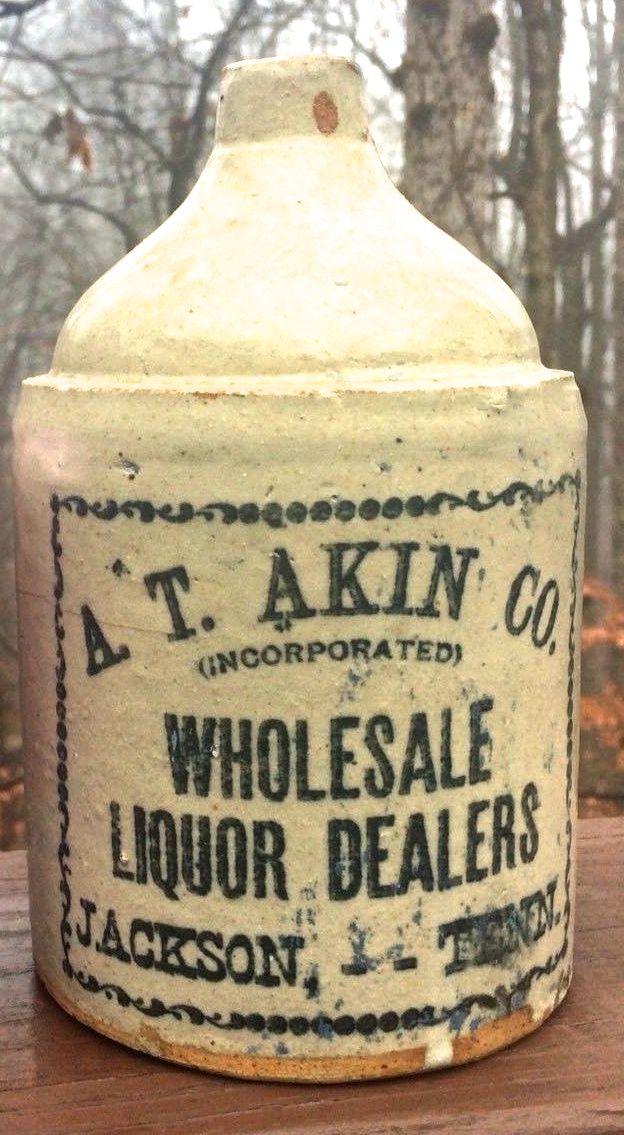
Indications are that Akins was taking advantage of the excellent train connection to ship whiskey from sources within Tennessee and reaching up into Kentucky where transit was easy.  He may have had difficulty initially in finding potteries to make his jugs as indicated by the two containers shown above.  Both are crudely stenciled.


As shown above and below here, Akin eventually was able to find a potter to provide him with an attractive design using an “underglaze transfer” of applying a distinctive label.  The size of his containers varied from quart (top left) to gallon (top right), two gallon (below left) and five gallon (below right).  The larger jugs would be for his wholesale customers, the whiskey to be poured into smaller containers before being served across a bar.


Although exact dates are hazy, Akin was established in Jackson by at least 1904.  That year he incorporated as A.T. Akin Company, with capital of $7,700.  He headed the incorporators joined by a W.T. Akin, relationship unclear, and two others in Jackson.  As the newly-come Tennessee whiskey man was to find out, that state was not immune to “dry” laws.  At the county level prohibitionist were whittling away at liquor sales. Jackson was not immune.  


By 1908 Akin had moved to still “wet” Memphis.  There he operated the A. T. Akin Company, Wholesale and Retail Whiskies at 150 South Main Street.  His son, Collins Akin, now an adult was the establishment’s manager.  By 1915 Akins’ liquor house had moved to 325 South Main, below, and Akin had taken a partner named Bates.  He also had put the management of the liquor house into other hands, including son Collins and retired with wife Amanda back to Aberdeen.  The same year a Tennessee law forbidding all alcohol sales passed court tests of its validity and began to be enforced.


From Aberdeen, Akin could watch the end of his peripatetic liquor house after a run of almost a third of a century.  Now 67 years old, his health was failing.  On March 14, 1916, Akin died.  He was buried in Aberdeen in the Old Fellows Rest Cemetery above.  His tombstone contains this tribute:  “None knew thee but to love thee.”  Amanda would join him there in 1923.  Her memorial reads:  “Thy memory will ever be a guiding star to Heaven.”


Note:  There are notable “holes” in this narrative about A. T. Akin, including how he was able to move from farm work to keeping a saloon.  I am hopeful some alert descendant will see this post and help me fill in the gaps.