Foreword: Three of the most important men in the history of American whiskey before National Prohibition were journalist writers who understood that the liquor trade was one of the nation’s most important industries, at the time generating the majority of tax revenues for the U.S. government. These men put enormous effort into advancing good trade practices and discouraging bad.
 About 1880, William Mida established a wholesale liquor house in Chicago. Although it was successful, Mida’s restless mind saw a grave need in America’s liquor industry and determined to fill it. In 1883 he published “Mida’s Handbook for Wholesale Liquor Dealers.” Its success encouraged him to publish a semi-monthly journal devoted to the trade, much of it devoted to explaining state liquor laws. He called it “Mida’s Criterion” and published it for nearly three decades. The success of the magazine prompted Mida to establish a publishing house, called Criterion Press. In quick succession he issued a number of publications.
Perhaps the most famous of them was “Mida’s National Register of Trade-Marks,” published in 1893, with a second volume in 1895 and a combined volume in 1898. During that period trademarks were a dicey proposition. A tough 1870 law had been struck down as interference with interstate commerce. Disputes over whiskey brand names were common and judges generally were unwilling to enforce the laws that existed if any home state interests were involved. Into this situation stepped William Mida. He believed that the trademarking of brands was a key to the orderly growth of the whiskey industry and in his register listed the several hundred trademarks that already had been recorded with the U.S. Patent and Trademark Office.
 Mida’s work was valuable in letting whiskey men know what brand names already had been registered. The index was by brand name, not company and thus easy to reference. He also was pushing the importance of registration to the liquor trade. When a stronger trademark law was passed by Congress in April 1905, with Mida’s backing it rapidly gained acceptance among distillers and rectifiers. At the same time he was trying to make sense for the liquor industry of the blizzard of federal and state laws, ever-changing and often reflecting the work of prohibition forces. In “Mida’s Compendium” (1889) and later “Mida’s Compilation of State and Federal Pure Food Laws” (1906), he parsed the laws and tried to answer questions about their application.
William Mida’s impact on the pre-Prohibition liquor trade was immense. When he died in October 1915 at the age of 76, a leading beverage industry publications said in his obituary: “He was probably the best known man among the distillers and liquor dealers in the United States and during his lifetime did much to advance their interests.”
 Shown here, George Rudy Washburne gave up his pursuit being a “big butter and egg man” in Louisville, Kentucky, to turn his attention to a more lucrative trade — liquor. It led to his founding and leading for 32 years a publication called the “Wine and Spirits Bulletin” where he became a vocal and influential leader in the ultimately losing fight against “Dry” forces pushing toward state and national prohibition of alcohol.
 In 1886, while a partner in a short-lived Louisville, Kentucky, commission house Washburne, described as a “hustler,” also was publishing a small newsletter aimed at the Louisville whiskey industry. He called it the “Wine and Spirits Bulletin.” Washburne proved to have a natural ability as an editor and publisher. Originally a four page weekly, eventually the Bulletin became a monthly of some 50 pages, well-illustrated and providing substantial news and information. It became essential reading for whiskey men.
Initially the Bulletin was primarily an organ of the whiskey industry in the Ohio Valley, covering Kentucky and Cincinnati, at the time the leading city in liquor marketing. Eventually the publication would open adjunct offices in New York, Baltimore, Cleveland, Buffalo, Milwaukee and New Orleans. A review of Bulletin front covers indicates that the publication was drawing advertisements from distillers and rectifiers around the country.

Washburne did not ignore the general population. In 1911 and again in 1914 he published a booklet he called “Beverages de Luxe,” a pioneering prelude to the “drink books” that currently flood the reading marketplace. He explained in a foreword: “Despite a spirit of fanaticism that periodically passes over the land, there is no denying that fine beverages are among the things that make life brighter, happier and worth while. A knowledge as to the best of them, their selection, their care and their serving, is, therefore, not amiss.” The publication provided recipes for cocktails of the era to the drinking public.
Most of Washburne’s efforts, however, were providing news and editorials about the growing trend in America toward banning alcohol in localities, states, and ultimately the entire country. As the U.S. inched closer to National Prohibition, a group of brewers in 1918, hoping to make friends of the powerful Anti-Saloon league, pointed fingers at distilled spirits as the culprit while championing beer as “food.” In effect, those beer makers were breaking with the distilling industry in last ditch effort to save themselves. Washburne wisely saw the folly in that approach, writing that: “If the brewers begin a warfare on distilled beverages, they will, in our opinion, make a very great mistake….” He understood that the forces of “dry” were intent on shutting down every saloon in America and cared not at all if liquor were served or only beer. Events soon would prove him right. As National Prohibition became assured in 1919, his client base was doomed. Washburne after 32 successful years was forced to cease publishing the Wine and Spirits Bulletin.
 Beginning as a printshop owner Charles Austin Bates was motivated by the lure of a high salary to become a journalist in New York City writing for “Printer’s Ink,” the leadlng publication of the advertising industry. He rapidly became aware that much of what passed for advertising in America was inferior. Soon Bates began his own publication called “Criticism” in which he advertised as following: “Send me two dollars, along with a batch of your trade paper, magazine, or newspaper ads, and I will send you a critical opinion of them with suggestions for their improvement, if improvement is possible.”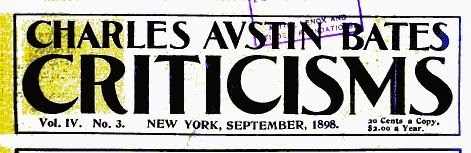
With advertising as a crucial element in liquor merchandising for distillers, rectifiers and dealers, Bates frequently was called upon to provide advice to practitioners in that industry. An example was Samuel Alexander (S.A.) Sloman, a whiskey wholesaler of Detroit and Cincinnati. Sloman in the late 1900s devised a business plan that largely depended on luring customers by marketing his “Diamond Wedding Whiskey” heavily through display ads in Midwestern newspapers. After several years of vigorous and expensive advertising, one example shown here, Sloman realized demand for Diamond Wedding Whiskey had remained slack.

Clearly frustrated by the poor results of his advertising blitz, in 1898 Sloman sent Bates copies of his newspaper ads. What Bates sent him back, according to Sloman, was “a beautiful roasting.” Nonetheless the whiskey man was grateful: “However, after recovering from the first shock cause by all the unpleasant things you said about our advertising effort, and the realization that so many hard earned dollars had been diverted in practically useless channels, we started in to follow some of the suggestions thrown out for our benefit.”
Paying another $2.00 to Bates Sloman sent Bates a copy of an advertising booklet that he had issued in 50,000 copies. They had been sent to dealers, imprinted with their names, for distribution to customers in hopes of enticing them to buy Diamond Wedding. I cannot find a record of Bates’ response. But his “copy credo” was well known: “Show price. Use simple English. Never overestimate the consumer’s IQ.” Finally and most important: “Be truthful.”
With those few commandments, Bates not only help to raise the general quality of advertising in America but more particularly that of a liquor industry that too often ventured into hyperbole and sometimes told outright lies. As for S.A. Sloman, he eventually gave up selling whiskey and returned to his family’s lucrative furrier business, presumably a happier man.
Note: Each of these three men have been treated in greater detail in prior posts: William Mida, Febuary 25, 2014; George Washburne, June 11, 2019; and Charles Austin Bates, March 10, 2015 and September 10, 2018.


