Foreword: Mixing whiskey with a range of ingredients ranging from sugar to citrus to yet other forms of alcohol goes back perhaps centuries but it was only at the beginning of the 1900s when the term “cocktail” was applied. While the origins of the word are disputed and likely lost in time, the cocktail has become the name for an entire category of alcoholic concoctions. Considered here are three men in the liquor trade who are credited with inventing and publicizing mixed drinks of varying character.
From a historical guidebook to Baltimore: “Often times the weary traveler desired a somewhat stronger potion than mineral water, he could stop in the establishment of Charles W. Geekie’s at Number 123 Baltimore Commons (street) and purchase a decanter of “Lady’s Blush” to satisfy his thirst.”
 Shown here, Geekie’s claim to fame lay in a cocktail he contrived in his saloon and billiards parlor and dubbed “Lady’s Blush.” It was an alcoholic drink whose main ingredient was creme de noyaux, which, translated from the French, means “cream of pits.” The liqueur is well named. Although almond flavored, creme de noyaux is made from the kernels within the pits of apricots, peaches and sometimes cherries.
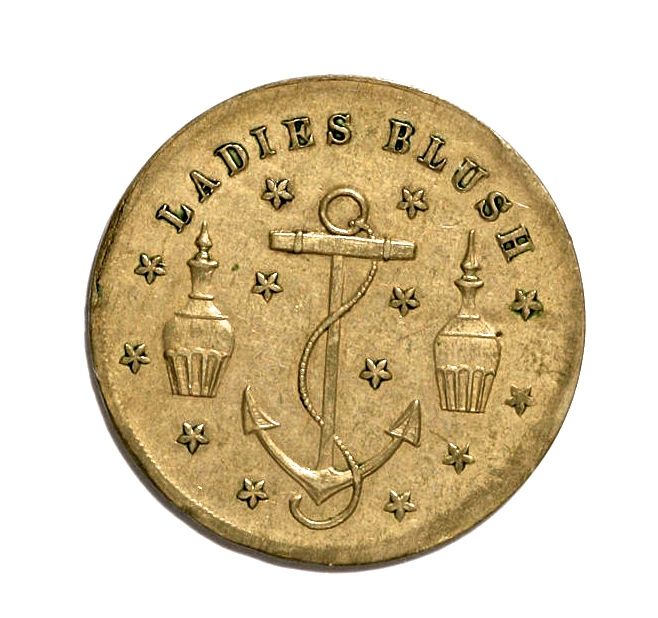
Geekie’s alcoholic concoction brought him fame in the drinking public of Baltimore. The saloonkeeper provided multiple incentives, issuing tokens in both brass, above, and a zinc amalgam known as “German silver” that provided five cents toward purchase of the libation. For favored customers he also provided an official looking paper token good for a 25 cents toward a Lady’s Blush or other mixed drinks.

When Charles died in 1892, his two sons continued to run the Geekie enterprises and serve Lady’s Blush. As the coming of National Prohibition became more and more evident, the business was shut down for good. With the demise of the firm came the end of the elder Geekie’s celebrated libation. The cocktail recipe seems to have disappeared along with the company.
 “Colonel” Joseph K. Rickey was a well-known Washington, D.C., lobbyist at the turn of the 20th Century and eventually the owner of the National Capitol’s most famous saloon, Shoomaker’s. Evidence suggests that Rickey himself first conceived his signature drink at his establishment on one typically hot, Washington summer day. The bartender, George Williamson, prepared the drink to the Colonel’s instructions and the first “Rickey” was born. It was a rye whiskey cocktail made with Shoomaker’s house brand. Very soon, gin would eclipse rye as the favored liquor for the cocktail and the Gin Rickey was born, a concoction that spawned a myriad of cocktails called “Rickeys”. Colonel Joe initially disavowed publicly that he had invented the gin drink connected with his name.
  In an interview published in the New York Telegraph, Rickey was quoted to say: “The drink named after me was always made by the experts in Shoomaker’s .…Only here in New York was it perverted and made a thing of shame. Here they make it with gin, which is a liquor no gentleman could ever bring himself to drink. In fact, the gin rickey is about the only kind known in this city and the average barkeeper looks surprised if you ask him for one made with rye whisky.” Despite this extensive disclaimer, in 1899 Colonel Rickey trademarked the name Rickey for both the whiskey and gin cocktails.
  After Rickey’s death in 1903, the drink became almost totally identified with gin. By order of the D.C. City Council, The gin rickey is the official cocktail of Washington. The recipe: Into a tall glass, 1.5 oz. of gin, 5 oz of fresh lime juice, add soda water. Garnish with lime wedge and/or sprig of mint. Drink slowly and remember Colonel Joe who, albeit reluctantly, gave it his name.
I have spun a fantasy for myself. It is 1915 and I am among the “beautiful people” who have gathered for cocktails late on a summer afternoon at a mountaintop mansion located not far from Hartford, Connecticut. But there is no bartender. Just a man named Gilbert Heublein and he pours out already prepared drinks from bottles that bear his name. We are witnessing a revolution in the liquor trade: Premixed cocktails.
 The story is told that Gilbert, shown here, worked in this father’s Hartford liquor business and had prepared a quantity of premixed cocktails for a large annual picnic. It rained and the event was canceled. A few days later an employee of the Heubleins was told to dispose of the unused beverages. Deciding to taste them first, he found that the drinks had suffered no deterioration and announced the discovery to his bosses. The Heubleins took note and began selling the premixed libations in their saloon and restaurant. The cocktails proved very popular with customers and increasingly became the focus of the family’s attention.
  Following the father’s death, in 1890 the company became Gilbert F. Heublein & Bro. The new firm concentrated on the premixed cocktails, advertising them widely. As shown here, Heublein’s ads called them “Club Cocktails.” “Would not such a drink put new life into the tired woman who has shopped all day? Would it not be the drink to offer to the husband when he returns home after his day’s business?”
  The Heubleins offered a wide choice of premixed drinks, including martinis and manhattans. Their ads offered snob appeal, catering to the “carriage trade.” They issued a recipe book that discussed popular cocktails and their ingredients but — why bother? — Heublein had taken the work out of the preparation.
  With the advent of National Prohibition the production, transportation and sale of all Heubleins' alcoholic products was made illegal. For 13 years Heublein Cocktails were only a memory. The company was able to survive by inventing A-1 Steak Sauce, a staple at the dinner table as well as in the restaurants of America. When Repeal came Gilbert was 85 years old and it was his grandson, John Martin, who resurrected the bottled cocktails and for a time made Heublein the largest liquor distributorship in America. Gilbert Heublein died in 1937, having revolutionized the drinks industry.
Note: More complete vignettes of these whiskey men can be found elsewhere on this blog: Charles W. Geekie, March 1, 2019; Col. Joseph Rickey, September 12, 2013, and Gilbert Heublein, May 5, 2014.


