Foreword: While prohibitionists as a movement seldom targeted individual whiskey men for their wrath, some free-lancing zealots did — Carrie Nation stands out as an example but others as well. As a result publicans and liquor dealers who simply were tending to business could find themselves singled out in their communities as targets. Presented here are four such situations and their often unforeseen consequences.

In 1914 Max Friedlander was operating a successful liquor house in Hazelton, Pennsylvania, when a traveling evangelist named Henry Stough, preaching at a tent revival there, leveled a personal blast at four men he said were principally responsible for sin and corruption in Hazelton. Among them was Max Friedlander. If it were not for that four, the evangelist declared, there would be no houses of prostitution, no saloons open on Sunday, no slot machines, no gambling dens or poker games in town. “I lay the moral condition of Hazelton and the vicious things here at the foot of these four. Let them take up the gauntlet. I have thrown it down,” Stough declaimed.

 Friedlander and the other three were quick to retaliate, filing suits for slander against Stough, shown left, each asking for $50,000 in damages, the equivalent of $1.2 million each today. The legal battle that ensued became a circus. The trial was disrupted by demonstrations by the preacher’s followers who crowded a Hazelton courtroom to “hoot and holler” during the taking of testimony. The trial had to be moved to Wilkes Barre and no one was allowed inside the courtroom except attorneys and “interested parties.” Nevertheless, the demonstrators followed and continued their loud protests in the courthouse corridors.
Eventually damages of $2,700 each ($65,000 today) were awarded to Max and the others. This time Stough went to court, appealing the judgment. His lawyer, explicitly cited the ethnicity of the allegedly slandered four, declaring in court that a Jewish liquor dealer (Max), an Irish councilman, an Italian politician and German brewer together held so much influence over the judges of Luzerne County that Stough could not get a fair trial there. The attorney was disbarred but in the end the State Supreme Court dismissed the cases against Stough. The preacher had been within his First Amendment rights and his charges were not slanderous or actionable, the judges ruled. Max and the others saw no compensation.
 But Friedlander had other rewards. The local community strongly rallied around him and not long after clergyman’s diatribe, he was elected president of the Hazelton Board of Trade. The newspaper account of Max’s election dismissed Stough as an “itinerant evangelist” and his accusations as “unpleasant.” Before the legal processes had run their course, Friedlander also had been elected a director of the Markle Banking and Trust Company, a Hazelton financial institution with assets equivalent to more than $12 million.
 John Nunan’s travails began about 1906 when Professor H.K. Taylor, was named president of the Kentucky Wesleyan College at Winchester, Kentucky. Early in his presidency Prof. Taylor became highly affronted by the saloons in Winchester, apparently feeling they were hotbeds of temptation for his male students. In 1908 Taylor plotted a “sting” he hoped would put Nunan, and other Winchester saloonkeepers either out of business or facing heavy fines and maybe jail time by having an underage student named Green buy a bottle of beer in each.
Being of a theological rather than legal turn of mind, the don had failed to mount an airtight prosecution. At the trial, young Green said he was sure the proprietor had not sold the beer to him but could not positively identify either of the bartenders. Other evidence that might have helped Prof. Taylor’s case were the bottles of beer that Green bought in each drink emporium. Taylor had marked the each bottle to show the saloon it came from. A local newspaper told the rest of the story: “…But the first night of the trial Prof. Taylor brought the bottles to the police court room and the trial was postponed. Prof. Taylor left the bottles in the court room but they disappeared and therefore could not be produced.”
 The judge summarily dismissed the case on the grounds that not only was there no physical evidence of purchases, Green could not identify who had sold him the beer. The decision applied to Nunan and the other saloonkeepers, who walked out of court seemingly vindicated. Prof. Taylor became a laughing stock in Winchester. Within several months, he resigned as president of Kentucky Wesleyan and his resignation was accepted, seemingly with alacrity, by the Methodist Educational Board. For a time Nunan went back to a more normal existence.
In November of 1908 Martin J. Breen, a Chicago wholesale liquor dealer, was arrested on a charge of giving liquor to a minor in suburban Englewood, and released only after posting a $500 bond. The warrant claimed that nine-year-old Elmer Flodin had been enticed to drink whiskey. “My boy had left the house on his way to school and was standing on the front porch when a man came up to him and gave him a bottle of whiskey,” his father related. “He hardly knows what whiskey is and is certainly not fit to handle it.” Down the street Flossie Thompson, age nine, and Emma Lindquist, thirteen, also reputedly were given bottles of liquor. Breen had been targeted by Little Elmer’s outraged father, A. S. Flodin, an anti-drink zealot.
 The law provided a fine of from $20 to $100 or a jail sentence of from ten to thirty days, or both, and Flodin was demanding a jail sentence. In his defense, Breen issued a statement admitting that his firm had been distributing sample bottles of whiskey but insisted that they were being given only to adults. He intimated that he was being framed by prohibitionary forces: “If bottles of our whiskey were delivered to children it probably was done by persons not connected with us in any way and who desired to prejudice the public mind against us merely by reason of our being engaged in the wholesale liquor business.” Although Breen likely paid a fine, there is no evidence he ever went to jail and he continued to run his liquor house.
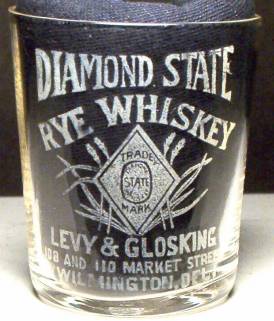
During the early 1900s Conrad Glosking and Jacob Levy had formed a highly successful distilling and wholesale liquor dealership in Wilmington, Delaware, attracting the attention of temperance advocates. The “drys” had succeed in getting a law passed in Delaware that decreed that no one under the age of 21 could work in a saloon or barroom. Because much of the help for such establishments came from youths under 21, the laws severely constricted the labor pool for drinking establishments.

 In 1914 Levy & Glosking reapplied for their usual state license. It allowed the company to compound and rectify as well as sell intoxicating liquors to be drunk off premises, in any quality not less than one-half gallon. To their surprise and consternation, the issuance of the license was challenged in court by local prohibitionists. They argued that the company employed minors in their store to handle liquor by transferring whiskey from barrels to bottles on premises. As a result, the Society contended, the liquor was unsealed and the opportunity given to minors to drink some. In effect, Levy & Glosking were being accused of running the equivalent of a saloon.
 If the Delaware license had been denied, Levy & Glosking were finished. The partners fought back by hiring perhaps the most potent lawyer available in the state. He was Daniel O. Hastings, a former Associate Justice of the Delaware Supreme Court, shown here. Hastings effectively made the case in court that Levy & Glosking were not, in fact, a saloon and that the law on minors had no application to them. The opposition had no real answer. The judge agreed with Hastings and dismissed the argument of the prohibitionists. Levy & Glosking received the precious license.
For Friedman, Nunan, Breen, and Levy & Glosking, overcoming those targeted attacks by prohibitionary “lone wolves,” marked only temporary victories for the whiskey men. As state after state went “dry” and finally the entire Nation in 1920, all of them were forced to shut down their enterprises for good.
Note: More extensive treatment of each of the men featured here can be found on this blog. Max Friedlander, January 7, 2016; John Nunan, October 20, 2015; Martin Breen, July 18, 2017, and Levy & Glosking, March 12, 2012.