Foreword: Because selling liquor could be a very lucrative occupation, many whiskey men became known for their philanthropy. Their generosity took many forms. Some contributed to the arts. Others helped immigrants or the poor or the sick. A few made education the object of their largesse, including individuals who in their youth had few educational opportunities. Presented here are four distillers and liquor dealers who gave generously to institutions of learning ranging from elementary schools to universities.
 John McDougal Atherton was a native-born Kentuckian with two obvious passions in his life, making good whiskey and promoting quality education for the people of Kentucky. Shown here as a young man, Atherton is remembered well in the state for the latter but, sadly, his whiskey history — the occupation that fueled his philanthropy — has been forgotten or ignored.
The son of a farmer-distiller, Atherton received a good education for the time, including Georgetown (Ky) College and the Louisville School of Law. Early on he decided on distilling as a career and by 1869 was operating two distilleries at Knob Creek, about 50 miles south of Louisville, the installations shown below.

Eventually he built two more distilleries at the location, a complex with worker housing he called “Athertonville.” The sesquicentennial History of Kentucky observed: “Thus the quality of the product caused the site, the enterprise and the brands to take on a national scope, becoming the largest single plant in the country for the manufacturing, warehousing and distribution of fine beverage whiskey for which Kentucky became so famous.”
In February 1899, Atherton sold his distilleries and brand names, giving him more time for his other passion: education. Even as a young man planning Athertonville he had built a schoolhouse at the top of a hill near the town. It appears to be the three-story building behind the distillery in the illustration above. The children of his employees received instruction there during the week and on weekends the building was used for Sunday School and prayer meetings. In 1884 Atherton was appointed as a member of a largely ineffectual Louisville school committee. There he fought for reforms that ended an antiquated system of school trustees in favor of a unified system that put management under a non-political Board of Education.
Nor did Atherton forget the academic institution that had given him an education. In 1893 he donated $30,000 ($750,000 equivalent today) to Georgetown College. The money created the Atherton-Farnam chair of natural science, done in tribute to his father-in-law, Dr. J.D. Farnam, who had taught him science there.
 Shown here in old age with his grandson, John Atherton enjoyed a long life, one filled with civic honors. In 1921, setting aside a rule forbidding the naming of a school after a living person, the Louisville Board of Education decided to give Atherton’s name to a proposed new girl’s high school.
  The Board then sent the octogenarian the following message: "The Board of Education honored itself as well as you in naming the girls' high school about to be built 'Atherton High School for Girls.' In wishing you a happy New Year it desires to record itself appreciative of the years of hard and successful work which you have given to public school education in Louisville and the State of Kentucky.”
  A secondary school in San Francisco is named for Jellis Clute (J.C.) Wilmerding, a philanthropist who left his affluent New York home at the age of sixteen to make his fortune in the West. He initially found only poverty but despite his lack of education, his intelligence and energy in the liquor trade ultimately brought him fame, fortune, and the resources to help educate young boys.
From a wealthy New York family, Wilmerding left home at 16 for San Francisco and blew through a borrowed $5,000, leaving himself impoverished. By dint of hard work over the next few years, he paid off his debt and by the early 1860s was able to buy a share of an established liquor house, issuing Old “49” Whiskey as his flagship brand.

Wilmerding proved to be an able businessman and amassed a considerable fortune from his whiskey trade, as well as from important banking interests. His generosity to a range of San Francisco charities was well known, many of them to assist children, for whom he was said to have a special concern although he never married. Wilmerding’s dream was to create a school: “To teach boys trades, fitting them to make a living with their hands, with little study and plenty of work.”
Some have traced Wilmerding’s passion for a vocational school back to having left home so early, with no opportunity to acquire a trade. It has been suggested he felt the lack of one when he recalled his own grinding poverty in San Francisco as his early attempts to earn a living largely failed. One biographer has speculated: “Perhaps his early hardships in California, coming on him so suddenly, made him look with greater fondness of his interrupted boyhood.”
 As his health deteriorated in 1893, Wilmerding made elaborate legal arrangements to finance an educational institution that would be called “The Wilmerding School of Industrial Arts” through a bequest to the Regents of the University of California who agreed to create the school. For the purpose, he left $400,000, the equivalent of $10 million today. After his death in 1884 the Regents, respecting his wishes, established the Wilmerding School. Over time the Wilmerding School merged with a training school for girls. The main building is shown above as it looked in the 1930s. Today it is known as the Lick-Wilmerding School and considered a prestige educational institution from which many students go on to college.
Beginning with a Columbus, Ohio, liquor house and evolving into a major bottler of soft drinks, William and Glenna Joyce, a couple themselves with limited educational opportunities, over the past 57 years through the Joyce Trust have distributed tens of millions of dollars toward the college education of more than 800 students at Ohio State and Notre Dame Universities.

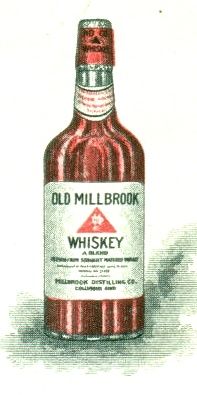
 With little formal education himself, William Joyce about 1909 with a partner founded the Millbrook Distilling Company, described as “Importer Distillers and Jobbers of Wines, Liquors and Fine Old Whiskey.” It was located at 548-550 High Street, Columbus, the three story building shown here. Milbrook Distilling also had a presence across the Ohio River in Covington, Kentucky. As the business prospered, Joyce opened a brewery.
After his first wife died, William married Glenna Stengel, a seamstress with little schooling but a penchant for business. When the coming of statewide prohibition forced the shutdown of the Millbrook Distillery and Joyce’s brewery, William started two new enterprises devoted to soft drinks, the Joyce Products Co. and Beverage Management Inc. He brought Glenna into company management, a position she maintained for years, even after William’s death in 1933.


Whether the idea for the Joyce Trust and the Glenna R. Joyce Scholarships originated with her or had been agreed earlier with her husband is unknown. Nor is it entirely clear why she selected to assist Ohio State and Notre Dame since the Joyces had no direct ties to either university. Candidates for the scholarships are limited to residents of seven Ohio counties around Columbus. They pay for the full cost of attendance for four years and are split evenly between Ohio State and Notre Dame. As of 2017 Trust assets were in excess of $28 million and the number of scholarship recipients annually has been increasing.
 Charles Rebstock was one of the Midwest’s most successful whiskey merchants, with customers in a multitude of states. During his career he successfully merchandised several brands with interesting trade cards and ads, while pursuing philanthropic interests that centered on higher education.
In 1870 at the age of 25, Rebstock founded a whiskey wholesale organization in St. Louis, Missouri, and began to sell his products in both in bulk and in bottles. As was characteristic with his mode of operating, he collaborated with a Kentuckian named D. L. Moore to build a distillery on the Shawnee River near Burgin, Kentucky. Eventually they formed a company called Moore and Rebstock Distillers. The products of this facility gave Charles an assured supply of whiskey for his several brands and over time he grew very wealthy.

After 24 profitable years in St. Louis, Rebstock eventually shut down his liquor business as National Prohibition approached. Now 74 years old and apparently without immediate heirs, this wealthy man began to look for likely places to practice philanthropy.
 The Journal of the American Medication Assn. reported in 1922 that Rebstock had purchased the Wintersteiner Collection of 13,000 microscopic preparations of pathologic changes of the eye and contributed them to the St. Louis University College of Medicine, shown here. The collection was said to be the most complete in Europe and in the U.S. was to be used for graduate instruction in opthamology.
 Four years later Rebstock, with no appointment, presented himself in the office of the Chancellor of Washington University of St. Louis, asking for an interview. Reluctantly ushered in by a secretary, he announced that his name was Charles Rebstock, distiller, and that he had one million dollars he wished to give the university for the construction of a new building with no specification of purpose other than it have his name on it. In 1926 a million dollars was a huge sum. During a walk through the campus with the Chancellor, Charles saw that the zoology and botany departments were poorly housed and decided that they deserved a new building that he would finance. Its front entrance shown above, the Charles Rebstock Building still is home to those departments and a professorship is maintained in his name.
Note: Longer and more complete biographies of each of the four whiskey men featured here are available elsewhere on this website. They are: John Atherton, February 12, 2015; J. C. Wilmerding, October 24, 2015; William and Glenna Joyce, September 22, 2018, and Charles Rebstock, September 6, 2011