Foreword: This post describes of activities of three Western gunslingers with checkered pasts who sought legitimacy in frontier towns by owning saloons and participating in the business life of their communities. When violence almost inevitably intruded, each man faced a different result.
 A member of the notorious Wild Bunch, Lonnie (Logan) Curry was on the lam from a train robbery in Wyoming when he arrived in Harlem, Blaine County, Northeast Montana, in July 1899. Shown here, Curry immediately rented a house in Harlem, declared the intention of settling down, and reunited with his wife Elfia and their two children. This sequence likely was a ploy to establish an alibi if arrested for the train robbery. Four days after he arrived Curry approached its owner about buying a half interest in the Club Saloon.
Given the gunslinger’s reputation, it clearly was an offer the proprietor could not refuse. The drinking establishment was renamed the Bowles and Curry Saloon. Lonnie became active in the Harlem community and made friends of some of its leading citizens. He began to wear suits and sprouted a mustache. Soon a Curry cousin and fellow outlaw named Bob Lee arrived in Harlem, identifying himself as Lonnie’s brother. On November 25 the two men concluded a deal making them the sole owners of the saloon. The cousins called it “The Curry Brothers’ Place.” They immediately began to redecorate the interior in order to attract Harlem’s elite to their drinking establishment, shown below.
Curry’s high profile in Harlem led to his downfall. As one author has speculated: “Apparently the saloon wasn’t profitable, perhaps of too many drinks on the house and unpaid tabs.” Dipping into the loot from the robbery, kept in a Harlem hotel safe, Lonnie tried to cash a $1,000 bank note, arousing suspicion. Pinkerton detectives were soon on the trail. In January 1890 agents posing as itinerant cowboys came to town looking for the Currys.
 Alerted to their presence Lonnie gathered up Bob Lee and left Harlem. Late that night the pair roused a local rancher named George Ringwald and sold him the saloon for $1,000 — $300 in cash and a promissory note for the balance. They then rode south. With them went the proceeds from a community raffle, ending Lonnie’s good reputation with the people of Harlem. Soon after Elfie and the children departed town. Following a circuitous route that took him through Colorado, Lonnie eventually reached Dodson, Missouri, possibly the Curry/Logan home town. There he hid out in a house with assorted aunts and cousins. In February 1900, Pinkerton detectives tracked him there and surrounded the residence. When Lonnie tried to escape, they shot him down — dead at 28 years old. His tombstone is shown here.
 When a man calling himself Tom Dunn, shown here, about 1893 rode horseback into Saco, Montana, no one in that ramshackle town knew who he was. He had sufficient money to buy a local drinking eatablishment, calling it “The Valley Saloon.” The newcomer became known as its genial proprietor, and even, some said, got married and settled down. “At the time of his death,” reported one Montana newspaper: “He had a fairly good reputation among his neighbors and others who knew him.”
“Tom Dunn” was, in truth, Ed Starr, a member of several well known outlaw gangs. According to Helen Huntington in her book, “War on Powder River,” Starr was regarded as a “vicious nonentity” and “a killer for killing’s sake.” When he arrived in Saco, the outlaw was on the lam from Wyoming, wanted as the head of the Hole in the Wall Gang and the outlaw who had killed a United States marshal.

In Saco, as saloonkeeper and livestock broker Starr/Dunn seemed to have turned over a new leaf. He soon was appointed deputy livestock inspector, reputedly compiling a good record. Old habits die hard, however, and in 1898, about nine miles from Saco, Starr/Dunn became involved in selling a string of horses, some of them apparently rustled. In this scheme he had as a partner another notorious Western “bad man” named Henry Thompson, known as “Long Henry.” When the time came for the two to settle accounts on the stolen animals, they could not agree on a division of the profits.
Angry with Thompson’s demands, Starr/Dunn began telling people in Saco that “Long Henry” had cheated him. In that small town it did not take long for the word to get back to Thompson himself. He cocked his gun and went looking for Starr/Dunn. On August 6, 1898, Thompson found the saloon owner and fugitive outlaw saddling a horse at a local ranch. Thompson accosted him with “I understand you say I have been robbing you.” Starr/Dunn said nothing, grabbed for his gun and fired twice at Thompson. According to press accounts: “The first bullet cut a gash in Long Henry’s scalp and the second made a flesh wound in his side. But neither of them knocked him down.” Almost simultaneously Thompson, an expert marksman, fired three times. The first bullet struck Starr/Dunn in the heart, killing him instantly.
 The bullet-ridden Ed “Tom Dunn” Starr was buried in Highland Cemetery in Glasgow, Montana, about 42 miles from Saco. His funeral was well attended by the friends and acquaintances he had made in Montana. The Reverend S.W. Russell, an Episcopalian priest from Miles City, conducted the funeral service.
 Violence swirled like dust in a windstorm around Jacob W. Swart’s “Bar Room” in Charleston, Arizona Territory. Located six miles from infamous Tombstone, Arizona, site of the “Gunfight at the OK Corral,” Swart’s watering hole was a favorite hangout of gunslingers and outlaws. This photo is believed to be Swart, standing in the doorway of his saloon.
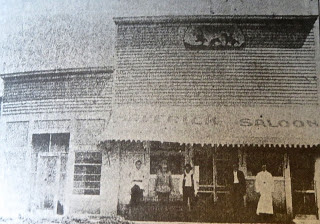
About 1876, the New York-born Swart had moved west. In 1879 the Pima County, Arizona, newspaper reported a payment of $11.44 to him as a quarterly fee for his services as deputy sheriff. Such jobs often were awarded to those handy with a six-shooter. Swart subsequently moved on to Charleston, Arizonfounded in 1879 as a milling site for the silver mines around Tombstone. In 1881 he bought an existing drinking establishment, shown below. In the years following Swart’s proprietorship of the saloon, it became known as a hangout for a loose group of outlaws known as the “Cowboys.” The photograph shown here is believed to depict a number of those desperadoes.

The violence that marked this part of Arizona did not leave Swart untouched. During the mid-1880s, the saloonkeeper had an altercation with a man named Chambers, a manager at one of the Charleston mills. Swart shot and killed him. In the West of those days if the dead man was armed and shot in the front, the verdict almost inevitably was “not guilty” and the shooter was not jailed. In this case Swart found himself facing Justice of the Peace James Burnett, a man known for assessing large fines for infractions and pocketing the money. Likely reckoning the accused a rich man, Burnett fined Swart $1,000, equivalent to $22,000 today. Rather than pay up, he hustled out of Charleston just ahead of a posse sent to arrest him.
Swart moved 300 miles west to Yuma, Arizona, on the Colorado River near the California border. Yuma was a far different place from Charleston and Tombstone. City Historian Tina Clark has called Yuma a “precious river town.” It was the first stop in Arizona for trains and steamboats coming from urban centers like Los Angeles and San Francisco. Tastes in Yuma were more refined and life was calmer.
 There Swart opened a new watering hole he called “The Identical Saloon” at the corner of Main and Second Streets. In a 1891 advertisement, one that misspelled his name, he boasted of always having on hand “First-class Whiskies, Wines and Brandies” as well as “Choice Key West Cigars.” Jacob clearly had taken his drinking establishment up a notch on the elegance scale. His advertising of “Cosy Club-rooms” suggests that he was entertaining gambling or perhaps something more intimate. At that point the trail goes cold on Jacob Swart. I have been unable to track his final years or his place of burial.
Note: Longer posts on each of these three gunslinging saloonkeepers may be found elsewhere on this blog: Lonnie Curry, May 28, 2020; Starr/Dunn, March 5, 2020; Jacob Swart, May 6, 1919;


