Foreword: Following are vignettes of three men involved in the pre-Prohibition liquor business who also made their mark as skilled athletes: boxer, wrestler, and marksman. They also made important contributions to their communities for which they also deserve to be remembered.
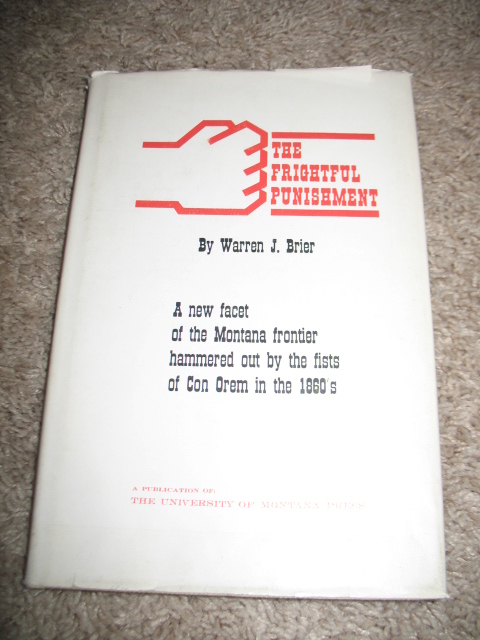
 Saloon owner John Condle “Con” Oram gained national fame for his 185-round, semi-bare knuckles prize fight in Virginia City, Montana, against a man who outweighed him by 52 pounds. Proving he was more than a pugilist, Oram, shown here, also has been credited by historians with advancing Montana’s cause for statehood.
Born in Ohio, after an successful early career in boxing, Oram in 1864 arrived in Virginia City, in what is now Montana. A non-drinker himself, he opened a liquor establishment he appropriately called “The Champion Saloon.” Not long after, Oram was challenged to a boxing match by an Irish heavyweight named Hugh O’Neil. The winner’s purse was $1,000, equivalent to about $22,000 today. That payoff was sufficient to coax Oram once more into the ring. Given his size and weight advantage, O’Neil was a 3 to 1 favorite.

For their money customers saw what Sports Illustrated has called: “One of the longest and most brutal fights in American ring history.” During three hours and 185 rounds the fighters hit the canvas 91 times, often deliberately to end a round. Finally as Oram seemed to be getting the worst of it, the referee stopped the fight, declaring a draw. The pot was split between the two contestants.

Subsequently Oram played an important role in achieving statehood for Montana. At a large outdoor citizen meeting, he mounted a wagon and began to harangue the crowd about their present grievances and the need to take immediate action to separate from Idaho and form a new political entity with its capital at Bannock, Montana. Apparently galvanized by Oram’s rhetoric, the crowd voted to send an emissary to President Lincoln with a petition to create the Montana Territory, a step toward statehood. Lincoln agreed. Oram was hailed as a hero, serenaded by the Virginia City Brass Band, an honor usually reserved for visiting dignitaries.
*****
 Shown here is a studio-posed photograph of Edward A. Kolb in a wrestling hold with his eldest son, Harry. A successful San Francisco liquor dealer, Kolb as a young man was renowned in California as a champion West Coast wrestler. He held the Pacific Coast Middle-Weight Amateur Championship from 1885 until 1890. Perhaps his most notable victory occurred in 1888 was when he met the heavyweight champion of the West Coast, a wrestler named Pritchard. After tussling for two hours without either man gaining a fall, the match was postponed for a month. At the rematch, Kolb won in two straight falls.
That same year Kolb teamed with his wife’s brother, Herman Denhard, to open a liquor store. Kolb had learned the whiskey and wine trade working in the storage cellars of Kohler & Van Bergen [see post on Van Bergen, Nov. 1, 2020]. Kolb & Denhard featured a wide range of imported and domestic wines, liquors and mineral waters at their 422 Montgomery Street address, shown below. That is Kolb standing at the left side of the photo, staring into the camera.

By all accounts the Kolb & Denard liquor house was a rousing success. So much did his business thrive that when Kohler & Van Bergen left their premises, Kolb, said to be fulfilling a youthful ambition, moved to that location. Said the San Francisco Call newspaper of of Kolb: “He…built up a big business by his untiring energy and by his big warmhearted manner.” Signs of trouble emerged in 1902 with dissolution of the partnership when Denhard withdrew from the liquor house. Kolb took over all assets, assumed liabilities and continued the business at the same address. But sole ownership took a toll.
 In 1903, according to a press account, Kolb: “…Suffered a nervous collapse, brought on by too close application to business. Although he abandoned the active life to which he had been accustomed,the rest did not bring him the wished for relief.” With his liquor business now being carried out by associates, Kolb sought respite in the quiet of the family’s country house in Palo Alto, 33 miles south of San Francisco. Nothing, however, seemed to ease his mental torment. Kolb died there on January 22, 1904. Although suicide was not suggested, his passing was totally unexpected. The wrestling champion apparently had met an opponent he could not overcome — his own mind.
*****
 Shown here on a passport photo, Ralph Lewis Spotts overcame a boyhood of straitened circumstances in Canton, Ohio, to win gold twice in his life, once at the end of a shotgun at the 1912 Olympic Games and secondly by inheriting one of New York City’s best known and most affluent liquor houses by wedding the daughter of the owner, New York City millionaire, Harford Kirk.
Spott’s marriage into society and wealth gained him entrance into the New York Athletic Club. There he began to attract wide notice as a crack shot. On November 21, 1910, The New York Times reported on shooting matches at the Yacht Club: "Ralph L. Spotts carried off the honors of the day, for he not only won the first prize of the season as high gun with a score of 119, but he also won the ten and five bird scratch events, and the leg for the Sauer gun. He also won the 200 target match.” Spott’s reputation won him a place at the 1912 Stockholm Summer Olympics representing the United States trap shooting team. In the team photo below I believe Spotts is standing second from right.

 When the competition ended on July 2, 1912, the Americans had captured the world team trapshooting title. With their captain shooting 94 of the 100 clay pigeons presented and no member hitting fewer than 80, the team shattered 532 of 600 targets. Spotts distinguished himself by scoring 90 of 100. Not only did he come back to wife and family bearing a gold medal, he and the team were honored in a parade of U.S. Olympic medal winners down Fifth Avenue as fans packed the streets, shown right.
Upon returning to New York Spotts assumed a heavy work load. After a period of declining health, Harford Kirk died in July 1907 leaving the management of the liquor house to Spotts, where he continued to expand the business. Increasingly wealthy, Spotts also became president of the Walton Hotel and a partner in the Cantono Electric Tractor Company. The poor boy from Canton had found two paths to winning gold.
Note: More complete vignettes on each of these three whiskey men may be found elsewhere on this website: Con Oram, June 3, 2019; Edward Kolb, March 10, 2022, and Ralph Spotts, April 27, 2022. A post on Harford Kirk ran on March 17, 2022.