Showing posts with label Oscar Pepper. Show all posts

Monday, September 11, 2017

Whiskey Men with Slaves


Foreword:  The recent revelation that Jack Daniels was taught how to make good bourbon by a slave has resulted in efforts by historians to research more thoroughly the role that enslaved blacks played in the development of the American whiskey industry.  According to one author, many distilleries in the Mountain South employed at least three slaves.  Presented here as part of the series grouping whiskey men into categories are four examples of distillers, both large and small, who manufactured whiskey with slave labor.

We begin with the Father of Our Country, George Washington.  Washington was a farmer at heart.  Upon returning to Mount Vernon after his presidency, he threw himself wholeheartedly into the agricultural activities of the plantation, including growing corn and rye wheat.  At the urging of his farm manager, James Anderson,  a Scotsman with experience making whiskey both in his homeland and in Virginia, Washington began commercial distilling.  Anderson had advised George that Mount Vernon’s crops, combined with his large gristmill and abundant water supply, would be a profitable venture.  Always looking for ways to make the estate pay off, Washington agreed.

As a result in 1897 the cooperage at Washington’s grist mill, 2.7 miles from the plantation house, was converted to distilling and two stills bought and put into operation.  Success came quickly and Anderson was able to convince Washington to increase production.  That fall construction began on a building large enough to hold five stills.  The foundation was laid from large rocks brought from the Falls of the Potomac where Washington was trying to build a canal.  The walls were of sandstone quarried right on the plantation itself.  George also invested heavily in the interior.  He bought five large copper kettles, 50 mash tubs, five work tubes and a boiler.  Shown below is an artist’s concept of the original complex.

The extensive, back-breaking labor involved in this project was provided almost entirely by slaves.  They constructed the distillery and then, under the guidance of Anderson’s son, were responsible for operating the machinery of the distilling process, as well as making the barrels for holding the finished product.  We know the names of those African slaves:   Hanson, Peter, Nat, Daniel, James and Timothy.  They made it possible for Washington between 1798 and 1799 to produce 11,000 gallons of whiskey, valued in that day at more than $7,000 (equivalent today to several hundred thousand dollars).  The distillery also made brandy using locally grown apples peaches and persimmons.

The success of Washingtons’s distillery was short-lived.  After his sudden death in 1799, the facility was closed and the buildings allowed to fall into disrepair, ultimately to be dismantled and the site obliterated.  Early in this century a multi-million dollar grant from the Distilled Spirits Council of America (DICUS) allowed the distillery as conceived and operated by Washington to be recreated on the original site and opened to the public in 2005.  True to the history, African-Americans are cast in the role of the distillery workers.

About the same time that Washington was distilling, Elijah Pepper, a native of Virginia, moved more than 500 miles west to Kentucky, settling near the town of Versailles, Woodford County, and about 1797 built a distillery, almost certainly with slave labor.  Census records for 1810 indicate that the Elijah owned nine enslaved blacks, some of whom worked in making whiskey as well doing as field labor.  

With the success of his enterprise, Pepper over the next ten years was able to increase his slave holdings to twelve, seven males and five females.  Owning more hands for field work allowed Elijah to increase his land holdings to 350 acres. Over the next ten years he was able to buy even more slaves.  The 1830 census recorded him now with twenty-five, thirteen males and twelve females.  With the help of those blacks he steadily was increasing the production of his distillery.

With his death in 1831 the distillery, its equipment, stored whiskey and the slaves devolved upon his widow, Sarah O’Bannon Pepper, who later sold her interest to her son, Oscar N. Pepper.  After buying out his siblings, Oscar, once again using slave labor, replaced the log structure of his father’s distillery to build a new facility, a one-and-a half story rectangular facility that allowed him to expanded whiskey production significantly.  Shown below is is an artist’s concept of the rebuilt Pepper distillery.

Oscar’s wealth included twelve male and eleven female slaves, some of them inherited from Elijah.  An 1859 Woodford County document recorded that two of his slave women had given birth in August, a girl christened Maria and a boy Willie.  Oscar Pepper is listed in the column for the father’s name.  My guess is that because slaves were considered property, not persons, Oscar’s name appears there as owner.  Three years later, with the outbreak of the Civil War and the Emancipation Proclamation, the slave era ended in Kentucky.  Nevertheless, the Peppers continued to operate the distillery until 1878 when the effects of a bankruptcy passed it to non-family ownership.

Today archeologists are attempting to reconstruct the Pepper distilling site.  The family home has been returned to its original state and outbuildings have been identified.  To date, however, efforts to find the location of the slave quarters have been unavailing.

To reach Arkansas, William Looney and his family were forced to endure a trek through much of Tennessee, bringing with them their young children and a few slaves.  Perhaps exhausted from the journey, they stopped in the far northeast of the state on the Eleven Point River where Looney settled on the west bank.  In contrast to the large landowners elsewhere in Arkansas, he was a yeoman farmer who also used several slaves to help him built and run a small distillery, likely similar to the scene shown below.
When compared to Washington and the Peppers, Looney was a small operator, prospering economically and socially by making and selling whiskey primarily to his neighbors.  Looney’s liquor warehouse and tavern, originally built with slave labor and shown here under restoration, is accounted the oldest commercial building in the state of Arkansas.

When Looney died in 1846 at about the age of 61, he was one of the richest men in Randolph County with extensive land holdings, owning thirteen slaves and considerable livestock.  Moreover, he had been sought out for public office.  During a period from about 1816 to 1825, he served as justice of the peace and magistrate in two local townships. 

Similar good fortune acceded to Looney’s tavern.  After his death his widow converted the building to a dwelling. Later it was donated to a local college. In recent years the structure has been restored as a tavern by a grant from the Arkansas Natural and Cultural Resources Council.  On the National Register of Historical Places,  Looney Tavern has become an important tourist destination in Northeast Arkansas.  The role of slaves in its original construction, however, does not appear to have been highlighted.

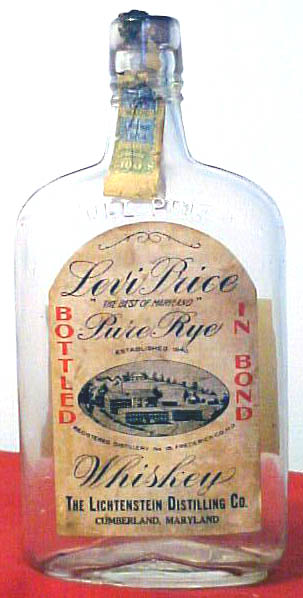
Like Looney, Levi Price, shown here, was a farmer/distiller whose output of whiskey was modest, meant largely for local consumption.  He launched himself in business in Frederick County, Maryland, when he was only 23 and reputedly had only 93 cents to his name.  His early financial success apparently resulted in innovations he made in the distilling process.  He recognized that any form of adulteration led to objectionable tastes in the newly made “raw” whiskey of his day.  Using care in the cleanliness of his process and a reputed “secret method” or two, he was able to manufacture a product that had the taste and smoothness of an aged whiskey while being newly distilled.  By eliminating most of the aging process, he saved money and was able to sell his whiskey for less than the competition.

In all these efforts, Price had the help of slaves and later freed blacks.  They assisted with the distilling process, made barrels, and rolled them out to the wagons of customers.  Shown here is the Price house in the process of its second restoration as an historical residence. Behind the house can be seen a field stone building that has been identified as slave quarters. 


Maryland dragged its feet on antislavery measures.  The state failed to act until 1864 when it conducted a emancipation referendum that only narrowly passed.  The vote tipped only after the absentee ballots of local soldiers in the Union army were counted.  Freedom day for enslaved blacks in Maryland came on November 1, 1864. The change seems not to have bothered Price who continued to prosper.  After his death the quality of his whiskey was recognized in a brand of rye issued under his name.

These four examples of whiskey men with slaves could be multiplied dozens of times.  Likely most distillery operations in the Mountain or Deep South employed African and Native American slaves in the pre-Civil War era.  Renewed interest in the role they played in the development of the U.S. liquor industry should, I believe, lead to a greater understanding and appreciation of their contributions.

Note:  More complete posts on each of these whiskey men can be found on this blog:   George Washington, March 2017;  The Peppers, January 21, 2017;  William Looney, July 16, 2013; and Levi Price, September 26, 2015.


Afterword: After posting this article I came across a picture that indicates the participation of American blacks in distilling.  Above is a photo of the first meeting of the Kentucky Distilling Association in 1880.  Gathered are many of the top distillers in the state.  Note the number of African-Americans included in the group.  


Saturday, January 21, 2017

Five Peppers Stirred the Copper Pot

Among the best known Kentucky bourbons is “Old Oscar Pepper,” a brand that endured for more than 80 years and a tradition honored even today.  The story behind this whiskey is so long that this post deals only with the Pepper family, the five members, including two women, who guided the fortunes of the distillery until 1878 when it was sold.  My next post will describe what happened over the following 40 years.  But first we get to know the Peppers:

Elijah Pepper:  He was the founding father of the Pepper distilling dynasty, born about 1775 in Fauquier County, Virginia, the son of Samuel Pepper and Elizabeth Holton, accounted “an English lady.”  In 1794, not long out of his teens,  Elijah married Sarah O’Bannon, who the records indicate may have been only 13 or 14 at the time.  In 1797, with Sarah and her brother, John O’Bannon, this Pepper moved more than 500 miles west into Kentucky, settling near the town of Versailles, Woodford County.  There he established his first distillery.

After moving for several years to Bourbon County, Elijah returned to Woodford County and by 1812 was paying taxes on 200 acres along Glenn’s Creek. He had selected this location because a branch stream coursed through the property and three pristine springs gushed near the banks of the creek.  There he established a farm, a gristmill and a distillery.  Although  other nearby Kentucky farmers had been forced to give up distilling because of the federal taxes imposed, Elijah seemingly had deeper pockets, bought their grain and legally made it into whiskey.

By that time Elijah and Sarah had a family of seven children, four boys and three girls.  For them he built a two-story log house with a massive exterior limestone chimney.  The only part of the original Pepper settlement that remains, the house was enlarged by subsequent residents.  It is shown here as part of a Kentucky archeological project that has sought to restore and preserve the site.

All of Elijah’s structures were built of timbers on foundations of stone.  Land division maps indicate the grist mill was constructed high on the stream where the force of the water could turn a wheel and that his distillery was nearby.  The location of his slave quarters has not been identified, for — truth be told — the Peppers were slave owners.  Census records for 1810 indicate that the family had nine enslaved blacks,  With the prosperity of his holdings, Elijah was able over the next ten years to increase his slave holdings to twelve, seven males and five females.  Owning more hands for field work allowed Elijah to increase his land holdings to 350 acres.

The prosperity that followed in the next decade allowed him to buy even more slaves and the 1830 census recorded him holding thirteen males and twelve females in bondage.  An inventory taken at Elijah’s death in March 1831 provided other indications of his wealth.  His distillery included six copper kettle stills, similar to the one shown here, 74 mash tubs, a number of kegs and 41 barrels of aging whiskey, equivalent to 1,560 gallons.  His livestock counted 22 horses, 113 hogs, 125 sheep and lambs, and more than 30 head of cattle.  He also owned numerous implements for use in agriculture and timbering. 

Sarah O’Bannon Pepper: Only days before his death, Elijah Pepper made a will that left the distillery and other property to his wife.  Now about 50 years old, Sarah seems to have been fully up to the task.  The daughter of William O’Bannon and Annie Neville, she was the niece of General John Neville of Virginia, a prominent officer in the Civil War and a personal friend of George Washington.  The Nevilles were wealthy gentry in Virginia and may have assisted the Peppers financially at the start.

Although Sarah’s education may have been truncated by her early marriage, her husband entrusted Sarah with aspects of managing their large farm and associated businesses.  The inventory of Elijah’s possessions indicate that she had overseen purchases of farm and distillery equipment including, “stills and tubs, etc., in still house.”  She also likely was responsible for buying the carpeting, silver and other expensive furnishings that are said to have graced the Pepper home.

The presumption of an historian who researched the property for inclusion on the National Register of Historic Places is that after Elijah’s death Sarah was in charge of managing the family businesses, including the distillery and whiskey sales, for a period of about seven years, 1831 until 1838.  That year she sold her interest to her eldest son, Oscar Pepper, who had been assisting her. 

Oscar Neville Pepper:  Born in 1809, Oscar took the relatively small whiskey business his father had founded to a new level.  Thus 1838 is recognized as the founding year of the re-named Oscar Pepper Distillery and the origin of the “Old Oscar Pepper” brand.  After buying out the shares of his brothers and sisters,  Oscar began making major improvements on the property.  He replaced the log structures of his father’s milling and distilling businesses with stone buildings and put an addition on the house.  Indicative of the amount of construction going on was a record in the 1850 census that a stone mason from Ireland named Thomas Mayhall was living with the family.  

The move from timber to stone was not a difficult one since the hillsides that surrounded the Pepper property were a rich source of limestone, a mineral important to the farmer-distiller families.  The limestone bedrock was good for growing corn and the waters of limestone-filtered springs helped produce whiskey with a distinct flavor.  Working with limestone for construction, however, took the kind of expertise that Mayhall brought.  To form building blocks the bedrock had to be quarried and shaped.  To create mortar the limestone had to be fired, ground and slaked.  As indicated by land records, the resulting distillery building was a one-and-a half story rectangle structure with an asymmetrical gable roof about 60 by 75 feet in area.   Shown below is a picture of Pepper’s stone distillery.

Oscar’s most important decision was to hire as his master distiller the now-famous Dr. James Crow, a Scottish chemist.  Crow has been hailed as the  individual who single-handed enhanced the bourbon-making process by improving and codifying sour-mash fermentation, pot still distillation, and the process of aging in wooden barrels.  

Crow also insisted that no more than two and one-half gallons of whiskey should be produced from a bushel of grain.  Shown here is a device that may have been invented by Crow.  It is a single chamber where the alcoholic content of distilled bourbon could be tested.  This example included hydrometers for checking both the first and second distillations.

Crow worked for the Peppers from 1833 until 1855, with exceptions being 1837 and 1838, possibly because Oscar’s stone construction was proceeding.  Crow’s deal was that he would be compensated by being given one-tenth of the production.  In 1855 the distillery produced 80 barrels from which Crow presumably drew eight.  In his admiration for the Scotsman, Oscar named one whiskey “Old Crow” and gave the distiller a house of his own on the property.

Meanwhile, Oscar Pepper was having a personal life.  In June 1845 he married Nancy Ann (also given as Annette) “Nannie” Edwards, a woman born and raised in Woodford County who was 18 years old when they wed and about 17 years younger than her husband.  In subsequent years under Oscar’s leadership the farm and distillery flourished and his family increased to seven children.  The 1860 census indicated real estate valued at $31,000, the equivalent of some $770,000 today.  His personal property that included such extravagances as a piano, an icebox, and law books valued at $36,000. 

Oscar’s wealth also included twelve male and eleven female slaves, some of them obviously inherited from Elijah.  They would have been tending the crops on his large farm as well as working in the Old Oscar Pepper Distillery along side Dr. Crow.  A record of births in Woodford County for 1859 lists Oscar and Nannie having a baby on April 10 to whom no name yet had been given, but data suggests later was christened Mary.  The same year two of the Peppers’ slave women had given birth in August, a girl named Maria and a boy named Willie.  Oscar Pepper is recorded in the column for the father’s name.  My guess is that because slaves were considered property not persons, he appears there as the owner not the progenitor.  

Oscar Pepper died in June 1865 at the age 56 and with his family and friends mourning by his graveside was interred in the Lexington Cemetery in Fayette County.  Shown here is his gravestone. 

Nannie Edwards Pepper:   The inventory of Oscar’s possessions taken after his death indicate how much he had expanded the Pepper estate.  It included 400 barrels of corn, 400 bushes of rye, 40 bushels of barley malt and 30 barrels of barley, a large copper still and a boiler, all part of the distilling operation.  The alcohol on hand included 120 gallons of whiskey.  This Pepper owned 829 acres of land and livestock that included 21 horses and mares, 7 mules, 25 milk cows, 30 yearlings and steers, 56 sheep and more than 100 hogs.

Unlike his father Oscar left no will.  A court settlement in 1869 divided his property in seven unequal lots for his seven children.  Presley O’Bannon Pepper, the youngest, only seven years old, received the largest share, including 160 acres of land, the distillery, the grist mill and the family home.  This was the court’s way carefully of providing for Nannie Pepper.   Since P. O’Bannon was a minor and would remain so for another 14 years, it put most of the financially productive property in her hands.

Still a relatively young woman at 36, Nannie, unlike her mother-in-law Sarah, seems to have had no interest in operating the distillery by herself.  Moreover, since the end of the Civil War all the Pepper slaves were gone.  As guardian of P. O’Bannon’s inheritance, she soon leased the property to Gaines, Berry & Company of Frankfort, Kentucky, a firm where the famous Col. E. H. Taylor Jr. was a partner.  The agreement gave the Frankfort group control over the distillery and all its equipment, the distiller’s house, and two stone warehouses.  The two-year agreement also included the grist mill and a pen near the distillery where the hogs were fed the spent mash.

Born in 1850, Nannie’s eldest son, James, 15 years old at the time of his father’s death, appears to have be given a role in the running of the distillery by Gaines, Berry & Co.  They appended the name “Old Crow Distillery” to the Pepper property and made “Old Crow” their flagship brand.

James Pepper:   Possibly egged on by the ambitious Col. Taylor [see my post of Jan. 2015], James Pepper apparently grew tired of playing second fiddle to his mother and in 1872 successfully sued to gain control of the distillery.  The result apparently did not cause a serious mother-son breach as Nannie is recorded giving a deposition for James later in a court case.

The next few years for the Pepper distillery are somewhat muddled.  After taking control, James apparently teamed with Col. Taylor, who had broken with Gaines, Berry and the two made improvements in the plant and increased operations.  Gaines, Berry, however, apparently retained sufficient financial interest that the “Old Crow” trademark was transferred to them, leaving James with the Old Oscar Pepper brand.

After five years of operating the distillery, James experienced severe financial difficulties and was declared bankrupt in 1877.  The Peppers’ loss was Col. Taylor’s temporary gain as he took sole ownership of the Old Oscar Pepper Distillery.  But Taylor — who had other distillery interests — shortly after met with his own financial downfall.  That led to the transfer of the Pepper distillery briefly to George T. Stagg, another well-known Kentucky whiskey man, and finally in 1878 to Leopold Labrot and James Graham of Frankfort.  Shown above is an illustration of the distillery at the time of their purchase.  Never again would a Pepper family member own the property founded by Elijah, nurtured by Sarah, expanded by Oscar, protected by Nannie, and lost by James.

Afterword:  Although the Old Oscar Pepper distillery was in other hands, the Pepper name continued for years in the trade when James later founded his own distillery in Lexington, [see my post of September 2012].  When James died in 1906, he was interred near his father and Nannie, who had passed in 1899.  A large monument, three Doric pillars on a three step base, marks the spot where the Pepper clan is buried in Lexington Cemetery. 

  
Now came the turn of Labrot & Graham to run the historic distillery.  Their names are combined with the Peppers in a mill wheel above. Their story and its outcome will be the subject of my next post. 

Note:  Much of the information for this post came from an undated National Park Service document associated with the listing of the Pepper properties on the National Register of Historic Places.


Saturday, September 22, 2012

James E. Pepper: Was His Whiskey Revolutionary?


James Pepper of Lexington, Kentucky, claimed that his whiskey could be dated to the year 1780,  smack in the midst of the American Revolutionary War.   His grandfather, Elijah Pepper, sometimes was credited with beginning the first distillery in Kentucky,  a claim that might have been disputed by others but never by his grandson.   As a result, as shown below,  Pepper’s merchandising, including signs, trays and tokens, that stress the Nation’s first war.  As will be explained later, however, the real revolution for his whiskey may have occurred after his death.

The story of Pepper whiskey and his Henry Clay distillery has been told well by William Ambrose in his 2002 book “Bottled in Bond.”  In keeping with my policy of not repeating  material that has been well done previously,  I will quote Ambrose for the bulk of this vignette but first set the scene:  Pepper who had already run a Kentucky distillery owned by his late father, Oscar, sold it,  went East to learn the wholesale liquor trade, returned to Kentucky in 1878, and teamed up with a  wealthy Kentucky businessman named George Starkweather.  Starkweather recently had bought the defunct Henry Clay distillery located in Fayette County, Kentucky.  Ambrose picks up the story in 1880:


Starkweather then established a partnership with Colonel James. E. Pepper and the pair reestablished a distillery on the site. Pepper designed the distillery and the layout of equipment and he hired local architect John McMurty to translate these ideas into plans and specifications.


The grounds contained 48-1/2 acres. The distillery was constructed of brick and enclosed a floor space of 40,000 sq. ft. The plant had 20 fermentation tubs of 6,500 gallons and 700 mash tubs of 72 gallons. The three-chambered beer still held 2,500 gallons and the doubler, 1,200 gallons. Both were made of copper.

Pepper installed four steam boilers to provide heat to the mash tubs and stills at a time when many distilleries were still using open flames for heat. In addition, he installed two steam engines of 125 hp each to supply power. The engines drove a series of shafts throughout the plant and these powered the machinery through a series of pulleys and belts. He purchased a six roller mill, also powered by belts, to grind his grains into uniform consistency. He designed rows of windows on two sides of his plant to allow ventilation and lighting. These designs, while not revolutionary, allowed the distillery to operate with higher efficient, improved yields and uniform quality. Moreover, it allowed him to distill a consistent, higher grade whiskey that was his hallmark.

The plant was finished in April with a capacity of 28 barrels (roughly 300 bu) per day. They produced "Old Pepper Whiskey" and "Old Henry Clay", a Rye whiskey.

In September 1880 the company let bids for the construction of two bonded warehouses. Both warehouses were roughly 9,000 sq. ft, four stories high and projected to hold 10,000 barrels of whiskey. The foundations were of stone, walls of brick and roof of iron clad. The first warehouse was finished in late 1880 and the second finished in early 1881.

Over the next twenty years, Pepper constructed four additional warehouses - giving the distillery bonded storage of 60,000 barrels. These warehouses were:
Warehouse "A" -- 10,000 barrels, built in 1880
Warehouse "B" -- 8,500 barrels, 1881
Warehouse "C" -- 6,000 barrels, 1890
Warehouse "D" -- 5,000 barrels, 1897
Warehouse "E" -- 8,500 barrels, 1897

Warehouse "F" -- 11,000 barrels, 1901
Water for the distillery was supplied from the farm of Colonel Wilson - with a basin of 75 feet square - and conveyed to the plant by a 5" pipeline. Two pumps supplied 1,000,000 gallons per day. The plant also maintained 500 head of cattle fed from the sillage.

The Louisville, Cincinnati and Lexington Railroad (later Louisville & Nashville Railroad) had tracks on both sides of the plant, with a siding into the distillery on the Frankfort Pike side.

1882: The plant's capacity had increased to 50 barrels per day, 10,000 barrels per year (value $300,000), operating 10 months of the year with 40 hands paid an average of $1.75 per day. They purchased oak barrels from the Bauer Cooperage Company for $2.50 each. The distillery was valued $125,000 and at the time was said to be the largest distillery in the world.


In February, fire destroyed the cattle sheds and pens with a net loss of $4,000 to $5,000. The incident was fully covered by the Western Insurance Company.

1883: Starkweather died in December and Pepper acquired his interest for $70,000. He then sold half his stake in the company to Colonel William S Barnes of Lexington, Kentucky. Both Colonels Pepper and Barnes traveled around the United States promoting "Old Pepper" whiskey. Colonel Pepper concentrated on the East Coast, especially New York, and Colonel Barnes promoted in the North and West, especially in the Chicago area.1886: The company began bottling "Old Pepper" whiskey in quarts and pint flasks. The entry into the bottling business was to counter the rectifiers that blended whiskey with cheaper substitutes and sold the product under the Pepper name.

1889: The bottling trade was so successful that the company faced a shortage of aged whiskey. They purchased 1,000 barrels from the Wm. Tarr & Co.'s Ashland Distillery and 500 barrels elsewhere. This was blended under Colonel Pepper's supervision with the existing stock of "Old Pepper" whiskey.
1891: In July, Pepper brought out Barnes for $100,000 in cash and brood mares. Over the ten years, Colonel Barnes had taken out $250,000 in profits; receiving $25,000 to $30,000 annually from his interest.
1892: In January, Pepper closed out all of bottling contracts with independent brokers. The following year, Krauss, Hart, Felbel & Company became the exclusive dealer in bottled "Old Pepper Whiskey" nationwide, except for California . The contract specified that they would purchase 30,000 cases of bourbon, 1,000 barrels of bourbon and 200 barrels of rye whiskey each year.

Insurance underwriter records from 1892 describe the distillery as being brick with a frame addition and with a metal or slate roof. The property included five warehouses:
Warehouse A -- brick with a metal or slate roof, located 275 ft SE of the still.
Warehouse B -- brick with a metal or slate roof, located 225 ft SE of the still. Part of this warehouse was Free.
Warehouse C -- ironclad with a metal or slate roof, located 475 ft SE of the still.
Warehouse D -- iron clad with a metal or slate roof, located 600 ft SE of the still. Warehouses "C" and "D" were adjoining.
Warehouse E -- ironclad with a metal or slate roof, located 600 ft SE of the still and 36 ft north of "C".

At that time, it was being operated by Jas. E Pepper & Co.

On September 12, the cattle pens were again destroyed by fire. The distillery had ceased production the previous month and arson was suspected because of several small fires around the distillery over the past few months. Damages were limited to several thousand dollars.

1893: An economic depression began that lasted five years and caused Pepper's thoroughbred investments and the value of whiskey stocks to fall dramatically. As a result, the company was placed in receivership (April 15, 1896).

1896: On September 19, the distillery was sold at public auction to Mrs. James E. Pepper for $43,142.69. She paid for it in cash from the prize purses of her thoroughbred stable.

In December, Jas. E. Pepper & Co. was organized, with $150,000 in capital. Colonel Pepper owned 2,994 shares, John G. Offutt (his bother-in-law) and Charles O. Johnson (bookkeeper) owned three shares each. These allowed them to quality as directors under the laws of the time. The company was authorized to "engage in the manufacturing, handling, selling and dealing in distilled spirits at the old distillery, formerly run by James E. Pepper, and in buying, feeding and selling of cattle and hogs".

1897: On February 9, Mrs. Pepper transferred the plant, equipment, stock and other assets purchased at auction to the new concern. The company issued $150,000 in bonds that matured in five years at 6% interest, payable in gold coins and secured with a first mortgage on the company assets. The assets included the Old Pepper Distillery and the trademarks of "Genuine Old Pepper", "Henry Clay" and script signature Jas. E. Pepper & Co. The financing allowed the resumption of operations and the next day the company resumed distilling bourbon. The officers at this time were James E. Pepper (President), A. G. Kinsley (Vice President) and James G. Hubbell (General Manager and Secretary & Treasurer). Mr. Kinsley represented the Harrisburg Trust (who issued the bonds) and the bank placed Mr. Hubbell at the distillery to oversee the financial side of the operations.


1898: Over the next year, Colonel Pepper had constant disagreements with his "overseers" from the trust company. In October Hubbell attempted to take control of the distillery by securing the bonds, but in November 1898, Mrs. Pepper purchased a majority of the bonds, again using winning purses from her thoroughbred stable. Hubbell made one more attempt to secure control of the distillery, by having the Harrisburg Trust declare the bonds in default and have a receiver (Mr. Hubbell) appointed. In February 1899 the court refused to appoint a receiver and sided with Mrs. Pepper in replacing the Harrisburg Trust as Trustee.

1899: In February, Warner S. Kinkead was hired as the distillery's Vice President. Mr. Kinkead was an attorney and assumed the business affairs of the company. He was former U. S. Consul to the UK and was married to Mrs. Pepper's sister. Eventually he would become the General Manager of the distillery.

Pepper continued to operate the distillery until his death in December 1906.

This ends the excerpt from Ambrose.  The following year a group of Chicago investors acquired the distillery from the Pepper estate,  improved the distillery and bottling operations.   It was their marketing that coined the slogan, “Born with the Revolution.” After the United States entered the First World War, the Federal government rationed barley grains stocks. The Pepper plant distilled for the last time on November 11, 1918, when the wartime restrictions on grain forced production to stop.  Under different ownerships the James E. Pepper brand continued after Prohibition until phased out in the 1960s.