
Alfred F. “Alf” Reed called his drinking establishment “The Bachelor” saloon.” If the name suggested to the townsfolk of Portland, Oregon, a somewhat disreputable and rowdy lifestyle, the proprietor likely didn’t object. A bachelor himself while running this drinking establishment, Reed, shown above, lived large “on the wild side.”
That is the conclusion to be drawn from a suit filed against Reed in Portland’s Circuit Court in March 1890 by a man named George Hanlon. A local bartender, Hanlon sought a judgment of $10,000 against the saloonkeeper — equivalent to $250,000 today — for “alienation of affections.” Hanlon charged that Reed had plied his wife, Eva Hanlon, with strong drink at the Bachelor Saloon, promised her “costly dresses and other articles of finery,” and she had transferred her affections to the saloonkeeper.
In court documents, Hanlon described his life with Eva in glowing terms. They had been married in Vancouver, Washington in October 1901. His wife had made his home “a little heaven” for seven years, he contended, until November 1908 when she had fallen under the spell of Alfred Reed and had gone to live with him at his home at 327 Larrabee Street, Portland. According to an account of the charges in the Daily Oregonian: “The willful seduction which is charged against Reed has caused Hanlon great disgrace and distress of body and mind, he says, which he thinks is worth $10,000.” George apparently preferred cash to getting Eva back.
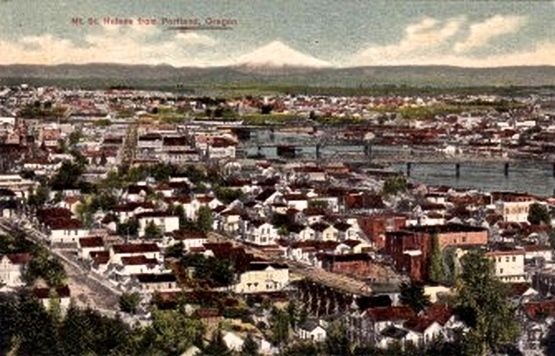
I can find no indication of how this suit was settled, but it must have been an irritant to Reed who had opened the Bachelor Saloon only the prior year. He had selected a good city for a drinking establishment. Portland was doing well early in the 1900s. It had the busiest port north of San Francisco but Seattle was growing just as fast. Figuring that they needed something to spur further growth, the city fathers decided to hold a world’s fair in Portland. Three million people came to town in 1905 for the event, entitled the Lewis & Clark Exposition. More than a few visitors decided to stay. As a result Portland, shown above, saw its population double from 90,000 in 1905 to 180,000 by 1910.

Reed was able to capitalized on this wave of humanity, many of them drinkers, by opening The Bachelor Saloon at 143 Third Street in 1908. Earlier that space had been occupied by the firm of Olds, Wortman & King, a dry goods store that had vacated to seek larger quarters. Whether Reed inherited a saloon at the location is unclear. A glass paperweight the saloonkeeper issued shows a rather narrow, long barroom with an ornate and well-stocked bar. As for the patrons posing on the weight, all seem well-dressed in suits and hats. I believe that is Reed himself standing at left behind the bar.

 While running his saloon, Reed produced glass flasks of similar design in half pint and pint sizes. The half pint, at just under seven inches, is shown here in both a photo and an illustration. These type bottles are known as “dandy flasks,” a general body shape with parallel sides, a short base pedestal that is almost as wide as the bottle and a highly compressed body from front to back that creates an flattened oval overall shape. The example shown here likely was mouth-blown in a mold with an applied lip. The embossing on the bottles read “The Bachelor…A.F. Reed” and gave the saloon’s street address. The bottles confirm that in addition to selling liquor to the boys along the bar, Reed was bottling his own whiskey to sell at retail for take home use.
 Dealing with the “alienation of affections” suit over the wayward Eva Hanlon was only one of Reed’s problems. Later a gang of burglars hit his establishment, cleaning out the cash drawer. Much more concerning to him was a November 1, 1909, police raid on The Bachelor, an event that once more put Reed in the headlines of the Daily Oregonian. On a Thursday afternoon, two detectives entered the saloon and probably acting on a tip made their way to the second floor. There they found a group of Portland locals huddled around a table, engaged in a poker game. Reed was among them. Gambling was an illegal enterprise according to city ordinance. The officers promptly arrested Alf and nine of his patrons.
According to the press account it took two trips of the paddy wagon to get all the prisoners, including the proprietor, to the police station. Reed was indignant when he reached headquarters, declaring vehemently that his customers were playing cards for fun. The detectives countered that they were caught playing for money. In short order Reed was charged with conducting a gambling game and gambling. The nine patrons were charged with gambling and visiting a gambling house. The police also seized Reed’s card tables, cards, chips and other paraphernalia. My guess is that the ten posted bond and, except for the bachelors like Reed, went home to angry wives.
Reed continued to operate the The Bachelor saloon for the next several years. Whatever the outcome of George Hanlon’s suit, Eva seems to have exited the scene. Alf, however, was about to give up his bachelor’s life. Circa 1911, he married a woman named Marie and she moved into his Larrabee Street house. Perhaps it was Marie’s influence that caused Reed in 1912, after about four years in business, to shut down The Bachelor; Marie may have objected to its checkered past and rowdy clientele.

 The former bachelor then opened Reed’s Cafe at 326 Alder Street, a few blocks away from his original location and in a “better” part of Portland. This establishment is reputed to have been a combination eatery and retail liquor store but was classified in at least one city directory as a “saloon.” This enterprise also appears to have been successful. Reed issued a bronze bar token that saved a patron two and one-half cents on a drink or meal, equivalent to about 63 cents today. But Reed’s Cafe also was fated to be a short-lived. Prohibitionary forces were growing dominant in Oregon and in 1915 a statewide ban was legislated on all alcohol sales. By 1918 Reed’s 326 Alder Street site was an optometrist’s office, to be followed in 1922 by a flower shop.
As for Reed’s personal life, outside of his scrapes with the law, not much is known. He seems always to have avoided the census takers. As a result both his early history and his life after Oregon’s prohibition are shrouded in the mists of time. For a brief six years, however, this “bad boy” Portland saloonkeeper garnered more than his share of headlines and left us with a rare bottle and a paperweight of note by which to remember his career as a saloonkeeper.
Special Note: This post marks the 400th entry since the Pre-Prohibition Whiskey Men blog began in April 2011. The distillers, whiskey wholesalers, and saloonkeepers of the period before 1920 have continued to be a rich source of historical material. The past year has seen several books published on whiskey that were gracious enough to cite this blog. The number of “followers” grew in 2015 from 55 to 81, a truly gratifying increase in people regularly checking in. The number of “hits” on the blog also has jumped and some days is close to 600. If these statistics were not enough to keep me going, exploratory research indicates that there are many good stories remaining to be told. Thus I will aim to spotlight one hundred more whiskey men (and women when possible) over the coming months. In the meantime, when new information and important images become available, I will go back to existing vignettes to correct or add to them. Thus, comments on individual posts are always welcome and will continue to draw a quick response.


