Showing posts with label Whiskey Trust. Show all posts

Monday, June 22, 2020

Whiskey Men of Science

                                              
Foreword:   Making good whiskey is both an art and a science.  Subtle changes in the chemistry of the distilling process can mean the difference between a good bourbon and rotgut.  Few of the men and women involved in making whiskey before 1920 had any scientific training but through experience and onsite experimentation often achieved good results.  A handful of whiskey men approached the process from a more scientific perspective.  Three of them are briefly profiled here, none of whom in the final analysis, succeeded.

David D. Cattanach of Pawtucket, Rhode Island, was a true “polymath,” that is, someone whose expertise spans a significant number of different fields, allowing the individual to solve problems that others can’t.  Born in Scotland in 1835, he emigrated to the United States about 1855, already having invented and sold an improved method for making gunpowder.  He first made his name on these shores as a stained glass artist and decorator of churches.  

Cattanach never stopped inventing.  Among his innovations was an improved furnace that reputedly would give the same amount of heat with one-third of the coal required by ordinary furnaces.  It also consumed its own smoke, something environmentalists today would applaud.  He also invented processes for refining and treating oils and in May, 1776, with other investors spearheaded a new company in Rhode Island called the “Chattan Oil and Paint Works” for the manufacture of paints and varnishes.

Then Cattanach turned his attention to making a whiskey that, he claimed, would be unlike other spirits that were “injurious…because of acids and alkalines.”  The U.S. Patent and Trademark Office in 1885 awarded him two patents.  One was for an “apparatus for the manufacture and distillation of alcohol, hydrocarbons, and acetic acid, and for aging and refining liquors.” The illustration he submitted with the application is shown here.  A second patent was for the process involved in employing the distilling apparatus. 
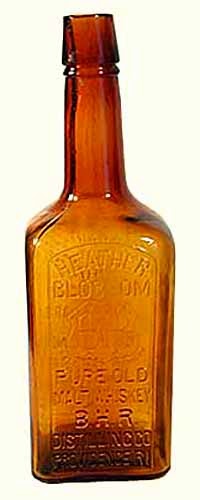
Perhaps unable to sell his system to established distillers, Cattanach determined to employ it himself.  In 1895, with other investors, he formed the Beverly Hill Road Distilling Co., capitalizing it at $100,000 and naming its principal product “Heather Blossom.”  The inventor advertised the product heavily to physicians:  One such ad read: “The B.H.R. Distilling Co. calls attention to their Heather Blossom pure malt Whiskeys, Brandies, Wines, etc., which through its new system of distillation by phyisco-chemical means, are rendered chemically pure, and are of reliable and uniform quality and adapted to the requirements of the Medical Faculty in its demand for a pure and nutritive stimulant.” 

Despite Cattanach’s efforts things did not go well for the Beverage Hill Road enterprise.  Perhaps the distilling process gave an off-taste to his whiskey.   Whatever the reason, only three years after it opened the company summarily shut down. Heather Blossom Whiskey disappeared forever. 

“The Cushing Medical Supply Company,” and its proprietor, Dr. Ira Barrows Cushing,  in their very names carry a certain expectation of authenticity and worthiness.  That is, until one discovers that the “medicine” mainly supplied by Cushing was whiskey that he mixed up in his Boston headquarters, presumably using the “Cushing Process for Purifying Alcoholic Liquors,” that he invented and patented in 1892. 

Shown here is the Rube Goldberg-like contraption that Cushing assembled for a process of and apparatus for purifying and maturing liquors or distilled spirits.”  His patent application explanation of how it worked ran to more than three highly technical and abstruse pages.  An example of his description: “My present invention consists in commingling a suitable quantity of oxygen gas with the atmospheric air employed for treating the liquor, whereby the air which is disseminated through the liquor is energized or rendered more active for the purpose of rapidly oxidizing the fusel-oils into their avoring-acids and the process of maturing the liquor thus accelerated and rendered more perfect than heretofore.   Whatever the examiner understood of “energized…atmospheric air,” “avoring acids,” and the rest, on November 1, 1892, the United States Patent Office issued Cushing Patent No. 485,984. 


A homeopathic doctor, Cushing had practiced in several Massachusetts towns before opening his “medical supply house” in Boston.  Along with other patent medicine nostrums he offered a variety of whiskey brands, many of them with “Cushing” in the title, e.g. “The Cushing Process Old Rye Whiskey.”  He continued to emphasize the importance of his “discovery” of the Cushing Process, telling a biographer: “It utilizes nature’s own means, and consists of forcing heated atmospheric air — which is first purified according to Professor Tyndall’s method of destroying germs of animalcule — through the liquors, thoroughly oxidizing the fusel oils and eliminating the poisons.”

Throughout his years selling alcoholic liquids from Boston, Cushing continued working as a homeopathic doctor.  He is recorded as being the “examining surgeon” for several Boston area charitable organizations and a member of both the Boston Medical Society and the Gynecological Society.  At the age of 61 Dr. Cushing was diagnosed with an advanced case of colon cancer.  An operation ensued but sepsis occurred and in August, 1908 he died. The Cushing Medical Supply Company appears to have survived for three more years under different management but went bankrupt and along with the doctor’s whiskeys  disappeared about 1912.  

It may seem like a stretch to call a Japanese pioneer of biotechnology, credited with the first isolation of adrenalin, a “whiskey man.”  Nonetheless, for several pivotal years in his life, Jokichi Takamine, a true scientist,  was financed for his research into a less expensive method of whiskey production by the Peoria, Illinois-based “Whiskey Trust.”
Born in Japan in 1854, Takamine came to the U.S. in 1884, married an American woman, and in rapid success had two sons.   He sought employment in America and decided to pursue his interest in distilling.  The key was adapting the methods of brewing Japanese sake (rice wine) to making whiskey.  In Peoria, Takamine sparked interest in one of the most important liquor executives in the Nation. He was Joseph Greenhut, the head of the Distilling and Cattle Feeding Company, a monopoly controlling dozens of distilleries in the Midwest and known popularly as “The Whiskey Trust.” 


After meeting Jokichi in person Greenhut was sufficiently impressed to give the Japanese scientist a contract to allow him to set up a research laboratory.  This facility, given heavy security by the Trust, was located inside the malt house of the Woolner Grove Distillery, along the river on the south side of Peoria.  Takamine called his lab “The White House.”  In 1891 word got out what Takamine was up to:  His use of rice rather than malt in the distilling  process would be simpler and faster, resulting in a lower cost for whiskey — Trust whiskey.

Hampered by arson at his original distillery, thought to have been set by malt workers, Takamine finally was able to put his distilling methods to the test.  He manufactured a lower cost whiskey which Jokichi called “Bonzai,” a greeting given to the Emperor of Japan meaning, “May you live ten thousand years!”  Under pressure from dissident distillers and experiencing financial problems, in 1894 the Whiskey Trust ousted Greenhut and broke off its relationship with Takamine.  It took Bonzai whiskey off the market and reverted entirely to creating its whiskey from malt.

Disappointed and broke, the Japanese scientist turned to the pharmaceutical business, inventing a remedy for indigestion that made him a multi-millionaire. He continued to be active as a scientist, including credited as the first person to isolate adrenalin.  He also started new biotechnical enterprises in Japan and the United States.  Takamine is remembered in the Nation’s Capitol for donating 3,020 Japanese cherry trees in 1912 to decorate the Tidal Basin.  Their blooming annually brings thousands to Washington.

Note:  More complete biographies of each of these men may be found elsewhere on this post:  David Cattanach, November 14, 2013;  Dr. Ira Barrows Cushing, October 9, 2017, and Jokichi Takamine,  August 5, 2018.


Sunday, January 31, 2016

Mort Field of Owensboro Jousted with the “Whisky Trust”


In the era when the infamous “Whiskey Trust” was pressuring Kentucky distillers to join its monopolistic efforts to corner whiskey production and thereby hike prices, J. W. Morton Field in Owensboro, Daviess County, instead took the perpetrators to court and during his lifetime won a judgment against the Trust today worth the equivalent of $1.25 million.

Field (sometimes incorrectly given as “Fields,”) was a native Kentuckian, born in 1844 in Daviess County to Thomas A. and Arabella Morton Field. His father, a farmer, died at the age of 42 when Mort was only three.   With his help and that of another son as they grew to maturity, Arabella stayed on the farm and managed its affairs skillfully and profitably.  The adult Mort moved to Owensboro, the county seat, and likely went to work for one of the many distillers who made their headquarters there, learning the trade.  

In 1867 he found a wife there, Elizabeth Angeline Hanning, known throughout her life as “Nannie,” the name that was chiseled into her gravestone shown below. She was the daughter of John F. Hanning, a distillery owner in Daviess County.   At the time of their marriage Mort was 22 and Nannie, 21.  They would have three children, Maybelle, born in 1868;  Robert William, 1870; and John Edward, 1873.
It may have been the impetus of a growing family and its needs that caused Field to strike out on his own as a distiller in 1873.  He bought the Old Reed Distillery in Reed, Kentucky, and moved it outside of Owensboro.  He chose a site on a grassy Kentucky slope overlooking a graceful bend in the Ohio River, shown above as it looks today.  At first, Field’s output was small, only about two and one-half bushels of grain mashed daily.  Over time capacity would grow to 250 bushels as the owner added to the facility.  It is shown below as it looked about 1900.

According to insurance records the property included three warehouses.  Warehouse A was frame with a metal or slate roof, located 104 feet north of the still.  Of similar construction, Warehouse B was located just north of A.  Both were bonded. A third warehouse was “free” with a frame and shingle construction located 180 feet northeast of the still.  A fourth frame and shingle warehouse ultimately was torn down.  Field’s property also housed cattle being fed from spent distillery mash.  The cows were sheltered in sheds on the west side of the still house.

As his sons, Robert William and John Edward, matured, Field took them into the business, changing the name of his firm to J.W.M. Field & Sons.  He advertised his firm as “Wholesale Dealers in Pure Kentucky Sour Mash Whiskey. ”  Field was selling his product to saloons and restaurants in a series of ceramic jugs, from quart to several gallon sizes.  Over the almost four decades the distillery was in business, a variety of designs were employed, as shown by those displayed throughout this post.  Field also provided customers with giveaway smaller containers, including mini-jugs holding just a swallow or two of whiskey and a half pint with an Celtic cross design.  Those would be gifted to saloonkeepers, bartenders and other favored patrons.

Field rapidly gained a reputation for producing good whiskey.  The Louisville Courier-Journal, a respected newspaper, hailed him as a distiller solidly in the tradition of the best Kentucky whiskey.  “J.W.M. Field is not a ‘progressive’ distiller,” the paper stated, “that is, he knows absolutely nothing of the modern processes by which the quantity of the yield is vastly multiplied…”  — at the expense of quality.  Field’s marketing reflected that old fashioned approach, advertising that he featured only one brand and that he made only “straight goods” — no mixing or blending as rectifiers did.

While Field was making whiskey in the traditional mode, however, the industry rapidly was changing around him.  Big moneyed interests from the East were taking a serious look at the distilling industry as a lucrative investment.  Among them were the Paris, Allen Co., located at 45 Broadway in New York City.  Originally importers of wines and liquors from abroad, company executives began to look to Kentucky for business opportunities.

In 1887 the New York firm bought a controlling interest in W. A. Gaines and Company, a Kentucky distillery that had originated in the 1860s and was producing well-known brands “Old Crow” and “Old Hermitage.”  While retaining some Kentucky whiskey men as directors, Allen became president and another wealthy investor, Edson Bradley, became vice president [see my post of Sept. 2011 on Bradley].  Almost immediately upon joining the distillery Bradley became the principal spokesman for the New York money men and represented their interests on Wall Street and in the halls of Congress.

Before long Eastern investors realized that because distilleries had proliferated in Kentucky and nearby states, resulting in vigorous cost competition, their ability to realize a windfall profit on whiskey was in peril.  This was still the era of monopolies and the money boys at Paris, Allen decided that the best way to increase liquor prices was significantly to control and reduce production.  Traditional distillers almost certainly were unaware of the ultimate intentions of the New Yorkers.  As a result when Paris, Allen in 1899 offered Field what turned out to be  “a devil’s bargain” he took it.

This was the deal:  The New Yorkers agreed that they would contract to buy 3,000 barrels of whiskey from J.W. M. Field & Sons over the next five years and then, under specified conditions, an additional 5,000 barrels annually over the next ten years.  In addition to this contracted production, Field could produce only 500 barrels more for his own use and sale.  If Field exceeded that amount, he would have to pay Paris, Allen a penalty of $5 per barrel.  Believing that there would be a great advantage in having a guaranteed customer for his whiskey for 15 years,  the Owensboro distiller agreed.
Field initially failed to recognize that Paris, Allen’s pact with him was part of a larger scheme to corner the Kentucky whiskey market, reduce production markedly and hoist prices.  It did not take long, however, before he realized that something was afoot.  When Field about 1901 decided to incorporate, Paris, Allen strongly objected, apparently fearing that the move would put his distillery out of their control.  By this time the Easterners had moved toward creating their “Whiskey Trust,” an organization they called the “Kentucky Distilleries & Warehouse Company.”  Despite the prior failure of a Peoria-based trust, Paris, Allen moved aggressively to rope in Kentucky distillers to their scheme, often offering them stock in exchange for shutting their plants down.  As a result, the Trust soon controlled a considerable number of distilleries and brand names.

Some Kentucky distillers began to balk at the idea of this whiskey monopoly.  Field was among them.  When Paris, Allen demanded he agree to transferring his contract to the Kentucky trust, he said an emphatic NO.  There ensued a year of correspondence that a court later characterized as showing “the Kentucky Company, taking advantage of trivial and technical mistakes”  and not dealing with the root of the contract.  In other words, the men behind the Trust were acting in bad faith and fully intending to keep Field’s whiskey out of the marketplace.  

Moreover, in retaliation for Field not signing up with the Kentucky Company, Paris, Allen refused to take any more of his production, leaving the Owensboro outfit “high and dry.”  The mastermind behind this strategy likely was George H. Allen, a man hailed by some for his “native shrewdness and energy” and excoriated by others for his ruthless business practices.  Seemingly left no other choice, Field sued in 1902. 
 

In the fight he had the wisdom to hire as his attorney, William Lindsay, a former chief justice of the Kentucky Supreme Court, shown left.  Although the suit was filed in the U.S. Circuit Court in New York, not in Kentucky, Lindsay persuaded the jury to give the distiller a judgment for damages against Paris, Allen in the amount of $50,000 (equiv. $1.25 million today).

Although J.W. M. Field & Co had won, the joy of victory was short-lived for Mort Field.  In August of 1903, he died at the age of 58.  With his widow and children grieving at his graveside he was buried in a Daviess County cemetery.  His and Nannie’s monument is shown below. Moreover,  family elation at having beaten the Whiskey Trust was short-lived when Paris, Allen appealed the decision to the U.S. Circuit Court of Appeals.  This time Lindsay was not as effective. That panel decided that the whiskey that Field could not sell and had stored in his warehouses actually was an asset, gaining value as it aged.  Thus no damage had been done to the Owensboro distiller.  The court nixed the payment and called for a new trial.  There is no evidence that it ever occurred. 


The distillery Field had founded survived his passing, managed by family members.  The officers became sons Robert W. as president and John Edwin as vice president, with other relatives in corporate roles.  By 1915, John Edwin had advanced to the presidency of the company.  He ran it until closed by National Prohibition.  Meanwhile, the Kentucky Distilleries & Warehouse Company was continuing to operate out of Louisville.  Never able to establish the desired monopoly and drive up Kentucky whiskey prices as dreamed of by Paris, Allen, the hollow shell of the Trust nonetheless survived until Prohibition.  Neither whiskey company reopened after Repeal.


Monday, July 20, 2015

“Re-Inventing” John Garnhart, Whiskey Man Inventor


 John H. Garnhart was a whiskey man and an inventor.  His most intense and enduring activity, however, may have been re-inventing himself, changing occupations and locations frequently, and known under at least three names during a foreshortened lifetime of only fifty years.

Likely as John “Garnhard,” our man was born in 1924 and raised in the part of Virginia that broke away to become West Virginia at the time of the Civil War.  As recorded in the book “Recollections of a ‘49er,” by Edward McIIheny, Garnhart was one of a company of men recruited in Jefferson County in 1849 who paid $300 for merchandise to sell to gold miners flocking to California.  Upon arrival after a difficult trek westward he was able to sell off his goods at premium prices.  His obituary suggested that Garnhart “laid the foundation for a fortune” in California.

Nearly a decade passed until gold seekers panned a creek near what is now the city of Denver.  Rich gold deposits were discovered and word quickly spread.  As with most of the gold rushes across the West, thousands of men uprooted themselves and headed to Colorado, the number estimated at around 100,000.  Garnhart (by this time it likely was the way he spelled his name) seemingly was in the vanguard.

Records shown him doing business in Denver during the mid to late 1850s.  A 1859 legal document indicated that Garnhart had been operating several enterprises in that city, including selling liquor and groceries, making vinegar, and engaging in banking and exchange activities.  By that year he had moved further east to St. Louis, Missouri, and had given over management responsibilities for his enterprises and power of attorney in Denver to a colleague.

In St. Louis Garnhart appeared to concentrate his efforts on the whiskey trade.   An 1854 city directory listed a firm called John H. Garnhard, located at 188 North Second Street.  In 1860, the listing for that address was Garnhart & Conner.  With the subsequent departure of his partner the firm became John H. Garnhart Co., but upon occasion later rendered again as “Garnhard.”   Not only was John H. selling whiskey, he was operating as a “rectifier,” blending whiskeys to achieve a particular look and taste.  Later he would be accused of adding coloring and water to raw alcohol and selling it as whiskey, but I can find no collaboration for that charge.

The year 1862 saw Garnhart’s first invention, shown above.  It was for a bottle of highly alcoholic bitters, sold as a patent medicine.  The nostrum had been invented by a New York whiskey merchant named James B. Kelly.  How Kelly found Garnhart across a wide expanse of America is not clear, but they clearly “clicked” as partners.  My surmise is that Garnhart was concocting the bitters in his rectifying operation and assisting Kelly with their sales.  The bottle with its log cabin shape was embossed with the legend “Kelly’s Old Cabin Bitters.”  Those bottles, examples shown throughout this post, have become highly desirable among collectors.

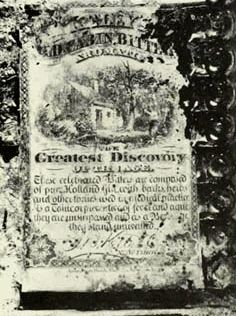
Whiskey men like Garnhart and Kelly had moved away from selling liquor to making bitters because of the high taxes levied by the Lincoln Administration against whiskey.  Bitters, when sold as medicine, were not so taxed.  Shown here, the label from a Kelly’s Log Cabin Bitters “modestly” touts it as “The Greatest Discovery of the Age” and a remedy for almost any ailment, large or small.  Advertised widely, Garnhart and Kelly’s bitters seemingly were an instant success and their bottles have been found in many locations, especially in the West.

By this time Garnhart had found a wife. She was Roberta Cecelia Noe, a woman about thirteen years younger than he and, like him, born in Virginia. The couple had seven children between1859 and 1873, one boy and six girls.  Two daughters died in infancy. In her obituary, Roberta was described thus:  “She was a lady of great amiability, full of life, cheerful in spirits, gentle in manner, sweet in disposition, the charm of social circles, faithful in all her domestic relations, a devoted and affectionate wife and mother.” 

Faced with the financial responsibilities of supporting a wife and growing family, Garnhart also found ways to benefit from the Civil War that raged over the Nation from 1861 to 1865.  No major battles were fought in or near St. Louis but the Mississippi River at his doorstep was a vital waterway during the conflict and he could supply his products via the river to other cities and towns.  Moreover, the Union soldiers who occupied and garrisoned St. Louis provided a lively market for strong drink.


 A Virginian by birth, it is not clear where Garnhart’s sentiments lay in the war.  He came under suspicion, however, as a possible Southern sympathizer in 1863.  In a letter of April that year Brigadier General Jeremiah C. Sullivan, who commanded troops garrisoning parts of Tennessee wrote a letter to the provost marshal in St. Louis about suspicious cargo off-loaded in his territory from the steamship “Belle of Memphis,” shown above. The shipment contained 80 barrels of whiskey, a box of drugs, and ten ounces of quinine — all bearing the name of Garnhart and Kelly.  Sullivan suggested the officer keep an eye on the firm.

As the war had progressed, the high taxes on liquor began to be applied to bitters.  The law was ambiguous.  Those selling bitters and other alcoholic compounds put up and sold as medicine were not required to pay the special tax.  Persons selling bitters or other alcoholic compounds “put up and stamped as rectified spirits” were taxed.  Garnhart and Kelly apparently were considered in the latter category and in 1864 began to affix their own government-approved stamp, one carrying a portrait of Kelly, shown here.   One writer has suggested that their stamps were fraudulent, but Federal records showed tax receipts of $5,800 from Garnhart & Kelly.

After the end of the Civil War Garnhart decided to “re-invent” himself once again. In 1866 he pulled up stakes in St. Louis and moved with his family to Madison, a modest-sized city and the capital of Wisconsin.  Now he became an industrialist with an invention for a new kind of grain reaper, incorporating a binder that he had been successful in patenting.  Garnhart’s original drawing is shown right. He also impressed the locals by immediately purchasing a mansion in Madison for his family, seen below in an artist’s version.

Madison was keen to rival Milwaukee as an industrial center.  In 1871 momentum for making agricultural equipment seemed to be occurring when Garnhart (now sometimes known as “Garnhardt") agreed to locate a large factory for his reaper in Madison.  A canny businessman, he had a price to ask of the locals.  At his bidding, investors donated an entire city block to him for his factory and additionally threw in $5,000 (equivalent to $200,000 today) to kick-start the company.

Garnhart made good on his promise and in 1872 began to produce his patented reaper.  He employed about fifty men most of the time and told the press he intended soon to increase the size of the works.  Then disaster.  As one writer tells it:  “…The 1873 depression swept across the country, leaving a rich harvest of new enterprises in its wake.  The once promising Garnhart Reaper Works was one such casualty.”

In the meantime, John H. still had a hand in St. Louis liquor.  As evidence of this continued interest, in 1868, more than a year after moving to Madison, he trademarked a label for a brand of whiskey bearing his name.  Shown here, the anchor design almost certainly was his handiwork.  As Garnhart had done with his Denver liquor interests, he brought in two partners to run his company and seemingly gave them full responsibility for its management and finances.  They were Robert P. Hall and Henry Ruggles.  During this period the firm featured a number of whisky brands, including "Chrystal Springs Bourbon,” "Clear Creek Bourbon” "Glendale Bourbon,” "Gold Spring Bourbon,” "I. N. Miller Bourbon,” and "Miller Rye.”   Business as usual, however, was about to end.

Beginning in 1871 the notorious “Whiskey Ring” was taking shape in St. Louis to defraud the U.S. Government.  The scam worked this way:  Crooked officials would attest that distillers and rectifiers had paid all their taxes when they actually had paid about 60% of what they owed, much of the money going as bribes.  The residual 40% owed stayed home.  The partners in J. H. Garnhart & Co. became part of the cabal.  Why?  It may have been a matter of “everybody was doing it” not only in St. Louis but also in Chicago, Milwaukee and other Midwest cities.  Non-joiners were being undersold on their whiskey and often faced financial hard times.

Activities of the Ring began to draw suspicion by 1872 as federal revenues from liquor sales in the region were observed to dwindle sharply.  When Washington asked for an investigation, it was a corrupt official named Brasher who conducted the inquiry.  His report, filed in January 1873 was drafted, a later investigation found, “such as suited the distillers and rectifiers.”  Brasher’s report purported to compare the books of the liquor firms, including Garnhart & Co., with the records of the Collector and Assessor of Internal Revenue (himself the ringleader) and not surprisingly found no discrepancies.  Brasher concluded that his investigation “has failed to disclose that condition of affairs, which was presumed to exist, from that condition of affairs made to me by persons claiming to possess most direct and positive information about the fraudulent distillation of spirits….”  The whistle-blowers, he declared, were flat wrong.

Nevertheless, rumors continued to fly, rumors that Garnhart in Madison must have been aware of.  Moreover, the collapse of his reaper factory was imminent.  Yet he apparently gave no hint of these concerns.  His obituary in the Wisconsin State Journal (giving his name as “Garnhardt”) reported that he had seemed “robust” with a strong hold on life.  His last hours, it recorded, were in the city attending to business in excellent heath and good spirits.  He spent his last evening on the porch of Madison’s Park Hotel in “animated conversation with his friends.”  The next morning, May 10, 1874, he died suddenly at the age of 50.  Cause of death was listed as “syncope,” a medical term of that day that could indicate a heart attack or stroke.

Garnhart’s death may have saved him from a prison term or at least profound embarrassment.  A month after his passing, a new Secretary of Treasury, Benjamin Bristow, took office, described as an honest man “with a passionate conviction that others in the public service should be honest, too.  He set a trap for the St. Louis racketeers and sprung it in May, 1875.  Garnhart’s company was among those where barrels of illicit whiskey and office ledgers were seized.  Criminal indictments followed for 175 people involved. Many were convicted and went to jail.

Whether Henry Ruggles was among them (Hall had died earlier) is not clear.  Even before the raid Garnhart’s company may to have gone out of business.  It was replaced by a liquor firm named Adler, Furst & Co., that advertised itself as “Successors to J. H. Garnhard & Co.”  Located at the 19-21 South Second Street, the company was listed in St. Louis business directories only for 1875.  The reason seems evident.   According to press accounts, Simon Adler and Abraham Furst were among those arrested in the Bristow raid.  Convicted, they were slapped with a large fine and a prison term of one year in the Cole County, Missouri, jail.

Meanwhile, back in Madison, Roberta Noe Garnhart was coping as well as she could, with two teenaged daughters and three younger children to bring up on her own.  Five years after John’s death, she married again, to the Chief Judge of the Wisconsin Supreme Court, Orasmus Cole.  Her obituary indicated that it had been a successful union:  “…No happier family has lived than that over which she presided with charming propriety and graceful dignity.”

John Garnhart’s body had been returned to St. Louis in 1874 where he was interred in Bellefontaine Cemetery in what has been described as a “family tomb.”   Roberta joined him there following her death in 1884 after a long illness.  Shown below, the mausoleum-like structure later had to be dismantled because of water damage and the bodies removed.  As a result the Garnharts currently lie in unmarked graves at the cemetery.


Over his foreshortened lifetime, John Garnhart packed enough entrepreneurial activity for five men, prospering in California; owning companies in Denver, St. Louis and Madison; designing bottles that today can fetch as much as $75,000; merchandising a patent medicine that swept the country; inventing and producing an improved grain harvester; and engaging in real estate and banking activities along the way.  While his early death may have spared him being caught in the web of the Whiskey Ring, by virtue of his continual reinvention he made his mark among the whiskey men of America.

Note:  For a number of years I had wanted to do a vignette on John Garnhart but lacked sufficient information.  To my rescue came Jean E. DeLauche, an indefatigable researcher and genealogist who is a distant relative of Roberta Noe Garnhart.  She was able to supply me with an immense amount of useful information on Garnhart, from his youthful trek to California to his current place of interment. She also was the source of two illustrations. I am deeply indebted to Ms. DeLauche for being able to tell this story. 


Monday, June 4, 2012

Thomas Lynch and a Big Bang in Chicago

On December 11,1888, at 6:15 a.m., according to press accounts, a tremendous explosion rocked Chicago’s Shufeldt distillery, smashing windows for blocks around and creating panic in the neighborhood.  Someone had thrown two packages of dynamite, each containing seven sticks seven inches long, onto the roof of the distillery storeroom.  There were no other clues.  But Thomas Lynch knew the culprits all too well.

Lynch had been born in Ireland in 1826, leaving during a period of unrest when explosions aimed at the British occupiers were common.  He arrived in Chicago at the age of 19 and appears to have entered the whiskey trade early in his career.   According to a Chicago business history, he worked for George L. Crosby who was listed in city directories as a “rectifer,”  that is an outfit that bought whiskey, refined and blended it, and sold it in bulk to saloons and in jugs and bottles to the public. 


In time Lynch came to own the Crosby firm, changing its name to Thomas Lynch & Co, with offices at 128 LaSalle.  He later moved to a facility at Larabee Street at the corner of Hawthorn Avenue, probably for rectifying and bottling liquor.  Not far away was H.H. Shufeldt & Co. at 54 South Water Street.  That firm ran one of Chicago’s oldest distilleries on South Water Street, established in 1857.  It also advertised alcohol for lamps, kerosene and coal.  An envelope ad from the 1860s pictures the small distillery.   According to the Chicago Tribune, both Lynch and Shufeldt fell victim to the Great Chicago Fire of October 1871.  It destroyed both of their establishments.  Packed with flammable substances, those liquor houses must have added substantially to the conflagration.

My surmise is that in the wake of the the fire, Lynch and Shufeldt joined forces in a distilling operation.   The company kept the name Henry H. Shufeldt & Company, as shown on a letterhead, but Thomas Lynch was running the operation.  The company built a new facility near the Chicago Av. bridge, not far from the original Lynch operation and established an office and recitifying house at the corner of Kinzie and Cass Street.  An illustration of the distillery claimed a capacity of 800,000 gallons.  Promotional materials also indicate the firm had offices in Philadelphia and St. Louis.

The company used the liquor brand names "Double Stamp", "Hamilton", "Royal Arms" "Imperial Gin", ,  and "Oconomowoc.”  The last name apparently reflected Oconomowoc, Wisconsin, famous for its summer homes for the rich, among them the Shufeldt family.  The distillery bottled  whiskey in a variety of containers, including square amber quarts with Shufeldt’s name embossed.  At the Paris Exhibition of 1878 the distillery was awarded a gold medal for its whiskey.

Meanwhile, Thomas Lynch had a personal life.  Early in the 1850s he married a woman of  similar Irish heritage,  Ann Flanagan.  They had four children, one daughter and three sons.  Two of the sons,  John A. and James D. would join their father in the distillery operation as they grew to maturity.  In addition Lynch was prominent in the affairs of the Democratic Party in Chicago and in 1881 was a candidate (unsuccessful) for Cook County Treasurer.  He also was a prominent Catholic and known for his generosity to church causes.

The 1880s were about to be a testing ground for Lynch.  During that decade, taking a lead from industries such as oil and sugar,  a number of Midwest whiskey men determined to establish a Whiskey Trust in attempt to control liquor prices.   Lynch adamantly refused to join the Trust and became one of its most vociferous opponents, even in the face of knowledge that the organization routinely used violence and sabotage to get their way.

Lynch was outspoken:  “How such an organization as the ‘Trust’ is allowed to exist, I cannot understand.  It has issued $35,000,000 of certificates and I can prove that it is not in possession of more than $4,000.000 worth of property,” he said.  In a letter a lawyer for the Trust complained that Lynch’s company was making money while the Trust was losing it by paying big salaries to former owners, carrying closed down plants in its capital accounts and shouldering other expenses.   He suggested:  “The Trust might easily put up the price of spirits but it cannot do so as long as Shufeldt holds out and it would be a mighty good thing for the Trust if Shufeldt is out of the way.”

Accordingly, in 1888 the Trust decided on concerted action against Lynch and Shufeldt & Co.  In April of that year the company discovered that one of its employees was a spy for the monopoly.  He confessed and pointed his finger at Trust officials.  In September a valve on a vat was found to have been tampered with to an extent that it could have caused an explosion.  Only by luck was an worker able to spot the sabotage. The real explosion occurred, as noted earlier, three months later.  Only one package of dynamite actually detonated, blowing a hole in the roof.  The other failed to explode and was recovered inside the vat room by Chicago police.

The Trust denied all knowledge of the incident.  Fourteen months later, however, its secretary, a man named Gibson, was arrested and indicted by Federal authorities for attempting to sabotage the Shufeldt plant.  A Chicago judge curiously quashed all charges, stating that bribing a U.S. official to undertake sabotage was not a crime covered under federal law.  Gibson resigned from the Trust and with a $290,000  “gift” from the cabal fled to Cuba and later died there.

The “big bang” worked a change of attitude on Lynch.  By this time his sons were both involved in the firm and owned shares. Perhaps for his safety and their own they prevailed on him to sell out to the Trust. The sale is reported to have brought the Lynches $1.75 million.   Thomas Lynch, however, could not admit that he was capitulating.  According to his write-up in Chicago and Cook County Biographies: “Mr. Lynch insisted to the last that he was not aware he was selling out to the Trust and that the ostensible purchaser was Lyman J. Gage of the First National Bank of Chicago.”  Gage was a respected Chicago banker and later Secretary of the Treasury under Presidents McKinley and Roosevelt.
 
Nevertheless, it was the Trust that ran H.H. Shufeldt Co. from 1891 on. They closed down the Chicago distilling and rectifying operation and moved equipment to Pekin, Illinois.  When the Trust got into deep financial trouble in 1895,  a new combine known as the American Spirits Distilling Company bought Shufeldt and 10 other Midwest distilleries.  An office for the firm continued to be listed in Chicago business directories until 1917.

Thomas Lynch died in September 1893 at the age of 67, leaving an estate of more than $1 million.  His sons became prominent Chicago businessmen, John as president of Chicago’s National Bank of the Republic and James as an investor and officer in the Globe Automatic Telephone Co. and the Buena Vista Plantation Co.  In their father’s obituary the Chicago Tribune commented:  “Until time laid its restraining finger on him, Thomas Lynch was one of the most prominent Irish-American citizens and businessmen in Chicago.