Monday, January 23, 2012

Herman’s Whiskey Started the Hulman Engines


Each year when the Indianapolis 500 about to begin, a voice calls out “Gentlemen, start your engines!” That voice, male or female, belongs to a member of the wealthy Hulman-George clan who own the Indianapolis Raceway. They owe much of their success to their ancestor, shown here, whose name was Herman Hulman.  Hulman’s life has been recounted in a number of publications as an entrepreneur of far-flung interests, a philanthropist, a loving husband, a doting father and grandfather, and a major force in the development of Terre Haute, Indiana.  This post, however, concentrates on the man whose whiskey trade in important ways made possible the Hulman dynasty. 

Shown here, Herman was born in 1831 in Lingen, Lower Saxony, a city of about 50,000 in Germany. Given the subsequent movement of Hulman children into the grocery business, his father almost assuredly was a storekeeper.  He was preceded as an immigrant into the U.S. by his brother, Francis, who set up a grocery in Terre Haute in 1851. Francis’ ad in a local newspaper that year featured his spiritous beverages. It bragged of the store’s assortment of domestic and foreign wines and liquors, including French brandies, Holland gin and port, Madeira and sweet Malaga wines. The ad also touted ”smooth as a sip” a Cincinnati-style blended whiskey. In 1854, Herman was importuned by his brother to leave Germany and his sweetheart, Antonia Riefenstal, to come to America and help in the grocery store. He arrived at age 23 and for three years served as a clerk for his brother. Four years later Francis, his wife and daughter were killed in a fire at sea in a ship returning from a trip to Germany. 

At age 28 Herman was left in charge of the grocery. Liquor was a major commodity. As the Civil War loomed, Herman faced personal and business problems. Personally he feared that Antonia could not make the voyage to the U.S. He also worried about obtaining sufficient goods for his grocery business, including receiving an adequate supply of whiskey from secessionist Kentucky. In 1862 Antonia finally arrived at the age of 29. He met her in New York and they were immediately married. It is said they enjoyed the sights of Manhattan from a borrowed buggy. They would have three children, a girl who died in infancy and two sons, Anton, born 1865, and Herman, born 1867. Not long after Herman Junior’s birth, the family moved to 657 Ohio Street on Terra Haute’s “Mansion Row.” The Hulman home had 16 rooms, including four bathrooms, and boasted multiple fireplaces with marble mantles. 

As the boys grew, Anton, with straight, pale brown hair, was depicted as studious and reserved, happy to putter for hours building a playhouse or a boat. Herman Junior, with wavy dark hair and a ready grin, was gregarious and very handsome. The postwar period continued to be highly favorable to Herman’s business interests. About 1869 he purchased the Alexander McGregor Distillery, the largest whiskey-making operation in Terre Haute and probably in Indiana. He hired a professional manager and with his help significantly enlarged its production capacity. Although Hulman briefly sold the distillery, in 1876 very soon he bought back a half-interest. 


In 1880 Terre Haute, by virtue of the distillery, was counted as the Nation’s fifth largest producer of distilled spirits. Over the years Hulman would be involved in five different enterprises involving the production and merchandising of alcohol. A principal enterprise was called Hulman and Beggs. With a partner, John Beggs, Herman launched a liquor wholesale house, erecting a building at Ninth and Cherry Streets in 1884. The structure also was illustrated on a etched shot glass issued for the company. Hulman and Beggs featured at least four brands, “Axtell,” “Low Land Spring,” “Traveler’s Joy,” and its flagship, “White Seal.” The only label Hulman registered with the government for a trademark was White Seal, in 1906.


He also commissioned artist Herm Michalairski to provide an attractive and somewhat erotic sign for saloons advertising White Seal Rye. The image was replicated on trade cards. A metal token also advertised the whiskey. Herman was ever the entrepreneur. He bought train car loads of cigars, thousands of barrels of coal oil, installed telephones connecting the distillery and the wholesale business, was an original stockholder in the Terre Haute Telephone Exchange and invested in railroads, the telegraph, water and sewage systems and gas and electric companies. In 1886 he joined his son Anton and another local as the managing partner of a large mercantile establishment known as Hulman and Company. He almost immediately determined to build a new building for it. 

A local historian says: ”Herman began looking for a site in 1888, and he found it at 9th and Wabash in 1892. `It was easy enough to plan the exterior, but to plan the interior and arrange the machinery and different departments from cellar to dome was a mental tax with which I never again want to be burdened,' Herman recalled. Finally after settling on plans, the building was opened in 1893. More than 5,000 people came out to see the Romanesque Revival-style building shown above.
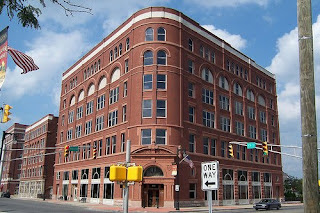


 In addition to selling “White Seal Rye,” this firm also featured “Richelieu Club Whiskey.” Hulman employed more than 150 people in Terra Haute, including a large cohort of traveling salesmen. By this time Herman was a widower. His beloved Antonia had died in 1882 at the age of 49. A devout Catholic, in her memory he bought a building in Terre Haute and turned it into a hospital run by nuns. It was named “St. Anthony’s” in her honor. 

As Herman aged, he occasionally took brief timeouts from business to hunt and fish, along with riding his horses and playing with his granddaughter.   His sons were also on his mind. Herman Junior became a well known sportsman and a race driver. He once made a record-breaking run from Chicago to Terre Haute in 14 hours, driving a four cylinder Peerless automobile. Anton worked with his father and produced a son, Anton Jr., shown here with Grandfather Herman. The grandson, known as Tony, not only would further the business interests of the Hulman family, but in 1945 purchased the Indianapolis Motor Speedway from Eddie Rickenbacker for $750,000. The Hulman name would be forever linked with racing and today the track is still a family property. 

The man who started it all, Herman Hulman, died in 1912 and is buried next to Antonia and other family members in Woodlawn Cemetery. When he died, as one observer put it, he represented “wealth, incredible wealth.” Although his business empire was a large and diverse one, in many important and seminal ways it had been fueled by whiskey.


Thursday, January 19, 2012

Emanuel of Manhattan: Eising on the Cake

In dealing with the story of Emanuel Eising, prominent New York whiskey man, I must be forgiven the awful pun on his name.  His record remains, however, that of a merchant who provided customers with a range of attractive artifacts to sell his already popular brands of liquor and so, in effect, put “icing on the cake.” 

Eising was born in Wallerstein, Bavaria, Germany in 1836 to parents of Jewish heritage. His Mother, Babette Wertheimer, had been born in Manhattan but following her marriage to Henlein Eising, a German 18 years her elder, she moved back with her husband to Bavaria. The entire family likely re-entered the United States sometime in the 1840’s-1850’s and settled in New York City. Henlein died in Manhattan in 1862. 

In 1864 the young Emanuel married Augusta Carolina Blun, a New York resident. She was an immigrant from Prussia, born in Worms, Hesse, in 1845. Nine years younger than her husband, she would bear him seven children, four boys and three girls. 


By the 1870s, Emanuel was fully into the whiskey trade. In 1874 he ran afoul of the Internal Revenue service for nonpayment of liquor taxes. Despite this setback, he clearly was prospering. The 1880 census found him living in a large house in Manhattan with Augusta, their children, and three servants, including a German nurse, an Austrian cook, and an Irish maid. Emanuel Eising & Co. first shows up in New York business directories in 1880 with a location at 47049 Front Street. 

As a blender of whiskey, Eising needed a steady supply of distilled product which apparently proved difficult from time to time. Over the years, the firm would claim control of or interest in at least three distilleries. Among them were the Baltimore Distilling Co. of Baltimore, Maryland. Early letterheads state Eising was the sole proprietor; later he claimed only to be a stockholder. A trade card shown here also lists E. Eising as the sole agent of the Orient Distillery of Baltimore. Founded by a leading Maryland businessman, Edwin Walters, that distillery was an enormous facility. The back side of the card advertises Eising as a distiller and dealer of bourbon and rye whiskies. 


Eising may have led a consortia of wholesale whiskey dealers who purchased the Orient Distillery from Walters. Later, in 1913, Eising claimed a stake in the Commercial Distilling Co. of Terre Haute, Indiana. Whatever his source of supply, Eising used a series of brand names, including “Stag,” “Heart of Maryland,” “Marshall,” “Old Dominion,” and “Old Manor.” He also advertised as the source of “Caracas Bitters.” Although he registered Old Dominion with the government in 1893 and again in 1906, his flagship brands appear to have been Stag and Heart of Maryland. He trademarked Heart of Maryland in 1905 and Stag in 1907, the latter with the slogan: “Try a Horn.” 


For each brand he issued giveaways for favored saloon customers, including expensive reverse painted mirrors. The Stag mirror appears intended for installation on a barroom door. Eising also gave away back of the bar bottles and shot glasses for the two brands, as well as a bar top dice game in a paperweight that advertised Stag Whiskey. The reach of Eising’s liquor brands was reflected in a 1908 novel in which the narrator says of an Irish drover: “By the cock of his hat and the leer of his eye I could see he had imbibed some more Old Dominion Rye on the road and was on the warpath.” 


Eising’s son Harry upon reaching maturity was brought into the firm and assumed more and more of the management as his father aged. Records indicate that Harry was sent periodically to Baltimore to look after his father’s important distilling interests. In 1910 while living in New York City, Harry was named a director of the Merchants Fire Company of Baltimore, a business primarily devoted to providing fire insurance to distillers. Prior years had seen a number of Baltimore whiskey operations go up in smoke. 

In time Emanuel Eising was recognized as a pioneering businessman in New York City. This was epitomized in 1913 when he was among the honored guests for a memorial service for Isador and Ida Straus, co-owners of Macy’s Department Store, who had lost their lives during the sinking of the Titanic. Harry Eising and his wife also were among the guests. 

With the advent of Prohibition, Eising and his son -- despite all their hard work -- were forced to shut down their liquor business. Emanuel never saw the law repealed. In 1924 he died at the advanced age of 88. He is buried with his wife and other family members behind a large family monument with individual headstones in Salem Fields Cemetery, Brooklyn.


Monday, January 16, 2012

The Doughertys of Philly Were Distilling Sons of St. Patrick

When a poor Irish boy left his home in Innishowen, County Derry, Ireland, for America he can scarcely have imagined the major distillery that he would establish and operate with two sons -- an organization that would endure and prosper for 70 years. That boy was John A. Dougherty, born in 1788 who arrived in Philadelphia in 1814 at the age of 26.

Beginning his career in America as a baker, John soon became involved in the whiskey business, learning the trade while working for local distillers on Philadelphia’s Spruce and Shippen Streets, shown here. During this period he married Eliza Sherbourne, herself an immigrant from Bristol, England. They had two sons, William P., born in 1825 and Charles A., born in 1827.

When William came of age, he worked with his father in the liquor trade for a time but became entranced with telegraphy, a new technology that was just coming into vogue. In 1847 he became an operator and later Assistant Superintendent of the Bain Chemical Telegraph, extending from Baltimore to Washington. Undetered by William’s defection, John Dougherty brought son Charles into his whiskey activities and in 1849 founded a business he called John A. Dougherty & Son.


Within a year the company’s distillery, above, was erected -- Distillery No. 2 of the 1st District of Pennsylvania. The still and warehouses were located in the 1000 block of Front Street. Shown here, Front Street runs north-south parallel to and near the Delaware River. One of the oldest streets in Philadephia it was constructed when the city was laid out by William Penn in 1682.

In 1851 William abandoned telegraphy to work with his father and brother Charles. They promptly changed the company name to John A. Dougherty & Sons. All three men were active in promoting Irish culture and assisting Irish immigrants to Philadephia. They were recorded as active members of The Friendly Sons of St. Patrick and of the Hiberian Society for the Relief of Emigrants from Ireland.


Dougherty’s “Pure Rye Whiskey” met with almost immediate success, capturing a market in the Philadelphia area and beyond. The company’s first still was a wooden one of 750 gallons. It soon was joined by a second copper still with a 1,200 gallon capacity. Both were fueled by steam. A new larger warehouse was built in 1864, with a capacity of 3,000 barrels.

In 1866 John Dougherty died at the age of 78 and was buried at the Cathedral Cemetery. Son William took over as senior manager and the company name was changed once again to J.A. Dougherty’s Sons. The business continued to grow. Three new warehouses were built over the next several years adding 12,900 gallons of storage capacity. The complex, shown here, employed some 30 workers. In 1879 the first warehouse was enlarged to hold 4,000 barrels.

Meanwhile William Dougherty was gaining prestige as a businessman and as a patron of the arts. He was a charter member of the Art Club and a prominent member of the Academy of Fine Arts and the Academy of Natural Sciences. His collection of mezzotints, etchings and engravings was said to be the finest in Philadelphia. William was also accounted accomplished in botany, gardening, metallurgy and chemistry, as well as conversant with Latin, Greek, French and Spanish.


With Willam’s artistic sense it is a reasonable assumption that he was responsible for the tasteful label design for Dougherty whiskey, as well as the saloon signs,  paperweights and other giveaway items the company featured, several of them shown here. At the age of 67 William died in 1892 at his residence at 1435 Girard Avenue in Philadelphia, leaving Charles as the manager of the firm.

The youngest Dougherty continued the successes forged by his father and brother. He discarded the wooden still in favor of a second copper pot and in 1893 rebuilt one warehouse to hold 3,800 barrels and added new floors to another to increase capacity to 25,000 barrels. The continued expansion was indicative of growing national market for Dougherty Pure Rye. Not as active in Philadelphia society as William, Charles was a member of the Board of Trade.

Important changes occurred in 1898. The mother, Eliza Dougherty, died and was buried next to her husband. That same year Charles, age 71 also died.  Family members who inherited the business continued its operation but sold after the imposition of National Prohibition in 1921. See the material supplied by Ann Richard below. The new owners, recognizing the potency of the name and tradition, continued operations under the Dougherty name but was supplied with whiskey from other sources, including Old Overholt Distillery.


Early in the 1920s during Prohibition a company, under non-family management, called Dougherty Distillery Warehouse Co., was formed and licensed as a concentration warehouse and bottler of medicinal whiskey, available only by prescription. A whiskey bottle from that period is shown here, along with a highly embossed flask. After Repeal, the Dougherty label on whiskey was resurrected by a series of owners and still is being merchandised today. Thus the tradition is perpetuated that was begun by an Irish immigrant and his sons who together created Philadelphia’s most famous whiskey name.


Tuesday, January 10, 2012

Crigler & Crigler: A Family Affair

No better example of close familial relationships in the whiskey trade exists than the story of Crigler & Crigler -- Robert and Llewellyn -- uncle and nephew. Together they created one of Kentucky’s leading distilling dynasties, one with a nationwide reach. The Crigler family were early immigrants from Germany to Madison County, Virginia. Jacob Crigler, the founder of the family, is recorded arriving in 1717. His descendent, Nicholas, an American soldier in the War of 1812, emigrated about 1828 from Virginia to Boone County, Kentucky, with his family. With him was an older son, Ephraim; another son, Robert, would be born in Boone County in 1834. 

 According to a Kentucky history published in 1887, Robert, sometimes known as “R.L.” left Kentucky at age 16 to seek his fortune in Cincinnati where he clerked in a dry goods store. By age 21 he had struck out on his own, successively running dry goods establishments in Cincinnati, and Paris and Lexington, Ky. In the latter location he began to invest in land. About 1874 he moved back to the Ohio city in the mercantile trade. In 1880 he married Jessie F. Talbert, a Cincinnati girl from a prominent family. 

Enter Llewellyn Crigler, shown above.  He was Ephriam’s son, born in 1841, and reared on the family’s Boone County farm. He was educated at the White Haven Seminary near Union, Ky., and at the age of 22 embarked on a business career as a storekeeper in Lawrenceburg and Lexington, Ky. Clearly a strong entrepreneurial spirit existed in the Crigler family and by the early 1870s -- probably 1874 -- Llewellyn was in Covington running a wholesale liquor business in partnership with A.R. Mullins of that city. By 1880, Mullins was out of the picture and Llewellyn had formed a new partnership with his Uncle Robert. 

Thus the firm of Crigler & Crigler was born, destined to be one of the Nation’s leading distillers. Robert was president, Llewellyn the vice president. The company was well located. Kentucky was the premier whiskey-making state. Cincinnati, across the Ohio river, was a commercial center for the entire Midwest with good access to Eastern markets. The pair lost no time in building their whiskey empire. The record suggests that by the time of the partnership, Llewellyn Crigler already was at least a partial owner of the Buffalo Springs Distillery, located in the colorfully named Stamping Grounds, a town in Scott County, Ky. This community was sited where huge buffalo herds once had congregated, probably to drink from a large natural spring, and had trampled down the surrounding vegetation.


According to Kentucky histories, the Stamping Grounds distillery first had been erected as a woolen mill in 1864. It had been turned to whiskey-making several years later by a man named Robert Samuels who was not a fulltime distiller and produced only 15 barrels a day. He sold out to a group of investors, among them Llewellyn Crigler. They expanded the facilities and increased production. Eventually the Criglers bought full ownership and began to advertise Buffalo Springs Whiskey prominently. Shown here a pre-Prohibition bottle, shot glass, and metal paperweight the partners issued with the Buffalo Springs logo. In 1898, Crigler & Crigler also acquired the Woodland Whiskey brand name and distillery operation. That Lexington area distillery was located on land leased from Robert Crigler. 


In 1872 Headley & Peck Co. had built a distillery, a brick warehouse, and three metal-clad warehouses with a total value of $30,000. It could produce up to 4,000 barrels of whiskey annually. In 1894, however, a scandal involving fraudulent warehouse receipts tainted the Headley & Peck operation and helped to throw it into bankruptcy. The Criglers were there to pick up the pieces and almost immediately established Woodland Straight Kentucky Whiskey as their flagship brand. The firm engaged upon a national advertising campaign that capitalized on the fact that Woodland Whiskey in 1899 had been selected by the U.S. Government for use at the National Hospital for the Insane (now St. Elizabeth’s) in Washington D.C. 


The Criglers also offered attractive giveaway items to favored customers, including match cases and tip trays. The whiskey business brought the Criglers great success. They fully exploited the mail order trade. For $4.75, the firm would send a customer two gallons of its whiskey -- express prepaid. The offer was backed by a money back guarantee. If you bought twenty Woodland quarts for $13 by mail and paid cash up front, Crigler would throw in four quarts of Old Special Stock Whiskey (guaranteed to be more than 12 years old) for free. The firm eventually (1908) occupied a six-story office building in Covington, Ky., shown here, and had dozens of employees. In 1909 the firm incorporated By 1914 the Criglers had opened offices in Kansas City, Missouri, to handle their Western trade and in Jacksonville, Florida, for Southland business. 


They invested in real estate in Ohio and Kentucky. Llewellyn became a director of the Dayton Syrup Refining Company of Dayton, Ohio. Both men had families and lived in spacious homes in Cincinnati. Over the lifetime of their distilling company Crigler & Crigler also offered other whiskey brands. Among them were “Brier Rabbit,” “Forsythe,” “ John Barley Corn,” “Crigler’s Favorite,” “Col. Bob Corn,” “Kentucky Senator” and “Sweet Sixteen.” However, they registered only Woodland (1906) for U.S. government trademark protection -- indicating its particular market importance. 

During the 1890s, the Criglers sold their Buffalo Spring distillery to the Morrin-Powers Company of Kansas City, who changed the name to the Buffalo Springs Distilling Co. That firm continued producing Buffalo Springs brand whiskey using the Criglers’ original recipe until Prohibition. After Repeal, subsequent owners continued to make and sell Buffalo Springs Whiskey. The distillery closed for good in 1968, after a 104 year history. Crigler & Crigler disappeared from Covington business directories in 1917. The Woodland brand name joined thousands of others that died with Prohibition. Moreover, research into the Crigler family has failed to disclose the fates of Robert and Llewellyn, or even the dates of their deaths.


Saturday, January 7, 2012

Harry Bayer Climbed Ohio's "Golden Hill"

More than a half century before Starbucks was conceived, an enterprising Columbus, Ohio, whiskey merchant devised a franchise scheme to market his products throughout the Buckeye State by establishing retail outlets in multiple cities. The merchant was Harry Bayer. The network he created was linked by a single name -- “The Golden Hill.” Bayer began as a partner in Bayer, Schwartz & Co., a whiskey distributor first listed in Columbus business directories in 1903, located at the northwest corner of Town and Fourth Streets. The firm, probably whiskey rectifiers, advertised several brands, including “Genesta,” “Grover Rye,” and “Red Lion.” Its flagship was “The Golden Hill Rye.” Shown here is a highly decorated etched shot glass from those early days, advertising the brand by showing a radiant sun rising over five hills. Bayer was eager to expand his market, both in Columbus and throughout Ohio.


At the time many breweries were buying up saloons or securing exclusive rights to provide beer to selected drinking establishments. Bayer saw an opportunity to do something similar for his whiskey trade. In 1905 he applied to the Federal Government to register “The Golden Hill” as a whiskey brand. This move was an attempt to discourage anyone else from appropriating the name. 


The same year Bayer opened two more liquor outlets named “The Golden Hill,” in Columbus, one at 76 W. Broad Street and a second at 1020 Mt. Vernon Avenue. Then Bayer went statewide. He soon made arrangements with saloon owners in Cleveland, Toledo, Akron and Youngstown to change the name of their establishments to the Golden Hill and to provide his whiskey on an exclusive basis. A corkscrew advertising the brand issued during this period stated: “For sale wherever good whiskey is sold.” 

How Bayer operated was suggested in evidence from an early 1900s lawsuit. An Ohio court decision described how the Columbus entrepreneur had loaned a Cleveland saloonkeeper named Hornstein a sum of money. In return Bayer controlled a chattel mortgage that covered all of Hornstein tangible assets and held an unsecured note for an additional $1,200. When Hornstein went bankrupt Bayer seized the property and caused the sheriff to sell the saloonkeeper’s liquor license. From the proceeds Bayer collected the amount of the note. Although the settlement was challenged in court by Hornstein’s wife, Bayer’s actions were upheld. A Golden Hill Liquor Co. outlet subsequently opened in Cleveland. 

Most of Harry Bayer’s business moves, however, do not appear to have been adversarial. In Toledo Harry H. Klein operated a saloon and liquor store, doing business as Klein Bros. Company. About 1905 he joined up with Bayer and changed the name of his establishment to The Golden Hill Liquor. Described in business directories as a distributor of “wines & brandies & fine whiskies,” the company initially occupied a building in downtown Toledo at the corner of Monroe and Adams Streets, then moved next door to 519-520 Adams Street. 

 Klein also opened an outlet at 520 Monroe St. Klein gave away Golden Hill mini-jugs and a wooden tip tray, shown here.  Two other Golden Hill franchises opened in 1905, one in Akron at 13 Market Street and the other in Youngstown. Business directories provide information about the Youngstown outlet. Under the name Golden Hill Liquor Company, saloons (or stores) were located at 308 W. Federal St. and 277 E. Federal St. In 1908, the latter outlet moved to 282 W. Federal. 


In 1907 Bayer incorporated his firm under a new name, now calling it The Golden Hill Distilling Company, as shown on a shot glass. It was common for such firms to claim to be distillers when, in fact, they bought their stock by the barrel from Kentucky distilleries, mixed it in the back room, filled bottles, and slapped their label on it. Court documents indicate that at Golden Hill Distilling the hard-charging Bayer held the positions of president, treasurer, chairman of the board and manager. The newly-christened firm also added two new whiskey brands, “American Beauty” and “Rob’s Rye.” Bayer registered both with the government in 1907. 


About the same time N. Trotstein opened a Golden Hill outlet in Lima, Ohio, likely as an adjunct to his saloon. It was located at 34 Public Square, a prime location in downtown Lima, shown above in a period postcard. Trotstein advertised widely in local media. His shotglass advertising Golden Hill Rye is virtually identical to the Columbus-issued versions. The similarity solidifies the notion that the two organizations were closely linked. Also shown here is a Golden Hill flask from Lima.  No artifacts have surfaced from the Golden Hill location in Fostoria, Ohio. It was housed in the downtown Foster Block building, identified as both a saloon and a liquor store. City records show that the owner/operator was L. J. Schild. 


Whatever dynamic was catapulting Harry Bayer and The Golden Hill into prominence in the whiskey trade was short-lived and appears to have waned by 1908. That year the Akron Golden Hill disappeared from directories. By 1910 the franchise was in a severe decline. A Golden Hill outlet opened that year in Cincinnati and closed within months. The Toledo Golden Hill disappeared from directories as did one of the two locations in Youngstown. At the parent organization in Columbus, the Broad St. and Mt. Vernon Av. units closed and the company moved to two High St. addresses. Bayer hired a new manager for his Columbus operations named Samuel Weinfeld. Weinfeld stayed two years, then left to found his own wholesale and retail liquor business. The Cleveland Golden Hill apparently closed in 1913 and the remaining Youngstown outlet in 1914 -- both gone from local business directories. 

Court records from 1914 may provide the best clue to Bayer’s decline. That year he was hailed into court by a man named Bump for sending whiskey by express mail to Mayville, Ohio, a completely “dry” town. Bump was a undercover agent for Prohibition forces and had conducted a sting on Bayer. After a trial in Mayville, the whiskey dealer was found guilty and fined. Bayer appealed on the grounds that he should have been tried in Columbus where the shipment originated. The Ohio Supreme Court agreed and threw out the earlier conviction. 

Bayer’s victory proved to be hollow as town after town under local option in Ohio voted to ban alcohol. The Columbus Golden Hill Distilling Co. -- the linchpin of Bayer’s empire -- disappeared from business directories in 1915, although it continued to be listed in a national directory of shippers as late as 1916. Like all his Ohio outlets, Bayer personally disappeared from public record by 1917, as Ohio voted to go completely dry. 

The Golden Hill proved to be a early experiment in franchising that fell far short of Starbucks. Today its legacy is represented by a few bottles, jugs, shot glasses, cork screws and a wooden tray -- not much to document Harry Bayer’s grand vision. He rapidly climbed The Golden Hill and then even more rapidly descended.


Thursday, January 5, 2012

The Success and Sorrows of John P. Gagen


When John Phillip Gagen died, his obituary in his Lafayette, Indiana, adopted hometown newspaper was headlined: “Rising from poor boy to command of thousands; He shows what can be accomplished by hard work.” The obituary went on to recount his triumphs in the liquor trade and other endeavors, but recorded as well the heartbreaking events that plagued his all-too-short life.

Gagen was born in Sandusky, Ohio, in 1848. His father, Patrick, had emigrated from Ireland and fathered eighteen or nineteen children from two wives. For 50 years he ran a grocery store in Sandusky. John’s mother, Mary Moore, Patrick’s first wife, died when John was but seven years old. A contemporary account of young John states: “At an early age, he displayed great business ability and for a time he sold groceries from a wagon direct to consumers through the country in vicinity of Sandusky, Ohio.” He also is said to have saved his money.

When he was in his early 20s, together with his brother Thomas, Gagen moved west from Ohio to settle in Lafayette, Tippecanoe County, Indiana. It is suggested that the brothers worked in the liquor trade in their adopted home town. In 1869, indicative of his increasing business stature, Gagen married Adaline (“Addie”) Green, a native of Lafayette said to be part of an old and well-established family. John was 21 and Addie 23. They would go on to have eight children, one of whom died at birth.


In 1874 Gagen and brother Thomas bought a wholesale liquor house located in the Purdue Block in downtown Lafayette. It is shown in the upper right of the map shown here, across from the Townsend Elevator. Three years later Thomas , still a young man, died and left John as the sole owner. Under his management the business grew steadily until Gagen Wholesale House became one of the largest in Indiana. During the 1880s, the firm was incorporated and Gagen was elected President.

Gagen was a blender of whiskey not a distiller. His flagship brand was “Cedar Grove.” He clearly had a good eye for attractive packaging and frequently went far afield to buy fancy ceramic containers for his whiskey. The gold trimmed one shown here was the product of the Fulper Pottery in Flemington, New Jersey, and the tall jug was produced by Sherwood Bros. of New Brighton, Pennsylvania. He also issued a shot glass advertising Cedar Grove Whisky (which he spelled without the “e”). Other Gagen brands were “Happy Valley" and "Mound Farm."


Gagen’s obituary in the local paper stated: “He had faith in the future of Lafayette and was at all times willing to contribute his share toward bringing an industry to the city. He was one of the promoters of the belt railway and had stock in many factories....He assisted in bringing the strawboard works to the city and was one of the first to sign his name for stock in the new stove foundry.” It also noted that Gagen had invested in real estate and was one of the largest property taxpayers in Lafayette.

He had two farms in Tippecanoe County and was in the habit of visiting  them regularly. His particular interest, according to the press, was in fast horses and fine cattle. One daughter recounted that Gagen also enjoyed hunting with a shotgun on the farm, shooting from his horse and buggy. She would drive the carriage while her father took aim and fired at rabbits and squirrels. Her father also was a skilled poker player, she recalled, and taught her how to play the game.


Success in business, however, was tempered by many personal concerns and sorrows. In addition to losing his mother at an early age, a child who died at birth, and the premature passing of his brother, John himself was troubled with bad health for much of his life. Most tragic, in 1896 his daughter Grace died as a result of being seriously injured by a runaway horse and buggy. It is said her death greatly affected John and that “he never seemed to get it off his mind.” 

Before Gagen’s own death four of his children already had already died and another was hospitalized and soon to go. In 1905 John himself took a serious turn for the worse and was confined to his home at 1123 South Street for the last four months of his life. His 1905 cause of death was attributed to “complications of diseases.” He was only 57 years old. 

Gagen left their home to wife Addie. Shown above, the house was one of the finest mansions in Lafayette. It was described as “modern in every respect, elegantly furnished and tastily kept.” Addie, shown here, also inherited a 320 acre farm and an estate estimated at $300,000 -- worth at least twenty times that in today’s dollar. She would live to see only two of her children survive beyond 1909. Addie Gagen died in 1921 and was buried next to John in Springvale Cemetery in Lafayette. The family cemetery monument is shown here.


A 1909 history of Tippecanoe County extolled Gagen as a poor boy who made good and said he surmounted “every obstacle he encountered in his pathway until he attained a position of eminence in the business circles of Lafayette, Indiana, second to none of his contemporaries.” That account says nothing, however, of the many tragic and premature deaths that afflicted him and his family that make so poignant the story of John P. Gagen.