Thursday, May 14, 2015

Max Mann and Booze Along the Bayou

                                         
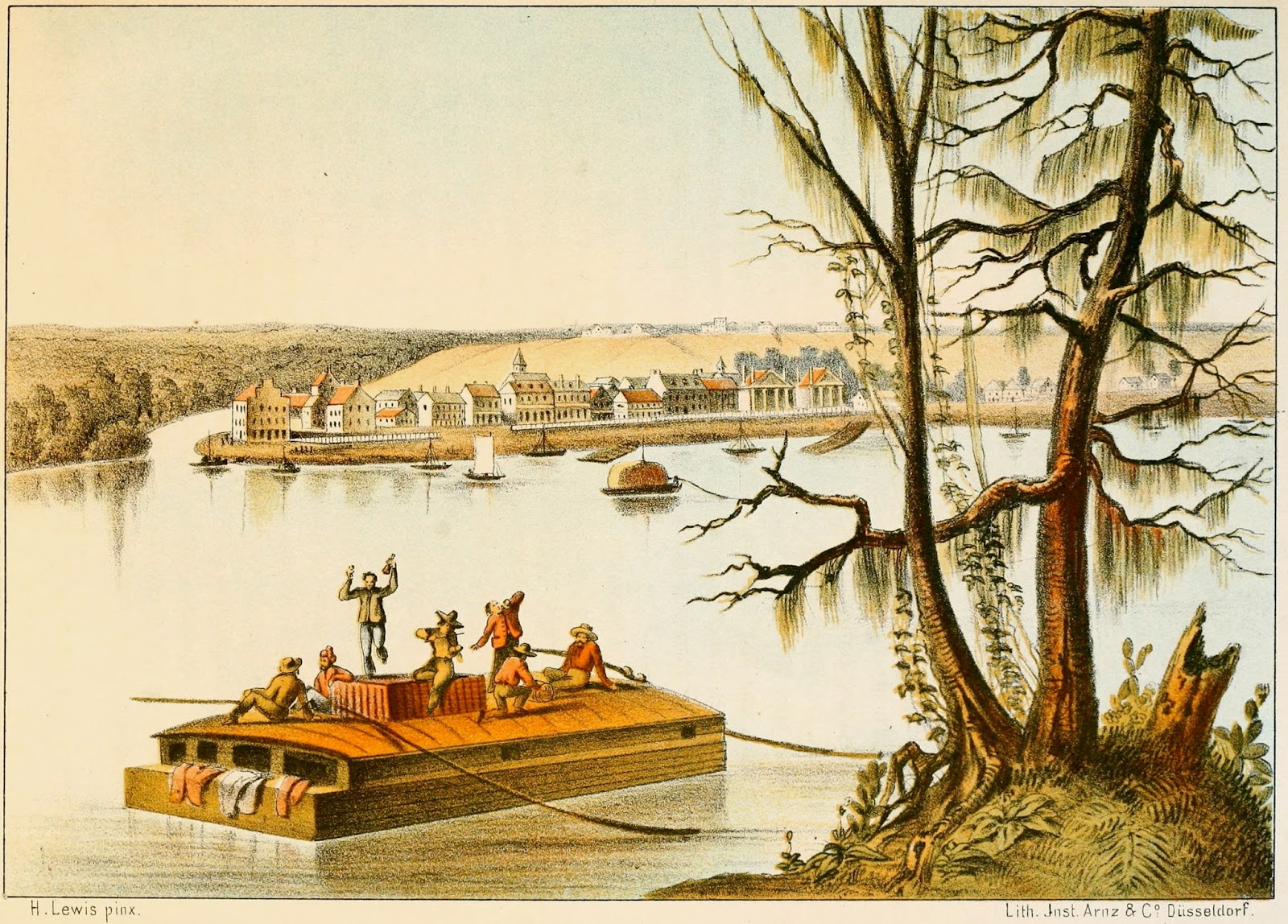
Bayou Sara,  the Mississippi River town shown above, no longer exists.  When it was a bustling Louisiana port in the second half of the 19th Century, however, Max Mann, the son of immigrant Jewish parents, kept the often rowdy residents and visitors well supplied with whiskey and thereby rose to wealth and local prominence.

Mann’s parents likely were among the Jewish emigres from Europe who often were escaping from religious persecution in their own countries and seeking the opportunities offered by America.  Many of them arrived here with little money and began to forge a living as peddlers, bringing needed goods to farm families and isolated communities.   They invested their money wisely and eventually could open stores.   As one writer has put it, these Jewish emigres lent “much needed merchandising and business skills to agrarian societies along the Mississippi River corridor.
The Manns had elected to settle in a Louisiana river town with a notorious reputation.  According to residents, early in its history ladies did not dare go onto the streets of Bayou Sara, including its main street, shown above, in daytime unescorted — and never after dark.  Saloons abounded, most of them featuring gambling tables.  Drunken brawls were common and since most residents carried pistols killings were not unusual.   It is said that five men were killed in one night in Bayou Sara.

In time things settled down as the town became a busy cotton port with a thriving commercial center and residential areas. It boasted drug stores, sawmills and lumberyards. livestock traders, fish markets, livery stables, grocers, dry goods stores, a bakery, post and express offices, icehouses, banks, and clothiers.  Bayou Sara even had a fair grounds and a ball park.   But the focus of much community life were the saloons.

The most popular drink emporium in town belonged to Max Mann.  Shown above, it was two stories tall and backed on the Mississippi River, the front on Bayou Sara’s main drag.  Like other buildings in town, the top story boasted a porch with a fancy wooden balustrade surrounding it. Max’s place was a frequent stop where both steamboat passengers and locals could get a glass of beer or whiskey.  My guess is that Max and his family lived above the saloon.

I believe that is Max himself standing next to his establishment in the photo right, balancing a bail type jug on his hand.  Not only was he serving up whiskey over the bar, he was selling it in ceramic containers to the locals.  As advertised on the front of his saloon, the jug probably held “Five Feathers Whiskey.”  This was a brand from Edwin Schiele & Company of St. Louis that Mann was importing from up the Mississippi River, carried in the many river boats plying those waters.  As on a second jug shown here, he claimed to be the sole agent for the label in Bayou Sara and vicinity.  This jug, by the way, recently sold at auction for $1,500.  

Five Feathers must have been popular — the saloon shown below during a flood was advertising its “Silver Feathers,” a brand I can find nowhere else and likely named to be competition for Mann’s brand.  Max also was a dealer for “Harper Rye,”  presumably the whiskey that I. W. Bernheim was producing in Louisville, another city with river access for shipping liquor to Bayou Sara.  Mann ran frequent ads for the brand in St. Francisville True Democrat newspaper, emphasizing that Harper Rye had been “scientifically distilled; naturally aged; best and safest for all uses.”

Whatever success Bayou Sara experienced over the years, it could not escape the reality that, as per the picture above, it flooded constantly.  With all its buildings of frame construction, it also suffered from fires.  After one particularly disastrous flood in 1893, Max Mann moved his saloon, lock, stock, barrels and jugs, to Ferdinand Street in St. Francisville, a town located on a high bluff overlooking Bayou Sara.  At this point Max also was wealthy enough to find a place for his family away from his business establishment and built a spacious home nearby on Royal Street.
The U.S. census-taker found the Manns there in 1910.  Max had been married 17 years earlier to a woman named Hettie Schlesinger.   He was 25 when they wed, Hettie was 23.  The couple soon began a family.  When the census taker called there were three children, Theresa, 16; Laurence, 13, and Vivian, 10.  Max’s occupation was given as “proprietor, saloon.” 


Mann was not totally tied up in the whiskey trade.  As early as 1896 he was advertising in the local newspapers his availability as an agent for M. Born & Co., billed as “The great Chicago Merchant Tailors,” a firm that made clothes to order.  

Also active in civic affairs in Bayou Sara,Max was one of a group of local businessmen who sought a public levy to extend the tracks of the railroad into town by putting a spur track from its then terminus south of town along the levee to the upper end. The railroad brought cotton from local plantations to the river packets docked at Bayou Sara.  The petitioners sought by the tax to raise $1,000 to make the extention possible.  In 1905, Mann was elected as a director of the People’s Bank, a financial institution in St. Francisville, a position he held until the bank was sold in 1913.  He also had a political career, serving a term as an member of the Board of Aldermen for West Feliciana Parish (County).

Things changed drastically for the Manns in 1920.  Even though Louisiana had never voted Prohibition and was counted among the “wettest” states in the Union, with advent of the Volstead Act Max was forced to shut down his saloon.   The 1930 census found him and wife Hettie living in New Orleans with his married daughter and their grandchild.  Now age 62, he listed no occupation.  Within a year or so, the couple left New Orleans for Woodville, Mississippi, where they made their home in retirement.    

While on a visit to a daughter in Lecompte, Louisiana, in 1934, Mann was stricken suddenly and died,  leaving behind his widow, three grown children, a grandchild and a brother.  He was buried in the Beth Israel Cemetery near Woodville.   Hettie would join him there ten years later.  Their joint headstone is shown here.

An historian of Bayou Sara and St. Francisville has described the benefits that the Jewish settlers brought to Louisiana:  “Accepted as contributing members of their adopted communities along the Mississippi River corridor, these immigrants as they succeeded in business supported public works and served in important civic offices.”  . 


Monday, May 11, 2015

B. J. Semmes and Jorantha: Love and Whiskey in Difficult Times

Benedict Joseph (B. J.) Semmes literally had been born into whiskey-making. But it was not until he had wooed and won the love of his life, Jorantha, the daughter of a New York congressman, that with her support he was able to steer Semmes distilling through many crises and maintain a whiskey dynasty down to three generations.
Semmes was born in 1823 in Georgetown, by then part of the District of Columbia, the son of Raphael and Matilda Semmes.  One relative had been the proprietor of the City Club Tavern in Georgetown and later Rhodes Tavern in Washington proper.  Four years before Benedict’s birth Semmes family members had begun making whiskey on a commercial basis.  In 1894 he told a U.S. Senate committee investigating the Whiskey Trust:  “We began business in 1819 in Washington, D.C., and built the first brick storehouse on south side of Pennsylvania Avenue, between the Capitol and the Treasury Department, and built the Yannissee Distillery in 1823 on Yannissee Creek, Maryland, within sight of the dome of the Capitol.”   The Semmes clan called their whiskey “Yannissee.”

Benedict’s youth apparently was unremarkable, growing up in a reasonably affluent D.C. family and educated in local schools.  He may well have worked in the Semmes liquor business from an early age.  At the age of 24, he met Jorantha Jordan, a New Yorker, when she accompanied her father Lawrence Pallette Jordan, a congressman, to a session of the House of Representatives.  Jorantha was 19.  With frequent letters between Washington and New York, their courtship lasted 18 months, complicated because of her initial reluctance to convert to his Catholicism.  During this period he came to appreciate her business skills, writing her:  “…You have an enquiring mind—speak precisely—act readily, and are not Dull at figures.”

In late 1849 or early 1850 they were married and Jorantha settled into the role of housewife and eventually mother.  The fuzzy photo shown here likely is that of the young couple. Their first child, Julia, was born in late 1850, followed by two boys, Joseph Malcolm in 1852 and Raphael Eustice in 1855.  Semmes supported the family by working in a District of Columbia store, recorded as a “wholesale merchant.” 

By 1859, however, he had seen brighter horizons westward and decided that Memphis, Tennessee, a fast growing community on the Mississippi river, held opportunities that the Nation’s Capital did not.  After a friend secured a $3,000 line of credit for him, Semmes traveled there by himself and opened a dry goods store.   Reputedly after having the building blessed by a local priest, he called for Jorantha and the children to join him.  

Semmes' venture into dry goods may have been short lived.  His letters to Jorantha had noted that business was slow.   By 1860, business directory listings indicate that the B. J. Semmes Company primarily was selling liquor.  Before the store could reap significant profits, however, the Civil War erupted.  ln March 1862,  Benedict enlisted as a sergeant in Company L, 154th Tennessee Regiment, leaving the store management to Jorantha.   Wounded only a month later at the Battle of Shiloh, Benedict went home to recuperate and helped his wife sell off the stock.  Upon returning to action, he was commissioned as a captain in the Army of Tennessee and later assigned as chief of the army's commissary. 

While he was away, Jorantha — now caring for six children — was showing considerable business initiative.  In 1863 she reported to her absent husband that she had earned a profit of $150 by bottling and selling whiskey and brandy to supplement the Semmes family income.  The older boys had helped her.  By the end of the war, however, she was forced by the fighting in Tennessee to remove the family to Corinth, Mississippi.  Promoted briefly to major,  Semmes surrendered with the Confederate Army in April 1865.  Author Frank Byrne says:  “In a matter of weeks Semmes returned to Memphis where Benedict reopened Semmes & Company, a wine and liquor firm….The early success of Semmes & Company rested in part upon the wartime activities of Semmes family, particularly the labor of his wife.”

This post-war period was one of bitterness in Southern towns like Memphis. In testimony to the U.S. Senate seeking protective legislation, Semmes maintained that he could not produce financial records from 1866 to 1883, as requested by the committee, as “Gen. Sherman burned our books on his ‘March to the Sea” so that we only have complete records since 1866” — likely a stretch since Sherman is recorded as having started that march from Atlanta, not Memphis.  Semmes also complained that:  “Our distillery was burned, without insurance, during the war.”   He did not make the location of that facility explicit.

Whatever damage had been done, with the support of Jorantha,  Benedict recouped quickly. After spending three years at an address at 234 Second Street, he moved to larger quarters at 297 Main Street. As a whiskey blender and compounder, Semmes featured a number of proprietary brands.   They included “Jo Blackburn,” and “Tennessee Club.”  Most important, he had carried the “Yannissee" name with him from Washington DC to Memphis and made it his flagship whiskey label.  He advertised it as shown right with a strange set of letters that have been widely misunderstood.  They are in the Coptic script and spell out “Memph,” the name of the ancient Egyptian town from which Memphis was derived.  Semmes trademarked the Coptic symbols and gave some of his ads Egyptian themes.

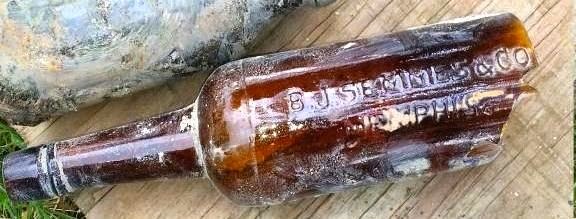
Semmes was packaging his whiskey both in ceramic and glass.  Shown here is a gallon jug that likely was meant for his wholesale trade.  It has a typical Bristol glaze off-white  body and Albany slip brown top with his name stenciled on the front in large letters.  His retail customers could received their Yannissee whiskey in dark amber quart bottles.  Two variations are shown below, the second one broken, uncovered by digger.

In his 1894 Senate testimony, Semmes stated that he was renting Charles Nelson’s Greenbriar Distillery, shown below, 22 miles from Nashville, and running it as the Yannissee Distillery for such time as he required each year. “…We never produce each year over 2,500 barrels or less than 600 barrels.”  In 1893 and 1894, however, “owing to depression in business and the recent financial panic,” Semmes had shut the distillery down and made not a single barrel.  Moreover, in 1890 he had exported 500 barrels of whiskey from the U.S. to Germany to avoid taxes amounting to $20,000 ($500,000 equivalent today). In effect, he was testifying in favor of reforms that became the Bottled-in-Bonding Act of 1897.
Semmes disclosed that in addition to distilling whiskey, he was buying wine and liquor both in the United States and abroad, including other national whiskey brands, in order to meet customer demand in Memphis and its environs.  Those products provided the company little benefit, he contended, because he was forced to compete on cost with dealers in other cities for the same brands.  Although Semmes did not state it specifically, his mail order sales would have been particularly affected.  Apparently comfortable with his trademarks, he added:  “Of course our own brands of domestic goods are ours and under our control.”

The whiskey dealer took the opportunity of his Senate testimony to rail against protectionist policies that shielded the manufacturers of Northern states, Alabama, and Louisiana.  He noted that the suit of clothes he was wearing while writing his testimony had cost him $65.  A friend  had showed him a similar suit bought in Canada that cost only $20.  Semmes may have been thinking of his own brood when he complained of the expense protectionism imposed on him and others “to support and educate a large family in elegant luxury.”

Throughout the challenges their liquor business faced, Jorantha continued to be consulted by Benedict on business matters.  Moreover, as his sons Joseph and Raphael reached maturity, both were taken into the firm and eventually into management positions.  An 1897 letterhead from B. J. Semmes & Co. listed all three men.  The letterhead also boasted that  after chemical analysis Yannissee brand whiskey had been awarded a U.S. Marine Hospital contract for medicinal whiskey.  The Semmes claimed to carry the largest stock of old Tennessee sour mash whiskeys in the state.  The company was continuing to prosper.

In 1902, Benedict Semmes died at age 77.  While his family gathered around his grave site he was interred at Calvary Cemetery in Memphis.  Jorantha would join him when she died in 1925. Their attractive marble headstones are shown here.  Joseph and Raphael kept the liquor business going, for a short period establishing an adjunct store in St. Louis, Missouri.  In 1910 they moved their Memphis operations to 50 N. Second St. and then to 14 N. Front Street.   With the onset of state prohibition in Tennessee, B. J. Semmes and Company was forced to close in 1915.

That event wrote the final chapter on this liquor dynasty and its Yannissee whiskey.  Company letterheads and advertising always cited 1819 as the date of its founding.  The Semmes family had kept making and selling liquor through the Civil War, Reconstruction, the financial “panic” of the late 1800s, harsh taxation, high tariffs, and the Whiskey Trust.   Benedict himself summed up the Semmes history in his Senate testimony:  “We have never failed or burned out during three generations of our family….”

Note:  The relationship between Benedict Semmes and his wife Jorantha, particularly as it relates to business matters, was featured by Frank J. Byrne in his 2006 book, Becoming Bourgeous:  Merchant Culture in the South, 1920-1865.  Byrne drew his material from letters exchanged by the couple from in 1848 to 1865 that are among the Benedict J. Semmes papers archived at the University of North Carolina at Chapel Hill.  I have drawn from Byrne’s book as well as other sources, particularly Semmes' 1894 written testimony to the Senate Finance Committee.


Saturday, May 9, 2015

The Forgotten Whiskey Man of Minneapolis — J. C. Oswald

Note:  As in the past, when I come across material about a whiskey man that is as good or better than anything of my authoring, I will reprint it in this blog.   Ron Feldhaus in his 1987 publication, “Bottles, Breweriana and Advertising Jugs” included a lengthy biography of J.C. Oswald.  Feldhaus in turn had gathered information from an 1890 book, “Biographical History of the Northwest” by Alonzo Phelps and an 1893 book, “History of the City of Minneapolis, Minnesota,”  by Isaac Atwater, both of which contained extensive biographies of Oswald. With a few additions signaled by brackets, Ron’s article is reprinted below by his permission.
*******


There have been some distinguished men in the history of the Minnesota liquor industry.  Some became known even outside the state, such as A. M. Smith and George Benz.  Others were influential in the growth of Minneapolis, such as Isaac Weil and Jonas F. Brown.  [This blog has posts on each of these whiskey men.]   However there is one man who is virtually unknown to the Minneapolis bottle collector because he seems to have left no embossed or paper labeled bottles or “go-withs” to mark his passing.  Yet this man was in the liquor business for over fifty years.  He was a pioneer of Minneapolis.  He was a State Senator.  He raised race horses of world renown.  And his native wines were known far beyond Minnesota’s borders.  This man [shown above] was John Conrad Oswald.


J. C. Oswald was born in the village of Oberaach, Canton Thurgau, Switzerland [shown above] on May 20, 1824.  At age 16 he was apprenticed to a cotton manufacturer, Godfrey Scheitlin,.  In two years his industry and aptness were rewarded by his appointment as overseer,  which he diligently pursued for the next five years.

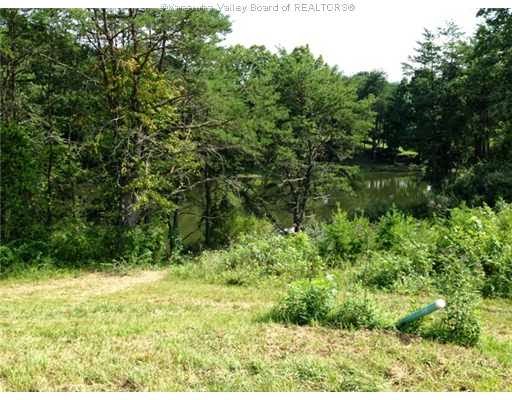
In 1847 he joined the tide of emigration which flowed toward the shores of America.  While in New York he was appointed the agent of large tract of land in Virginia.   He met Ursula Scheitlin, an old girlfriend and also the sister of his former employer.  They soon married and she accompanied him to the scene of his labor for the next ten years.  It was a wild region [Cabell County, now West Virginia, shown here]  and offered none of the comfort and convenience of life.

He opened a country store, cleared and cultivated a farm and met with fair success.  Five children were born while the Oswalds were in the South.  Only one survived.

In 1857, he sold out and came to Minneapolis, where Godfrey Scheitlin, his former employer and now brother-in-law, had preceded him.  He opened a general store with his brother Henry Oswald and after a year bought out his brother’s interest.  He moved his stock goods to the old land office buildings in lower town.  In the spring of 1859 took a new partner, Mathias Nothakel.  The firm continued in business until 1862, when both members sold out.


He then bought a 160 acre farm named “Oak Grove,” which was on the site of the present Bryn Mawr area of Minneapolis.  Experimenting with an unusual crop for Minnesota, he raised tobacco and made a success of it for two years, but the tobacco was destroyed by frost in August 1863 and he never repeated the attempt. Oswald had a fondness for horses, which he bred and raised.  His mares brought him nine colts, every one a trotter and some breaking world records.

His knowledge of wine making in the valleys of his native land directed his attention to the adaptation of the fruits of this country for wine.  In 1858, he and Godfrey Scheitlin experimented in the the manufacture of native fruit wine.  The experiments proved a great success.  In 1862 Oswald constructed a wine cellar on his farm, and engaged in the manufacture of wine on an extensive scale.  “J. C. Oswald’s Native Wines” became celebrated and brought orders from distant places.
About 1866 he added to the wine business that of distilled liquors and established the first wholesale wine and liquor business in Minneapolis.  [Normandy Rye, Monogram Whiskey and Nelson Rye among his brands.]  The first location was an old stand at the corner of First Street and Hennepin Avenue.  In 1867 he moved to No. 3 Pence Opera House.
In 1874 he erected a four-story brick store at No. 17 Washington Avenue North, where he stayed until his death  [the building at the far right of the photo]. In 1881 he associated with Mr. Theophil Basting, who long had been manager of the business and also his son-in-law.  The firm’s name was J.C. Oswald and Co. That same year he had a huge elegant home built at 1332 Hennepin Avenue [below].

Oswald always took an active interest in public affairs.  He was on the Board of Commissioners who directed the building of the present County Courthouse in Minneapolis.  He was instrumental in the development of the first electric street car system.  For many years he was a member of the Park Board.  During these years the foundation of the magnificent park system of the city was laid, and its plans largely perfected.
Oswald was a distinguished looking man.  He had piercing eyes, white hair surrounding a balding top and a white General Custer style mustache and goatee.  In 1887 he was elected to the State Senate and he held the office for four years.  At this time he sold his farm, 119 acres of it going for nearly one-half million dollars. 


At the time of his death on June 13, 1905, J.C. Oswald was Vice-President and Director of the Germania Bank and Director of the F&M Bank. Shortly after Oswald’s death, Basting closed the  J.C. Oswald and Co. doors for the last time.


Note:  Oswald is buried in Section 2, Lot 136, Grave 4, of Lakewood Cemetery in Minneapolis.  His headstone is shown here.  The "fancy" jug for Normandy Rye, shown above is a 2018 arrival to this post.  It graciously was sent to me by Verlyn Durene, a Minnesotan who eagerly has sought Oswald materials and artifacts.

, 


Tuesday, May 5, 2015

Martin Shaughnessy of St. Louis: Fire Within and Fires Without

Martin Shaughnessy was about fire.  Fired within by strong ambition to succeed, principally by selling whiskey, this Irish immigrant lad quickly gained recognition in the business circles of St. Louis.  But the fires that ravaged major landmarks in the city seem likewise to have been on his mind — and eventually spurred him to action.
Martin was born in County Galway on the west of Ireland in 1855, the son of Michael S. and Mary Mooney Shaughnessy.  When he was about eleven years old the family came to the United States and settled in St. Louis where they already had relatives living.  The boy was educated in local schools.

The Shaughnessys had resided in the Missouri city only a few months before a major conflagration had all of St. Louis buzzing.  Shown above in ruins, the Lindell Hotel, touted in the local press as “the largest building of its kind on the Continent, if not in the world,” was destroyed in March 1867.  After a mysterious blaze broke out on the fifth floor, firemen were unable to reach the flames with their hoses and fire quickly spread to upper floors, in the end reducing the vaunted hotel to rubble.  Martin, now 11, almost certainly witnessed it as city residents by the thousands flocked to the flaming site. 

Upon completing his education, Shaughnessy went to work for an uncle who was in the hotel business, managing the American House Hotel.  After learning the hospitality business, the young man moved to John C. Foley Company, wholesale whiskey commercial merchants.  He spent three years there learning the liquor trade. Then, fired by ambition, he struck out on his own in 1877.  He was assisted in this effort by his ability to take over for an uncle, John Mooney,  who owned a St. Louis wholesale and retail liquor dealership, listed in local directories at 100 East Twelfth Street. 

Martin almost immediately changed the name of Mooney’s firm to his own — “M. Shaughnessy & Co.” — another sign of the ambition burning inside him. He found almost immediate success in the whiskey trade.  His first address listed in directories was 121 Locust Street, followed by a a rapid series of consecutive moves to locations on North Main, North Sixth, and for many years an address on St. Charles.   His need for larger and larger spaces likely was driven by his activities as a “rectifier,”  that is, he was blending and compounding raw whiskeys received from distillers to achieve desired taste and smoothness, bottling them and applying his own labels.  

His proprietary brands, included “Coal Port,”  “Grandee,” “Leroy,” “San Bois,” “Diamond Brand,” “Shaughnessy Rye Malt,” and “Shaughnessy’s Special.”  His flagship was “Club House Whiskey,” which he trademarked in 1888  and again in 1905, after Congress stiffened the infringement laws.  By 1906, despite the expense involved, he had trademarked most of his brands.  Those whiskies were issued at retail in both clear and amber bottles, sized from minis to flasks to quarts.
Much of Shaughnessy’s success can be attributed to his frequent and imaginative advertising.  Shown left is an 1891 ad for his Diamond Brand.  He describes it as “distilled from selected rye and barley malt, after the formula of a noted Pennsylvania distillery.”   Like many whiskey men of his time, he ascribed medicinal qualities to the blend claiming:  “It will be found especially valuable in conjunction with milk in the treatment of all pulmonary troubles.”  At right is a 1900 ad in the National Druggist magazine for his Club House Brand, touted there as a stimulant.  Pure whiskey is sometimes hard to get, the ad states, but yet “how essential it is for medicinal purposes.”

Shaughnessy also adopted merchandising techniques common with wholesale whiskey dealers.   He issued a series of shot glasses that advertised his brands, particularly Club House Whiskey.  Those items would be given to favored customers, particularly saloon owners and bartenders who were buying and featuring his brands.  Also echoing a trend in his trade, in 1905 Martin changed the name of his firm to the M. Shaughnessy Distilling Company.  Although laws prevented rectifiers from designating themselves “distillers,”  the “distilling company” label was legal for them.

Meanwhile, Martin found time to marry.  At age 36 in 1891, he wed Agnes Tivy, born in 1867 in St. Louis, the daughter of John Tivy, an Irish immigrant, and Margaret Ahern, a native of St. Louis.  Agnes has been described by one source as “a young woman of means.”  By this time Martin himself also was growing wealthy.  A 1924 newspaper article said Shaughnessy’s career “soon brought him among the first St. Louisans in wealth and prestige.” 
 

Martin and Agnes are not recorded as having children and apparently spent much of their married life living in hotels.  One of them likely was the Lindell Hotel that had been rebuilt following the 1867 fire. Once again it was the largest hostelry in St. Louis, and accounted “the best appointed and conducted hotel” for travelers in town.  In April 1886, the Lindell caught fire a second time;  this blaze originated in the basement, spread to the lobby and smoke engulfed the entire building.  The press described the hotel as “so badly damaged by fire, smoke and water that tonight its interior presents a sad appearance.”  This time, however, it was not destroyed.

Hotel fires seem to have been endemic in St. Louis.  In 1883 the four story Occidental Hotel was ruined an a fire that took the life of a firefighter.  A residential hotel fire took the lives of eleven occupants.  Later, the Hotel Belvidere burned at the southeast corner of 14th Street and Washington Avenue.   Shaughnessy must have been well aware of the dangers but decided to invest in a hostelry that already had burned twice.  As one writer described it:  “Not content with his considerable assets, he decided in 1898 to acquire and manage the Lindell Hotel….”  With the purchase of the Lindell, Martin and Agnes made it their home.

Meanwhile, Shaughnessy’s whiskey business required a larger warehouse facility for storing his whiskey for aging.  In 1903 he acquired for $70,000 (equivalent to $1.75 million today), a parcel at the northwest corner of Washington Avenue and 22nd Street.  There in 1906 he commissioned a structure that still stands today as the Martin Shaughnessy Building, a six-story red brick Classical Revival warehouse now on the National Register of Historic Places.  Shown right, the building’s claim to fame is that it was the very first fireproof warehouse in St. Louis and one of the city’s first completely fireproof buildings.  One writer has speculated:  “Probably having witnessed…the 1867 fire at the old Lindell Hotel, the 1885 fire at the new Lindell Hotel or any number of other local conflagrations, Shaughnessy would have had ample inspiration to speculate capital on an innovative fireproof storage warehouse.”

Recognizing the inflammatory nature of his stored whiskey, Shaughnessy insisted that the building be constructed entirely with fireproof materials, including brick and terra cotta on the exterior and concrete flooring and ceiling on the interior.  Load-bearing interior iron columns were sheathed in hollow-tile terra cotta, then coated with a layer of concrete to provide extra protection from fire.  Heavy fire doors at each floor sealed access to storage spaces.

During this period, Shaughnessy also was deciding the fate of the Lindell Hotel.  Never the same after the second blaze, the hostelry was torn down to make way for new commercial construction.  Martin and Agnes now moved to the Washington Hotel, but only temporarily.   Wealthy St. Louisans were  foreshadowing the gated communities of our own time.  They were creating self-governing enclaves known as “private places” whose streets and common gardens were owned by the residents, gated, and patrolled.  One of those was Washington Terrace, a private place near in the Central West End of St. Louis.  There in 1908,  Shaughnessy built a three-bay, two story mansion in the Tudor Revival style at No. One.  A carved foliated cartouche over large front doors proudly bore that address.  Shown here at the right of the spectacular gatehouse, the still extant Shaughnessy mansion is on the Historical Register.

Shaughnessy maintained his whiskey business even as prohibitionary forces were shutting down his markets.   According to directories, his firm made a last office move in 1916 to 118 North Third Street and then was forced to shut down about 1919 as National Prohibition loomed.  Club House and other Shaughnessy brands disappeared.   The 1920 census found Agnes and Martin, now age 62, living alone in their mansion with three servants. Although Shaughnessy gave his occupation as “none” to the census taker, he actively was looking after his considerable real estate holdings in St. Louis. 

Martin died six years later in September 1926.  A Roman Catholic, he received a Requiem Mass and was buried in Section 18, Lot 294, of Calvary Cemetery in St. Louis.  Agnes would join him there 19 years later.  Their joint gravestone is shown here.  Although the stone carries no epitaph, Reedy’s Mirror, a St. Louis periodical, earlier had described Shaughnessy thus:  “…A leading citizen and an extensive owner of real estate, a patron of the arts, a supporter of many charitable movements, and a man who performs religiously the duties of citizenship.”   Martin Shaughnessy, I would add, also had dealt successfully with fires inside and out.

Note:  Much of the information provided here was derived from the National Park Service “statement of significance” required to place the Martin Shaughnessy Building on the National Register of Historic Places.  The form was prepared by Matthew Bivens, researcher, and Carolyn Toft, executive director, for the Landmarks Association of St. Louis.


Friday, May 1, 2015

The Thomas Hall Story Almost Ended Before It Began

In his 1905 book, “A History of the New California:  Its Resources and Its People,” author Leigh Hadley Irvine devoted two and one half pages to Thomas B. Hall, a highly successful Sacramento grocer and whiskey dealer, whose accomplishments included forming a state military unit and serving as its commander, helping frame the Sacramento city charter, and playing a key role in settling large tracts of California land with colonist farmers.   Hall’s accomplished life, however, came close to ending before it began. 
The same year that Hall was born, 1853, his father, an immigrant from Ireland of English descent, was drawn westward by the idea of California riches.  He pulled up stakes in Illinois and bringing his family, including baby Thomas, headed to Sacramento.  There he went to work for the Folsom and Placerville Railroad.  When the owners neglected to pay him, Richard Hall decided to return East, taking a steamer via the Panama route.   The ship was the ill-fated Yankee Blade, which wrecked at Point Conception off the coast of Santa Barbara in 1854, costing an estimated 30 to 40 lives.

The Hall family, carrying baby Thomas, struggled to reach the coast five miles away but survived.  There they were picked up by another steamer that took them to Los Angeles.  After remaining there a week, they took another ship to San Francisco.  Deciding that the fates had decreed that the Halls should stay in California, the father bought a farm near Sacramento and for the rest of his life tilled the soil.

After spending his early days on the farm and receiving his education in the public schools of Sacramento and some training at a San Francisco business college, Thomas Hall, now sixteen, decided it was more profitable to sell food than to raise it.  He began as a porter at a Sacramento wholesale grocery firm.   As his biographer Irvine tells it:  “Seven years from that time he succeeded his employers in the business.”  With a partner named Luhrs, Hall established a grocery firm that would operate for decades.


As shown here on a trade card, the firm specialized in ham and rye — not rye bread, but rye whiskey.  Although Hall and his partner sold whiskey in their grocery, in 1882 they bought out a existing  liquor dealership and made whiskey a major element in their business.   They used the brand names, “Derby Brand,”  Double Stamp,” Old Log Cabin,” “Pride of the West.”  
Their flagship was “Snow Flake Whiskey, advertised as Kentucky Bourbon with the claim:  “Unrivaled for purity, mellowness and bouquet.”  

Bottle collectors know Hall, Luhrs & Co. as a prolific distributor of whiskey, with at least five embossed round quart bottles, several mini-cylinders and at least one pumpkinseed flask.  As many wholesale liquor dealers did, Hall, Luhrs also issued advertising shot glasses as giveaway items to saloons and other establishments carrying their brands of liquor

Meanwhile Thomas Hall was having a personal life.  In March 1876 he was married in Sacramento to Selina A. Govan, a native of Pennsylvania and the daughter of James and Elizabeth Govan, from a family descended from a line of Scotch/English stonemasons, marble-cutters and builders.   Thomas and Selina would have two children, a boy,  Ward, and a girl, Ethel.  The 1880 census found the family living in Sacramento with their two small children and two boys, likely relatives of Selina, whom Hall was sending to school.  His occupation was given as “wholesale liquor.”  Son Ward would join the firm upon maturity, initially working as a cashier.  Daughter Ethel would benefit from her father’s prosperity by being sent to Stanford University.  
Hall, Luhrs first location was at the corner of Third and K Streets in Sacramento, but by 1883 the increased business volume had required that larger quarters be obtained.  As a result the following year the company moved into a more spacious building on Second Street, specifically erected for the partners and obtained under a longterm lease.  The Sacramento Daily Union described the facilities in glowing terms under the headline “A Splendid New Structure for the Firm of Hall, Luhrs & Co.”   The building was drawn to plans of Hall’s own devising, rising three stories.  The main floor front was constructed wholly of iron and glass and the upper stories were also made of iron and glass.  The Daily Union reporter marveled over the sample room for its “…artistic design, composed wholly of wooden framework and glass.  It rises to the height of the eighteen-foot ceiling and over it is a large opening with the upper skylight above, throwing a strong but softened light through the glass roof.”
On either side of the office and sample room were railway tracks traversing the entire length of the building.  Goods could be delivered at the front door, placed on cars, and transported to any part of the main floor or sent below or above by a three-story hydraulic elevator.  After having served other purposes over the years including as a hotel,  the Hall, Luhrs & Co. building now is part of the Sacramento Historical District and has been restored to its original glory, as shown below.  
Established in its new quarters and the acknowledged largest wholesale grocery and liquor business in the city,  Thomas Hall turned his attention to other interests.  He was one of the organizers of the Mount Shasta Mineral Springs Company of Siskiyou County and a founder of the Orangevale Colonization Project, a venture that settled large tracts of California agricultural land with farm families.   He also maintained his own farm near Sacramento.   Active in the Republican Party,  Hall frequently was tapped for public service,  serving as a framer of the city charter and on Sacramento committees dealing with public works and business development.  When an auditing board for the state Commissioner of Public Works was created, the Republican governor chose Hall as a member.  Hall also promoted local sports.  In 1889 Hall, Luhrs sponsored Snowflake Park in Sacramento, obviously named after the firm’s flagship whiskey brand.  The park was the city’s primary baseball venue for at least a decade.

Hall’s military career deserves special attention.  In 1885, age 32 and still building his business, he joined an artillery regiment as a private, part of the California militia, equivalent today to the National Guard.  Shortly after his enlistment, his leadership qualities were recognized and he quickly was advanced to corporal.  When a new unit, Company G, later was being organized, Hall was elected its captain, a post he held for ten years before retiring.  He carried the “captain” title with him throughout the rest of his life. 

With the coming of National Prohibition the Hall, Luhrs Company was forced to shut down its liquor sales.  Snowflake Whiskey as a brand disappeared, not to be revived after Repeal.  The grocery company is reported to have survived until 1928.   I have been unable to find the date of death for Thomas Hall or his resting place.


A fitting epitaph for this extraordinary whiskey man was written about him in 1905:   “From porter to proprietor would aptly characterize the business career of Mr. Hall, and every successive step of progress has been earned by his earnest and diligent efforts.”  The author did not dwell on how close this successful whiskey man had come to death in the Yankee Blade disaster — how the extraordinary life of Thomas Hall had almost ended before it began.

Note: The 1905 book, “A History of the New California:  Its Resources and Its People,” by Leigh Hadley Irvine provided a wealth of information about Thomas Hall as did newspaper articles and other sources.