Monday, January 13, 2020

Financier Whiskey Men

        
Foreword:  Among those whom I have profiled as “whiskey men” are a number of individuals whose interest in making and selling liquor resided in the potential for profit.  They were capitalist “money men” and sometimes said so to the census taker.  Of them I have selected three who represent a range of “financiers.”  

Shown here at 70, Edson Bradley growing up probably  could not tell sour mash from sweet corn, but in maturity he turned whiskey-making into abounding wealth. Bradley was born into money, well educated and eventually trained for a career in finance. While still in his twenties he became associated with Paris, Allen & Company, a leading New York and London financial and importing firm.  

Although the whiskey industry has always emphasized the backwoods, rustic nature of distilling, the truth is more complicated. New York Wall Street investors frequently were directly involved in the liquor trade. Almost immediately upon joining Paris, Allen the youthful Bradley was anointed the principal spokesman on Wall Street and before Congress for the new Whiskey Trust the company financed in Kentucky during the 1880s, including the "Old Crow" distillery below.  


As a driving force behind the Trust, Bradley soon became a national figure.  In the process he also was becoming wealthy. Soon the nation’s newspapers were referring to Bradley as a liquor millionaire and kingpin of the American distilling industry. About this time he moved his family from New York City to Washington, D.C.  He bought a large Victorian home on fashionable DuPont Circle and tore it down to build the grandest mansion the Nation’s Capitol had ever seen. 

Retired at 70 and enormously rich from whiskey profits, Bradley left Washington, moving to fashionable Newport, Rhode Island.  Incredibly, he took his castle with him.  Brick by brick, tile by tile, the mansion was dismantled and transported to Rhode Island while the fascinated populace of Washington looked on. Ripley’s “Believe It or Not” highlighted the event for a national audience. In Newport Bradley purchased a large existing home and joined the two structures to become one of the largest mansions in America, shown here.

Beginning as a grocer and drug salesman, by 1900 George Carragan of Bayonne, New Jersey, early built a reputation as New York financier.  He was the “financial head” of August Kress & Co., importer of grocer specialties; directed the wholesale commission house of R. B. Poucher & Co; and co-owned Carragan & Tilson, a New York company that manufactured badges, rubber stamps, stencils, and seals.  Back in Bayonne he was a founder and director of the Mechanics Trust Company and later the First National Bank.  Said his biographer:  “These various business associations indicate in a small measure Mr. Carragan’s ability and success as a financier.  

When Carragan engaged with Cook & Bernheimer, a New York whiskey wholesaler, is not clear.  Founded in 1863, the company had been in business for some years before he became involved, investing in it and ultimately becoming its president.  Carragan's leadership was evident in the late 1890s when the liquor firm had a burst of energy, operating from a large building at 144-150 Franklin St. in Manhattan, shown right, and opening offices around the country: In Chicago on Wabash Avenue in 1897, a year later in Cincinnati, San Francisco and Terre Haute, Indiana.  Cook & Bernheimer took a gold medal for the company’s flagship “Old Valley Whiskey” at the Paris Exposition of 1900.  

Under Carragan’s direction Cook & Bernheimer also obtained an exclusive contract to bottle and distribute “Mt. Vernon Whiskey,” distilled by the Hannis Company of Baltimore and Philadelphia. Featuring a blizzard of brands, including "Old Valley,"  the company commanded all or part of the output of numerous distillers in Pennsylvania, New York, and Maryland.  In 1905 Cook & Bernheimer took control of the Dalwhinnie Distillery in the Scottish Highlands, marking the very first U.S. investment in the Scotch whiskey industry.  

The Scottish adventure ended in 1920 with the imposition of National Prohibition when all legal sales of alcoholic beverages in the U.S. were forced to cease.  After more than a half century of successful operation this juggernaut among liquor houses closed its doors for good.  George Carragan lived on another five years, dying at the age of 81 at his Bayonne residence.  

Led by Warren Buffett,  Omaha, Nebraska, boasts that it has more millionaires per capita than any other city in America.   Peter E. Iler, an Omaha whiskey man, was an exemplar for the local money men to follow, a multimillionaire who built the Nation’s third largest pre-Prohibition distillery as well as financing other major business enterprises. Shown left, Iler had, people said, “the restless mind of a capitalist.”  

Every capitalist needs capital and Iler had achieved a bundle, apparently some of it through a fluke.   He and his brother had bought and prepaid for a shipment of bourbon from Kentucky.  Through an unexplained stroke of luck, the federal tax on alcohol changed while the bourbon was in transit, increasing the value of the shipment by a whopping $36,000, instantly making the Ohio storekeeper a wealthy man. Evincing his restless mind, about 1883 Iler decided that his fortune lay by going west.

About the same time, the Willow Springs Distillery on the Council Bluffs, Iowa, side of the Missouri River was closed by the Federal Government for nonpayment of taxes.  Sensing an opportunity,  Iler bought the distillery and moved it across the river to Omaha, becoming the first (legal) distillery in Nebraska. Iler subsequently set up local sales offices at the building shown here,   He also began a steady expansion of the relocated Willow Springs Distillery.

  
By 1882, when the steel engraving shown above was done,  Willow Springs had expanded to roughly 10 acres with multiple buildings. Sales of Iler’s whiskey steadily increased, reaching nearly $3,000,000 annually.  The cost of material used in the distillery during 1886 was $250,000, representing 510,000 bushels of grain. Over 10,000 tons of coal were consumed. Employment was given to 125 men, with an annual payroll of over $80,000 (roughly equiv. $2 milllion today.)

Eventually Willow Springs became the third largest distillery in the United States and paid government taxes of more than $2,000,000 annually, including providing 90 percent of Nebraska’s tax revenues.  When labor riots of broke out in Omaha in 1882, the Governor dispatched the National Guard to protect Iler’s “cash cow” facility.  

After years making whiskey in Omaha Iler about 1990 obtained options on 3,500 acres fronting on San Francisco Bay at San Bruno Point and incorporated the South San Francisco Land and Improvement Company, taking personal charge of the development.  This foray seemingly indicated Peter’s declining interest in distilling or perhaps a premonition of Prohibition.  Whatever the cause, he sold the Willow Springs Distillery.  Continuing to be active in business until about 1912 when he retired, Peter Iler had proved himself a worthy predecessor of Warren Buffet and other Omaha millionaires. 


Notes:  More complete biographies of each of these three men may be found elsewhere on this site:  Edson Bradley, September 19, 2011;  George Carragan, November 7, 2016;  and Peter Iler, May 10, 2012.


Thursday, January 9, 2020

George Brown Raised the Bible Against Prohibition


Foreword:  In May 2012, on a post here I profiled J.T.S. Brown and his family as one of the pioneering Kentucky distilling clans. In the vignette, I also introduced briefly George Brown, a half-brother, who had joined J.T.S. in a Louisville liquor business only to break away on his own about a decade later. That business is still extant as the famous Brown-Foreman Company.  George definitely has deserved a post of his own, if for nothing else, his book on the Bible and Prohibition.

George Garvin Brown, shown here, was born in Munfordville, Kentucky, in September 1846, part of three generations of Browns in the Bluegrass State. His grandfather, William, had emigrated with a young wife from Virginia,  settling down as a planter and merchant.  William’s son, John, was a merchant, postmaster, and officer in the Confederate Army who married twice.  George was a product of the second marriage;  his mother was Mary Jane Garvin.  

“I was raised on a farm, a son of Scotch and Irish parents from whom I inherited the highest reverence for religion and the Bible,” he later wrote. At the age of sixteen in 1862 Brown moved 74 miles north to Louisville, Kentucky, to attend the Male High School.  Founded in 1856, this institution was the first secondary school west of the Allegheny Mountains and highly prestigious.  How long Brown stayed is unknown but he pursued an early career as a wholesale drug salesman, working for a man named Henry Chambers.  Asked by J.T.S. Brown to join his liquor firm as a partner in 1870, George agreed.  Likely a result of George’s experience, the company initially concentrated on medicinal sales.  

Introduced in 1873, the company flagship whiskey was "Old Forester," reputedly named after a physician, Dr. William Forrester, who had endorsed its use, but eliminating one “r” on the label to avoid direct reference to the well-known physician.  Old Forester was bottled and sealed at the distillery as a way to guard against adulteration and substitution of the contents.  The sealed bottle was popular with doctors and pharmacists who sold the product.  Their endorsements spurred the Browns to seek a wider customer base among the drinking public.

In 1874, for reasons still unclear, George's partnership with J.T.S. Brown ended.  Some accounts say that the half-brothers could not agree on the quality of whiskey to be sold, with George favoring a higher priced liquor, while J.T.S. was more interested in generating a wider customer base with cheaper whiskey.  George moved on to form his own company.  With him went George Foreman, originally of Paris, Kentucky.  Hired initially as a salesman, Foreman eventually moved up to the post of bookkeeper.  The new firm also included Brown’s old boss, Henry Chambers, who was bought in as major stockholder.  The company became Brown, Chambers & Co. 

Meanwhile George was having a personal life.  In Louisville he had met Amelia Bryan Owsley, born in Danville, Kentucky, the daughter of Erasmus and Catherine Owsley.  They married on February 1, 1876, in Louisville.  George was 30;  Amelia, 28.  The couple would have nine children over a nineteen year period, five daughters and four sons.  Two of the boys would die in infancy, obviously a source of great household sorrow.

In 1876, Brown’s cousin from Ireland, James Thompson, was hired in a management role.  As the reputation of Brown, Chambers for bottling and selling quality bourbon grew,  Brown determined to create a separate sales agency to serve as the merchandising arm of the liquor house.  He enlisted Foreman and Thompson for the work.  Two years later Chambers retired and sold his shares to Mssrs. Brown, Thompson and Foreman.  The reorganized company became Brown, Thompson & Co. with Foreman as a junior partner.

This management team was intact for the next decade of expansion.  In 1890, however, Thompson sold out to Brown and Foreman in order to strike out on his own, using his profits to buy the Glenmore Distillery in Louisville from the Monarch estate.  The company name was changed once again, now it was Brown, Foreman & Co.  Brown owned 90% of the stock, Foreman 10%.  


This arrangement held for another decade until 1901 when Foreman died and his widow sold his share to Brown while permitting the continued use of Foreman’s name.  Now a sole proprietor, George lost no time in incorporating the firm, capitalizing it at $100,000.  Up to this time, Brown did not own a distillery. He was operating as a wholesaler, obtaining product from a range of Kentucky producers,including the Mellwood distillery in Louisville,  J.B.Mattingly at St. Marys in Marion County and Pleasure Ridge Park in Jefferson County.  

Now in full charge, in 1902 Brown moved quickly to acquire the Ben Mattingly Distillery, #14, District 5. Insurance underwriter records compiled in 1892 indicate that that the distillery was located 1-1/2 miles southwest of St Marys. The plant was of frame construction with a shingle roof. The property included a cattle shed and three warehouses, one still unfinished. Both of the bonded warehouses were of frame construction with shingle roofs, one located 160 feet east of the still, the second  located 170 feet east of the still.  In 1907 Brown expanded the facility, expending $70,000 (equivalent today to $1.5 million) to build additional warehouses and a bottling house.


Now having an assured supply of whiskey,  Brown added new proprietary brands to his Old Forester flagship.  They included “Old Tucker Whiskey," “Old Forman,” “Beech Fork,” “Fox Mountain,” “Cloverdale,” “Gilded Age,” “Major Paul,” and “Old Polk.”   He registered many, but not all, these labels in 1905 after Congress had strengthened the trademark laws.  He also advertised several widely through saloon signs, serving trays, pocket mirrors and back-of-the-bar bottles, examples seen throughout this post.

In insisting on bottling his whiskey at the distillery, Brown was significantly ahead of his time.  He had already been using glass for years before the Bottled-in-Bond Act was passed by Congress in 1897, mandating that whiskey distilled under the Act (bestowing tax benefits) had to be bottled at the source.  When the Owens bottling machine was invented in the early 1900s, Brown was in a position quickly to avail himself of the savings.

After Forman’s death, George also brought in a new management team. Of them the most important was his son Owsley Brown designated as the manager of the sales department.  These executives were able to free up the founder for his national role in fighting prohibition.  From his position as the first president of the National Liquor Dealer’s Assn., George became a leading spokesman and writer against the movement to ban liquor and beer production and sales throughout the U.S.  A caricature of him in the book “Kentuckians as We See Them,” depicted him sitting on a barrel of Old Forester penning a diatribe.

The propensity of “dry” proponents to cite religion and the Bible encouraged Brown to write his famous book on the subject, entitled “The Holy Bible Repudiates ‘Prohibition.’”  The subtitle describes the contents as a compilation of all Bible verses that mention wine or strong drink,  His objective was to prove that the Scriptures “commend and command” the temperate use of alcoholic beverages — not a total ban.  Copyrighted in 1910, Brown sold it for $1.00 in cloth cover, 25 cents in paper.

In the introduction, Brown openly admitted his bias:  “I have been a whiskey merchant and manufacturer for forty years and believe now, as I have always believed, that there is no more moral turpitude in selling an intoxicating liquor than there is in manufacturing and selling any other product.” His purpose for writing, he said, was “to expose the most dangerous propaganda against civil and religious liberty that has ever confronted the American people — ‘prohibition.’”

What followed was Brown’s line by line parsing of Old and New Testament Biblical passages where wine or strong drink is mentioned and, where needed, he said, to add his own “honest explanation” of each passage.  He found many opportunities for comments, with a particularly long exposition over the Wedding Feast at Cana, concluding:  “If it had been wrong to make or use wine and give it to one’s neighbors, Jesus would not have set this example.”

Brown ended his book with a brief chapter he called “Reflections.”  In it he provided a harsh critique of prohibitionists.  Among them:  “This sort of fanaticism when practiced in the name of religion, is on the principle, ‘it is not our duty now to burn heretics but we will make the laws and Caesar will do the rest.’”  The book found a ready audience among the distillers, liquor dealers, saloonkeepers, and the drinking public of America.  Brown was widely hailed for his scholarship but, as might be expected, pilloried by the “Drys.”

George Brown did not live to see his worst fears realized, dying in January 1917 at the age of 71, three years before the imposition of National Prohibition. He was buried in Louisville’s Cave Cemetery where the graves many of Kentucky’s distilling giants can be found.  Appropriately, Brown’s above ground granite tomb bears a large cross. His widow Amelia would join him in the family plot seven years later.  

The Brown-Forman Company continued to thrive even after George Brown's death.  Owsley Brown took over for his father.  When Prohibition arrived Owsley secured one of only ten federal permits allowing Brown-Forman to store whiskey and distribute it to druggists for sale by doctor-written prescription — a trade that boomed during the ensuing fourteen years.  After Repeal Owsley resumed to normal distilling and sales of whiskey.  With family members down to five generations involved in its management since 1890, Brown-Foreman has grown steadily to become one of the largest wine and spirits companies in the world with sales in excess of $2 billion annually. 

George Garvin Brown has remained a hallowed figure in the whiskey dynasty he set in motion.  In his honor, a 68-foot tall Old Forester bottle was erected on the company’s Garneau Building.  Moreover, Brown’s book seemingly has never been out of print.   During the 21st Century it has been reprinted often and currently is readily available for purchase.  One publisher has commented:  “This work has been selected by scholars as being culturally important and is part of the knowledge base of civilization as we know it.”  George would be proud to know that.


Sunday, January 5, 2020

5’3” Sol Weinberger Became A Big Man in Idaho Springs


Shown here standing behind the bar of his saloon, Solomon “Sol” Weinberger was a diminutive five feet, three inches, tall.  His height had little to do with his reputation in Idaho Springs, Colorado, as a genial proprietor and civic-minded citizen of his adopted country. 

The diminutive Sol was born in July 1864 in a part of Europe then in the Austro-Hungarian Empire, the son of Abraham and Henche Weinberger.  At the age of 17 he emigrated to the United States, arriving in June 1881 aboard the
steamer Normannia, shown here.  In that move Sol apparently had been preceded by an elder brother, Simon, and two half-brothers, Herman and Nathan, all of whom had settled in Colorado. Simon was living in boom town Cripple Creek where he was running a saloon.

Records indicate that Sol, a bachelor, may have been working in Simon’s saloon and living with Simon’s family that included his wife, Bettie, and son Bernard.  In Cripple Creek Weinburger met his future wife, Anna Glauber, a woman who had immigrated to Colorado from Hungary.   When they married in April 1892 he was 28 and she was 27.  They would have a family of two sons and a daughter:  Maurice “Morrie” born in 1893, Wilhemina “Minnie” a year later, and Alvin in 1905.  

By 1900 indications are that Sol had left Simon’s employ and struck out on his own, opening a liquor business.  The 1900 census found him in Cripple Creek and recorded his occupation as “wholesale liquor.”  For reasons undisclosed, not long after Sol pull up stakes there and moved his family 105 miles north to Idaho Springs, in Clear Creek County, Colorado, about 30 miles west of Denver.  


Idaho Springs, shown here as it looks today, had been the site of the Pike’s Peak Gold Rush, the state’s first gold
strike.  Findings of gold in stream beds were soon followed by discoveries of rich veins in the rocks of the canyon walls on both sides of Clear Creek. 

Underground mining for valuable metals and minerals became the mainstay of the town long after the gold-bearing gravels were exhausted.   As a result, Idaho Springs continued into the 20th Century with a healthy economy.  An early photo captures dozens of wagon hauling ore and other goods down the town’s main drag, Miner Street.


In Idaho Springs, Weinberger opened his saloon and liquor store.  A photo of the interior shows him with four customers, none of whom seem to be drinking.  He has installed or inherited a fancy carved bar with an unusual elaborate tower that held bottles of liquor.  The usual foot rail and spitoons are in evidence and an array of glasses reflected in the large mirror.  From his facial expression and body language, Sol looks somewhat discomfited by having his picture taken.  
Called the Weinberger Liquor Company, the saloon and store stood at 1630 Miner Street.  The building reportedly was owned by Simon.  Nathan and Jacob also may have had saloons in town.


Sol appears rapidly to have gained popularity in Idaho Springs as a saloonkeeper, providing strong drink to thirsty miners.  He gave a healthy five cent token to regular customers, always a way to gain acclaim among the populace.  As this mining camp evolved into a town whose main street is now on the National Register of Historical Places,  Weinberger became known for his civic contributions.  

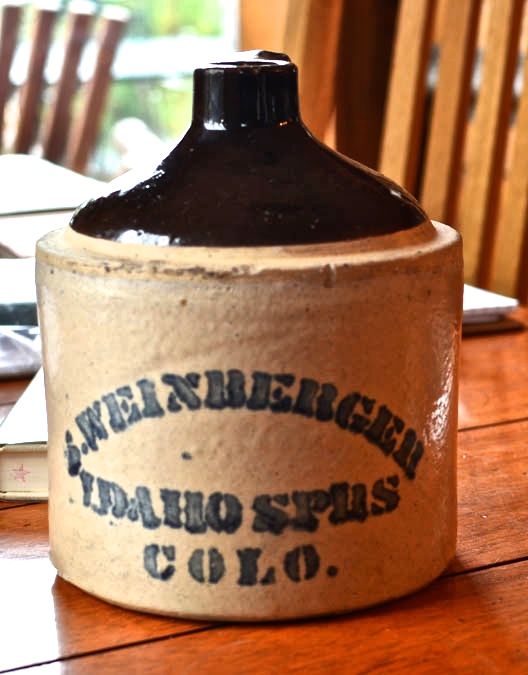
His wholesale and retail whiskey sales proved lucrative.   A railroad financed by Jay Gould, head Union Pacific, had reached Idaho Springs in 1877, opening access to freight.  As a result, Weinberger could obtain shipments of whisky in barrels through Denver.   Sol would decant them into one and two gallon ceramic jugs and sell them to the many other saloons that inhabited the town. As shown here, those containers varied from very rough pottery with crudely stenciled labels to more crafted stoneware jugs with lettering under an Albany slip glaze.


Sol’s containers are avidly collected today:  The jug above left recently fetched $332 at auction.  Weinberger also was selling whiskey at retail, using glass flasks holding a pint of liquor.  The bottle shown here with embossing of his name and location are indicative of his healthy trade.  Embossed bottles cost more than plain glass with a paper label.


Although Idaho Springs continued to exhibit a buoyant economy into the 20th Century, prohibition was making a statement in Colorado, first through local option laws and then a state law establishing a total ban on making or selling alcoholic beverages.   On January 1, 1916 — four years before National Prohibition — Colorado went “dry.”  Sol had no choice but to shut down his saloon and liquor business.  But he wasted no time in making another move.

Taking his profits from his Idahol Springs saloon, Weinberger said goodbye to Colorado for “wet” California, settling in San Francisco. The 1920 Census found him there, living on Hyde Street with Anna and their two sons.  Sol gave his occupation as “oyster salesman.”  Not long after, however, with Theodore Glauber, a relative of his wife, Weinberger opened a restaurant at 1510 Fillmore Street.  This was soon followed by a second eatery in which he appears to have been sole proprietor, located at 1106 Market Street.  

The San Francisco restaurant business must have been profitable for Weinberger.  By 1933 he had moved with his wife to this elegant large townhouse and at 69 years old, retired.  In 1937, Anna died at age 72 and was buried in Hills of Eternity Memorial Park in Colma, outside San Francisco.  

Sol lived on another 15 years, dying at the age of 87 in June 1952.  His small stature and labors in the hardscrabble America West clearly had not proved an impediment to longevity.  His grave lies adjacent to Anna’s.

Note:  The photo above of Sol Weinberger in his saloon has fascinated me for its depiction of the distinctly slight immigrant proprietor holding his own among the rough and tumble residents of a sometimes rowdy Western mining town.  It was displayed on the web in 2014 by a great-grandson, Mark Weinberger, who was operating a local history museum outside San Francisco.  He in turn credited Marjorie Bell of the Idaho Springs Historical Society for finding the photo, dated circa 1915.


Wednesday, January 1, 2020

William Boothby — Frisco’s Bartender Scribe


When the author depicted on the cover of a book he is trying to sell shows himself with the body and feet of a rooster, he signals a flamboyant, perhaps unique, personality.  That would be William T. Boothby, sometime politician, saloonkeeper, and famed San Francisco  bartender whose “drink books” continue to be available.

Boothby was born in San Francisco in November 1862 to “Forty Niner” parents who had come from the East to California during the Gold Rush of the mid- 1800s.   Although they did not find gold, his father from Maine earned a living as a baker and saloon keeper.  Upon ending his education in his early teens, William tried several occupations and, as one author put it, “…proved himself at a young age to have a great deal of that useful quality, hustle.”

After toiling at tailoring, clerking, and attendant for a streetcar company, Boothby’s skills at singing and dancing landed him a job with Dr. McConkey’s Vigor of Life Minstrel Company.  Traveling throughout the West, this troupe peddled a patent remedy later identified as a useless “alcoholic bracer” by medical authorities.  A natural show-off, William, now in his early 20s, shown here, thrived in the medicine show, billing himself as “The Great Boothby — King of Terpsichore.”  His signature stunt was dancing a jig on stage with a glass of water on his head.


Apparently tiring of the traveling life by the late 1880s, Boothby turned to the profession that would mark the rest of his life.  He became a bartender, serving out drinks at a variety of establishments in the San Francisco area.  An early job was at Byron Springs Hotel, a fancy resort about fifteen miles east of downtown.  The prestigious hotel and spa shown above, the Byron was popular place for Frisco residents to take the waters, including the fiery waters Boothby dished out.  In time he moved on to the Silver Palace saloon in the heart of San Francisco.


By 1891 Boothby was tending bar at the swanky San Rafael Hotel in the nearby town of the same name.  Self-described as the “Presiding Deity” of the Rafael barroom, he decided, wisely as it turned out, to publish a drink recipe book, aiming it at “all students of mixology.”  Calling himself “Cocktail Boothby” and the “Standard Authority,”  he advertised with the line:  “Bar-Keepers – You're Not In It If You Don't Read Cocktail Boothby's 'American Bartender’”.  An early edition is shown below.

In truth, at this time Boothby did not have a significant amount of bartending experience or know many drink recipes so he included other material.  It included his “Ten Commandments” for bartenders, that included: III.  Always appear pleasant and obliging under all circumstances.  “IV.  Avoid conversation of a religious or political nature.  VI.  Sell all the liquor you can, but use as little as possible yourself.”  He also tossed in several pieces of his own verse, including:

Just say to all smart booze clerks who question your sense,
And hold all your wisdom at naught:
You’ve been forced to turn knowledge away every night,
And you’ve standing room only for thought.

Boothby’s first edition also contained advice on how to rescue punky beer and tricks for artificially aging beer, using, believe it or not, pickled cucumbers and Seville oranges.  His drink recipes ranged from an Absinthe Bracer using the green liqueur and a raw egg, to the Zsa Zsa Cocktail, concocted of Dubonnet sweet wine, dry sherry and orange bitters.

His drinks book brought Boothby the kind of recognition he craved.  When offered a larger salary at the San Francisco’s Parker House, he jumped there.  The management gave him star billing, painting a life-size picture of him in his “cock’s tail” mode painted on the outside wall of the bar.  As his celebrity rose Boothby opened his own saloon and restaurant on Powell Street.

Riding on his personal popularity and as an authoritative author of a mixed drink book, Boothby decided to run for the California legislature.  Mark Twain might have understood what was at work:  “The cheapest way to become an influential man and be looked on by the community at large was to stand behind a bar, wear a diamond cluster pin and sell whiskey.  I am not sure but that the saloonkeeper had a shade higher rank than any other member of society.  His opinion had weight.”

In that era Frisco’s saloon owners had been organized into a distinct political block.  With their backing, William stood unopposed as the Republican candidate for the city’s Tenderloin neighborhood, the 43rd Assembly District.   In a later edition of his book he recognized this help with the dedication:  "To the liquor dealers of San Francisco who unanimously assisted in my election to the Legislature by an unprecedented majority.”   Serving only one term, he was recognized particularly for championing legislation that might positively affect San Francisco saloons and drinking public.  Thereafter he liked to be referred to as “The Honorable Willliam Boothby,”

The San Francisco earthquake and fire in 1906, devastating much of the city,  destroyed the printing plates for Boothby’s book.  That meant that the 1908 third edition had to be written largely anew, and could incorporate all that Boothby had learned in the meantime. It was chockfull of new cocktails and for the first time he gave named credit to other bartenders for many of the recipes.  Under the name “Cocktail” Boothby, he touted himself as “Premier Mixologist.”


Moving once again, William began working at the Pied Piper Bar of the Palace Hotel in downtown San Francisco, shown above.  It was there that he is said by some (opinions differ) to have invented the “Boothby Cocktail,”  to my mind a glorified Manhattan. Here is the recipe:

INGREDIENTS:
2 oz Rye whiskey
1 oz Sweet vermouth
2 dashes Orange bitters
2 drops Angostura Bitters
1 oz Brut Champagne, chilled
Garnish: Maraschino cherry
PREPARATION:
Add all the ingredients except the champagne to a mixing glass and fill with cracked ice. Stir well and strain into a chilled flat bowl champagne glass. Float some champagne on the top and garnish with a maraschino cherry.

Of Boothby’s personal life, little has been recorded.  The 1880 and 1900 Federal censuses showed him living with his mother, Sarah. There is no record of his ever having married.  He was a member of the Olympic Club of San Francisco, the oldest athletic club in the U.S. and a gathering place for the elite of the city.  As he aged, he donned a mustache, as shown here on a trade card.


Boothby continued as Frisco’s premier bartender until National Prohibition shut down all production and sales of alcohol.  Even then he found it hard to stop, continuing to serve drinks “under the counter” at the Orpheum Theatre Annex to his old customers. He was arrested there in 1922 for violating the Volstead Act and paid a fine.  Members of his loyal following stepped in to find him jobs, including one as a steward at the St. Francis Hotel.  In his mid-60s Boothby was diagnosed with cancer and died of the disease in August 1930, at the age of 68. His funeral was thronged with mourners, including an estimated 100 bartenders from across America, many of them grateful for mentions in Boothby’s books.  I have been unable to trace the bartender’s place of burial.  

Although William did not live to see Repeal in 1934, his drinks books would survive and provide the foundation for the thousands that have followed.  Shown here is a post-Prohibition copy of his “World Drinks and How to to Mix Them.”  Although this flamboyant “mixologist,” a man so careful of his image, likely would blanche at being referred to as “Cocktail Bill” he would be proud that his bartending legacy has traveled down the years.

Note:  Although this post has been gathered from a variety of sources, two proved to be most important in telling Boothby’s story:  A Difford Guide online biography by Theodora Sutcliffe, no date, and a story in The Daily Beast by David Wondrich, entitled “San Francisco’s Deep Cocktail Roots,” dated April 9, 2018.