Wednesday, August 17, 2022

Andrew Jackson: Tennessee Distiller


While a number of American presidents have been known to drink whiskey, only three are documented to have made it.  The first was George Washington whose distilling career has been widely described and his distillery reconstructed near Mount Vernon.  The second was Andrew Jackson.   By contrast with Washington, very little is found in the historical record about Jackson’s distilling activities.  This has not deterred others in the liquor trade, however, from linking the Seventh President to their brands.


The year was 1796 when Jackson, age 29, bought a farm two miles from the Cumberland River outside Nashville called “Hunting Hill” and made a home there for himself and his wife, Rachel.   His celebrity as the military hero of the Battle of New Orleans was almost two decades in the future.  The past few years had been tumultuous ones.  His marriage (and re-marriage) to Rachel, shown here, had engendered slurs on her character when it was discovered that her divorce from her first husband had not been concluded before their first wedding.  Jackson would fight multiple duels over her honor, one in which he killed a man.  From 1795 to 1798, he also had served without particular distinction as Tennessee’s first congressman and later as a senator.


My guess is that Jackson’s purchase of Hunter's Hill was an attempt at a quieter rural life where he and Rachel could be country gentry, largely insulated from public scrutiny.  The move also opened the opportunity for Jackson to become a distiller.  Although it is not clear if Jackson acquired the distillery with his purchase or built it himself, by 1799 he was operating two stills said to be capable of producing 197 gallons annually.  One reputedly had capacity of 127 gallons; the other was a 70 gallon pot still.


Shown here is the entry for Jackson’s whiskey-making operation in the official ledger of John Overton, the collector in Tennessee of the whiskey tax.  This first Federal excise tax was the revenue-generating plan of Washington's Secretary of the Treasury, Alexander Hamilton,  to repay the bonded debt owed from the Revolutionary War and to establish the fiscal standing of the national government. Because it was done on the backs of farmers, many of whom distilled their corn into value-added whiskey, the excise was widely unpopular in rural areas,  sparking the Whiskey Rebellion in western Pennsylvania (1891-1894).


Overton’s ledgers listed distillers in Tennessee by county,  The record details those who manufactured spirits, the number of pots or stills, the annual production of distilled spirits in gallons, and the amount of tax owed.  Jackson in Davidson County was recorded as paying his tax.


In June 1799, however, a devastating fire at Hunting Hill burned down Jackson’s stills, barrels and destroyed more than 300 gallons of aging whiskey.  The future President was required to pay the whiskey tax even though the whiskey was gone.  Authorities in Washington were all too aware that some distillers seeking to avoid the levy were hiding their whiskey, burning down their often ramshackle buildings, and then making claims for refunds.  No evidence exists that Jackson was among them.  In fact, he moved quickly to rebuild his plant.


Jackson subsequently made use of the one appeals process the U.S. government provided.  Petitions and claims on the controversial tax could be submitted to the U.S. House of Representatives.  There they were sent to a joint Committee on Claims, established in 1894,  to be adjudicated.   On February 12, 1803, Congress received the petition for a tax refund from Andrew Jackson.  Shown right, he expressed concern, possibly based on his own experience in the House, that he was totally reliant on that body to satisfy his claim.  Jackson said he had no doubt that: “A power to grant relief, in such Cases, was lodg’d in the hands of the Secretary of the Treasury, or in some other department of the Government;  he could not believe that the United States would draw Money from the misfortunes of her Citizens. 


The Committee on Claims reviewed Jackson’s claim and voted to reject it.  This may have been an indicator of Jackson’s lack of popularity among his former colleagues in Congress.  One historian has speculated:  “I like to think that Jackson was so furious about not receiving his money back that he decided to go into politics.”  


While living at Hunting Hill, Jackson had purchased 640 acres of adjacent land.  With his growing wealth from farming and land speculation, he sold this original homestead and built a new house there.  He called it “The Hermitage,” the mansion home, shown here that has come to be identified with him.


 The Hermitage was surrounded by a host of outbuildings.  They included kitchens, spring houses, an icehouse, carriage garage, dwellings for the overseer and the slaves,  blacksmith and carpenter’s shops, a cotton gin and press, stables, smokehouses, a sawmill and barns.  Most important for purposes here, The Hermitage outbuildings included a whiskey distillery.   Unfortunately, little has been written about this facility or Jackson’s involvement with it.  He soon would be brought away from his Tennessee properties by his immersion in the military activities of the young Nation and ultimately by the American presidency.


That absence did not discourage future distillers, however, claiming Jackson as one of their own. Sometimes the claim was pure nonsense.  Shown here are two ads for “Old Crow.”  In both Jackson is depicted serving up that brand to two other American political figures who would eventually become President on the Democratic ticket, James K. Polk and Martin Van Buren.  The ads are correct that both men were friends and allies of Jackson.  Both ads claim, however, that  according to an unnamed 19th century newspaper report, “Jackson favored Old Crow and praised it most highly.”   Baloney.  As a brand name, Old Crow emerged about 1855.  Jackson died in 1845.


More legitimacy attaches to one of several American whiskeys that use Jackson’s nickname of “Old Hickory.”  It was given to him by his troops for his tough-minded willingness to endure whatever his men were experiencing.  The nickname was first associated with whiskey when Fayette County, Kentucky, distiller John Robb produced "Old Hickory Sour-Mash Kentucky Copper" whiskey.  In 1868 the name gravitated to the E.R. Betterton Company of Chattanooga, Tennessee. [See my post on Betterton, August 10, 2013].   It later was used by other pre-Prohibition liquor houses to memorialize a national hero who was himself a distiller.

The tradition reaches down to today.  In 2011 the R.S. Lipman Company, located in Nashville, Tennessee, revived the brand name.  Shown here are bottles of “Old Hickory, Great American” blended and straight bourbons.  They feature labels bearing Jackson’s picture.   Primarily a wine importing company, Lipman markets these whiskey but they apparently were distilled in Lawrenceberg, Indiana.

Note:  This post contains information and images drawn from a wide variety of Internet and other sources.  The third President to operate a distillery was William Henry Harrison.  See my post of October 16, 2022.


.

Saturday, August 13, 2022

The Westermans Were Pekin’s Odd Couple

 Despite widely divergent reputations, seldom does a married couple dominate their city’s attention the way that Henry and Mary Westerman did in Pekin, Illinois, during the mid-1880s.  A favorite whipping boy of Pekin newspapers, Henry was a gun-toting distiller whose cheating on his revenue taxes brought him a federal arrest.  In contrast, Mary was a beloved, indefatigable worker for the welfare of Civil War veterans and Pekin civic betterment. 

Shown above, Westerman was born in August 1836 in St. Louis, the son of Conrad and Margaretha Lang Westerman.   When Henry was ten years old the family moved to Pekin.  There he attended public schools and went on to get a degree from Bell’s Commercial College in Chicago.  He returned to Pekin, shown below, to work as a clerk in a local dry good store.  In October 1856, he married Mary Leslie Gregg.  Henry was 20; Mary was 18.  They had four children only two of whom lived to maturity.


Westerman’s leadership qualities were evident early in his career. In 1861 at the age of 25 the voters of Pekin’s Fourth Ward elected him their alderman.  Apparently finding politics distasteful, however, he resigned the same year.  The post had brought Westerman in contact with Pekin’s mayor who owned a distillery he was seeking to sell.  Exiting dry goods, Westerman bought the plant in pursuit of wet goods.


Westerman clearly had an aptitude for the liquor trade.  Calling the distillery the “Pekin Alcohol Manufacturers Company," his whiskey was sold under the brand name “Crown.” The illustration below shows the extent of the facility.  Not only was it served by railroad, its location along the Illinois River allowed it as well to be connected to water transport, symbolized by a steamboat heading for the loading dock.


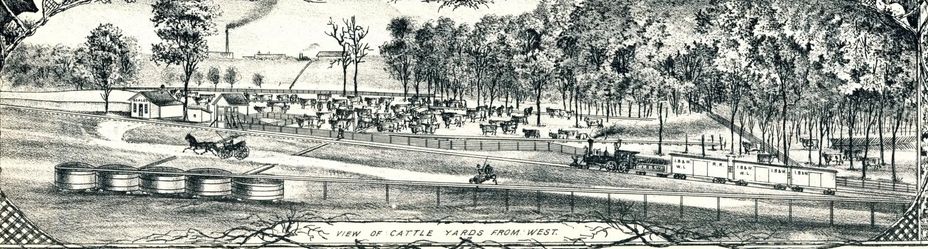
A second illustration depicts the large herd of cattle Westerman was grazing on a tract downwind of the distillery, seen in the background, and feeding on the spent mash from manufacturing process held in tanks.  Note that a railroad line runs along the edge of the property, suggesting that the railroad at the distillery was a spur.  All engraved illustrations here are from an 1873 publication entitled “Atlas Map of Tazewell County.”


A sure sign of the Westermans’ growing wealth and status in the Pekin community was the family’s impressive home, a large frame Victorian mansion the couple called “Rose Villa.”  The mansion was located on Washington Street at the head of Buena Vista Avenue, a street address now designated 420 Washington St.  Shown here, the property encompassed a sweeping driveway, numerous  walkways, and several outbuildings hidden behind impressive stands of large pines.  St.  Replaced by a subsequent owner in 1912 with a brick structure the property was added to the National Register of Historic Places in 1992.


Mary Westerman was making her own mark in Pekin.  Although only 23 when the Civil War Broke out, she immediately took a leadership role in the Soldiers Aid Society.  Despite her youth she served as president of the local chapter for two years and another two years as its secretary.  In his 1879 “History of Tazewell County, Illinois,” Charles C. Chapman, while giving her husband only a paragraph, devoted two pages of tribute to Mary.


Chapman wrote of her:  “Her natural abilities are superior and are carefully cultured by study and extensive travel. She is a woman of great energy and a firmness of purpose that has assured success in all undertakings….At the breaking out of the Civil war, although young in years, Mrs. W. proved a woman of great foresight and executive ability, being a leader of what may well be denominated the "home guards," that noble army of women of whom history is silent, but from whose courage and generous aid the soldiers drew much of the inspiration which brought success to their arms.”


Mary's Letter

One notable success was Mary’s ability to importune The White House for autographed photographs of Lincoln to be auctioned off to raise money for the Soldiers Aid Society.  When her letter apparently went unanswered, she wrote the President a second time:  “I cannot give up the idea of our President giving us something. If you remember I stopped you at the White House steps on one Cabinet day and you asked me what I wanted you to do. I told you and you said that you were worn out and could not go up again for anything but said you would remember my petition.” 


“Now this time if you cannot conveniently give us anything else we insist on you send a large picture of yourself which we can make a great deal on it. It is the earnest wishes of our Soldiers Aid Society that you would do something as it would inspire others to donate.”  Mary went on to insist she was not an impostor and her identity could be be verified.  Lincoln’s secretary sent her six small signed photos, two of which are shown right.


Mary’s fair raised $3,163 for the Union cause.  The Soldier’s Aid Society, however, was roiled about how to spend the money.  A majority of the board wanted to buy religious tracts and Bibles to distribute to soldiers.  Insisting that the funds go for clothing, medicine and sick room supplies, Mary hired a lawyer who filed an injunction.  Mary was pilloried in several local papers as a Southern sympathizer but prevailed.  Author Chapman commented:  “Knowing the righteousness of her cause, she persevered with the true courage which rises superior to taunts and scoffs, and in the end was her complete vindication.”  Later Mary would be hailed for her contributions to the Pekin Public Library for her prominent role in founding the Ladies Library Assn., its forerunner.


While the Westermans were enjoying their prosperity and social status in Pekin, a major scandal was brewing.  During the Civil War the federal government had put a tax of $2 a gallon on every gallon of whiskey produced.  In an attempt to avoid the levies, a conspiracy that became known as “The Whiskey Ring” was formed involving distillers, “rectifiers (blenders), and corrupt government officials.  As much as 2/3rds of liquor taxes were being avoided.  Beginning in St. Louis, the revenue conspiracy spread to cities across the Midwest.  Among them was Pekin.


As the local press reported, Pekin’s large city cisterns, meant to hold water for fighting fires, surreptitiously were drained and filled with highly flammable whiskey.  Liquor also was said to have been stashed away in corn stalks and in hundreds of wooden kegs sealed and sunk in the Illinois River.  In one reported incident an honest revenue agent was arrested by Pekin authorities and held in custody on a trumped up charge while a boatload of illicit whiskey was cleared off the dock and hidden away.  Identified as the “kingpin” of this criminal enterprise was Henry Westerman.  


In December 1875, a Federal District Court issued a warrant for Westerman’s arrest.  He was charged with frauds perpetrated at his Pekin distillery, specifically for refusing to produce the books of the Pekin Alcohol Manufacturing Company during the period of the conspiracy.  The penalty was from $500 to $5,000 and six months to ten years in prison.  More than 300 individuals were arrested as participants in the Whiskey Ring but only 110 ultimately were convicted in federal court.  They tended to be the “lesser fry” in the scheme and many of those at the center of the Whiskey Ring paid fines but were not sent to jail.  Westerman appears to have been among them.  


Elements of Pekikn’s press were not shy in pointing out that the accused former head of the Pekin whiskey ring was still at large.  This enraged Westerman.  Among his antagonists was William H. Bates, the editor of the Tazewell Republican.  Westerman, a Democrat, made headlines in November 1881 when he threatened Bates at his paper while brandishing what was described by the Peoria Journal as “an immense Missouri bushwacker’s rifle.”  The threat was unambiguous to Bates and other critics.  The same paper reported that the editor of the Freie Presse,  “with blood in his eye and his ears flopping,” was marching around Pekin with a shotgun over his shoulder, apparently hoping to encounter Westerman. “All the editors here appear to be on the warpath,” the Journal opined. “Peace, peace, brethren.”  Eventually tempers cooled all around.


Despite Henry’s dubious reputation, the Westermans were considered among the  influentials in Pekin.  Perhaps some of Mary’s community work helped leaven her husband’s “bad boy” image.  In 1897 she died in Pekin at the age of 59 and was buried in Pekin’s Lakeside Cemetery.  Mary’s gravestone is shown here.  


Mary may have been the anchor that kept Henry in Pekin despite the negative press. They had been married for 41 years.  After her death Westerman promptly moved to California where he resided for the next 25 years, living with a daughter in San Francisco.  He died there in May 1922 at the age of 86.  His body was returned to Pekin where funeral services and interment occurred.  Although buried at Lakeside Cemetery, Westerman’s grave was left unmarked, perhaps to deter any revenge desecration.


Note:  This post would not have been possible without the diligent work of Jared Olar, an assistant at the Local History Room of the Pekin Public Library.  In several articles that deal with Mary and Henry Westerman, Mr. Olar draws on a rich body of resources to tell their story. 


Tuesday, August 9, 2022

J. J. Murphy and Texas Tales from the Ruby Saloon


Joseph John (“Joe”) Murphy, who spent more than a quarter century as its proprietor, boasted that his Ruby Saloon in Palestine, northeast Texas, was: “One of the oldest and best conducted Liquor Establishments” in the Lone Star State.  Even so, Murphy would have to admit that as the site of dismantling Santa Anna’s knee buckle and a deadly shootout triggered by Palestine’s telephone service, sometimes the West could still be wild at the Ruby Saloon.

Palestine, Texas 1880s

Murphy was born in New Orleans in 1863, in the midst of the Civil War when Union troops ran the city.  His father, John C., an immigrant from Ireland, died when the boy was only four. He and a sister, Mary Ellen, were raised by a single mother, Ellen Mary McGrath.   At some point the family  moved to Paris, Texas.  In the late 1880s Murphy relocated 140 miles south to Palestine, a relatively small Texas city and the seat of Anderson County.  There he founded the “The Ruby” saloon about 1888.


Shown above is Spring Street, the principal avenue of Palestine.  Murphy’s establishment was near the center of the town’s business district and adjacent to Palestine’s major hostelry, the Lindell Hotel.  This made for lively trade not just from locals but also visitors to town.   Murphy believed in the power of advertising and his trade cards left no doubt that “The Dear Old Dollar” was welcome at The Ruby to buy “whiskies, wines and alcohol.”  He saluted the coin in verse: 


How dear to our hearts is the old silver dollar.

When some kind customer presents it to view—

The liberty head without necktie or collar.

And all the strange things that to us seem so new;

The wide-spreading eagle, the arrows below it,

The stars and the word with queer things to tell.

The coin of our fathers! We’re glad we know it,

For some time or other ’twill come in right well—

The spreading dollar, the old silver dollar,

The big welcome dollar we love so well.


Although extolling the dollar, Murphy offered his customers bar tokens toward future drinks coins worth 12 and 1/2 cents.  As shown below, the Ruby Saloon tokens came in several formats.  He also provided advertising shot glasses to his clientele.


As a result of his success as a saloonkeeper, Murphy could advertise in 1914 that he had been in business for more than 25 years.  By that time the Irishman had amassed a wealth of experiences from the history of “The Ruby.” Here are two of them:


Santa Anna’s Knee Buckle


Murphy would be able to recount the day that Texan William Broyles brought to The Ruby Saloon the oval knee buckle of Santa Anna, the former president and military leader of Mexico during the Mexican War with the United States.  Santa Anna, shown here, was fond of the ornamentation that went along with the uniform of a high ranking Mexican officer.  After the Battle of San Jacinto in 1836, Santa Anna escaped but was captured the next day.  During the next three weeks the general was held prisoner by the Americans until he signed the peace treaty that led to Texas independence.


During his captivity, it appears that Santa Anna’s uniform was stripped from him, including his oval jeweled knee buckles.  Shown here, this was an ornament composed of a metal base and originally set with 22 square jewels, described only as “brilliants.”  These might have been diamonds but more likely other clear stones that were cut to emphasize their light-flashing facets.  Set at intervals along the bottom edge of the oval pin were four additional rounded gems.  


Look closely at the ornament, shown here, and note that four of the jewels are missing.  That is where Murphy’s saloon gets involved.  The story goes that this trophy from a defeated enemy was given to the victorious General Sam Houston.  It subsequently was held by the Houston family until Sam’s daughter, Elizabeth Houston Morrow, for reasons unknown gave it to William Broyles.   A patron of Murphy’s saloon, Broyles showed up there one night, possibly a bit of “the drop taken,”  pried out four of the “brilliants” and gave them to friends along the bar.  Today the knee buckle, still lacking the four jewels, resides under glass at the Museum of History in San Jacinto.


A Shootout over Telephone Service


Perhaps the most bizarre of all the shootouts—and killings—in Texas history originated at the Ruby Saloon.  Incredibly, the gunplay erupted over a complaint about Palestine’s telephone service. 


R. J. Hiatt was a traveling salesman for the Dallas-based Jesse French Piano Company. His territory included Palestine and Hiatt spent much of his time in that city.  Encountering a co-owner of the local telephone company,  A. P. Henderson, outside the Ruby Saloon, Hiatt accosted him, shouting that Palestine’s telephone service was rotten.  He could not converse over the phone, the salesman said, without being cut off.


Henderson was well aware of the problem. He pointed out to Hiatt that he was being disconnected because of the profanity he frequently used on the telephone.  His language was deemed not fit for young female operators to hear.  Women at the central office objected to Hiatt’s foul mouth, Henderson said, and were “plugging him out.”  The salesman objected to the allegation and called Henderson “a damn liar.”  Henderson swung on Hiatt, breaking his nose which bled profusely.   Bystanders intervened, ending the fight—for the moment.  


As reported in the Palestine Daily Herald on September 16, 1905, Hiatt “had a doctor to dress the nose, and those who observed him afterward, said he brooded over the matter all the afternoon, not saying much or making threats, but his attitude was such that friends, it is reported, warned Henderson to look out, that they thought Hiatt had armed himself. Henderson is reported to have replied in a light vein that he was not afraid; that he could take a pistol away from him, if he should attempt to use it.”


The telephone company co-owner was unwary and it cost him.  That evening about seven Henderson was in The Ruby with friends when Hiatt walked in the front door.  Shouting “that son of a bitch broke my nose,”  the piano salesman began firing.  One of three bullets found Henderson’s thigh and he slumped to the floor, badly wounded.  Others grappled with Hiatt and took the gun from him before he could fire again.


Hiatt then attempted to escape by running into the Lindell Hotel next door where he had a room on an upper floor.  He began to climb the stairs.   The newspaper reported:  He was soon followed by City Policeman Jeff Watts. A few seconds later a pistol shot rang out, and parties rushing upstairs found the officer and Hiatt together in the hall, and Hiatt was shot through the body. The man lingered in great agony for thirty or forty minutes, and died….From appearances… he was shot through the back, just to the right of the spinal column, and the ball passed entirely through the body, coming out just to the right of the navel.


Policeman Watts later said he was unaware that Hiatt no longer had a gun when he fired at the fleeing salesman.  Nevertheless, Watts, the brother of Palestine’s sheriff, immediately was arrested and incarcerated in the county jail, awaiting an investigation.  Meanwhile in a local hospital Henderson’s condition while serious was said by doctors not to be life-threatening.


As for the disposition of Policeman Watts, my guess is the statement he made following the killing proved sufficient to exonerate him:  “…He arrived on the scene just after the shooting of Henderson, and hearing that Hiatt had gone in the hotel, followed him, and being told that Henderson had been killed supposed the man was still armed, as he swore to kill an officer if he followed him. They ran onto the third floor, where the shooting took place. Watts says he shot…in self-protection, as Hiatt kept threatening to kill him if he came on. He did not know until afterwards that Hiatt had been disarmed.…  My assumption is that Watts’ testimony, combined with his ties to the sheriff, were sufficient to exonerate him.


The Rest of the Story


With the coming of statewide prohibition to Texas in 1919, Murphy was forced to close down his drinking establishment and while still only 51, census records indicate, turned to operating a drug and tobacco store.   Married at 30 in 1893 to Ella Orena Wheeler, a local Palestine woman, Murphy would sire three sons and a daughter.  After 1905 he housed his family in a spacious home at 1403 North Queen Street in Palestine, shown here.


Joe Murphy lived to be 80 years old, an advanced age for that time.  He must have mused frequently about his decades spent running “one of the oldest and best conducted liquor establishments in Texas.”  But even the Texas saloon owner would have to admit that at times events at the Ruby Saloon could get out of hand.  Murphy died in October 1943 and was buried in Saint Joseph’s Cemetery, Palestine,  He was joined in the grave by wife Ella five years later.  Their joint monument is shown here.


Note:  I was drawn to the story of J.J. Murphy and The Ruby Saloon by the trade card that opens this vignette.  It led me to the stories of Santa Anna’s buckle and the shootout over disconnected telephone calls.  For the latter incident the story as reported by the Palestine Daily Herald, referenced above, was a crucial source.


Friday, August 5, 2022

Whiskey Men as Pioneer Western Merchants


Foreword:  In reciting the line of occupations that pioneered the American West, the storekeeper often gets left out of the conversation despite the important role those entrepreneurs played in developing and civilizing life in remote places.  For many of these men selling whiskey was essential to the profitability and sustainability of their mercantile efforts.  Here are the stories of three such Western merchants.


Harry Gesus was among the Jewish pioneers who helped build the frontier American West by striving to meet the mercantile desires, including liquor, of growing populations in Wyoming, Idaho and Utah.  Henry’s efforts, however, were thwarted by greedy mine owners and exacted a high family cost in the premature death of three children.


During the 1890s, a decade of economic recession, Gesus and his wife with their five children moved west from New York City to Kemmerer, Wyoming, shown below, an upstart mining town created by finding rich coal deposits nearby.  With a brother Gesus opened a clothing and dry goods store there, soon expanding to two other boom towns in the region.  All were company-owned settlements where coal mine operators dictated many of the condition of life for residents.  Seeing the mercantile success of the Gesus family, owners pressured workers to use the company stores instead.  The Gesus stores closed.


Gesus moved on to Blackfoot, Idaho, a town that called itself "Potato Capital of the World.  There he abandoned selling long johns and embraced liquor. He opened a saloon and liquor business he called the Kentucky Liquor Store, selling both at wholesale to local saloons and restaurants and at retail. Although living conditions in Blackfoot were better than Kemmerer, sanitary conditions were similarly poor.  Outdoor privies were often crudely constructed and water supplies polluted.  Doctors were few and often badly trained.  Hospitals were non-existent.  After having one child succumb in Kemmerer, two more Gesus children died in Blackfoot.


Gesus did not linger long in Idaho.  Perhaps the memories were just too bitter.  The family moved to Price, Utah, a mining settlement 120 miles south of Salt Lake City.  In Price Harry Gesas opened another liquor store, advertising himself as “The Whiskey Merchant.”  Again he was selling at both wholesale and retail, buying whiskey by the barrel and decanting it into ceramic jugs for his customers. When Utah went “dry” in 1917, Gesus made a final move to Salt Lake City, where his three children lay buried.  There he sold tobacco.


Terming the Mormon leader Brigham Young a “whiskey man” might strike some as an absurdity, given the injunction against strong drink that has been a traditional teaching of the Church of the Latter Day Saints.  The facts seem otherwise.  For example, in 1873 at Young’s request the territorial legislature granted him the exclusive right to manufacture and distribute whiskey and other spiritous liquors in Utah.  “Valley Tan” was the name of his principal brand.


Another link from Brigham Young to Valley Tan was through the large mercantile store the leader established to provide necessities to Mormons in Salt Lake City.  He ostensibly acted on the belief that non-Mormon “Gentile” local merchants were gouging his people.  Young called the establishment “Zion’s Cooperative Mercantile Institution” (ZCMI).  The store, shown below, sold Valley Tan.   That could never have occurred without the leader’s blessing. 


ZCMI became a formidable business force, eventually manufacturing its own of boots, shoes, and a line of work clothes. It also sold everything from housing needs, lumber, nails, and the like, to household needs such as fabric, needles, thread, food preservation products, furniture, and draperies, even some beauty products.  In effect ZCMI nearly everything the pioneers needed to survive and thrive.  Some have called this the first real department store west of the Mississippi. It continued to be church associated until 1999.


The photo above of Sauer-McShane Mercantile in Central City, Colorado, shows a several men posing on the sidewalk in front of the building.  Among them likely were Otto Sauer and John McShane, two entrepreneurs who opened the first general store in a Colorado mining town that was virtually nothing but an assemblage of wooden shacks.  With whiskey as a major seller, the partners eventually made their enterprise a retail giant.  They recognized that an immense amount of money from gold, silver and other metals was being unearthed and available in that part of Colorado.  Area mines annually were producing the equivalent value today of $75,000,000, mostly in gold, and many mine owners were exceedingly rich.


Men of wealth often had wives or mistresses that they wanted dressed in the best finery.  Sauer-McShane obliged by featuring tea and floor length dresses, laced shoes with high heels, straw and fabric hats with elaborate decoration, and bows, gloves, and brooches.  While such fashionable garb might have been available in Denver, that city was over the mountains.  Sauer-McShane could provide haute couture close to home and the male partner’s cash box.


As a result, among the store’s clientele were two of the most talked-about women of the West.  Elizabeth “Baby Doe” Tabor, shown here, was the wife of Horace Tabor, a wealthy silver magnate and future U.S senator who had divorced his wife of 25 years to marry the beautiful Elizabeth although he was twice her age. The marriage set off a major scandal in Colorado.  Baby Doe, as she became known in media coverage nationwide, had plenty of money to spend with Sauer-McShane until Tabor lost all of his in the Panic of 1893.


The other woman was Alice Ivers, shown here.  When her husband was killed in a mining accident in Leadville, Colorado, she was in difficult financial straits and turned to playing cards for a living.  Shown here, Alice used her good looks to distract men at the poker table.  She was also very good at counting cards and winning big pots, that helped her become known throughout the West as “Poker Alice.” Ivers always wore the newest fashion dresses, many bought from Sauer-McShane.


By 1895, the Sauer-McShane store was doing the current equivalent of $5,000,000 in sales annually.  The need for more space resulted in their building a new warehouse. It still stands today, bearing their name, and is on the National Register of Historic Places.


Note:  More extensive material on each of these three vignettes is available elsewhere on this website:  Harry Gesus, April 23, 2021;  Brigham Young,  August 18, 2016; and Sauer-McShane, April 19, 2018.