Wednesday, January 2, 2013

The Netters: “Wherefore Art Thou, Brother?”


The Netter boys were successful in the liquor trade in Philadelphia for a very long time as a band of brothers. Over time, however, each brother broke with the family business and set up on his own.   What caused the Netter brothers breakup has been lost in the mists of time.  Left to us are the bottles that defined the businesses.

The Netters were born of German immigrants who settled initially in California, possibly as participants in one of the gold rushes that regularly swept over Western landscapes.  Eventually the family migrated East.  There were four brothers:  Henry H., Seligman, David and Theodore. Theodore gave his birth year as 1865 in California. Their liquor store first shows up in city directories in 1886, located at 2323 N. Second Street in Philadelphia.  They called it Netter Bros. Company.  Within three years they had moved to larger quarters at 732 Third Street, near Brown Street.  This address is memorialized on an amber flask shown here.  The trade mark, in detail, is an enigmatic one:  a woman standing next to a shield inside the Man in the Moon.  The company used the brand name “Golden Gate All Rye,” perhaps reflecting the brothers’ West Coast origins.


Initially, according to Philadelphia business directories, three Netters were proprietors:  Henry H., David and Theodore.   Four years later they had been joined by a fourth sibling,
Seligman.  The first brother to defect appears to have been Henry.  In 1893 he appears in directories as Henry H. Netter & Co.  There his firm was noted as: “Producers of California and Ohio wines and brandies and Pennsylvania rye whiskies.”  Henry’s brands included "Del Monte Rye Whiskey,”"Highground,” “Roxana” and "Pen & Pencil.”  The last was his flagship brand, trademarked in 1905.

The next Netter to open his own business apparently was David in 1898. In partnership with Jacob Marcus he opened a store at 441-445 Market Street.  He was shown as a a wine & liquor dealer, importer, distiller and proprietor of “Telegram Rye.” David issued a series of shot glasses advertising that brand and on a cobalt bottle, both shown here.  The bottle claimed David Netter to have won a 1900 prize in Paris for his whiskey.

Seligman, perhaps as early as 1900,  opened his own liquor store under the name “S. Netter.”  Although several address are given, he appears to have located at several addresses on North Third Street until 1911 when he moved to 736 Arch Street. Seligman’s company used the brand name “Ryvalley Whiskey, for which it issued a shot glass, shown here. Seligman also continued to be listed as running Netter Bros., which he shut down in 1907 after a 21 year business life.

Although Theodore Netter was listed with Netter Bros. until 1900,  at least one author, rightly or wrongly, has blamed him for the breakup, citing intra-family tensions. Sometime in the late 1890’s Theodore, with his wife, Hilda,  established their own liquor business.  After initial beginning at 54 North 13th Street,  the firm moved to its permanent base at 1232 Market Street, next to Philadelphia’s Savoy Theater.  From 1907 to 1914 Theodore also had a branch office in Chicago.


The 1910 Census found him and Hilda living with his brother-in-law,  Benjamin Lyons and family, in Philadelphia 37th Ward.  Theodore was 45 and listed his occupation as “merchant, liquor.   Lyons is listed as a “salesman, liquor,” leading to the conclusion that the two also had a business relationship.  The Theodore Netter firm used a number of brand names, including "American Perfection,” "Crystal Creek Rye,” "Juniper Leaf Gin,” "Lord Cecil Gin",”"Netters Famous No. 10 Rye, "Netter’s Silver Label", and "Old Phillie."

Although Theodore packaged his whiskey in the usual quart size, he also became known for issuing his whiskey in unusual glass containers   Among them was a barrel shaped bottle that said “Greetings.”  It may have been a giveaway at holiday times. Theodore’s barrel came in clear, as the one shown, aqua and cobalt.  Even more unusual were Theodore Netter’s pigs, issued in clear and amber.  They may have held rum.  Some pigs bore the practical message that after draining the whiskey,  the porker should be filled with sand and used as a paperweight.

When Prohibition arrived, all four brothers were forced to shut down.  By 1919 Seligman had moved to 818 North Broad Street and was running an auto supply store, according to Philadelphia directories.  David remained at his address but his firm became “merchandise brokers.” Theodore seems to have gone into the cigar business,  advertising in 1920 that he was selling Havana cigars for $3.50 a box of 50.  A 1921 listing shows him involved in “dining.” Apparently he died not long afterward as Hilda Netter was listed as a widow in 1925.

Not withstanding Theodore’s death, after Repeal his firm’s name reemerged in the whiskey business, advertising liquor in regional newspapers and selling Crystal Creek whiskey for $1.15 a fifth.
Whether any of the family members were involved is unclear.  Shown here is a post-Prohibition Netter bottle,  identified by the requirement to list “proof” on the label.

Was Theodore the problem child who broke up the Netter Brothers? He had a penchant for running afoul of the pure food and drug laws, being fined twice for adulterating his wines. In his advertising he continually emphasized that this Netter had only one store -- indicating that  he saw his brothers in definite competition.  His was, Theodore claimed, “the largest and leading liquor store.”  As to why the brothers all went their separate ways, however, the story remains untold.

Note:  Telling the Netter Bros story in a few paragraphs is not easy because of difference among sources as to dates and addresses.   I have tried to use the most likely information, but suspect that there are important gaps here.


Tuesday, January 1, 2013

The Goldsboroughs: Blue Bloods of Baltimore Booze


As an aristocratic Maryland family, the Goldsboroughs ranked at the top.  The two Charles Goldsborough,  father and son, did not rise to the apex of the Baltimore business and social world merely because of blood lines, however, but because they made good whiskey and scads of money selling it.

The Goldsborough ancestors came to America from England in 1639, settling in Maryland.  The paternal grandfather of Charles Senior had been a Governor of the state, as had been his mother’s father.  Charles father, William, was a state senator.  The ancestral manor was located on large fertile acreage south of Cambridge, Maryland.  Known as “Horn’s Point,” the Goldsborough spread was described by contemporaries as “second to none as a plantation.”


Charles Senior was born in Annapolis in 1839.  Father William saw to it that his heir received a thorough education and Charles completed his education, age 18, at the prestigious Balmar School in West Chester, Pennsylvania.   He entered business life in 1857 working for a Maryland shipping company and quickly rose in the ranks. 
 
When the Civil War broke out, despite Maryland staying in the Union, Charles cast his lot with the Confederacy.   It is likely that the Goldborough plantation used slave labor and that may have help shape his decision.   He was immediately commissioned an officer in the Confederate Navy,  an appointment influenced by his uncle by marriage,  Franklin Buchanan, the only full admiral for the South.  Quickly disillusions by life aboard a gunship, Charles quit the Navy and enlisted in the First Maryland Light Artillery.  He saw action in several battles, including Gettysburg, and surrendered with Lee at Appomattox.

Despite the fact that the Civil War pitted Marylander against Marylander, and even Goldsborough against Goldsborough, Charles returned home, apparently without any rancor, to reenter business in 1865 as the head of the Baltimore firm of Goldsborough and Tate. That company was listed in local business directories as “jobbers and dealers in wine, brandies, and whiskies.”   The same year he also got married.  His bride was Mary Galt, the daughter of James Galt,  an opulent planter and owner of 4,000 acres of good farmland in Fluvanna County, Virginia. Charles was 25 years old and Mary was 18.  From this union eventually would come seven children,  including Charles Junior, born in 1870.

In ensuing years the elder Goldsborough continued running a successful liquor trade on Baltimore’s South Gay Street.  Alfred Ulman was conducting a similar business just down the street.   By 1878, the two had decided that cooperation was better than competition and so combined their two firms as the Ulman-Goldsborough Company.   Soon after the merger the partners contracted to take all or most of the whiskey being made at a distillery in High Spire, Pennsylvania, just down the Susquehanna River from Harrisburg.  It had been founded by a Welsh immigrant named Robert Wilson in 1823.  He and his family had run the distillery until 1870 when they sold it and a succession of owners ensued.


Goldsborough and Ulman apparently found the contractual relationship with Wilson’s less than satisfactory and in 1887 the partners bought the plant and ran it themselves, calling it the “High Spire Distillery.”   They promptly appropriated the 1823 founding date for their own advertising purposes and moved their flagship brand from “Atlas” to “Wilson.”  Their offices were at 41 South Gay Street with a sales outlet at 100 North Broadway in Baltimore.  Eventually they built a large bottling plant on Belair Road.  Under their ownership,  Wilson Whiskey achieved a national reputation for quality and sales soared.

 
Soaring too was Charles Goldborough’s reputation in Baltimore business and social circles. During this period he was president of both the Merchants’ and Atheneum Clubs, and governor of the Maryland Club, the oldest in the city.  The Merchants’ Club was described as “the most influential, opulent and potent citizens of Baltimore.”   Charles Senior was a member of the Elkridge Fox and Hunting Club and held memberships in both the Manhattan and Commercial Clubs of New York City.

Meanwhile, he was seeing that Charles Junior was being groomed to manage the family enterprise.  The son entered the firm at the bottom rung and was said to  have been employed in every department in order to achieve mastery of it.   Both Goldsboroughs were on hand for the disastrous news that came to them on June 17, 1893.  As reported by the Williamsport PA Daily Gazette and Bulletin,  a fire had left the High Spire Distillery in ashes. 


Suspected to be of incendiary origin, the flames had raced through the entire complex.  Within an hour the plant, including the buildings, a large bonded warehouse containing 5,000 barrels of whiskey, a barrel factory and the office were in ruins.  Fire departments from Harrisburg and Middletown were dispatched and prevented the fire from reaching nearby homes.  Two large warehouses containing an estimated 12,000 barrels of aging whiskey also were saved.  The loss, though partially insured, was put at $200,000 (20 times that in current dollars) and fell mainly on the Ulman-Goldsborough Company.   Undeterred, however, the partners almost immediately began restoring the property.  The rebuilt distillery was said to yield 1,000 barrels of whiskey per day and was capitalized at $500,000.


Meanwhile, their whiskey was building a reputation as high quality liquor.  It was called “That luxury whiskey of bon vivants known the world over as Wilson Whiskey.”  In its advertising the company did nothing to dispel the image.  A trade card shown here pictures just such a bon vivant.  The whiskey also became known for the brevity of some ads that read, “Wilson, That’ s All.”  It ran as full page ads, prompting considerable comment.   One writer opined tongue-in-cheek about its brevity:  “What a nice time the Wilson copy man must have had....He had leisure....”  A Brooklyn minister gave a sermon he entitled “Whiskey - That Isn’t All.”

The brand was also noted for being sold in bottles, quart and smaller containers, to the public.  Nor did the firm neglect giving advertising items to their saloon patrons.  Over the years Wilson Whiskey was featured on an array of signs suitable for hanging in drinking establishments,  some fashionable, some risque, some colorful.  Shown here, the Wilson sign of signs appeared on the wall of a tall building in Chicago.  The sign touted itself as “the largest picture in the world.  It depicts a distinguished gentleman shooting seltzer into a glass containing whiskey.  It helpfully provided the dimensions of the image, including the factoid that the man’s head was 38 feet high.  “Wilson High Ball, That’s All,” topped the display.

About 1900, changes occurred in the company structure.  The Ulman-Goldsborough Company disappeared from directories.  In its place by 1901 was the Highspire Distilling Company, in which the Goldsboroughs were said to have a controlling interest.  Its first address was at the corner of Calvert and Baltimore Streets.  Not  long after the Goldsboroughs moved into this new enterprise,  Charles Senior died in May 1903, age 64.  He left his son, photo shown below, to run the business.


Charles Jr. appears to have been cut from the same enterprising cloth as his father.  Under his management High Spire Whiskey became increasingly popular.  This Goldsborough continued the tradition of giveaways to saloons, notably back of the bar bottles.  In 1907, probably spurred by the 1893 fire at his distillery, Charles Junior also founded the Distillers Mutual Fire Insurance Company in Baltimore. Although failing to match his father elections to positions in the top clubs of Philadelphia, Charles Jr. was a member of the Baltimore Country Club and the Baltimore Athletic Club.  Apparently a bachelor all his life, this Goldsborough’s interests seem more scholarly than social.  He was a member of the Maryland Historical Society and the Original Research Society.

Charles Junior continued to run the Highspire Distillery until it  was forced to close down in 1919 because of National Prohibition.  One Temperance publication gloated that the facility in 1923 had been turned into a hosiery manufacturer, commenting on the suggested irony that many children had gone without socks because of money wasted on whiskey.  After Repeal other members of the Goldsborough clan reopened the distillery in 1935 and it operated into the 1950s. 


Saturday, December 1, 2012

This Monarch Was Acclaimed Whiskey "King"


Martin Van Buren (he preferred M.V.)  Monarch built a distilling empire that led him to be acclaimed “King of the whiskey trade in Kentucky.”   Moreover, this Monarch, shown here about age 40, was reputed to be an every inch a exemplary leader: “handsome, courteous, generous, wealthy and honest.”

Monarch was born in Daviess County, Kentucky in 1842.  His parents were Thomas and Susan (Daviess) Monarch They had ten children of whom only six lived to maturity.  Thomas Monarch may have been in the whiskey trade himself;  three of his sons became distillers. Thomas apparently was wealthy enough to send M.V. to private schools in Owensboro and to continue his education well past that of most young men of that time.  The young Monarch in his early 20s attended Cecilian College,  a classical institution of learning in nearby Hardin County.


M.V. entered business life engaged in the tobacco trade for several years until 1867.  That year he began distilling whiskey in a small way in Daviess County, about five miles west of Owensboro, a town of about 15,000, shown here.  At this facility he was able to produce only one barrel a day.   His product apparently was an immediate success because by the following year he had erected another distillery about one and one half miles east of Owensboro.  There, initially, he was able to make five barrels of sour mash whiskey a day.

This site proved to be an unusually good natural location for a distillery and the quality of the water with which it was supplied.  The water was obtained from deep wells,  85 feet below the surface and held at a steady temperature of 56 degrees the year around.   It was said to be “clear as crystal” and imparted a flavor that was unique to Kentucky and elsewhere.
In the meantime, Monarch had found time to marry.  His bride was Elizabeth Ann O’Bryan, a native of Meade City, Kentucky, and daughter of William and Mary A. (Vowels) O’Bryan. The Monarchs would go on to have six children, five of whom lived to maturity.  They were Henry, born 1872, Daniel 1874, A. Ermenie 1876, Martin Van Buren Jr. 1878, and Bineta 1881.


In 1873 tragedy struck Monarch’s enterprise.  That March a distillery boiler exploded and blew parts 200-300 yards into the nearby river.  Two African-American employees were killed.  Undeterred by this setback, M.V. continue to expand his distillery.  By the spring of 1880 he was turning out 20 barrels a day.  He also was feeding the spent mash to a herd of cattle.   Shown above is a contemporary illustration of his operation.  

In 1870 Monarch had hired a younger man named Peter (P. E.) Payne, who turned out to be a super salesman for his whiskey.   Payne subsequently married Ann Monarch’s sister,  Mary Ellen O’Bryan, becoming M.V.’s brother-in-law.  In 1880 with Payne as Vice President,  M.V. incorporated as the Sour Mash Distilling Company.   By this time he had gained a national audience for his whiskey,  a result of its quality and Payne’s exertions in merchandising aided by a team of three or four traveling salesmen.  The company opened offices in New York City and Louisville and maintained agents in Chicago and Dallas.  The Texas Monarch outlet is shown above left.

As the reputation of his whiskey grew, so did Monarch’s standing in Daviess County.  In 1881 he became a director of the First National Bank of Owensboro.  The following year he became a director of a gravel company that had contracts to upgrade the roads all around Owensboro.   A strong Roman Catholic, about this time M.V. founded the city's St. Vincent de Paul Society,  a volunteer organization aimed at assisting the poor of Daviess County

Named after a former Democratic President,  M.V. was an adherent of that political party and in 1882 was elected as a Democrat to be an Owensboro councilman.   Two years later, however, he broke with his party and its candidate,  Grover Cleveland,  and backed the Republican, James G. Blaine.  Cleveland won and Monarch’s political career seemed to end.


That personal setback for Monarch did not deter the Sour Mash Distilling Company from continuing to grow.  In 1888 Monarch’s firm purchased  purchased other old and well-established Daviess County  distilleries.  They included the E.C. Berry Distillery, founded in 1868, one that had an export market;  the John Hanning Distilling Co., established in 1871, with a strong regional reputation, and the Cliff Falls Distillery, established in 1881 in Birk City  on the banks of the Green River by T. J. Monarch,  M.V.’s brother.

According to an 1893 publication,  Monarch and his people found it difficult to handle and sell the product of so many distilleries separately.   As a result in 1890 they incorporated the M.V. Monarch Company, with M.V. as president and Payne once again listed as vice president. This company was formed for the purpose of handling and distributing throughout the United States all the liquor products of the distilleries Monarch now owned.  The move was so successful that three years later Monarch was the largest distributor of sour mash whiskeys in the United States.   It was then M.V. was crowned “King of the whiskey trade in Kentucky.”


The company, as shown here,  advertised its brands vigorously.  They included "Cliff Falls", “Daylight Special,”, "E. C. Berry,” "Eagle," “Jockey Club,” "John Hanning,” "Kentucky Cyclone,” "Kentucky Tip,” "M. V. Monarch,” "Millett,” "Monarch's Maryland Pure Rye,” and "Sovereign."  M.V. Monarch,  as only befitting a king, was the flagship label.  My favorite brand is Kentucky Cyclone.  Reputedly made by a process known only to the distillers, this whiskey was stored in heated warehouses for only four to six months and then sold.  It was said to be “far superior to any other quick-aging goods ever put on the market.”  These whiskeys were sold by the barrel to saloons and in ceramic jugs at retail.


As Monarch grew increasingly wealthy he built a large home, shown right, located not far from his distillery and close to Payne and his wife’s other sister who had married another Monarch brother, Sylvester.  Although the Monarch house was torn down, the Payne home has survived to be part of the National Register of Historical Places.

During his lifetime,  Monarch frequently was extolled.  In 1893 the Pacific Wine & Spirits Review said Monarch “seems to be endowed by nature to take a commanding position everywhere and his physique is in perfect harmony with his mental force...There is neither hypocrisy nor deception about him, nor anything he does.”   Other authors give him similar adulation.   He died in 1906, age 62,  and following a Catholic funeral was buried at Mater Delarosa Cemetery in Owensboro.

His widow, Elizabeth Ann, shown left, lived 13 more years, dying in August 1919.  She was interred beside her husband.  The Monarch liquor interests continued on until the advent of Prohibition.


Thursday, November 29, 2012

Steinhardt Bros.: Big Business in the Big Apple

Four brothers named Steinhardt -- Lewis, Morris, Henry and David -- created a pre-Prohibition liquor business in New York City that boasted multiple locations, a plethora of brands, attractive giveaways and fancy ceramic containers.  With that combination, the Steinhardts for a long time did big business in the Big Apple.

The four brothers were the sons of Simon and Sophia Steinhardt.  The parents were born in Austria and,  if census data is accurate,  moved to Germany where Lewis and Morris were born.  Sometime between 1853 and 1857 the family emigrated to the United States, settling in Manhattan.   All their other six children would be born in New York.


Simon seems to have forged a business career in his adopted country.   The 1870 census found him, Sophia and all eight children living on 16th Street between First Avenue and Avenue A.   Simon gave his occupation as cigar merchant.   By the time the next census was taken, things had changed significantly.   Lewis and Morris were no longer in the home but not recorded in other census data.   The rest of the family was still together, but Simon, 59,  and the two remaining sons,  Henry, 22, and David, 18,  all listed their occupation as “liquor dealer.”

And well they might have.  1880 marked the year that Steinhardt Bros. & Company first showed up in New York Business directories.  Their initial location was 456-458 Greenwich Street.   Lewis, the eldest Steinhardt appears to have been the top manager there.  Another location opened that same year and was listed at 192 Division Street.

There followed a proliferation of stores.  In 1885,  a Steinhardt location was listed for 313-315 Bowery.  David Steinhardt was recorded as manager there.  In 1890 stores were at  87-93 Hudson,  that Morris apparently was running, and at 2259 Second Avenue, the Harlem Branch.   A 1991 Steinhardt calendar cited the Bowery and Second addresses adding 299-301 Patchen Av., corner of Chauncy Street, in Brooklyn.  In a 1902,  a business directory shows the Steinhardts at 2207 Third Avenue and 134-138 Mott Street. A 1903 directory lists an outlet at 29 Ninth Street.   With four brothers and apparently for a time their father,  the Steinhardts could run multiple liquor stores.   Henry, for example, is listed as having a shop at 143 Broome.


The Steinhardts were not distillers.   They collected whiskey from a variety of sources,  “rectified” (mixed), probably at their Mott St. facility.  Now considered part of Chinatown, Mott in the early 1900s was a hotbed of new immigrants from Europe. The brothers sold their liquor both nationally and from outlets in New York.  For example,  Roxbury Rye,  one of the Steinhardt’s flagship labels, was a made in Maryland by George Gambrill [See June 2011 post].   Hauled into court by a disgruntled employee, Gambrill made the bizarre claim that he was not in the distilling business since his entire product  for five years -- 3,000 barrels of whiskey -- had been consigned to the Steinhardt Brothers and that, in effect, the Steinhardts owned his distillery.  The court rejected that defense out of hand.  Roxbury Rye deal apparently held, however, and the label was heavily advertised by the Steinhardts.

Other Steinhardt brands were “Littlemore,” “Old Methusalem,”  “Hill Side,”  “Lafayette Club Old Rye,”  ”Old Ballymore,” “Hill Brook,” “The Kintore,” “Emerald Brand,” “Mountain Dew”  and “White Lily Pure Rye.”  Like  many whiskey dealers of their time the Steinhardts featured lots of giveaways to favor customers.  If you stocked their Littlemore “whiskey of merit” in your saloon,  their largesse might include  colorful lithographed tip trays or a wooden wall clock.  For Hill Side Rye, the Steinhardts gifted a reverse glass sign.

What initially drew my interest to the Steinhardts, however, was not their giveaways but the quality of the ceramic containers in which they packaged their liquor.  They had a “fancy for the fancy.”  A prime example is the White Lily jug.    This container was the product of the Knowles, Taylor and Knowles Pottery of East Liverpool,  Ohio.    The white semi-china jug is known  in three colors -- blue,  red and green -- of which the green is the most common.    All three have a round yellow monogram in the lower left corner.   About the size of the new dollar coin,  the mark shows a tiger-like beast pierced through by a spear on which is written “trade mark.”   Below are the initials “S.B. & C.”   The Steinhardt brothers featured this whiskey a great deal in their merchandising. In addition to displaying an illustration on their case labels,  an artist’s rendering of the KT&K jug also was featured on their annual calendars. 

But this New York City outfit didn’t stop there.   In the early part of the 1900s,  it  ordered up -- likely from Sherwood Bros. pottery of New Brighton, Pennsylvania --  another series of very fancy whiskey jugs.  Among them was one furnished for their Kintore “Scotch.”  Its underglaze label features Scottish thistles, a coat of arms topped by a crown that seems vaguely old country, and the Steinhardt name in script. 


Not shown here were “twin” ceramic containers.  They were matching jugs of which one appeared to contained Irish whiskey and the other Scotch.   Neither jug,  however, was explicit about its contents.  Both Emerald Brand  and Mountain Dew are cited on the label as “a blend of whiskey.”   The former boasts an “art nouveau” label with shamrocks rampant and a woman playing a harp in a circle at the center, indicating Irish whiskey.  The other is similar but its motif is thistles and a wolf-like creature,  indicating Scotch.  Steinhardt Bros. & Co.  New York is identical on both ceramics.   Those probably were meant to be placed next to each other on the liquor store shelf and to entice the customers by standing out from spirituous products in glass containers.

Lavish giveaways and fancy jugs could not save Steinhardt Bros. & Co. from the inroads of Prohibition.  As state after state went dry,  the company’s mail order business suffered repeated blows.  By 1915, if New York directories are accurate, the brothers were down to one outlet,  at 29 Ninth Street.   In 1918 all mentions of the firm disappear.   By this time Lewis was 67 years old and Morris 65.  Time to retire.  It had been a 38 year run of business success in the Big Apple.  To paraphrase the song, “New York, New York:”  If they could make it there they could make it anywhere.


Monday, November 26, 2012

Luke Kearney Knew How to “Keep Christmas”


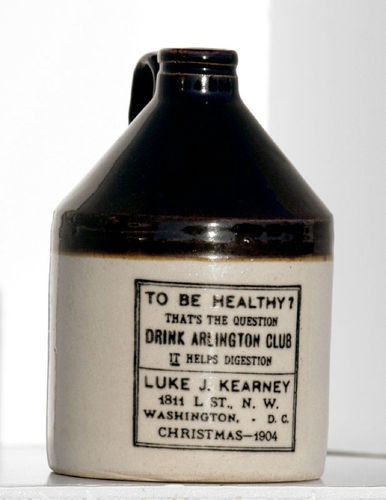
A District of Columbia saloonkeeper, named Luke J.Kearney, was notable for giving away to favored customers at Christmas time small jugs of whiskey.  While other whiskey distributors and tavern keepers sometimes gave customers favors at Christmas and New Years. Kearney’s giveaways are distinctive. Virtually all are two-toned stoneware mini-jugs about 5 and 1/2 inches high. More important, each year had a new slogan -- something for the drinking public to ponder while draining the modest contents of the jug.

The earliest seems to have been issued in 1900. Its under glaze label read: “You are not left...Not by a Jug Full"...Compliments of...Luke J. Kearney... Christmas 1900.” This was followed in 1901 by “Another Jug Full...  Compliments Of...” In 1902, Kearney used the slogan: “While we live - let’s live.” Later ceramics would add his address at 1811 L Street in the District of Columbia.

The next year the Washingtonian employed a personal motto: “Well I’ll be Jugged...Here’s Another Jug with Compliments of Luke J. Kearney.”  The 1904 version was “If You Try Me Once, You Will Try Me Again.” . It appears that Luke also issued a second version in 1904.  It contains a verse that says:
“To Be Healthy? That’s the Question; Drink Arlington Club; It Aids Digestion.”

Although I have yet to identify a giveaway for 1905,  Kearney issued two items in 1906.  One bore the enigmatic motto, “As I Go Up the Hill of Prosperity, May I Never Meet a Friend. “  The second 1906 stoneware is a squared jug with the simple question: “Is Everybody 
Happy?...Christmas 1906...Luke J. Kearney.” The 1907 issue reads “Another Jug Added to What You Have Makes Another Jug More.”

After 1907 the jugs apparently ceased, although Kearney continued to sell whiskey in embossed glass bottles.  He also gave out shot glasses advertising Arlington Club Whiskey,  a brand registered to the Hellman Distilling Co. of St. Louis.  Kearney’s saloon continued to be listed in local business directories until by Act of Congress the District went dry in 1917.


Luke Kearney was the product of an Irish Catholic family whose parents had emigrated to the U.S., before his birth.  His father, also named Luke,   found a job as a watchman in federal service, working for 50 years.  He and his wife, Mary, had a family of six children. Among them was our Luke, born in 1868.  The family lived at 3331 O Street in Georgetown.

The source and length of Kearney’s education and early business career is shrouded in time, but the 1900 Census found him, age 32, living at 1811 L Street, above his saloon.  He was married to a woman named Catherine with whom he had three children. In 1906, Catherine died, leaving Luke to raise Mary, 8; Luke Jr., 6, and Frank, 3.  Kearney does not appear to have remarried.  His parents may have helped him with the parenting for a time but his father died in 1916 and mother in 1917.

Kearney brushed with celebrity in 1903 when he accepted a check from a customer drawn on the Riggs Bank by Harry K. Thaw.  Thaw was the young socialite who later murdered famous architect Stanford White over the showgirl, Evelyn Nesbit, “The Girl in the Red Velvet Swing.” A sensation of its time, the incident has spawned a number of books and more than one motion picture. Thaw may have been a customer in Luke’s L Street saloon.  In 1915, Kearney was reported to own a baseball club in DC.

Kearney died in 1933, at the age of 65.  He is buried with his wife Catherine, his parents and other family members in Holy Rood Cemetery situated just above Georgetown.  It is a predominantly Irish Catholic graveyard associated with the Jesuit parish of Holy Trinity Church.  Most of the burials took place from the mid 19th century into the early years of the 20th.  Today the cemetery is in very sad repair.   Numerous gravestones have been destroyed or overturned.

Sanborn fire maps of the time show Kearney's 1811 L Street saloon as a two story brick building 25 feet wide and extending rearward almost one-half block to an alley. There was an empty lot on the east side, possibly for hitching horses.  Today the address itself has vanished between a large office building at 1801 L St. and a restaurant and bakery at 1819.  The street is shown as it looks today.

When the Holiday Season comes upon us, we should remember Luke  Kearney, to quote Charles Dickens, as “a man who knew how to keep Christmas.” and, as appropriate, let’s salute Luke’s memory by taking a nip from a jug of our own.