Friday, October 11, 2013

A Milestone at 200

                             “There is a history in all men’s lives” -- Shakespeare
                
This marks the 200th post in the blog I have created and called “Those Pre-Prohibition Whiskey Men.”  It began in April 2011 with a posted article on the Theobald Brothers of Columbus, Ohio, and has added vignettes of U.S. distillers,  rectifiers, liquor dealers,  saloon keepers, and whiskey-selling druggists  on a regular basis over ensuing months.  The blog has had 60,307 views as of October 11, 2013.  It also has attracted 25  “Members” to whom I am most grateful for their continuing attention.  Mini-portraits of many are exhibited here.
Some "Pre-Pro Whiskey Men" Members
I receive e-mails  almost daily relating to the website.  Some are comments contributed by readers to the blog itself.  Not unexpectedly, many e-mails are the result of someone finding a bottle or other whiskey artifact and wanting to know more about it,  often asking me for some idea of its worth.   Although far from an expert in pricing, I try to identify a general context of values.  Often my advice is, “If you like it,  put it on a shelf and admire it.” 

Not so expected were the many responses I get from relatives of featured whiskey men, people who are doing genealogical research and come upon my blog by the use of the “key word” mechanism. The vast majority of those respondents have been pleased with the treatment of their ancestor.  New information about individuals often comes from such communications.  When possible, I add this material to the biography.  In two cases the additional data showed sufficient deficiencies in the original story that I took down the post,  rewrote it,  and posted it again.

It is flattering as well to receive requests to use my stories on other internet sites and I always give permission.  The historical newsletter of Alexandria, Virginia, asked me to consolidate two stories of Virginia whiskey men into an article that subsequently has been published.   A periodical called “Western States Jewish History” is reprinting with added material a several of my pieces on Jewish whiskey men from the West Coast.  So far one article has been published and two more are in prospect.  That is indeed an honor. 

Doing this blog has been an educational experience as I gather information about the whiskey men from the Internet, books, and other resources.  One theme that emerges is the strong presence of immigrants among them.  The liquor trade appears to have been an occupation in which newcomers to America could engage and find prosperity.   Immigrants were of from a range of European countries.  Important among them were Jews from Germany,  Austria, Russia and elsewhere in Eastern Europe.  Either fleeing persecution or seeking a better opportunity in the New World, they played a key role in developing the U.S. liquor industry.  Another important group were the Irish who, because of famine or other circumstances, charted a course for America.  Speaking English from the moment they arrived,  many gravitated into the business of alcohol.  German Lutherans, Mennonites, British Episcopalians and an occasional Italian, in general round out the immigrant group.  

Of course, “native-born” Americans are also represented.  Many distillers from states like Maryland, Kentucky and North Carolina could trace their ancestry back to the origins of the country.  Others were descendants of distillers from Pennsylvania and points East who went to Kentucky and Tennessee after the Whiskey Rebellion (1791-1794).  A key find was Jere Blowe, a son of slaves who became a liquor dealer in Natchez, Mississippi.  His story was particularly fascinating because of his success during the “Jim Crow” era in the South.  Going forward, I hope to find other African-Americans important in the liquor trade.  I also am looking for a woman to be the featured in this highly male-dominated trade.

My objective has been to write up at least one whiskey man from each of the 50 states and the District of Columbia.  At present eleven states have not had the representation of even one, despite my vigorous efforts.  Those states are Alaska, Arizona, Idaho, Kansas, Maine, Nevada,  New Mexico, North Dakota, Oklahoma, South Carolina and Wyoming.  My objective is to whittle that number down considerably in coming months.  Suggestions are most welcome.

Of the states with the most vignettes, not suprisingly, Kentucky leads the list with 25.  Its distilling industry not only has been marked by singular characters,  information on them is plentiful in books and on the Internet.  Closely following is Ohio with 23 vignettes. Its major cities, especially Cincinnati,  spawned many liquor-related businesses.   These states are followed by Pennsylvania, 23 posts, and Maryland, 14; both are states that early dominated national distilling.  Of other states with double digit numbers the biggest surprise to me was Missouri.  It had no “dry” laws until National Prohibition in 1919 and its distillers and wholesalers prospered by supplying through rail express and the mails thirsty customers in Western localities that had banned alcohol sales.

I have been asked about running out of subject matter.  That may occur some day but I do not seem close to that time.  Although I have been gathering information and illustrations on some whiskey men over months and sometimes years before attempting an article, several of the most recent subjects ( e.g.,Thomas Shea of San Francisco,  Nicholas Matthews of Baltimore and N. Glenn Williams of North Carolina)  only recently had come to my notice.

The quote from Shakespeare that opens this post states the idea neatly. There is indeed a history in the lives of everyone. Perhaps more to the point, I am still having fun authoring the historical description of America’s early whiskey men and displaying a few of the artifacts they left behind. On to 300!


Monday, October 7, 2013

Nicholas Matthews Mixed Whiskey and Fine Art

At a time when most whiskey men fancied the kind of large paintings of nudes that typically hung behind the bar of many saloons,  Nicholas Martin Matthews of Baltimore amassed a collection of fine art that became the subject of major national attention.  Just how he was motivated to collecting and why he ultimately sold off his paintings still remain something of a mystery.

Like a number of other Maryland distillers and liquor distributors, Matthews was from an old and distinguished family.  One of his ancestors, through his mother, had been a member of the Maryland House of Delegates and then the governor of the state.   Born in 1858 to Thomas and Rebecca Martin Matthews,  the 1870 census found Nicholas a school boy of 12 years living on a large Talbot County plantation owned by his 85-year-old maternal grandfather,  Nicholas Martin, after whom he had been named.   His father Thomas was operating the farm together with several resident field hands.  Also in the household was his mother’s brother, John Martin, a school teacher, and two of his pupils.   It is highly possible that young Nicholas was home schooled.

An only child, Matthews likely was the ultimate inheritor of the plantation, which may have provided the financial backing for his opening a wholesale liquor establishment in Baltimore in 1888.  As is shown by his elaborate “art nouveau” letterhead, the company initially was located at 128 Calvert Street, a major commercial avenue.  His headquarters, as seen in an illustration, was an imposing four-story frame building.

By this time Nicholas was married. In 1882 he wed Bessie Vanderveer Matthews, who had been born in Alabama and was slightly older than he.   They would have a family of three girls,  Eleanor (Nellie), born in 1883;  Bessie, 1885; and Lucie, 1889.  The 1900 census found the Matthews family living at 154 Fryer Street.   Nicholas’ occupation was given as “liquor dealer.”

During this period  Matthews had moved his company to larger quarters at 110-112  East Pratt Street.   He would remain there from 1900 until 1904.  By this time his Altamont Pure Rye would be firmly established as a Maryland brand name, with major outlets in Washington, D.C. and elsewhere around the mid-Atlantic.  He advertised his whiskey with the illustration of a very well-dressed gentleman exclaiming as he took a sip, “Ah! That flavor.”  Jim Bready, the guru of Baltimore whiskey, noted that a visitor arriving at the city by steamer was greeted by a huge sign that read “Altamont Pure Rye,  Finest American Whiskey.”


Matthews packaged his liquor largely in glass bottles with an embossed logo on them, as seen here.  Like other whiskey men, he also provided saloons that stocked Altamont Rye with fancy engraved and etched back-of-the-bar bottles.   He also issued an etched shot glass with “Altamont Whiskey” etched into the glass and, for bartenders, an unusual folding corkscrew advertising his whiskey.
Matthews suffered a costly but temporary setback in 1904 when the Great Baltimore Fire swept over his neighborhood.  N. M. Matthews & Co. was among the 41 distilling and wholesale liquor houses that suffered damage.  Despite the losing all his records and stored whiskey, Matthews quickly relocated his business down the street to  34 East Pratt.  He stayed at that location until 1909, making a final move to 17 East Lombard Street in 1910.

Throughout this entire period,  Matthews was buying fine art at a furious pace.  It is unclear whether he came by this passion as a result of his upbringing in an educated and possibly art-interested family, or was encouraged by his wife, Bessie, who may also have come from an aristocratic background.  It is evident, however, that a substantial part  of the wealth he was accruing from his whiskey sales he was plowing into buying fine paintings. Matthews bought both old and modern masters, both European and American.  His tastes went to oils and acrylics, most of them small to moderate size,  and subject matter that ranged from landscapes to genre paintings.  There were several portraits.  Nudes seem to have been absent among Matthews’ purchases.
 
Although Matthews was said to have had a particular eye for Dutch painters, he also held a significant number of French artists of the Barbizon School,  a group that emphasized painting outdoors directly from nature.  Among the French, he owned paintings by such famous artists as Gustave Courbet and Theodore Gericault and lesser lights as Diaz de la Pena,  Rosa Bonheur and Jean Ferdinand Chaigneau.   The Baltimorean’s holdings also included the Spaniard Ribera, the Italian Canaletto and Englishmen Constable and Romney.  It is a wonder how Matthews was able to collect so many European masterworks in seemingly so a short time.

His collection also included paintings by such well known American artists as Thomas Cole,  William Hartnett,  Albert Bierstadt,  William Trost Richards and Arthur Quartley, the last a close comrade of Winslow Homer.   Shown here is a painting in Matthews’ collection by the noted American landscape artist,  George Inness.   It is entitled, “The Juniata River near Harrisburg, Pennsylvania.”   Note the several cows at the river.   Matthews, apparently drawing on his childhood on the farm, frequently bought paintings that included cattle.


As he was collecting, a member of his family was making news.  His oldest daughter Nellie at a dance had met a young Naval Academy appointee named Reed Marquette Fawell  and they had fallen in love.   As a young ensign Fawell had been assign as the skipper of the gunboat “Samar” in Hong Kong.  In 1908  Nellie personally saw President Theodore Roosevelt to ask him to transfer her fiancĂ© to the United States.  When Roosevelt refused, she made the 15,000 mile trip to the Orient and the couple were married.  The romance made headlines across America.

The 1910 census recorded Matthews, age 51, living in a mansion at 1312 Eutaw Place, his occupation given as “dealer - liquor.   Living with him are his wife, Bessie.  Nellie, her husband apparently still deployed in Asia, is living with them as are his other two daughters.  One imagines his house filled with fine art.

Two years later in 1912, however, Matthews’ wholesale liquor business was terminated abruptly and Altamont Maryland Rye disappeared as a brand.  Two years later all or most of  his art collection was put up for auction.  The paintings going “under the hammer” numbered a whopping 134.   Shown here is the front page of the sales catalogue.  It depicted a painting by a Belgian artist, Frans Synders (1579-1657) entitled “The King is Dead - Long Live the King.”  The picture is a humorous rendition of a disparate group of birds all presumably celebrating after reading a parchment proclamation of the king’s demise posted on a stump.

Before the paintings in the Matthews Collection went on sale, they were exhibited at the American Art Galleries in New York City.   There they drew national attention.   The “Collector and Art Critic”  magazine chose to feature them as part of its “American Private Art Collections” series.  A journal critic commented on the attractive manner in which the galley had lighted the Baltimorean’s collection.   A New York Times writer was impressed with the many paintings of birds and animals. 

The auction took place on February 17, 1914, held in the Grand Ballroom of Gotham’s prestigious Plaza Hotel.  Many of America’s leading art collectors or their representatives were present to vie for Matthews’ collection.  The press reported the prices being paid.  “Mount Shasta, Calif”  by W. Keith sold for $1,400, “Still Life and Landscape by Jan Weenix was hammered down for $1,140,  and “Dogs Attacking Stags,” by Frans Snyders, fetched $1,000 -- big money for that era.

Why did Matthews’ business shut down and why was the art collection sold?  One 1914 news article referred to Nicholas as “the late N.M. Matthew.”  That might offer one solid clue to the sudden change in activity.   A major online genealogy site, however, says Matthews died in 1930.  Yet another site lists the date of his demise as “unknown.”  Below in a comment, a descendent has confirmed the 1930 date and kindly added some details about this fascinating whiskey man.


Friday, October 4, 2013

This Whiskey Man Had the “Old Nick” in Him

“Old Nick.”  It is a common term for the Satan, the Devil, Beelzebub, or what ever you call the evil spirit.  Nicholas Glenn Williams, a North Carolina whiskey man, not only ran a distillery business called the “Old Nick Williams Company,” but demonstrated repeatedly during  his life, that he truly had the “Old Nick” in him and indeed was capable of “raising Hell.” He is shown left.

A rebel spirit ran in the family.  Nicholas was a direct descendant of Col. Joseph Williams, an officer in George Washington’s Revolutionary Army, who was said to have been “exceedingly obnoxious” to the Tory opposition.  So hated was he that three of his neighbors hatched a plot to murder him.   When the scheme was uncovered, two of the plotters were taken from their homes by the Colonel and his friends and summarily shot.

The home and plantation
"Panther Creek" Plantation House
Col. Williams established  on 8,000 acres in the Yadkin River Valley he called “Panther Creek.” It became the site of a distillery founded by his son, Nicholas Lanier Williams, that came to be known as “The Old Nick Williams Company.”

A trade card from the distillery, shown here, claimed existence over three centuries:  “Established in the 18th, covered every day of the 19th and growing in popularity in this, the 20th.  That’s the record of The Old Nick Williams Whiskies -- 133 years under the proprietorship of son, grandson and great-grandson of Col. Joseph Williams....”   For many of those years the distillery apparently had a relatively small output of whiskey. It was the great-grandson, our Nick Williams ( sometimes known as N. Glenn Williams) who stepped up production and sales to regional,  national, and even international markets.

After taking charge of the distillery in 1887, Nick expanded the plant and also diversified the farm’s crops and cattle operations by growing corn for his whiskey production and feeding the spent mash to a herd of cattle.  In the 1900 census Williams noted his occupation as “farmer.”  At that time he was 34 years old and living with his wife,  Margaret, a woman 11 years his junior.  With them were their children, ages three to six months.   During the following decade the couple would produce a total of nine.  The Williams household also included four hired hands and a housekeeper.

Williams featured one brand name, his own, and labeled it on whiskeys he designated as rye, bourbon, corn, wheat,  and sour mash.  He also featured brandies, apparently made from fruit grown on his farm, as well as beverages labeled “Rock and Rye” and “Peach and Honey.”  He packaged his products in both ceramic jugs and in glass bottles, the latter both in quarts and in pint flasks.  Those frequently had elaborate paper labels,  like the one shown below left of a colonial gent with a cocktail glass in hand and two bottles at his side. Williams’ bottles also contained the embossed name and address of his company.  Like many enterprising distillers and merchandisers, the North Carolinian provided giveaway advertising items to favored customers like saloons.  As shown below, they included an attractive label-under-glass back-of-the-bar bottle advertising “Old Nick Rye.”

Along with his reputation for “hell raising,”  Williams’ wealth and business acumen also translated into local political clout.   In North Carolina during the late 1880s and early 1900s the Prohibitionist squeeze was being felt by distillers and liquor dealers.   William’s Panther Creek was located in Forsythe County.  When that jurisdiction went “dry” and harassed Williams about his whiskey production,  he used his political skills to have the county line moved so that his business would reside in Yadkin County where liquor was still legal.  Local option in North Carolina and elsewhere in the South presented him with an opportunity to send his whiskey into dry localities via the mails or express office. He advertised his “Lock Box No. 11” address vigorously for mail order sales.

In 1903 North Carolina began a statewide march against alcohol.  An early law forbid distilleries outside of chartered towns. As a result Panther Creek and the Old Nick Distillery became the town of Williams, North Carolina, founded by its namesake specifically for the purpose of keeping his distillery in operation.  The town of Williams is recorded as having had a population of 52, virtually all of them members of Nick’s family, his farm workers and his distillery employees. The town name appears on both embossed bottles shown here. This legal fiction persisted for five years while Nicholas expanded the market for his liquor by emphasizing long distance transport.  He bragged that his goods were so securely packed that “they will ship hundreds of miles without breaking.”

“Old Nick” Williams not only was fighting forces in North Carolina.  Early in the 1900s he got crosswise with the Federal Government by failing to pay his liquor taxes.  The story is that during a visit to nearby Winston-Salem, North Carolina, Williams was confronted by a  revenue officer who accused him of tax evasion.  A powerfully built man, Williams is said to have pulled the official out of the Federal Building and onto the street where he beat him with a buggy whip.  So potent was Nick’s political clout that he was never charged or arrested for the assault.

As everyone knows, however, the Feds are not easily discouraged.  Williams was hauled into Federal Court for failure to pay his rectifier tax. In addition to distilling spirits he also was rectifying (blending) them for sale.  Already paying a stiff federal tax on each gallon of whiskey he was distilling, the law directed him to pay the government to blend them, a levy he and other rectifiers bitterly resented.   Found guilty. Williams was ordered to pay a fine of $5,000, more than twenty times that amount in today’s dollar, and assessed court  costs.

Ever the stubborn rebel,  Williams fought the decision, claiming that the original Federal Circuit Court had erred in setting the payment date and thus nulled the verdict.  He claimed to owe nothing. First heard in Federal Appeals Court, the case eventually made its way to the United States Supreme Court. That body in 1905, rendered a decision that, in effect, told Old Nick to pay up.

Soon after, Williams was out of the whiskey trade.  In 1908 North Carolina by a substantial vote of the populace banned all alcohol production and sales.  The Williams distillery was forced cease making whiskey but still could sell supplies out of state.Some of his work force moved on to Kentucky, reportedly taking the stills with them.  The town of Williams disappeared. Panther Creek reverted purely to farming.  In the 1910 census, Williams would list his occupation as running a horse farm.  He was 45 years old.

Three years later Williams died on November 25, 1913.  He left his widow, Margaret, with a 1,400 acre farm operate, nine children to raise, the youngest two and a half years old, and 28,000 gallons of sequestered whiskey.   When National Prohibition was enacted, Margaret had no choice but to destroy the remaining whiskey.   

After Prohibition and the end of the Great Depression some of the sons of feisty Nicholas Glenn considered reviving the Old Nick Distillery in Virginia but nothing came of the idea.  As the years passed other descendants of “Old Nick” became serious about the idea.  In 2014 brothers Van and John Williams and their grown sons, Zeb and Matt, decided to re-establish the distillery.  They built it in Lewisville North Carolina where they now produce their flagship brand — “Old Nick Carolina Bourbon Whiskey.”


Monday, September 30, 2013

Sam Levin Could Clothe, Shelter and Slake a Thirst

Samuel Levin
In a career that spanned 33 years Samuel Levin was, by turns,  a leading haberdasher,  the manager of three hotels, and the owner of  establishments that provided whiskey over the bar and over the counter.  If your clothes were in rags or you needed a room or were looking for strong drink in Trenton, New Jersey,  Sam would oblige.

Levin was born in Russia in 1873, the fifth child of Bernard and Celia Wein Levin.  He came to the United States during his mid-teens, about 1887 or 1888,  apparently along with other members of his family.  Naturalized in 1895, a year later he married married Mary Lidsky, herself born in Russia.  The 1900 census found the Levins living at 325 North Broad Street  in Trenton with Samuel’s father, one of his brothers and their first son, Louis.  Later two other sons, Joshua and Max, would join the family.

By 1900, Levin had already engaged in his first enterprise.  The family’s Broad street residence was an apartment above his clothing store. Called “Gent’s Furnisher,” it was a joint venture between Samuel and a younger brother, Isadore, who would remain almost exclusively in the clothing business for most of his life.  Not Sam.  By 1904 he was managing a hotel  called Princeton Junction House.  Like most hostelries of the time, this one almost certainly featured a saloon.

South Broad Street, Trenton, c1912

It may have been there that Levin hatched the idea of becoming a liquor merchant,  With another brother, Harris, who previously had worked as a butcher, he opened a wholesale wine and liquor dealership at 475-459 South Broad Street.   Before long Sam added an outlet at 167-169 South Broad.  Two liquor jugs from that period carry that address.  The location was also that of a second hotel that Samuel  managed, called the Star Hotel.  Trenton city directories of 1910 list him as the “proprietor” of that establishment.   For a time he made the hotel the family residence. Sam and Celia’s fourth and final son, Henry, would be born at that location.

It is unclear from records but likely that Levin had a ownership share in the Star Hotel.  He continued in its management until 1912 when he once again returned to 457-459 South Broad to work with Harris selling wholesale liquor. During this period he may also have opened a store in New York City.  A seltzer bottle with that address bearing his name is shown here. Once more, however, the hotel business beckoned.  Trenton’s National Hotel, once a premier hotel, had been the subject of litigation, experienced a parade of owners, and had fallen on hard times.  About 1915 Levin bought it.  He added rooms, doubling its size   He also appears to have installed his own saloon in the building, again with brother Harris in the picture.  By now Sam had sufficient wealth to install his family in a regular home, locating them on Trenton’s residential State Street.

The coming of National Prohibition changed everything.  The Levins’ wholesale liquor outlets and their saloon came to an end.  Samuel never skipped a beat.  By now a man of substantial wealth, he successively became an investor in the Stacy Building & Loan Association,  the Treasure Trenton Laundry, and M&S Retail Clothes.  Now grown to maturity,  both Joshua and Max joined him in these businesses, Joshua in the laundry trade and Max in haberdashery.   A final Levin enterprise was the Eton Boys Clothing Store.


Brother Harris did not make the transition out of liquor quite so gracefully.  After Prohibition he moved to operating a cafe and a grocery store.  In 1932 he was found to be running a saloon and was raided and a quantity of whiskey, wine and beer was seized.  He was fined $250 and placed on probation.  Afterward Harris went into the real estate business.  While his brother’s problems obviously were a concern for Samuel, he continued his entrepreneurial ways until his death in 1938.
 
With his grieving family standing by his gravesite, he was interred in the consecrated Jewish section of Greenwood Cemetery in Hamilton Township, New Jersey.  A plinth bearing  the Star of Davis marks the Levin family plots and a simple headstone, with a Masonic symbol,  lies over Samuel’s grave.   Among the mourners was his son Henry, shown here, who became one of Hollywood’s best known and most prolific film directors,  responsible for some 50 motion pictures, including such favorites as “Where the Boys Are” and “Journey to the Center of the Earth.”

Although the entrepreneurial career of Samuel Levin ended in 1938, he can still be remembered for the energy and enterprise he brought to selling clothing, shelter and  whiskey to the citizenry.  Way before the term had currency, Sam had demonstrated “multi-tasking” to the people of Trenton, New Jersey.

Note:  Much of the information contained here was gleaned from a family website that tracked the various occupations of Sam Levin.


Wednesday, September 25, 2013

What’s In a Name?: For James Shea, a Lot

In his famous play, “Romeo and Juliet,” Shakespeare has his heroine say:  “What’s in a name, that which we call a rose by any other name would smell as sweet.”   Growing up in Ireland,  James Sheehy may have known of the phrase but it was his coming to America that transformed him by name into James Shea and one of San Francisco’s leading whiskey dealers.

Sheehy/Shea, shown here as a young man, was born in Skibbereen,  Country Cork, about 1835.  Unlike many Irish immigrants,  he was a relatively old 28 years when he came to the United States, arriving in San Francisco in 1863  by way of Cape Horn.  He apparently had brothers already living in Watsonville, California.  James may have left his future wife as his sweetheart back in Ireland.  She was Anne Shipsey from Clear Island in County Cork.  Annie arrived in California shortly after James via the Isthmus of Panama.  According to census data they were married in 1865 in San Francisco.

Sheehy had rapidly established himself in business, likely working for a San Francisco liquor  dealership named Sullivan and Cashman.  During this period he also had applied for and was granted citizenship under the name of “James Sheehy.”  Not long after, however, he repaired to the courts and had his last name changed to “Shea,” a move that some descendants believe greatly upset his brothers.  The reason for their concern may have been in part because of their Cork origins;  Shea was a Kerry name, across a sometimes contentious county border.
 
When Sullivan and Cashman retired from the liquor trade about 1868,  the newly anointed  James Shea took over at their location at the corner of Front and Jackson Streets.  With a partner,  he opened Shea, Hussey & Company.  After several years,  Hussey was gone and Shea was in business with three new partners.  They were the Bocqueraz brothers,  Antoine and Leon, both immigrants from Europe, and Robert M. McKee,  who himself had a history in dealing San Francisco liquors.


The  Front Street store they occupied is shown here with a group of men posing outside.  We may assume that Shea is among them.  The building was a large structure that had been divided into two businesses and separate addresses.  Next door was the M. Gruenburg Company, another whiskey wholesaler and a competitor.  Advertising themselves as “importers and wholesale liquor dealers,”  Shea, Bocqueraz & McKee were also “rectifiers,” blenders and compounders of whiskey from other sources, chiefly from Kentucky.

The firm used a number of brand names, including “Roanoke Rye,”  “Roanoke Rock and Rye,” “Springfield,” “Tea Kettle,”  “Golden,” and “Astor.”  Although they advertised several of these brands, their flagship label was “Tea Cup,”  sometimes merchandised as “Tea Cup Extra Old Bourbon Whiskey.”  It was the only one of their brands that the company apparently trademarked, registering the name in 1891 and again in 1906.  The brand likely had been brought to the firm by McKee who earlier had obtain the name rights.  Some observers speculate that the brand was a low quality, rectified product given the dearth of embossed bottles bearing the name.  Shown above left is a labeled flask that depicts a elderly rustic couple drinking from tea cups.  Tea Cup Bourbon also appears on a ceramic miniature jug with a cobalt blue picture of a tea cup.

Whatever the quality of Tea Cup Whiskey, Shea and his partners advertised it heavily and also provided a number of giveaway items, particularly signs and shot glasses to saloons and other customers using their products.   Like other San Francisco wholesale dealers, they distributed fancy etched glasses,  some with gold rims, like ones shown above.  The quantities that have survived indicate a generous flow of these items.  Unlike the risque saloon pictures favored by many whiskey men,  Shea and his partners issued a series of attractive  signs involving glamorous, well-clothed females.   These were color lithographs of paintings by Philip Boileau, a French Canadian artist who specialized in idealized portraits of women.  The signs advertised Old Teacup Whiskey and Springfield Straight Whiskey. 

In 1885,  McKee died and several years later the firm changed its name to Shea, Bocqueraz & Co., sometimes abbreviated as “S.B. Co.”  as seen here on a shot glass. A 1902 letterhead listed as officers James Shea and the Bocqueraz brothers.  In 1898 they moved the company from Front Street and relocated at 525 Market Street.   An ad for the partner’s Roanoke Rye Honey and Horehound gave that new address.

In the meantime,  James Shea was having a personal life.  The 1900 census found him, age 60, with his family, living at 1375 Golden Gate Avenue in San Francisco.  It would be their home for 40 years.  With Shea and wife Annie are recorded a number of their children, ages 26 to 18.  Additionally we have a wonderful picture of the Sheas, courtesy of a descendant, posing in a vernal setting.  Annie and the girls, Elizabeth, Ethel and Rose, all very comely lasses, are wearing identical blouses and neckwear.  Son Alfred, with cap and cricket bat, is leaning on his mother’s arm.  Papa Shea, in a straw hat,  necktie, and jacket seems almost lost among the foliage and the women. 


Things would change drastically in 1906 for Shea, Bocquerez with the great San Francisco Earthquake and Fire.  The Market Street location was burned out.  Located at the edge of a marsh, the whole area subsequently became a site for dumping the city’s disaster debris.  It later was filled in to accommodate the Panama-Pacific International Exposition of 1915 and is now the Wharf area of San Francisco, famous for its seafood restaurants and sea lions.  The wholesale liquor dealership was forced to make another move in 1907, this time to 509-517 Mission Street. The firm survived until 1919 when shut down by the looming National Prohibition.  

Members of the the Shea family are buried in the Catholic Cemetery, shown left, in Colma, California, outside San Francisco, known as the "Cemetery City."  James Shea built a mausoleum and he, his wife and others are interred there.  

We are left with the memory of a pre-Prohibition whiskey man who, somewhat inexplicably, changed his name from one Irish moniker to another over family objections  and found a bountiful prosperity in the business that subsequently bore his new name.  James Sheehy/Shea could echo Juliet:   “What, indeed, is in a name?”

Note:  Some information that was lacking in an earlier version of this vignette has been provided subsequently by Peggy, a descendant of James Shea.  I am grateful for her help.


Saturday, September 14, 2013

Jonas Brown, the Rectifier Who (Eventually) Went Straight

Jonas F. Brown, a prominent liquor dealer in Minneapolis, initially disdained the “straight” whiskeys of his day for the blended and compounded brands he mixed up in a back room of his establishment.  When he failed to pay the extra taxes levied on “rectified” whiskey, federal authorities hauled him into court.  Facing ruin, Brown somehow escaped punishment, went straight, and prospered.

Federal laws clearly discriminated against rectifiers like Brown.  Not only were they obliged to pay $1.10 cents per proof gallon of whiskey, a fee levied on all alcoholic spirits, they were subjected to a number of additional taxes.  For example, rectifiers were required to pay the IRS  $200 dollars a years as a special tax on their occupation. This tax covered only the blending process. If a rectifier, not unnaturally, wanted to sell his blended spirits he was compelled to pay still another tax as a wholesale liquor dealer.  That added an additional $100 annually.  In the year ending 1915 the total of these special taxes on rectifiers amounted to a total of $482,988, paid by whiskey men like Brown just for the privilege of blending tax-paid spirits and selling them.

Moreover, attempts constantly were being made to increase taxes on rectifiers by the federal government, often egged on by the straight whiskey producers, particularly those in Kentucky who had a powerful lobby in Washington.  One rationale was that  rectifiers used unhealthy or extraneous ingredients in their liquors.  Obviously some did. An industry spokesman, however, countered before a Congressional committee that:  “Rectified spirits are no more adulterated, unhealthful, or the subject of unfair trade practices than are unrectified distilled spirits.”


Jonas Brown would have agreed with that statement.  His method of protesting was to forego paying the required taxes.  Nothing in his background, however, indicated risky behavior or a rebellious spirit.   He was born near Worchester, Massachusetts, in 1830 into an established Yankee family.  As a young man he worked for the Providence and Worchester Railroad.  He left New England about 1860, reputedly for health reasons, and settled in Minneapolis.   Early in his Minnesota career, Brown entered the liquor trade.  In an ad he identified the beginning date as 1866.  The 1870 U.S. Census found him, now 40 years old and still unmarried, living by himself in a rented room. His occupation was given as “liquor-wholesale.”

Brown established his liquor dealership and saloon at 216 Nicollet Avenue, one of the principal commercial avenues of Minneapolis.  He advertised the location extensively as shown on a Hennepin Avenue billboard.  A 1903 publication of Minneapolis resources and industries described Brown’s establishment as a “palatial resort” and elaborated:  “He is located in a three-story brick building, where he occupies the entire building, with basement for storage, which gives him a combined floor space of 11,000 square feet....The interior is very handsomely fitted with bar and fixtures composed of black walnut, the shelving behind resplendent with fine large mirrors and cut glass.” 

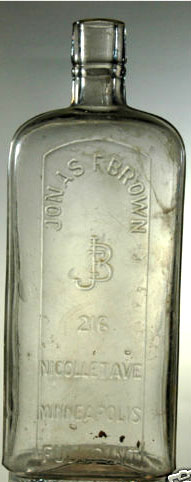
He called his business “Jonas F. Brown & Co., Wines and Liquors.”  Many of those liquors Brown was mixing up in one of the many rooms in his building, merchandising brands of his own he called “Gopher Rye,”  “Blood Port,” and “Finest in America.”  He packaged his goods both in large ceramic jugs and in glass bottles.  His strap sided pints and quarts were embossed with his name,  monogram, and address.  He also issued a decorative flask, probably for the Holiday Season.

It was during the 1870s that Brown had his scrape with federal authorities. After ignoring several warnings from Internal Revenue agents, in 1875 he was arrested for failing to pay rectifier taxes amounting to $1,200, more than 20 times that in today’s dollar.  It was a highly serious matter.  Had he been found guilty,  the government could have confiscated his stock, levied a stiff fine on top of his tax arrears, and actually sent him to prison.  The case made headlines in Minneapolis newspapers but the ultimate verdict remains unknown.  Brown, it appears, escaped confiscation and doing time.


During this same period Brown married a woman named Emma, surname unknown.  Like himself, according to census data,  she was of New England stock, born in Massachusetts as were her parents.  Emma was eleven years younger than Jonas.  They lived in a house at Sixth Street and Fourth Street for 40 years.  Although the couple apparently had no children,  the 1880 census recorded two men in their early twenties boarding with them.  The occupation of both was listed as “clerk in store,”  probably working for for Jonas F. Brown & Co.

Despite his brush with the law,  Brown subsequently established himself as a respected businessman and solid citizen.   One tribute made during his lifetime said:  “Mr. Jonas F. Brown...has always been prominent in any movement inaugurated for the welfare and betterment of the city.”  Jonas also was serving up not only his own blends (and presumably paying the requisite taxes),  but also purveying some of the leading brands of Kentucky and Pennsylvania “straight” whiskeys,  including “Old Crow,” “Old Taylor Bourbon,” “Old Monogram Rye,” and “Golden Wedding Rye.”  Like other Twin Cities whiskey men,  Brown issued advertising shot glasses to favored customers.  Into his 70s he continued to guide the fortunes of the firm he had founded.


In February 1908,  Jonas Brown died in Los Angeles, California, where he may have gone to escape the harsh Minnesota winter.  He was 78 years old.  His widow, Emma, would follow him to the grave in September of the same year.  The firm, however, survived for seven more years.  The new management kept the same name but moved in 1909 to a different location at 19 Washington Avenue, North.   As shown here, the company maintained Brown’s emphasis on bottling their whiskey in ceramic jugs.

Jonas Brown’s 1908 obituary in the Minneapolis Journal declared him one of the city’s most widely known men.   It testified to his standing as a business owner, calling him:  “...The last survivor of the old school of liquor dealers.  In the days when card and wine rooms, slot machines, music and free lunches were recognized as adjunct of the saloon,  Mr. Brown continued himself strictly to the business of selling liquor as an ordinary commercial proposition.”

It would appear from this account that the young rebel who had dared flaunt the IRS on paying his taxes, as he aged had become a somewhat conservative Minneapolis businessman.  The final judgment of history might well be that Jonas Brown had rectified himself personally and gone straight.

Note:  Much of the information for this vignette was derived from Ron Feldhaus and his 1987 publication,  “The Bottles, Breweriana and Advertising Jugs of Minnesota, 1850-1920.”  It has become a classic for bottle collectors.