Thursday, September 15, 2016

The Ripys of Kentucky: “From Father to Son Since 1831"

 That slogan was adopted in the latter part of the 19th Century by the Ripy distilling interests to emphasize the heritage of their bourbon.   Although the validity of the date might be questioned, father and son, James Ripy and Thomas B. Ripy,  combined to create what once was reputed to be the largest whiskey-making operation not only in Kentucky, but in the world.

The Rippey family were Hugenots, French Protestants who fled their homeland under persecution and settled in Northern Ireland where they found a welcome.  James Rippey was born there in March 1811.  While still in his teens, James, with  a brother, John, and sister, Eliza, left Ireland and family members in 1830 to seek better opportunities in America.   Entering through the port of Philadelphia, the trio eventually found their way to Lawrenceburg, Kentucky.


Initially the Rippeys lived in a wooden cabin in a small community below what is now known as Wild Turkey Hill in Lawrenceburg, perhaps similar to the one above.  James became a clerk in a dry goods store, proved to have a knack for business, and before long was operating his own mercantile establishment.  He counted among his customers the many small distillery owners of Anderson County who may also have been supplying him with whiskey to sell.

The year 1839 was a pivotal one for James:   He went before a court in Bourbon County, Kentucky, renounced his British citizenship and became an American as “James Ripy.”  Although his naturalization papers say he appeared to be about 24 years old, assuming his birth date was 1811, he was several years older than that.   Family lore provides two different reasons for the change in spelling James’ name. One is that a sign painter hired to render a sign for his store ran out of room and so shortened the spelling.  A second version is that the immigration official who processed his paper work in Philadelphia spelled it that way.  In any case the spelling stuck.

That same year James married Artemesia Walker, a woman about his own age who had been born in Kentucky, the daughter of a prominent local family.  The couple would have two sons who survived to adulthood.  The eldest,  James P., served in the Confederate cavalry, married into the family that produced Bond & Lilliard Whiskey, and became a distiller.  The younger son, Thomas Beebe (T.B.) born in 1847, was given a good education, attending the Kentucky Military Institute in Louisville, the oldest private military school in the U.S.  Later he would attend Sayre Institute in Frankfort. 

The senior James Ripy, enriched by his mercantile business, had taken a increasing interest in distilling. As early as the 1850s a small distillery had been established on the banks of the Kentucky River four miles east of Lawrenceburg.  About 1868 the operation was taken over by a group of local businessmen, among them the 53-year-old Ripy.   Before long the distillery successfully was mashing more than 100 barrels of grain a day — significant capacity at those times.

This arrangement proved to be short-lived as within months the owners decided to sell.  The buyers were Judge W. H. McBrayer [see my post of October 2011] and young Thomas “T.B” Ripy, the latter likely financed by his father.  By the following year, McBrayer had departed and at the tender age of 21 Thomas became the sole owner.  He would operate the plant under the names “T. B. Ripy Cliff Springs Distilling Co.” and “Anderson County Sour Mash Distilling Co #112.”   

Thomas renamed the site of the distillery, earlier called “Steamville” because steamships on the Kentucky River landed there.   Now the location became “Tyrone,” a tribute to the province in Ireland from whence the Ripys had come.  Before long Tyrone became a bustling town of 1,000 residents with stores, a post office, and a port for excursion boats from Frankfort.  A photo shows one approaching the town.   

As T.B. Ripy was rising to the top of  Kentucky distillers, his father was faltering.  After moving the Ripy family into whiskey-making prominence, James Ripy had experienced some health setbacks.  These must have been difficult times for Artemesia and their sons.  In June 1872,  James Ripy, only 61 years old, died and was buried in the Walker Family Cemetery near Lawrenceburg. The founding father had come a long way from his roots in County Tyrone, Ireland. His monument is shown here.

Two years after his father’s death, Thomas, now 26, married Sally Fidler, daughter of a prosperous local family with extensive land holdings.  They had ten children who lived to adulthood and another who died in infancy. Sally became affectionately known as “Ma’am Ripy,” described as “a tiny lady, with a sharp mind and keen sense of propriety.”  A relative described her in her elder years:  “She sat in her chair to the right of the fireplace in the parlor, frequently cautioning her children and grandchildren to ‘Love One Another,” as the Ripy men engaged in their favorite pastime — argument.”

By 1873 Thomas Ripy had torn down some of the original Cliff Springs buildings and replaced them with sturdier structures, shown above. Insurance records indicate that the distillery was brick with a metal or slate roof.   Of the three warehouses, one was brick, stone and ironclad, a second was iron-clad, and a third frame and iron clad.  All had fire resistant roofs.  A cattle barn and a shed also were on the property.  As a result of the renovations, mashing capacity of the distillery was increased to 600 bushels daily.

Harking back to his immigrant father’s foray into distilling, Ripy coined the slogan for his products:  “From father to son since 1831.”  Although that year makes a clever verse, the date is a bit misleading.  James Ripy had arrived in the U.S. by that time but was just getting established in Kentucky, likely selling whiskey but not making it.  The turn to distilling occurred in 1868 when James and partners bought the small plant at what later became Tyrone.  Perhaps Thomas could not find a suitable rhyme for the actual beginning of the Ripy whiskey dynasty.

Thomas continued to seek new opportunities.  In 1881 with partners J. M. Waterfill & John Dowling he built the Clover Bottom Distillery #418 at Tyrone.  Insurance reports indicate that this distillery was a four-story brick building with two frame warehouses with metal roofs, one located 101 feet east of the still and another 112 feet west.   A frame barn, where the spent mash was fed to cattle, was 750 feet northwest of the distillery.  In 1885 Ripy bought out his partners and expanded mashing capacity of Clover Bottom to 1,500 bushels daily.

Before his career ended, this Ripy had a hand in several different Kentucky distilleries.  In addition to the two located in Tyrone, at various times he owned  the Belle of Anderson Distillery that he sold almost immediately and the Old Joe Distillery at McBrayer, Kentucky. He sold that plant to Wiley Searcy, whose name it took. [See my post on Searcy, June 2013.]  Employing hundreds of local folks, as shown above, Ripy’s Tyrone facilities alone made him the largest distiller in the state and, according to claims, at the time the largest distiller in the world.

Along with quantity, Ripy was providing quality in his whiskey.  When the State of Kentucky had to select one distillery to feature at its exhibit at the 1893 Chicago World’s Fair, his was chosen among 400 potential claimants. The front windows of a Salt Lake City 1900s liquor store in which the entire display is “Old Ripy” whiskey, give an idea of the national scope of the company sales.  Although it is difficult to date any specific “Old Ripy” bottles or giveaways, the several scattered though this post give an idea of the many products over time that carried the Ripy name. 

As their family grew to ten children, Thomas and Sally determined to build a house in Lawrenceburg able to accommodate them all.  The result was an imposing mansion, shown above, completed in 1888, sitting on 100 acres near the center of town.  Five years in the building, the new home and grounds contained many features rare at the time including a carbide lighting system, indoor plumbing, a tennis court and a swimming pool.  The T. B. Ripy house has been called “…A work of art that is also a definitive piece of American history, representing the people who lived and defined the American Dream.”  In 1980 the house was placed on the National Register of Historical Places.  The Ripy family sold it in 1965 but descendants in 2010 have repurchased and repaired it.  Today the mansion is a Kentucky tourist attraction.  
In the spring of 1899,  perhaps in declining health, Ripy sold his Tyrone distilleries to the Kentucky Distilleries and Warehouse Co., better known as the notorious “Whiskey Trust.”   He died two years later at the age of 55 and was buried in the Lawrenceburg Cemetery.  His gravestone is shown here.   The sale of the distilleries may have met with opposition from Ripy’s older sons who were working for their father in various capacities and might otherwise have inherited the business.  Sons Ezra, Ernest, Forest and Robert subsequently opened their own distillery near Tyrone and operated it under the name “Ripy Brothers.” until Prohibition.

After Repeal Ripy’s sons and grandsons continued to be active in the U.S. whiskey industry.  Several sons operated the Hoffman Distillery near Lawrenceburg and bottled “Old Hoffman,” “Rip Van Winkle” and “Ezra Brooks” whiskeys.  Another son, E.W. Ripy rebuilt the Ripy Brothers Distillery near Tyrone.  Two of his sons, T.B. Ripy III and E.W. Ripy Jr., were engaged in that enterprise.  Subsequently the distillery was sold to Austin Nichols whose Wild Turkey distillery at Lawrenceburg would become world famous.   

Schenley owned the Ripy trademark for a number of years, marketing whiskey under that name after Repeal.  More recently, Wild Turkey, operating in the vicinity of the original Ripy distilleries, has registered labels, among them one that features silhouettes of James and Artemesia Ripy, the progenitors of this famous American whiskey clan.  The distillery to date has not yet marketed a whiskey under the name.  It should.

Note:   During the researching and writing of this post, through the good offices of a friend, I was put in touch with Mr. Beebe Ripy, a descendant of James and Thomas and a man knowledgeable about family history.   He was gracious enough to read my initial draft and give suggestions for corrections and additions. I am most grateful for his prompt and valuable help.  


Sunday, September 11, 2016

Adolph Moll of St. Louis Sold Booze Among the Bushel Baskets

     
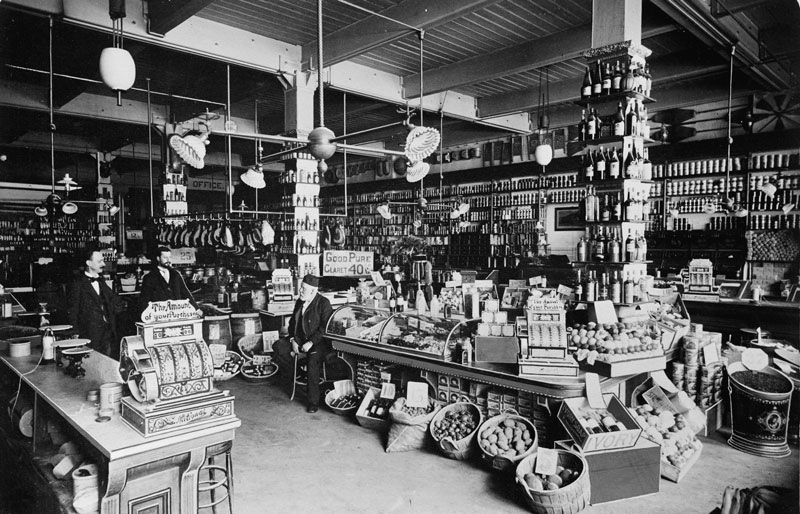
Seated in the photo above, I believe, is Adolph Moll, the old gentleman with a cap, surrounded by the elegant St. Louis grocery store he had established years earlier and worked hard to make successful.  Note the displays of potatoes, onions and other produce in the foreground and then the bottles of whiskey and wine that seem to climb every pillar in the store.  Moll knew that although bushels of veggies made money, liquor made him a lot more.

Shown here in middle-age, Adolph Moll likely was born in Frankenstein, Prussia, in 1834, although the 1880 census gave his birthplace as Berlin.  He emigrated with his family from Germany to New York City in May 1952 at the age of 18, living for a time in Brooklyn.  About 1856 he moved to St. Louis, a city with a large German population.  A passport application indicated Adolph was five feet, six inches tall, with blue eyes and a fair complexion. In 1858 at the age of 24 he became a American citizen, sworn in before a St. Louis commissioner.

Moll’s first employment in St. Louis was working for a company that sold safes.  He proved to have a good business head and an entrepreneurial spirit that recommended him to the German community.  As a result he was able to borrow sufficient funds and with a local partner named Heidsick open a small grocery store on Third Street between Market and Chestnut.
His obituary in the St. Louis Post Dispatch described Moll’s rise to grocery prominence:  “He did it all by his own energy.  He would work at everything about the place, from heavy boxes to the keeping of books.”  He also had a flair for advertising, billing his establishment as “A. Moll Grocer Co., Importers and Wholesale Grocers” and emphasizing his trade in “wines, liquors & cigars.”  Those were the money-makers.

But it was not all work and no personal life for Adolph.  In 1861, he married Emma Friederike Hedwig Ballaseus, the daughter of Johann Wilhelm and Julianna Justina (Wagner) Ballaseus.  Known simply as Hedwig, the bride had arrived from Prussia the previous year and was living in St. Louis with her mother.  Married in the Evangelist Church of the Holy Ghost in St. Louis, the couple would go on to have eight children.  Adolph had selected well.  Not only was Hedwig an attentive mother, she proved to be, as one observer put it, “also a strong presence in the business concern.”  She is shown here in maturity.  
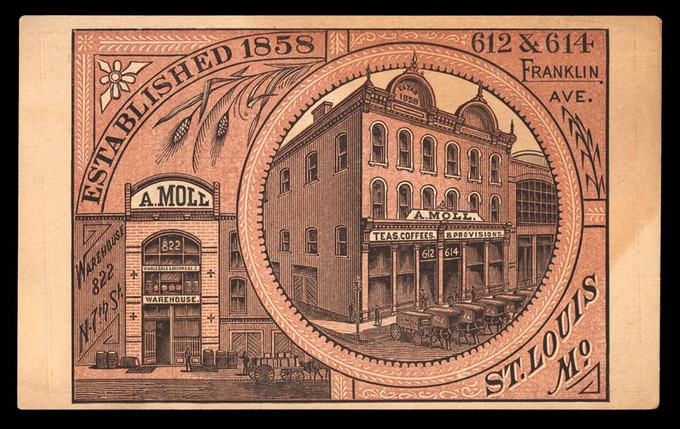
Before long the A. Moll Grocery Co. had outgrown its original quarters and by 1863 was located in a much larger building at 612-614 Franklin Avenue, as shown on a impressive trade card.  Subsequently Moll opened a warehouse at 822 North Seventh Street, also shown on the card.  The latter gave him space for mixing his own batches of whiskey, using raw product gathered from a variety of Missouri and Kentucky distilleries.  For his wholesale customers, he provided his products in attractive “bee-hive” ceramics, with Albany slip tops and Bristol glaze bodies.  Shown here right is a gallon jug, left is a half-gallon.  
For his retail trade, Moll featured two brands, “Old Bob Pepper Whiskey,” and “Delmar Club Rye.”  In a typical ad, shown above, he advertised Old Bob Pepper as aged four years and selling for $2.00 a gallon.  He also advertised bottles of “Home-made Blackberry Brandy” for 43 cents and Missouri Concord Wine for a half dollar.  For his Delmar Club label, Moll issued a shot glass that would have been given to saloons and restaurants carrying the brand.  Moll never bothered to trademark his whiskeys.

Along the way, Moll found another profitable beverage well-laced with alcohol called Mexican Pulque Bitters.  Pulque is a fermented drink made from the sap of the agave plant.  The color of milk, pulque has a molasses-like consistency and a sour taste.   Although some folks like the notorious Texas Judge Roy Bean favored it, pulque had been eclipsed by beer as a cheap high.  

Marketing pulque as a bitters — and thus medicine — may have been a way of reviving its popularity.  Claiming to be the sole agent for the United States, Moll advertised that Mexican Pulque Bitters relieved stomach distress and could be “used for diseases of the Liver, Kidneys, Stomach and Bowels.”  He marketed it with trade cards depicting dogs on the hunt — nothing to do with Mexico — and sold the tonic for 60 cents a bottle. 

In addition to understanding how to merchandise alcoholic beverages, Moll gained a reputation in St. Louis for his general business acumen.  The well organized interior of his store in the photo above attests to his merchandising skills.  He once drew customers to his store by displaying a 2,300 pound wheel of cheese and vigorously advertising its presence.  In time Moll became known the “Grocery King” of Franklin Street.  As his children matured, he engaged them in the business, particularly the eldest, Paul, and a younger brother, Adolph Arthur.  They may be the two men to whom he is speaking in the photo above.

Moll is reputed to have assisted many of his relatives by providing jobs at the grocery.  He also is credited with bring kinsfolk to St. Louis, including his widowed father; his brothers, Frederick and Robert;  Hedwig’s brothers, Adolph and Arthur Ballaseus; a brother-in-law William Paust, and a widowed sister-in-law, Antonia Bormann.  The photo below is said to picture his children and other relatives working at his Franklin Avenue store.
Moll was also taking an interest in St. Louis business, serving as a founder and officer of the Franklin Bank, and in national affairs as an active participant in the  Single Tax League.  At the turn of the last century, Henry George and the single tax philosophy he proposed were a hot topic.  George’s 1879 book Progress and Poverty  had captured the imagination of millions of Americans.  Many endorsed his proposed economic system that would have the government tax only land, not the profits made on it, but distribute revenues equitably to the populace.  As emphasized in his obituaries, Moll was a strong advocate for the cause.

On June 22, 1898, after an illness of three weeks, Adolph Moll died at his home on Berlin Avenue.  He was 64 years old.  His funeral was a major event.  As the Post-Dispatch reported:  “Bankers, business men, turners, workingmen — in fact people representing every walk of life — yesterday afternoon thronged the residence of the late Adolph Moll…and formed a part of the largest funeral held in that part of the city in years…Those who mourned were legion.”  

After a memorial service, some of it conducted in German, Moll’s funeral cortege, with leading St. Louis citizens as pallbearers, traveled to Bellefontaine Cemetery.  As family and friends looked on, the “Grocery King” was interred.  His gravestone is shown here.

After the founder’s death, family members took over the management of “kingdom” he had founded.  Paul Moll initially assume the leadership but died five years later.  After Paul’s death Adolph Arthur Moll, who had entered the business as boy clerk and risen to acting general manager, became vice president and general manager.  In 1907 he was named president of A. Moll Groceries.

“Grocery King” Adolph Moll has been credited by contemporaries as a hard working immigrant who had started with virtually nothing and built one of the most solid and advanced grocery businesses in America.  “All who knew him say he earned every cent of his comfortable fortune and built up his business on business lines and not by speculation,” opined the St. Louis Post-Dispatch.  As indicated here, the most financially rewarding of those business lines were based on alcohol.  With the coming of National Prohibition, however,  the grocery was forced to cease liquor sales.  

The sale of the Mexican Pulque Stomach Bitters likely had been affected earlier when the Federal government in 1912 branded them as “bracers,” beverages claiming to be medicines that were in truth “compound liquors” providing substantial alcohol but insufficient medical benefits.  Merchants selling them were required to have a liquor license and pay a substantial federal tax on sales.

Note:  Although I had been gathering material regarding A. Moll for some weeks, when I settled down to serious research on this St. Louis merchant, I found that Ferdinand Weber IV, the estimable president of the Federation of Historical Bottle Collectors, already had featured Moll in his “Peachridge Glass” blog, one that often features bitters bottles.  Because my emphasis would be on Moll as a “whiskey man,” I determined to pursue the story but have used some of Ferd’s pictures and information.  My thanks to him for this material.


Wednesday, September 7, 2016

“Best Whiskey on Earth”: Who Were the Guggenheims Kidding?

While successfully operating a Cleveland, Ohio, liquor house for some 27 years, brothers Herman and Julius Guggenheim brought to their business a wry humor, calling one of their whiskey brands, B. W. O. E., initials almost certainly standing for “Best Whiskey on Earth.”   This was a subtle send-up of the B.P.O.E, the Benevolent Protective Order of Elks, always a popular fraternal organization in Cleveland and other cities and towns throughout the United States.

If there are any doubts about the Guggenheims’ intentions, they should be dispelled by a shot glass the brothers gifted to saloons and restaurants featuring their liquor.  Shown here, the glass bears the initials B.W.O.E but has the etched head of an antlered elk on it, directly linking the initials to the Elks fraternal order. This elk has a smile on his face as if in on some great joke.  The Guggenheims and their customers must have enjoyed the humorous inference.

The brothers also gave favored customers an advertising serving tray carrying the B.W.O.E. brand name.  As shown here, the tray featured the face of a pretty young blonde wearing a Japanese kimono.  It also displays bottles of B.W.O.E. on the sides and identifies Guggenheim Bros., Cleveland, U.S.A.  The relatively large size of the tray is evident in an online image of a little girl holding it for a photograph.  She looks as if she would rather have been skipping rope.  By the way, a tray like this one sold for $292 on eBay in July 2016.

The Guggenheim’s story began in Baden, Germany.  Herman was the elder brother, born in 1851.  Julius came along five years later.  In 1874 when Herman was 23 and Julius 18, the brothers departed Europe on the S.S.Pomerania, heading for the United States, and eventually settled in Tiffin, Ohio.  They apparently quickly became engaged in the liquor trade.   The 1880 census found the brothers living together in Tiffin, their occupation given as  “liquor store.”
By 1882, the Guggenheims had moved to Cleveland where their wholesale liquor establishment first showed up in business directories located at 66 Michigan Street In addition to being “jobbers” of whiskey, they also were rectifiers, that is, mixing and blending their own proprietary brands.  

In addition to B.W.O.E., those labels were “Gorman Rye,” that the brothers openly advertised as a blend, and “Adalyn.”   Demonstrating the progressive merchandising acumen of the Guggenheims, they issued shot glasses for both brands. They did not bother, however, to trademark any of their labels.

During this period each of the brothers also was establishing a family.  Herman, once established in business in 1884 married Ella Lowentritt, a native Clevelander.  They would go on to have two sons, Joseph H., and Arthur L.   Julius had married earlier, in 1876.   His wife was was the former Tillie Kronthal, born in Sandusky, Ohio.  They would have at least one child, Edna.  Cleveland directories indicate that the brothers lived close to each other, Herman at 115 Beech Street, Julius at 102 Beech.

The Guggenheims appear rapidly to have met with considerable success in the liquor trade, requiring larger and larger quarters as their business expanded.  By 1889 they had moved to 60 Michigan Street.  After some six years at that location, they relocated to 183 Prospect until 1904 when the firm again moved, this time to 716-720 Bolivar Street SE.  After 1909, Guggenheim Bros., without explanation,  disappeared from Cleveland business directories.  Their closing was seven years in advance of Ohio voting “dry.”

What the brothers did after shutting down their liquor business is not clear.  They may simply have retired.  In the 1920 census Julius is recorded as having no occupation.  Herman died at home in May, 1919, at the age of 67.   Julius followed in October, 1929, at 73.  Both are buried in Cleveland’s Mayfield Cemetery, shown here.

The Guggenheims may never have written their names in the history books of Cleveland but they deserve to be remembered, if for nothing else, for their play on the Elks initials B.P.O.E. to name their liquor B.W.O.E — “Best Whiskey on Earth.”


Saturday, September 3, 2016

Hiram Walker and Whiskey: A Foot in Two Countries


Foreword:  Hiram Walker is one of the best known names in American whiskey history whose distillery was not located in Kentucky, but rather in Michigan and Ontario, Canada.  Although I have done short bits on Walker in the past, when I decided to do a vignette my research took me to a website called “Robinson’s Library” that contained a succinct summary of Walker’s life.  As in the past when a prior write-up of a whiskey man is appropriate to this site, rather than duplicate it, my policy is to get permission to use it.  Scott Robinson, the intellectual force behind the library, has graciously consented.  His article follows:

Hiram Walker was born in Douglas, Massachusetts, on July 4, 1816, the son of Willis and Ruth Buffum Walker. He grew up on the family farm, attended the local schools, and moved to Detroit, Michigan, in 1838. He married Mary Abigail Williams on October 5, 1846, and the couple eventually had five sons and two daughters.

After moving to Detroit, Walker tried his hand at several business ventures before finally finding success with the Walker Wholesale and Retail Store, about 1850. The store's primary business was groceries, but Walker began expanding the enterprise almost from the start. He began by distilling and selling his own vinegar, and then expanded his distilling business to including whiskey.  Then, knowing that the quality of his whiskey depended in large part on the quality of the grains used, he became involved in the grain-buying and -supplying business.
Move to Canada.  In 1855, Michigan passed a law forbidding the sale of liquor by anyone other than a druggist, and only for medicinal purposes. Although the law was never effectively enforced, Walker was concerned enough that he decided to locate his distillery elsewhere. Already familiar with the area around Windsor, Ontario, Canada, because of his grain business, the decision to move across the Detroit River was an easy one, and, in 1856, he purchased 468 acres east of Windsor. By 1859 the property boasted a distillery, steam-driven flour mill, vinegar factory, grocery store, and livestock yards. The latter business grew because the resourceful Walker used the grain leftover from the distilling operation to fatten his and neighbors' livestock.

Walkerville Barrelhouse
Birth of a Brand. In Walker's day, distillers sold their products in unmarked barrels, but Walker set a precedent by putting his product in bottles that bore the brand name "Walker's Club Whisky." As his whiskey gained popularity, Walker's U.S. competitors became increasingly nervous and, in 1880, succeeded in getting legislation passed that made it mandatory for the country of origin to be stated on the label. Walker complied with the law by simply renaming his whiskey "Canadian Club." And, thanks to the popularity of Canadian Club, Canada enacted laws governing what can and cannot be legally called Canadian whiskey, with the majority of those laws being based on Walker's whiskey-making process.

Walkerville. In 1861, Hiram Walker moved his family across the Detroit River into a large frame-house, the Cottage, in order to be closer to his operations. In 1864, with all his projects doing well, he returned to Detroit, where he lived for the remainder of his life.
While building his business enterprises, Walker also built a community. Known interchangeably as Walkerville and Walkertown, by 1867 the settlement contained the distillery, a hotel, a store, and “several tenements built by Walker and Co. for the convenience of their employees, which number from eighty to one hundred.” On March 1, 1869, the Canadian government officially recognized Walkerville as a post-office village.

Walkerville Bottling Room

By the early 1880's Walkerville had a population of 600 people, who lived in homes built and owned by Hiram Walker. They worked in Walker-owned industries, drank water pumped through pipes laid by him, received police and fire protection at his expense, and could attend the church built by him (named St. Mary’s in memory of his wife, who had died in 1872). In the absence of a commercial bank, Walker’s employees could deposit their savings in the private Walker bank.

Distillery Headquarters
On January 29, 1890, a petition was forwarded to the Ontario legislature requesting Walkerville’s incorporation as a town and citing the significant contributions of the Walker family to the development of the settlement. The act of incorporation was passed on April 7, and Hiram Alexis Walker, a nephew of the founder, became the first mayor. After incorporation, Edward Chandler Walker, Hiram’s eldest son, made his home there in a large mansion, Willistead, and so the Walker influence continued in local matters. Walkerville was annexed into the City of Windsor in 1935.
Distillery Executive Dining Room
Other Enterprises:  In 1880, Walker leased the ferry Essex from the Jenking Brothers shipyard just below Walkerville and built docking facilities on both sides of the river. Originally established for Walker's convenience, the enterprise became the Walkerville and Detroit Ferry Company in 1888, with Hiram and his sons as its executive officers, and remained in operation until 1942.

Walker also turned his entrepreneurial talents to the task of railway building. The Lake Erie, Essex and Detroit River Railway was incorporated in 1885. By the spring of 1889 the line had been completed as far as Leamington, and in 1901 the railway reached its eastern terminus, St Thomas. The Lake Erie and Detroit River Railway, as it was known then, had become an important line. Many rural people patronized the railway company’s excursions to Detroit and nearby Belle Isle, utilizing Walker’s ferry service in the process. The railway also gave impetus to a new industry -- the shipment of fresh fruit, vegetables, and fish from southern Essex to Detroit and Windsor.

The construction of the railway was followed by the establishment in Walkerville of a large number of industries, among them the Detroit drug firm of Parke, Davis and Company, the Globe Furniture Company, the Walkerville Malleable Iron Company, the Ontario Basket Company, and the Milner-Walker Wagon Works, the forerunner of the Ford Motor Company of Canada. Additional industries moved into the village before the turn of the century, creating an impressive industrial complex along Walker Road.

Walker’s interests in Walkerville failed to absorb all of his energy, and he remained equally active as an entrepreneur in Detroit after his return there in 1864. His name was associated with such enterprises as the Detroit Car Works, the Detroit Transit Railway, the National Bank of Detroit, the Michigan Land and Immigration Company, and the Hamtramck Iron Works. He also owned extensive real estate, including important parcels of land in the central business district, and was a prominent shareholder in the Detroit Advertiser and Tribune, a Republican newspaper.

Later Life:  Walker’s many businesses initially operated under the corporate umbrella of Hiram Walker and Sons, comprising Hiram and his sons, Edward Chandler, Franklin Hiram, and James Harrington. In 1890, however, it was decided to separate the interests and to that end the several individual companies were incorporated separately. Hiram Walker and Sons Limited continued to be associated with the manufacturing and marketing of distillery products, while most of Walker’s Canadian real-estate holdings were placed under the Walkerville Land and Building Company, and the utilities installed by the Walkers during the early years of the town’s development went under the Walkerville Gas and Water Company Limited.
In 1895, in declining health, Walker retired from his various business interests and transferred his holdings to his three sons. He died in Detroit on January 12, 1899. His sons and grandsons ran Hiram Walker and Sons until 1926, when Harry C. Hatch bought it for $14 million.

Afterword:  Again thanks to Scott Robinson for the use of his material on Hiram Walker.  For additional information on this giant of the whiskey industry, my post on Charles Klyman,  April 2016,  deals in part with Walker’s relentless legal pursuit of those who would dare to violate his trademarks.


Tuesday, August 30, 2016

Boston’s Irish John Walsh Did Apply — And Flourished


Throughout the years of the Potato Famine, nearly a million Irish arrived in the United States, often to face hostility.  The roughest welcome of all was in Boston, Massachusetts, with a population of about 115,000.  In 1847, the first big year of the Famine emigration, that city was inundated with 37,000 Irish Catholics immigrants — and they kept coming.  The result was “No Irish Need Apply” signs posted in shop windows and plant gates.   John H. Walsh likely saw such signs when he arrived on these shores as a youth but ignored them, applying himself in the whiskey trade and creating for himself and his family a flourishing business that lasted some 35 years.

Walsh was born in County Tipperary about 1841, just as the potato famine was beginning.  Although we have no photo, a passport application indicates he had a light complexion, blue eyes and a red beard.  Most notable, he stood over six feet, quite tall at time when the average height of a Harvard graduate was five feet, seven inches.  He arrived in America in 1865 at the age of 24, possibly having waited until the Civil War had ended.  Immigrant Irish frequently found themselves marshaled into military ranks.

Walsh’s early years in America are lost in the mists of time, but he appears to have apprenticed with a Boston wholesale liquor house, learning the trade, saving his money, and biding his time to strike out on his own.  He first surfaced in Boston business directories about 1878 as a liquor dealer and the proprietor of a boarding residence called “Centennial House.”  The 1880 Census disclosed the population of that establishment.  In addition to Walsh himself, listed as a “liquor dealer,” were his wife, Nancy, running the household, and two sons, James J., age 13, and William, age 11, both in school.  Nancy was aided by a staff of two, one of them John’s sister, Katie Walsh.   Among occupations of the eight boarders were two other liquor dealers, Richard Barry and Michael Kelly, and a barkeeper, Dennis Brown.  It would not have been unusual if these men were working for Walsh;  boarding with one’s employer was common in the time.

By 1880 Walsh was firmly ensconced in selling liquor from his headquarters in Haymarket Square, an historic former mercantile center in Boston. Opened in 1845, the square, shown above, was a well-known location from the mid-19th century to the mid-20th, when the buildings around it were demolished to make way for government offices. 

John H. Walsh & Company advertised widely in Boston newspapers, offering themselves as “importers and wholesalers.”  Proof of the owner’s wholesale merchandising, likely to Boston area saloons and restaurants, is in the large ceramic jug shown here, holding a gallon of whiskey.  For his retail trade and back of the bar, Walsh featured a long necked attractive amber-hued glass container.  It was embossed in bold letters with the company name and on the base “Boston.”


The Irish immigrant also marketed several proprietary brands of rye whiskey, including “Walsh’s,” trademarked by the owner in 1894, and “Sphinx,” “Owl,” “Kernwood,” and “Ashworth.”   Evidence is that Walsh was rectifying this liquor, that is, blending raw whiskeys in a back room to achieve particular taste, smoothness and color.  

Walsh's flagship brand appears to have been Sphinx Rye, its labels depicting a Egyptian background replete with pyramids and the limestone statue of the Sphinx of Egypt, a reclining creature with a lion’s body and a human head.  Even Walsh’s bottle stoppers contained the Sphinx image.

Even as John Walsh was flourishing at the liquor trade, the condition of the Irish in Boston was improving as their numbers became a political force.   As late as 1867, however, an anti-Irish, anti-Catholic candidate captured the Democratic nomination and was elected the city’s mayor.  The first Irish mayor of Boston, with many others to come after, would not be elected until 1885.  The “No Irish Need Apply” signs began to disappear.  

John Walsh lived long enough to see these changes in Boston and contributed to his adopted country in several ways.  He was heavily involved in local politics, serving as a member of the Democratic City Committee and the State Central Committee and also helped organize the Irish Athletic Club of Boston. Another accomplishment was establishing the Centennial House hotel in Allston, Maine.  He died in 1888. 

By that time, Walsh’s eldest son, James was approaching 30 years old and had worked with his father in John H. Walsh & Co., for a decade.  While keeping the name of the liquor house constant, James brought new vigor and ideas to the firm.  As an example, he trademarked both Sphinx and Owl Ryes and appears to have opened a second outlet at 14 Cross Street in Boston.  He also was advertising an alcoholic tonic called “Walsh’s Rock, Rye and Gentian.”

James Walsh also issued a number of shot glasses advertising his proprietary brands of whiskey.   These items would have been given to special customers, including saloonkeepers and bartenders using Walsh’s liquor in their establishments.  The detailed etching on these glasses, both the sphinx and the owl, render them of particular interest.  

These glasses also would have been relatively more expensive to produce than the average shot.  For his retail customers James provided a delightful pocket lucky piece.  It incorporated a 1901 Indian head penny rampant on a four leaf clover and the motto “It is pure whiskey.”
In his personal life, James had known tragedy.  The 1900 census found him living as a widower in Boston’s Ward 25, caring for a four year old son, John H., named for the grandfather.  By the 1910 census, this Walsh had married again, a woman whose first name was Ellen.  John H. was now 14 and no other children were recorded.  James’ 1910 occupation was given as “Owner - Liquor Business.”


How much longer James would have run the liquor business founded by his father is unclear.  I can find no Boston business directory entry for John H. Walsh & Co., after 1913.  Even so, the firm the Irish immigrant had founded as early as 1878 had survived at least 35 years.  With men like John Walsh applying their talents in Boston, the Irish had come a long way over that span — and would go further still. In 1913 the mayor of Boston was John F. (“Honey Fitz”) Fitzgerald, the grandfather of President John Fitzgerald Kennedy. 

Note:  This vignette unfortunately lacks details on John Walsh’s early life in Ireland and his occupational history from 1865 to 1878.  The material on James Walsh also is sketchy.  I am hope a relative who has done genealogical work on these Walshes will see the post and help me fill in the blanks and correct any wrong assumptions I may have made.

Note 2:  In 2018 Peter Samuelson, a noted collector from the Northeast of labeled whiskeys, was kind enough to send me the striking labels of Walsh's Sphinx whiskey.  I was able to add them above and appreciate his sending them to me.