Showing posts sorted by relevance for query mahoney. Sort by date Show all posts

Friday, April 15, 2011

Fixing Whiskey in Mahoneyville

Identified by McClure’s magazine in 1920 as the U.S.Government’s “chief analyst of whiskey,” a professor named Tolman declared that the widely sold brand of liquor merchandised as “Arlington Pure Rye” was simply neutral spirits colored and flavored. In short, this purported whiskey was an outright fraud on the public. The conclusions of the Federal inspector must have caused a chaos in Mahoneyville.


 Not that Mahoneyville ever really existed. In modern parlance, it was a “virtual” place, apparently encompassing Alexandria, Portsmouth and Norfolk,Virginia, and eventually Baltimore, Maryland. Nonetheless, an investor could have bought stock in its distillery. Mahoneyville was the brainchild of two brothers, Edward and John Mahoney of Portsmouth. An 1872 local directory listed them as wine and liquor dealers doing business under the name J & E Mahoney at 11 and 13 High Street. Edward was president and John was treasurer. Subsequently the pair hatched the idea of moving into distilling whiskey and calling the operation “Mahoneyville.” 


 They located the distillery in Alexandria, as indicated in a 1893 ad. Liquor tax records from the Federal Government indicate that Mahoneyville Distilling carried out transactions at its Alexandria area facility from 1898 at least through 1914. The brothers also adopted Northern Virginia names for their whiskeys: "Arlington Pure Rye" and "Cameron Springs Whiskey." Their other liquor brands also reflected Commonwealth origins: "Belle of Virginia Blended Rye," "Lake Drummond Rye," and "Hampton Roads Whiskey."  The company registered most of these trade names with the U.S. during 1905 and 1906. "Monogram Whiskey,"  another Mahoney product, was not among them.

 
 Although labels long ago have been washed away from most of its containers, Mahoney whiskey bottles were strongly embossed and can be readily identified. Subsequent bottles are more elaborately lettered and identify the Mahoneys as “distillers” At some point the brothers also acknowledged their role as “rectifiers,” that is, outfits that mixed whiskey -- and too often other substances -- to obtain a more tasty, smoother product. 

Early in the 20th Century, the Mahoneys opened a store in Norfolk and began to cite that location on their bottles. The brother’s liquor empire included several entities. In addition to Mahoneyville Distilling and J & E Mahoney, the family members operated the Edward L. Mahoney Company of Norfolk (1898-1913) and E. Mahoney & Son of Norfolk (1906-1908). A mini-jug from the latter firm boasts that the whiskey inside is “On the Square,” adding: “You know the rest, it is Mahoney’s best.” John and Edward also branched out into selling beer, advertising themselves as agents for the Consumer Brewing Company and its Bronco Export Beer. 

Mahoneyville came to a screeching halt in Virginia in 1916 when the state voted for a complete prohibition of alcoholic beverages. The Mahoneys then moved their operations to Maryland where they set up shop at 30 S. Calvert Street in Baltimore. They continued to sell their whiskeys from that location from 1917 until 1920 when the Nation went completely dry and the business closed. 

My guess is that the adulteration of Arlington Pure Rye, as decried by Professor Tolman and McClure’s magazine, was a result of the Mahoneys shutting down the Alexandria distillery and moving entirely into rectifying whiskey in Baltimore. Instead of creating and aging their products, they were mixing up ingredients in batches in a back room and slapping the old labels on it. To paraphrase Shakespeare: Something rotten was going on in Mahoneyville.


Saturday, November 2, 2024

Singing Along with Prohibition: Part One

 Foreword:  From “Yankee Doodle,” to the “Battle Hymn of the Republic,” to “Blowin’ in the Wind,”  many American songs have had a strong political content.  National Prohibition spawned many such a lyric,  both in anticipation of the Nation going “dry” in 1920 and during the 14 year experience of “The Great (Failed) Experiment.”  This post and the one to follow will explore some of those songs and their messages.  This post deals with the anticipation of Prohibition; the second will feature songs spawned by the actual experience.  


The lyrics below are from an 1918 ditty by writers William Jerome and Jack Mahoney, two of the best known songwriters of the early 20th Century.  Jerome created many popular songs of the era as well as musical comedies.  Mahoney, a lyricist, is best known for his co-authorship of the American favorite “When You Wore a Tulip and I Wore a Big Red Rose.”  Their anti-Prohibition song was entitled “Every Day Will be Sunday When the Town Goes Dry,” alluding to the general Lord’s Day ban on alcohol sales.   The cover of the sheet music shows a well-dressed gent in a top hat contemplating the doom destined to fall with National Prohibition. 


Goodbye, Hunter; So long, Scotch; Farewell Haig and Haig;

Oh my darling old frappe, they will soon take you away,

At the table with Lola they will serve us Coca-Cola;

No more saying: "Let me buy,"

No more coming thru the Rye;

Old Manhattan and Martini have received the big subpoena,

Ev'ry day'll be Sunday when the town goes dry.


In something of the same vein is “How Are You Going to Wet Your Whistle (When the Whole Darn World Is Dry?”)  It shows a similarly tuxedoed man about town asking the crucial question outside a cafe that once sold whiskey and draft beer that tried to get by on candy and soda.  Apparently the attempt failed since the sign on the door says “for rent.”  One of the authors, Percy Wenrich, began his career as a music demonstrator in a Milwaukee store and staff writer for music publishing companies.  Moving to New York Wenrich became one of the Nation’s most successful song writers, remembered even today for “Moonlight Bay,” “Sail Along, Silv’ry Moon,” and “Put on Your Old Gray Bonnet.”


Like the foregoing, several pre-Prohibition songs speculated on the kinds of effects the alcohol ban would have on daily life.  Among them was “What’ll We Do on a Saturday Night (When the Town Goes Dry).”  It shows a young swain talking his lady friend to the movies but worried about what to do afterward:


What'll we do on a Saturday night,

When the town goes dry?

Where will we go after seeing a show

to make the weary hours fly?

Imagine a fellow with a cute little queen,

Trying to win her on a plate of ice cream;

        What'll we do on a Saturday night,

           When the town goes dry?


The songwriter was Harry Ruby, who with his longtime partner Bert Kalmar were a successful songwriting team for nearly three decades.  In 1950 MGM made a musical of their lives called “Three Little Words,” starring Fred Astaire as Kalmar and Red Skelton as Ruby.


Another anti-Prohibition song of 1919 contemplated massive unemployment as a result of shutting down saloons and cafes.  Called “No Beer — No Work,” the cover of the sheet music shows four men, all apparently unemployed, standing outside a closed drinking establishment with a for rent sign. It is padlocked and someone has thrown a rock at the front window.  The lyrics told a story about a miner named Johnny Hymer who being told impending about National Prohibition, threw his tools on the ground and intoned:  “No beer, no work will be my battle cry;  No beer, no work when I am feeling dry.”  Hymer’s unemployment seemingly would be self imposed:  “I’ll hide myself away, until some brighter day.”


Naturally the thought of National Prohibition would bring on “The Blues” for many and songwriters were there to express it.   Al Sweet, a rather obscure composer who died in 1945 at the age of 59, wrote both the music and words to a 1917 “Prohibition Blues,” that included this lyric:


Oh! my Brothers and Sisters, listen to what I say

By nineteen twenty dere'll be no boose sold in the U.S.A.

De whole country am goin' bone dry,

Prohibition am de battle cry,

'Scuse me while I shed a tear,

For good old whiskey,gin and beer.

Goodbye forever, Goodbye forever

Ah got de Prohibition, Prohibition, Prohibition blues.


The cover for the sheet music is particularly interesting for the image of the distraught diner over not having any wine, the weeping waiter, and the bottles of wine, whiskey and beer flying away.  The man in the top hat peering around the corner was known as “Mr. Dry,” the creation of a New York cartoonist. [See my post on “Mr. Dry” on December 23, 2023.]


Since it is not possible to copyright a title, a second “Prohibition Blues” followed in 1918.  This one was produced by two celebrities.  Ring Lardner, noted as one of America’s prime short story writers and novelists, also was a composer and lyricist.  His co-author, Nora Bayes, was a well known American singer, comedienne and actress of the period.  In 1918 she was at the height of her fame, having been heavily involved in morale-boosting activities during the First World War.  Her photo and credits on the front of the sheet music would have boosted sales.  A year later Bayes recorded “How Ya Gonna Keep Them Down on the Farm (After They’ve Seen Paree),” a huge hit for Columbia Records.


As the months rolled on toward total abstinence, the song “I’ve Got the Prohibition Blues (for My Booze)” was rolled out in 1919 by the Elite Music Company of St. Louis.  The sheet music featured a waitress and two customers faced with a choice of tea, coffee, milk or soda, and clearly unhappy with any of them.  The lyrics to many anti-Prohibition songs are far from distinguished, but this one is among the worst.  Penned by an obscure songwriter named Carl Zerse, part of it goes like this: “I’m so thirsty that I’m blue, Old friend Booze I long for you.  I never knew that I’d miss you, the way I do, Boo-hoo, Boo-hoo.”  Think of that verse put to music.


Joseph McCarthy was an American lyricist whose most famous songs include “You Made Me Love You,” and “I’m Always Chasing Rainbows.”  For this 1919 song — “I’m Going to Settle Down Outside of London Town (When I’m Dry, Dry, Dry)” — he teamed with four time Academy Award nominee, James Monaco.  The words tell the story of a man who loves America but will settle in an English village by the sea come June.  He hates to say “goodbye,” but he is man “who must have a little liquor when I’m dry, dry, dry.”  He then pledges to come back when America has changed its mind.  That, unfortunately would be more than 14 years away.


Others apparently saw no reason for such drastic action.  Another 1919 song seemed to take the alcohol ban with some aplomb.  Written by a trio of New York “Tin Pan Alley” songwriters, it was entitled:  “(For If Kisses Are Are Intoxicating As They Say) Prohibition, You Have Lost Your Sting.”  The cover of the sheet music indicated that it had been successfully introduced by Sophie Tucker, backed by her band, the Five Kings of Syncopation.  Known as “The Last of the Red Hot Mamas,”  Ms. Tucker was one of the most popular entertainers in America during the early to mid-20th Century.  With the advent of television in the 1950s she had a rebirth of popularity and I remember her well.  Over the years she spawned almost as many imitators as Elvis.


As January 1, 1920, hove into sight, one song captured the dread.  As the cover of the sheet music made clear, even as the couples waltz around the floor, the hour was about to chime midnight ushering in an “alcohol-free” America,  The Grim Reaper — perhaps Mr. Dry in disguise — was lurking there to point out the lateness of the hour.  The song is entitled “At the Prohibition Ball.” Written by Alex Gerber and Abner Silver, the lyrics provide a fitting conclusion to the songs antecedent to “The Great Experiment.”


We'll be at the Prohibition Ball,

There we'll mix with Mister Alcohol;

Folks will pay their last respects

to Highballs and to Horse's Necks.


Note:  The songs above all were penned and published in advance of the imposition of National Prohibition.  The next article, to be posted shortly, treats some of the songs that followed during the ensuing 14 (ostensibly) “dry” years.


Saturday, August 15, 2015

Jacksonville’s Charles Blum Was “Dialed in” for Success

Take a good look at the figure at right.  His name was Charles Blum, a German immigrant  whose career began as the manager of a run-down saloon in Jacksonville, Florida, and who graduated to being one of the city’s leading liquor dealers.  Note the instrument in his left hand.  Along the way Blum also founded a Jacksonville telephone company and earned this caricature in the book of prominent businessmen, “Floridians as the World Sees ‘Em.”
Blum was born in 1861 to German parents, immigrating to the United States at the age of 17 in 1878, according to census data.  In the 1880 census, living in a Jacksonville boarding house, he gave his occupation as “baker.”   Local directories picked Blum up two years later working as a “clerk,” likely in the liquor business and learning the trade.  By 1887 he was listed as the manager of the Harry Mason Saloon and Restaurant on Bay Street. See the jug detail here. This place must have been a real dive.  The following year a report to the chairman of the city’s Sanitary Commission examined the condition of the floors of every business on either side of Bay Street, show below, between Cedar and Washington Streets.   The report had this devastating comment:  “Mason’s saloon, in bad condition, with rotten floors and improper drainage.”
Whether this report was the reason for a change in employment or not, by 1891 Blum was working for the Henry Mason Company, a Jacksonville wholesale liquor, wine and cigar dealer first recorded in business in 1882, located at 107-115 West Bay.  The relationship of this Mason to the saloon is unclear.  Blum was employed at the Mason firm for several years before striking out on his own.  A Jacksonville directory in 1895 first listed “Charles Blum & Company” as a wholesale/retail liquor dealer, located on Bay Street, shown above. 
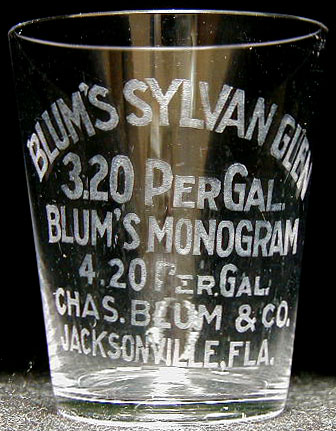
The following year the company moved further down West Bay to larger quarters.  That location may also have contained a saloon.  Blum’s brother, Jacob, who was his partner in his enterprises was listed as a “bartender” in directories.  Those larger quarters would be home to Charles Blum & Co. for the next 24 years and provided sufficient space for “rectifying,” that is, mixing and blending whiskeys to achieve a particular color and taste.  Blum sold his products in ceramic jugs that requested that they be returned to his establishment.  His flagship brands were “Sylvan Glen” and “Blum’s Monogram.”  There is no evidence that he trademarked either.

Already with a reputation as a successful businessman, in 1892 Blum married.  His bride was Margaret E. Mahoney, known by her family as “Maggie.”  Shown here, she had been born in 1860 in Florida into a family of native Floridians.  Maggie appears to have had a prior marriage.  The 1900 census recorded that two Blum stepsons named Murray were living with the family.  Charles and Maggie would have four children of their own, Charles, born in 1883;  Jennie, 1885; Margaret, 1889, and Fred, 1902.   

About 1903, Blum built a mansion to house his growing brood.  It stood at the intersection of Main and Second Street in a neighborhood of large homes. The home featured a hodgepodge of architectural styles, as was common then for such structures.  The Blum residence featured a series of doric columns, one set supporting a two story portico;  wrap-around porches on both the first and second stories; a “captain’s walk” on the top floor, and three large chimneys.  It was a house befitting an up-and-coming Jacksonville businessman.

Throughout this period, Blum was continuing to run a successful saloon and liquor dealership at  517 West Bay Street.  In 1900 directory listings indicate he additionally had opened a cigar factory at 923 West Bay.   Throughout most of that decade Charles Blum & Co., with brother Jacob listed as co-owner, continued to be recorded as dealing in wholesale and retail liquors.  Like many whiskey men of his time, Blum was gifting advertising items to favored saloons and restaurants carrying his liquors, in particular, shot glasses.  As shown below his offerings went from glasses etched with a simple recounting of the company name to more elaborate labels that cited the prices of Sylvan Glen and Blum’s Monogram.

Being a canny entrepreneur, Blum seems to have been increasingly aware that prohibitionary forces were gaining momentum in Florida as well as in the Nation.  In 1906 for the first time Blum advertised as a wholesale dealer for a non-alcoholic drink — Sheboygan (Wis.) Mineral Waters.  He also was moving into a completely new field — communications.  In 1913, Blum and other investors had organized the Jacksonville Home Telephone Company, “a corporation organized for the purpose of constructing and operating an automatic telephone system in Jacksonville.”  Blum was elected president.

Despite competition from the Bell Company,  Blum in his first annual report to stockholders stated that the company had more than 3,000 telephones in use and 1,875 subscribers.  Telephones were being installed at the rate of 25 a day and faced a backlog of requests.  The payroll had been $100,000 the previous year.  In his statement Blum emphasized the home-grown nature of the company:   “There are over 400 local stockholders, and with the exception of only about 10 percent of the stock, all of the stock of your company is owned and held by Jacksonville people.”   As a result, he asserted, subscriber money would stay in Jacksonville, amounting to over $150,000 annually, to be reinvested in the city and paid to its people as dividends. 

Meanwhile changes were taking place in Blum’s liquor business.  About 1910 his brother Jacob died and a new group of executives assumed the positions of vice president and secretary/treasurer.  His son, Charles Junior, joined the firm as a clerk.  New outlets were opened.  A wholesale department was located first at 4 E. S.Viaduct and soon moved to 738-742 West Bay.  In addition to the original store, two new retail outlets were opened, one at 411-417 E. Bay and a second at 517-523 W. Bay.  

At the same time, however, it was becoming increasingly clear that Florida would be going dry.   With the same energies that had propelled him into the liquor and telephone businesses, Charles moved quickly into non-alcoholic beverages.  According to a notation attached to the caricature that opens this vignette, Blum was owner, president or founder of four soft drink companies:  Blum Beverage Co.; Charles Blum Beverage Co., Inc.;  Jacksonville Gay-Ola Bottling Co., and Tropical Manufacturing Co.

When Florida voted to ban completely sales of alcohol in 1918,  Blum closed up his liquor interests and moved entirely to making soft drinks.  In declining heath, he lived long enough to see the imposition of National Prohibition.  The  1920 census found him living at his mansion with Margaret and three of his now-grown children.   That same year in February at the age of 57,  Blum died and was buried in Jacksonville’s Evergreen Cemetery.   His widow would join him there twenty years later.  Their family monument and headstones are shown below.

From an unpromising start, arriving as a youthful German speaking little English and later managing a rundown Jacksonville saloon, Charles Blum had risen to the top echelons of Florida business circles, epitomized by the caricature in the volume, “Floridians as the World Sees ‘Em.”  Not only had he succeeded in establishing one of the city’s most successful liquor dealerships, he had founded a cigar manufacturer,  a telephone exchange, and as many as four soft drink companies.   This immigrant boy clearly had made his mark in his adopted city and state.  

Addendum:  This Blum jug sold on eBay in March 2020 for $341:


Friday, August 13, 2021

Jerry Mullins: Out of the Mines to Fight Prohibition


The caricature that opens this post pictures one of the “prominent men of Montana”  whose career took him from laboring in the earth as a youthful miner to running a successful Butte liquor house and brewery and later heading up the fight against the forces of Prohibition in “The Bonanza State.”  His name was Jeremiah “Jerry” Mullins.


Mullins was born in Quebec, Canada, in August 1838 of Irish immigrant parents.  His father, Daniel Mullins from County Cork, immigrated to North America in 1846 at the outset of the Irish potato famine.  After a period in Massachusetts, Daniel went to Canada to work on the Canadian Grand Trunk Railway.  Jerry’s mother, Mary Mahoney, was born in Ireland and brought to Canada as a child.  The parents married there.  They would have nine children, of whom Jerry was the youngest. 


By the time Jerry Mullins reached school age the family had relocated to Marquette County, Michigan, where he attended elementary school.  His education ended when he was fourteen, forced by family circumstances to go to work.  “He subsequently earned his first money by driving a horse, receiving a dollar a day wages,”  according to a 1913 biography. “…His first permanent employment was as a day laborer on the Canadian Pacific Railroad.”


When he reached 21, Mullins, pulled by the lure of gold, left his Michigan home for the Black Hills of South Dakota.  The greatest days in Black Hills mining history had come three years earlier in 1876, when a team of four men discovered a gold bearing outcropping near present day Lead, S.D., staked a lode claim, and named their new mine the Homestake. They had located a part of the most significant gold vein in American history.  Thousands flocked to the area; many like Mullins were too late to experience a golden harvest.   After laboring in the soil there for two years, in 1881 Mullins moved 520 miles west to Butte, Montana, and resumed his mining efforts.


Those activities may have been more fruitful.  After five years in mining he found sufficient resources to open a saloon on the east side of Butte’s Main Street, shown here.  This venture proved unsuccessful and after only a year Mullins abandoned the role of saloonkeeper and, as his biography put it:  “The ensuing four years was variously employed….”   Among occupations, he served two years as deputy sheriff of Silver Bow County.   Even then Mullins’ talents were becoming increasing evident to himself and residents of Butte.


Thus, it probably surprised no one when John A. Stromberg who ran a store on the corner of Arizona and Platinum Streets featuring “whole fruits, produce, wines, liquor and cigars” took Mullins on as a partner.  The new enterprise, Stromberg, Mullins Company ditched fruit and vegetables and became entirely a liquor house, also selling bar equipment and supplies, and boasting an adjacent saloon.  Shown here as it looks today, the company’s chief location was known as the Stromberg-Mullins Building.


Artifacts from Stromberg, Mullins are rare.  An exception is a bar token advertising Lemp beer, the product of the W. J. Lemp Brewing Company of St. Louis.  The token is believed by collectors to have originated in Butte where Stromberg, Mullins Co. represented the brewery.


Meanwhile Jerry Mullins was having a personal life.  In August 1893, at the age of 35, he married Katherine O’Neil, a woman of Irish heritage, born in Michigan and according to records was 17 when they wed.  A year later their daughter, Mary Leona was born.  She was their only child.  By now prosperous, Mullins moved his family into a modest one story house at 510 West Galena Street in Butte.  Then he set about remodeling it extensively.  He added a one story extension and second story.  Today the house is on the historic register for its curved glass parlor bay, original Victorian interior, including a double staircase, an ornate support pillar, maple floors, and original light fixtures.  Mullins left his personal mark on the residence, carving his name in the granite doorstep and initials in the beveled glass above the door.  Shown here, although the exterior facade has been changed, the house interior is much as Jerry and Kate left it.


Mullins took a strong interest in local and state politics, active in the Democratic party organization in Butte.  He was elected from the Sixth Ward to a two year term on the City Council and followed with second term, named by his peers as Council President in City Hall, shown here. During this same period, he left Stromberg to open to his own saloon/liquor store and in 1904  joined with other Butte locals in starting a new brewery called the Tivoli Brewing Company.  Mullins was secretary treasurer and his saloon described as the main distribution point for wholesale and retail beer customers.

While Mullins may have been growing ever more wealthy from his liquor and brewery revenues, the forces of prohibition were accelerating in Montana as well as throughout the Nation.  Some brewers and beer distributors were employing a strategy that decried the evils of whiskey, allying themselves with the “Drys,” but insisting that beer was akin to “food” and should not be banned.  Alarmed, leading voices in the liquor industry, recognizing that the argument was damaging the entire effort at staving off bans on alcohol, created an organization called the National Protective Association.  It operated through a network of state units.  


As an individual who was involved with both liquor and beer, Jerry Mullins was a natural choice to be chosen president of the Montana Protective Association.  Traveling throughout the state advising on local issues, he became a widely recognized figure.  Thus it was no surprise when Mullins was selected among 100 Montana residents to be chosen for a caricature in the 1911 book, “Cartoons and Caricatures of Prominent Men of Montana,” — the picture that opens this post.  Mullins was the only “whiskey man” depicted.


In the end, Mullins efforts to beat back the forces of prohibition were futile.  On December 31, 1918, a year before the imposition of National Prohibition, Montana went “dry.”  Mullins was forced to close his saloon and witness the demise of the Tivoli Brewery after 14 years in operation.  Earlier he had taken a financial setback as the president of a mining company headquartered in Butte, capitalized at $1.5 million in 1914 dollars.  A mining journal reported the company owned the Ultamilla gold mine near Helena, Montana but was “in debt and idle.”


Whether it was these twin setbacks or other causes, Jerry and Kate moved to Seattle, Washington, the home of their now-married daughter.  There Mullins health declined because of heart problems.  In a weakened condition, he became a victim of a flu epidemic and died in January 15, 1923.  He was 64 years old.  On his death certificate his wife Kate gave his occupation as “hotel proprietor,” although I can find no record of his having been thus engaged.  After a funeral Mass in Seattle’s St. James Cathedral, he was buried in Calvary Catholic Cemetery, below. 


Over his lifetime Jerry Mullins, an immigrant’s son with limited schooling and a miner’s beginning, by dint of intelligence and effort in the alcoholic beverage trade had risen in business and political recognition to become one of Montana’s most prominent men.


Note:  This post was assembled from a variety of reference materials.  Principal was the book, A History of Montana, Volume 2,  published in 1913. Page 1167.“Cartoons and Caricatures of Prominent Men of Montana,”  was published in 1911 by J.C. Terry, artist and publisher.