Wednesday, June 13, 2018

Crawford Fairbanks: Distilling Made “Indiana’s Richest Man”


Although characterized as a poor boy with limited education who studied by candle light, Crawford Fairbanks, shown here as a young man, had the advantages of a distinguished ancestry and a father who was mayor of Terre Haute.  Cited as “Indiana’s greatest financial genius,” Fairbanks seized every opportunity, beginning with owning distilleries, to amass his fortune.

Crawford’s pedigree included an ancestor, Jonathan Fairbanks, who came from Sowerly in Yorkshire, England, to Boston and settled in Dedham, Massachusetts.  There Jonathan built the noted “old Fairbanks House” in 1636 that is still standing as the oldest dwelling in New England, shown below. 


Crawford’s father, Henry, shown here, was born in Massachusetts and moved to Terre Haute in 1835, considered an early settler.  A farmer, the father eventually became “a strong factor in the political and general development in that part of the state,” according to a biography, serving as both Vigo County treasurer and mayor of Terre Haute.  

Crawford Fairbanks was born in 1843 near Terre Haute.  Despite his family’s prominence he was educated in local schools, said to have studied at night by candlelight after finishing farm chores.  He left school and home at the age of 17 to work as a clerk in town for $5.00 a week but soon was advanced to bookkeeper and given a raise.   

When the Civil War broke out, young Fairbanks answered the call and on March 1, 1864, at the age of 21, was mustered into the 129th Indiana Infantry Regiment and became a lieutenant.  His unit,  employed on Sherman’s march on Atlanta, saw some hot fighting along the way, including the Battles of Resaca, Decatur, and Franklin.  The last, shown below, was a crushing blow for the Confederacy resulting in devastating losses and 14 rebel generals either killed, wounded or captured.


At war’s end Fairbanks returned to Terre Haute to begin a business career, starting in the grain business, an enterprise that was a huge success.  When his partner left for the California gold rush, Fairbanks moved into making whiskey.  A major distillery in town had its beginnings about 1840, operated by a series of owners until Herman Hulman bought it in 1870.  [See my post on Hulman, June 23, 2012.]   Fairbanks became an associate of Hulman who, embarking on a long holiday trip to Europe, sold him the distillery.  When Hulman returned, having decided to re-enter distilling, Crawford sold him back a half interest.

The two men were partners in the distillery they now called “The Phoenix,” a name that might have been prophetic given the multiple times the facility had to come up from ashes.  In 1878 a fire destroyed a significant portion of the cattle pens and livestock on the property where cows were being fed the spent mash.  The cattle feeding operation had no sooner been re-established when in January, 1879, an explosion occurred that killed two employees and did considerable damage to the facility.  The partners quickly rebuilt.

Meanwhile Crawford Fairbanks was having a personal life.  In December 1872 at the age of 29 he had married Clara T. Collett, a local girl born in Indiana.  The 1880 census found them living in Terre Haute with a daughter, Sarah, and an Irish servant girl. 

Fairbanks and Hulman found themselves in legal trouble with a grand jury in Indianapolis in April 1879, accused of 1) illegally operating on Sunday, 2) hiding untaxed whiskey under a corn pile, and 3) owing the State of Indiana $57,000 for unpaid liquor taxes.  The partners either denied the charges or offered explanations, agreeing nonetheless to pay any delinquent taxes.  The grand jury dismissed the charges holding that the evidence presented did not prove fraud by Hulman & Fairbanks.

Again exiting the distilling trade, Hulman sold his half ownership to Robert S. Cox and the company became Cox & Fairbanks, in 1800 claimed to be “the world’s largest distillery.”  The four story main building was capable of mashing 5,600 bushels of grain daily and operated on an aging steam system.  One afternoon in October 1880 a boiler exploded and catapulted into the malt house, destroying the rear of the main building.  Although local firemen with the aid of citizens soon put out the fire, the blast killed seven employees, six immediately and one who later died from burns.  An inspector from Cincinnati also was killed.  A similar number of people were severely injured.  The concussion was heard for miles around.

Reeling from the 1880 disaster, Cox sold his half interest to Louis Duenweg and the company became Fairbanks & Duenweg.  The disasters kept coming.  Although no human casualties occurred, in June 1884 the the original four-story distillery burned to the ground.  Three hundred hogs were roasted when the fire spread to a nearby barn.  At that point Duenweg sold out to Fairbanks who turned to John H. Beggs, a distillery executive from Peoria, for help. [See my  post on the Beggs family, Oct. 17, 2017.]  Together they organized the Terre Haute Distilling Co., reputed to have been the world’s largest at the time.


The company produced "Elkader Whiskey," that came in flask and quart sized bottles. Shown here is an example of the care Fairbanks put into the marketing of his products. The label is a striking gold color with the whiskey name in an elegant script.  Even more interesting is the reverse side that carries the seal of Elkader, an Algerian Muslim who fought against French Rule. Note the sword, half-moon and star, all Arabic symbols.  This likely is the only American whiskey named for an Muslim hero.  

By now immensely wealthy, Fairbanks expanded his entrepreneurial abilities into other areas.  In 1889 with Beggs and minor investors he purchased the Terre Haute Brewing Company, one of the Nation’s largest.  At about the same time, Crawford built a strawboard factory in Elgin, Ill., which later became part of the American Strawboard Co., a $6 million concern known as the “Strawboard Trust.”  Fairbanks was elected president of the company on Feb. 4, 1897.  In addition, he had investments in and served as an officer and director of Diamond Paper Co., of Anderson, Ind.; Haverhill Paper Co. of Massachusetts.; Chicago Paper Co. of Illinois; Piedmont Paper Co. of New York; and Southern Indiana Gas Co., of Greenfield and Shelbyville.  He also owned Terre Haute’s principal newspaper, The Tribune, shown above left.


Fairbanks liked owning hotels, buying the Denison in Indianapolis, the Terre Haute House, shown above, and was co-owner of the French Lick Springs Hotel, a resort popular for its warm springs and reputed healing waters, shown left. At one time he also was the principal investor in Indiana Sonora Copper & Mining Co., and president of the Terre Haute Water Works and Terre Haute Street Railway Co.  At the time of his death Crawford was the principal owner of Standard Wheel Co. and president and major stockholder of Wabash Realty & Loan Co., which held title to most of his real estate, including several farms where he raised race horses. 


Along with his growing wealth, Fairbanks was generous to his home town.  After the Terre Haute Distillery was torn down, he gave the Henry Fairbanks Memorial Park to Terre Haute on the former site. To honor the memory of his mother, Crawford donated the Emeline Fairbanks Memorial Library to the city.  Both are shown here.  After his wife’s death in 1911 Crawford built the Clara Fairbanks Home for Aged Women in her honor.  A family history said of him:  “In his natural make up, the selfish and the small are absolutely left out, while all flash and extravagance…are as far removed from his nature and conduct as it is possible to have them.”


As he aged, Fairbanks’ health declined.  Described as “a man with few intimate friends,” he was close to his personal physician, Dr. Henry Jennings of Indianapolis, who apparently prescribed that the millionaire spend his winters in Florida.  When Fairbanks continued to worsen as he approached 81 years, Dr. Jennings accompanied him by train back to Terre Haute.  Crawford died in his suite at the Terre Haute House in May 1924.  After a private funeral he was interred in the family mausoleum with his late wife and daughter, Sara, who had died in 1915.

Obituaries of Fairbanks ran in newspapers throughout Indiana and beyond.  One state journal hailed him as “Indiana’s greatest financial genius.”  Another reporter declared him “Indiana’s Richest Man.”  What too frequently was ignored was the original driving source of Crawford’s wealth and entrepreneurship — making and selling whiskey.  

Note:  The information for this article came from two principal sources:  An article of March 15, 2014, by Mike McCormick to the Terre Haute Tribune-Star and a Vigo County Library Historical Biography by Dr. Dipa Sarkar.


Saturday, June 9, 2018

Whiskey Men in Mormon Land

                                          
Foreword:  For every fourth post on this blog I currently am consolidating brief stories of whiskey men previously profiled who have similar characteristics in order to obtain a broader picture of them and their times.  This post is devoted to those who were involved with liquor in a seemingly unlikely place — Mormon Utah.

Terming the Mormon leader Brigham Young a “whiskey man” might strike some as an absurdity, given the injunction against strong drink that has been a traditional teaching of the Church of the Latter Day Saints.  The facts seem otherwise.  For example, in 1873 at Young’s request the Utah territorial legislature granted him the exclusive right to manufacture and distribute whiskey and other spiritous liquors.  “Valley Tan” was the name of his principal brand.


Young seems to have been of two minds on the subject of strong drink.  Although indications are that he drank beer when polluted water was an issue, he is said never to have tasted whiskey.  Brigham is recorded saying:   “If I had the power, I would blow out the brains of every thief in the territory, and I despise the whiskey maker more than I do the thieves.”  Strong words indeed from a religious leader and sometime distiller.  

Valley Tan predates Young’s monopoly over Utah whiskey.  The name itself was associated with a range of goods produced by Mormons in Utah.  One of the first industries they introduced into Salt Lake Valley was leather tanning.  Because their tanning process often was done crudely, the term became associated with any article of home manufacture done in a rough-hewn way, including distilling liquor. 


Another link from Brigham Young to Valley Tan was its sale in the department-like store the leader had established to provide necessities to Mormons in Salt Lake City, ostensibly because non-Mormon local merchants were gouging his people.  Called Zion’s Cooperative Mercantile Institution (ZCMI), the store, shown here, sold Valley Tan.   That could never have occurred without the leader’s blessing.   Because Young died in 1877, however,  his whiskey monopoly may have lasted only a short four years.


After Young’s death,  number of liquor stores were established in Salt Lake City, among them Henry Sadler’s emporium, just a little over a block way from the spires of the Mormon Temple.  There Sadler, an immigrant from England, successfully ran a saloon and sold whiskey to both the wholesale and retail trade, beginning after 1880.  Shown above is the front window of Sadler’s Mercantile Company.   It was located on South Main Street, a major thoroughfare that originates immediately south of Temple Square.  Note that the window contains full a display of “Old Ripy,” a well-known Kentucky bourbon.

Sadler’s sales room occupied the front portion of the building and was 24 by 75 feet in dimensions.  The center was the saloon portion of the establishment where Budweiser could be had on draught.  In the rear was the bottling and shipping departments.  The Deseret News, a Salt Lake daily owned by the Mormon Church, enthused:  “The company [is] extensive bottlers of fine wines and liquors and have every modern facility for bottling, corking and labeling, the packages they put up are noted for their neatness as well as purity and excellence of contents.”  

Sadler saw his liquor business slowly dwindle as Prohibition forces took the offensive.  Both Idaho and Colorado voted bans on distilling or selling alcoholic beverages in 1916.  Utah followed in August of the following year.  The Mormon Church itself remained largely neutral on a liquor ban, reputedly fearing a backlash by non-members.  As will be seen later, however, other forces were at work that eventually would cause Sadler to close his doors. 


To quote one observer:  “It is a sight you would never encounter today: liquor bottles proudly displayed to the public in a big shop window, only a couple of blocks from Temple Square, right out there on a bustling thoroughfare for the whole world -- Mormon and gentile alike -- to admire.”  He was talking about the picture shown above of the Salt Lake City store where Jacob (“Jake”)  Bergerman sold whiskey.  Bergerman called his firm the Utah Liquor Company.

Bergerman’s liquor store and saloon first shows up in Salt Lake City directories in 1898. From the outset,  he was not shy about selling whiskey in the heartland of the Mormons.   For example, he issued a metal token good for 12&1/2 cents in trade that had an image of the Mormon Tabernacle on the reverse.  

Bergerman also showed considerable imagination in the containers he chose for his liquor.  Among them are patterned molded gray canteens with cobalt decoration that depict on one side a scene of men drinking and on the other has the address of his firm.  They were made by White’s Pottery in far off Utica, New York.

Ironically, the man principally responsible for prohibition in Utah, Gov. Simon Bamberger, was a close friend of Bergerman.   On August 1, 1917, the governor, a Jewish immigrant from Germany,  pushed through a law making it a crime to manufacture, sell or consume alcohol.  The local press estimated that the law would affect four thousand persons in Salt Lake City alone who were dependent on the liquor trade.  Among them obviously was Jake Bergerman.  As the deadline approached, he and others sold their stocks at bargain prices. The Salt Lake Tribune estimated that hundreds of thousands of dollars worth of liquor had been so acquired and was stored in the cellars of Salt Lake residents.  

After a young manhood of restless wandering through America, another German immigrant, Frederick “Fred” Kiesel,  settled in Ogden, Utah, where in 1887 he established a liquor house and became known for his staunch opposition to Mormon church rule in the state.  Although he was frequently involved in politics and served a term in the Utah Legislature in 1901-1902,  Kiesel, shown here,  was primarily an entrepreneur.  He incorporated his business in 1887 under the name of Fred J. Kiesel and Company,  of which he was both president and manager.

Kiesel’s willingness to tweak the nose of the religious advocates of prohibition and the Mormon Church was epitomized by an 1909 ad that he placed in a magazine called The Western Monthly.  Claiming that “Uncle Sam Is Our Partner,” Kiesel boasted of being able to reach into “dry” Idaho Counties and other parts of the West where alcoholic beverages had been banned.  He said he was able to supply all demands of the thirsty, including “Ministers, Bootleggers, or even Politicians, from the Governor down to the least official.”
Among Kiesel’s jabs was issuing his own Valley Tan whiskey and advertising it with a picture of the Brigham Young monument that stood in downtown Salt Lake City.  Shown here is a celluloid match safe with an ad touting Valley Tan as “Pioneer of Whiskies.”  The other side of the safe advertised “Brigham Young Tonic Bitters” with a picture of the Mormon leader.  As with Sadler and Bergerman, Kiesel was forced to shut down when Utah went dry.

The history of whiskey in Utah is far more complicated and interesting than it might seem at first glance.   Events took several interesting twists and turns — from Brigham Young as a state-sponsored whiskey dealer, “Gentiles” running thriving liquor houses in the shadow of the Mormon Temple, a Jewish governor  responsible for the state going “dry,” and Young’s name, figure and face being appropriated for a whiskey and a highly alcoholic bitters.


Tuesday, June 5, 2018

How the Hergets Shaped Pekin, Illinois

                                   
The Hergets, two immigrant brothers from Germany and their sons, enhanced the economy of Pekin through their enterprise and investments encompassing eight decades.  At the center of their local business empire was making and selling whiskey.  Nonetheless, a 1910 history of Illinois described the Hergets this way:   “The members of the family stand high in the social circles of the city, and are universally respected for worth and nobility of character.” 

The Herget brothers, John and George, hailed from Hergershausen, Hesse-Darmstadt, Germany, the sons of Philip and Margaret (Reuling) Herget.  Their mother died while both boys were very young. Their father married again and had five more children. A former soldier, Philip was a wagon-maker who taught both sons the trade. 

John, born in 1830, was the first to immigrate to the United States, arriving in 1849 and finding his way to Gettysburg where he was engaged by a local wagon-maker.  His brother, George, born in 1933, followed three years later sailing from Le Harve, France.  He joined John in Gettysburg and was employed in the same wagon factory.

After a year George in 1853 decided to move west, traveling via the Ohio and Mississippi Rivers.  He fetched up in Pekin, Tazewell County, Illinois, where he took a job with a local retail grocer.  Shown above, Pekin was a city with a large German population where George would have felt comfortable.  John lagged behind.  He had fallen in love with Ernestine Schreck, who had been born in Saxony near Saxe-Weimar.  After they wed in Gettysburg, John with his new bride joined George in Pekin.  John and Ernestine would go on to have eight children, five girls and three boys.  George Herget was married in Pekin in 1861 to Caroline Goehner, a native of Pekin and the daughter of George Goehner, characterized as an old settler and prominent farmer of Tazewell County.  This couple would have four children, two sons and two daughters.  

About 1860 (dates differ) the brothers opened their own grocery business on Court Street, called J. & G. Herget.  From the outset an emphasis was on liquor sales. Meeting with rapid success, by 1870 the brothers erected a store twice the size of their original quarters.  It was located diagonally northwest from their first site and provided ample space for their wholesale grocery and liquor business.  The profits allowed the brothers — shown here, John is left — to branch out into other enterprises.


Key among those investments were distilleries.  In the fall of 1888 the Hergets built the Star Distillery in Pekin and two years later opened a second they called the Crescent Distillery.  In 1892 the family sold its interest in both plants to Samuel Woolner, one of the founders of the Illinois-based “Whiskey Trust.”  With the proceeds they erected the Globe Distillery, at the time the largest distilling facility in Pekin, having a capacity of mashing 5,000 bushels of grain daily.

By this time the Herget brothers had been joined by their sons in their enterprises.  George’s son, Henry, born in 1833, had been educated in both private and public schools in Pekin before being sent for secondary education at Elmhurst, Illinois.  Upon his return Henry, shown right, worked in the Herget brothers grocery, rising to manager.  In 1890 he was entrusted with supervising the erection of the Crescent Distilling Company and became its president.

John’s son, Carl, while following a slightly different career path, also was employed to further the family liquor interests.  Born in 1865, he was educated in local schools and subsequently entered the employ of J & G Herget.  After continuing there for some years, Carl, shown left, was dispatched to Mexico to look after his father’s extensive mining interests. Upon his return to Pekin he worked for the Star Distillery until it was sold and then supervised the construction of the Globe Distillery.  He managed that facility even after its 1898 sale to the Standard Distilling and Distributing Company. 

Having shut down their grocery and liquor business about 1891, the Herget brothers were free to pursue their many other business interests.  John was involved with the Pekin Steam Cooperage Company, Pekin Gas and Electric Light Company., Turner-Hudnut Grain firm, Globe Cattle Company, Farmer’s National Bank, the beet sugar factory, and was a large landowner in Tazewell County.  George was a major investor in the founding of the Illinois Sugar Refining Company; the Globe Cattle Company, and the Pekin Stave and Barrel Manufacturing Company, of which he was president. In 1905, with sons Henry and William, he founded the Herget & Sons Bank, shown right.

Additionally, the Herget brothers were active in Pekin’s community life.  John, a Republican, at various times was a city alderman, county supervisor, and mayor of Pekin in 1874 and 1875.  George served as alderman, supervisor, and a member of the Pekin Board of Education. He was elected the first president of the Pekin Park District.  He also assisted the city’s efforts to open a public library by contributing the land for the building.  Both men were among the founders of St. Paul’s Evangelical Church, shown here, and accounted generous contributors to its work.

Said to be “a man of stalwart physique” with excellent habits and good health, John Herget reputedly was struck down in September 1899 by malaria, a disease that was believed to have caused paralysis, causing his death at the age of 69.  In obituary it was said of this Herget:  “His life furnished an example to be emulated by all who wish to attain ideals of honest and manly citizenship.”  George lived another 15 years, dying at 80 in 1914.  “…His position in the financial world has been reached only by the exercise of sound business principles and unswerving integrity,” said one account.  John and George both are buried in Pekin’s Lakeside Cemetery, their gravestones shown here.


As the fathers moved off-stage, the Herget sons ably filled their roles in Pekin.  Henry became the president of Pekin Gas and Electric and secretary and general manager of Pekin Stave.  He also was vice president of the Doud Stock Car Company, an enterprise operating 2,000 train cars for hauling livestock. He also had interests in beet sugar, a paper mill, two wagon companies, a leather product manufacturer, a race track, a daily newspaper, and large timber holdings.  Stricken with a stroke at 77, he died in 1943.  Of him an obituary said:  “Henry G. Herget was the builder of modern industrial Pekin.  Many believe that if he had not lived, Pekin would be a town of less 10,000 today, instead of the thriving, industrial city of 20,000.”

Henry’s first cousin, Carl, was equally involved in Pekin’s industrial life.  While continuing to manage the Globe Distillery even after its sale, he also was director of many of the enterprises fostered by his father and uncle as well as of the American Brewing Company, a Pekin brewery founded in 1900. He also was a large landowner in Tazewell County.

This Herget is best remembered in Pekin for his mansion built in 1912 at 420 Washington Street.  Now on the Register of Historic Places, the house, shown here, was designed in the Classical Revival style and occupies the land of entire city block.  Carl Herget died in 1946 at age 80 and is buried with other family members in Lakeside Cemetery.

The importance of the Herget family to Pekin can hardly be overestimated during the period of eighty years when they were actively involved with the city’s economy and growth.  Although little spoken of at the time, it is important to remember that profits from distilling and liquor sales fueled the growth of their Illinois business empire.


Friday, June 1, 2018

Alphons Dryfoos Had Bottles on His Mind

Alphons Dryfoos was listed in New York directories as a liquor dealer from 1875 until National Prohibition shut him down in 1920.  Through much of that history he was fixated on bottles, in particular designing and patenting unusual and extravagant ones.  Clearly proud of his inventive abilities, Dryfoos displayed some of his “brainchildren” on his letterhead, as shown here. 

The whiskey man’s first foray into bottles was in September 1900.  Dryfoos filed with U.S. Patent and Trademark authorities a design for a bottle he called a “composite receptacle” that comprised “a plurality of sections forming together a unitary body, and a covering inclosing said sections and provided at its upper end  with a contracted tubular portion or neck serving as a handle for said body and also as a means for preventing the upward movement of the sections.”  He provided no model but simply an illustration that shows the three sections, each with a hinged cap.

It appears that Dryfoos was aiming to create a decanter that would allow a bartender or home mixologist to provide a cocktail from a single bottle.  For example, to make a Manhattan, one segment would hold the whiskey, another the sweet vermouth, and the third, Angostura Bitters.  Perhaps because this “receptacle” apparently never was put into production, Dryfoos continued his quest for an effective multi-sectioned “composite bottle,” as he termed it.  In 1894 he filed for another patent.  From three segments, this time he had moved to five.  Around a larger central receptacle, he arranged four other test tube-sized containers.  “If desired, two Stoppers may be removed at the same time, so that when the bottle is tilted two different liquids will flow….”  Again no model accompanied his patent application, simply a drawing.

A little more than a year later, Dryfoos was back with a new bottle.  This time he had given up on multiple sections but clearly was enamored of the idea of items clustered around a central decanter.   As shown here, this bottle had three niches into which he had inserted what he called “statues,” that is, miniature standing figures.  The accompanying drawing showed a gentleman in a top hat and a policeman.  

For once, however, Dryfoos appears to have had a model made.  It surfaced in November of last year and was put at auction on eBay.  Purchased by Bob Ferri, a Texan, for $1,000, it since has been displayed in detail in Bottles and Extras, the magazine of the Federation of Historical Bottle Collectors.  While the carved figures differ from those shown in the drawing, they remain unique in the bottle world.  In all probability it is the only one in existence.  In the future the bottle will be on display at a tavern owned by Mr. Ferri’s son in Memphis, Tennessee.

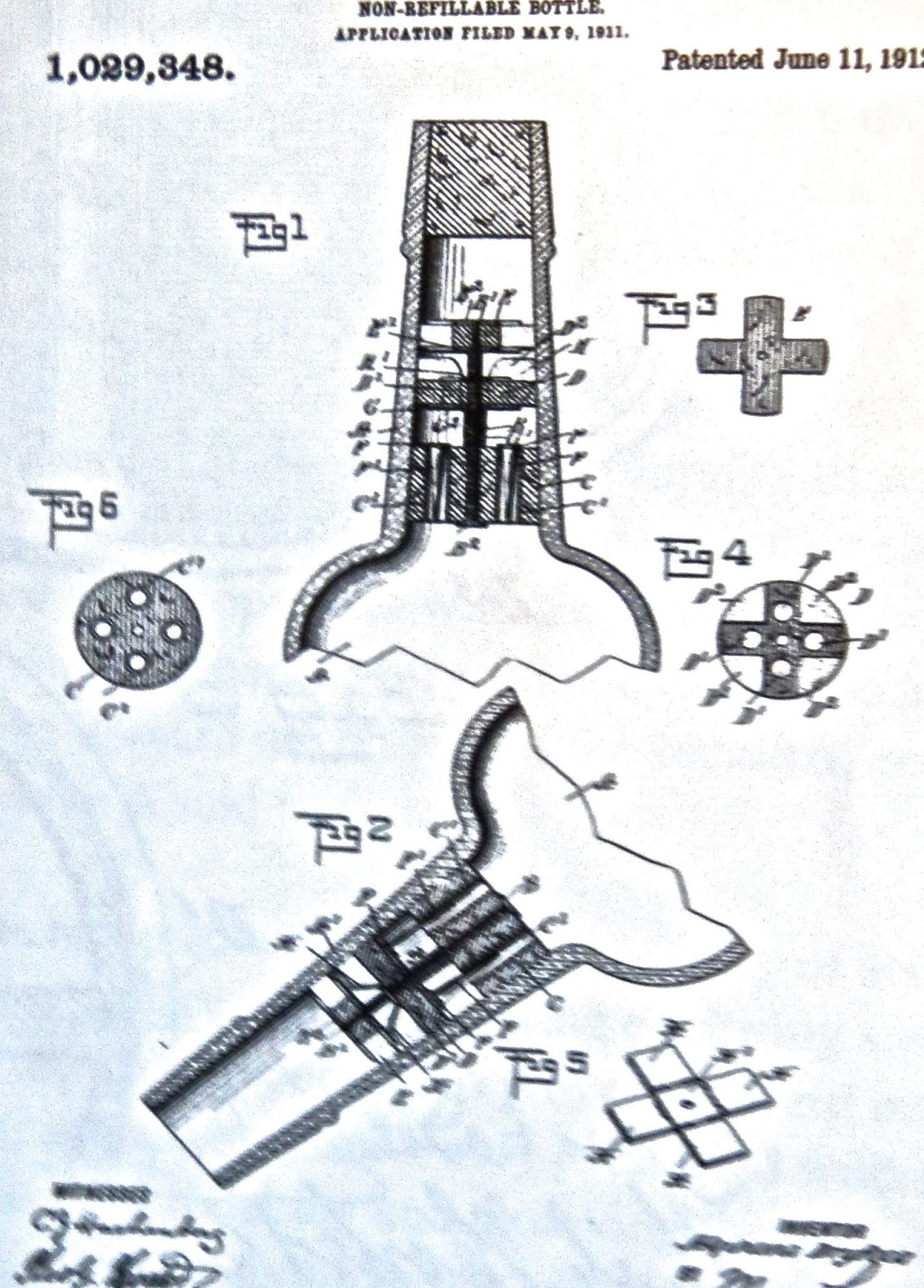
Even after creating this marvel, Alphons was not finished designing bottles.  In 1911 he took on the challenge of inventing a non-refillable bottle.  Others had tried but never found commercial success for their efforts although many makers of premier whiskey were deeply concerned about their bottles being refilled with rotgut by unscrupulous saloonkeepers and bartenders.  Dryfoos' solution was to insert a stopper with a central stem that released the liquid in the bottle through a series of overlapping valves.  While the stopper would allow liquor to pour out, the valves would block any effort at refilling.  

Along the way, the New Yorker had registered the design of a bottle with three sides based on encompassing one-third of a circle.  Dryfoos used a design patent in order to protect the ornamental appearance of his bottles, not their structural or utilitarian features.  In order to qualify, his design had to be judged as new and not obvious in view of prior designs.  Patented in 1894, the triangular bottle must have met the tests but once again no record exists of its commercial use.

Just who was Alphons Dryfoos — a man obsessed with improvements to bottles?   From records we know he was born in Niederhochstradt Rheinfalz, Dei Landau, Germany, in 1847, the son of Jacob and Theresa (Kaufman) Dryfoos.  At the age of 16, he left home and boarded the ship Goshen in Harve, France, setting out for the U.S.  He landed in New York City where he settled for the rest of his life.  Dryfoos became a citizen in 1884.  He was described on an 1889 passport application as about five feet, six inches tall, with a high forehead, oval face, fair complexion, and thinning brown hair.  In 1879 Alphons married Augusta “Gussie” Samuels in New York City.  He was 31; she was 20. There is no record of children.

Dryfoos’ early days in Gotham, roughly the decade from 1865 to 1875 have gone unrecorded.  My guess is that he was employed as a clerk in one of the many liquor houses in Manhattan, learning the trade.  In 1875 he surfaced in a city directory as “Alphons Dryfoos, Liquors” located at 737 Second Avenue.  Shown here, the building is still standing.  While at that address he registered a trademark for “Wald Koenig Bitters.”  Although he advertised this product widely no bottles bearing the name thus far have been found.

By 1886 Dryfoos was in new quarters at 654 Second Avenue, in 1887 opening a second store at 150 Chambers Street, located in the Tribeca District of Lower Manhattan. The building as it looks today is shown here.  Currently providing trendy housing for young Manhattanites, then Tribeca was a busy industrial and warehouse area.  Dryfoos maintained both stores through most of the 21 years he was passionately involved in inventing bottles.  By 1898 he had added a partner, Eugene Blum, to assist in the management of his liquor business. 


By 1902, Dryfoos, Blum & Co. had moved one last time, to 42 West Broadway — the northwest corner of Broadway and Park Place.  Feist Samuels, apparently a relative of Gussie, also was working with Alphons.  Shown here is an amethyst flask bearing the name of the partners.  Its color and shape make the bottle interesting even if it fails to reflect the flamboyance of Dryfoos’ other creations.

In 1920, with the coming of National Prohibition, Dryfoos, Blum & Co. was forced to shut down.   Nine years later, in January 1929, Alphons died at home, age 81.  Although he never attained fame or fortune for his inventions in bottles, Dryfoos had been in the whiskey business in The Big Apple for at least 45 years. That in itself was a notable achievement.

Note:  For anyone interested in learning more about Alphons Dryfoos, the May-June 2018 issue of Bottles and Extras has a longer article on his bottles, with larger illustrations.  The author/editor is Ferdinand Meyer V who has been following the Wald Koenig Bitters story for years.