Tuesday, June 11, 2019

George Washburne: A Voice for Spirits in a “Drying” Nation


Shown here, George Rudy Washburne gave up his pursuit being a “big butter and egg man” in Louisville, Kentucky, to turn his attention to a more lucrative trade — liquor.  It led to his founding and leading for 32 years a publication called the “Wine and Spirits Bulletin” where he became a vocal and influential leader in the ultimately losing fight against “Dry” forces pushing toward state and national prohibition of alcohol.


George was born on June 1, 1860,  the fourth of seven children of Jermaine and Mary Ann Rudy Washburne, at a town called St. Mathew in Jefferson County, Kentucky, about nine miles from Louisville.  Jermaine was a farmer and both George and his older brother, Delaney, were recorded in the 1880 census as “assisting farmer.”  The family lived in the frame house shown here, at 711 Fountain Avenue in St. Mathew.  Built by an ancestor on a 50 acre tract, Jermaine Washburne had inherited it when his father died and added a two-story rear wing.  Shown above, the house still stands and is considered a county historic landmark.

Neither Washburne boy fancied farming life.  Dulaney headed to medical school and became a well-known professor of medicine.  George skipped higher education and went into the dairy business.  Louisville directories in 1883 and 1884 listed him as foreman in a local dairy.  By the following year Washburne had moved to the Louisville Creamery and Supply Co.   The pivotal year was 1886 when George was 26.  He partnered with Harry Tramplet, a local businessman, as commission agents for a variety of products, including dairy, soft drinks, and a distinct emphasis on alcohol.

Although Tramplet & Washburne was an short-lived venture, George, described as a “hustler,” also was publishing a small newsletter aimed at the Louisville liquor industry.   He called it the “Wine and Spirits Bulletin.”  Washburne proved to have a natural ability as an editor and publisher.   Originally a four page weekly eventually the Bulletin became a monthly of some 50 pages, well-illustrated and providing substantial news and information.

In 1893, a competitor trade journal, the Pacific Wine and Spirits Review, did a brief profile of Washburne describing him as “…young comparatively, but he has been identified with the liquor trade for some years”  and congratulated him on the growth of his publication.  The item concluded:  “Mr. Washburne is a jovial, good-natured man personally, whom it is a pleasure to meet and his visitors always receive a royal welcome.”

Despite the success of the Bulletin, other ventures had proved less so.  Washburne joined a group of colleagues in investing in a real estate development call Warwick Villa, an area in the countryside about 20 minutes from Louisville.  George was recorded buying ten lots for resale.  The panic of 1893 doomed the effort as the land company of which he was a member went bankrupt and lawsuits resulted.  Washburne himself declared bankruptcy the following year.  The Courier-Journal reported:  "...  No estimate of assets and liabilities could be given. It seems that there is small demand for real estate in the country, which is said to form a considerable portion of Washburne's assets, he being one of the promoters of the Warwick Villa scheme ... It is understood that his liabilities are much larger than his assets.”

These untoward events occurred not long after George had found a bride. She was Mary A. Moore, the eldest daughter of W. B. Moore of Louisville and a native-born Kentuckian.  Shown here later in life, Mary was 22 at the time of the marriage, he was 34.  On April 28, 1893, they were married in the First Christian Church, the Rev. Mr. Powell officiating.  The Louisville Courier-Journal described an elaborate wedding and a church “crowded to suffocation.”  The couple would go on to have two daughters. 


Eventually Washburne recouped his wealth.  He bought a four-acre lot at LaGrange and Ash Avenues in a hamlet about 22 miles east of Louisville called “Peewee Valley” and built a large family home, shown above as it looks today.  Now on the National Register of Historic Places and known as the Washburne-Waterfill House, the structure is described as “eclectic” in architecture.  Also located on the property were two sets of historic gates, servants’ quarters, a pump house and a carriage house.  

Despite the failure of the Warwick Villa venture, Washburn continued to dabble in real estate, emphasizing land in Peewee Valley.   Elected mayor of the small town, George was responsible for a brochure called “Beautiful Pewee Valley”  with scenic photographs.  It extolled:  “Every resident of the city desiring a change of scene, and to escape the grime and clatter of the metropolis, would do well to consider Pewee Valley as the site for either a summer or permanent home.” Increasingly popular as a summer resort, the sales of cottage sites proved brisk.

Meanwhile Washburne was building his magazine.  In a special editorial in the January issue welcoming in the 20th Century, he commented about progress since he founded the Bulletin:  “We cannot but look with pride to what has been accomplished in the past, and with regard to the future we desire to renew our pledge to our patrons that we will spare no means and expense to maintain the high standard we have set and to improve on…the excellent news service furnished our readers.”


The publisher emphasized that the Bulletin was primarily an organ of the whiskey industry in the Ohio Valley, covering Kentucky and Cincinnati, at the time the leading city in liquor marketing.  Eventually the publication would open adjunct offices in New York, Baltimore, Cleveland, Buffalo, Milwaukee and New Orleans.  A review of Bulletin front covers indicates that the publication was drawing advertisements from distillers and rectifiers in Pennsylvania, Maryland, and other eastern cities.   

The Bulletin was well illustrated, including photographs of leading distillers, whiskey wholesalers and others in the liquor trade, as well pictures of their store fronts. The magazine’s attention grabbers, full pages scattered among more serious items, were of European paintings known as “salon nudes,” and analogous to the naked ladies often found displayed in American saloons.

Washburne did not ignore the general population.  In 1911 and again in 1914 he published a booklet he called “Beverages de Luxe,” a prelude to the “drink books” that currently flood the reading marketplace.  He explained in a foreword:  “Despite a spirit of fanaticism that periodically passes over the land, there is no denying that fine beverages are among the things that make life brighter, happier and worth while. A knowledge as to the best of them, their selection, their care and their serving, is, therefore, not amiss.”   The publication provided recipes for cocktails of the era to the drinking public.

Most of Washburne’s efforts, however, were providing news and editorials about the growing trend in America toward banning alcohol in localities, states, and ultimately the entire country.  As the U.S. inched closer to National Prohibition, a group of  brewers in 1918, hoping to make friends of the powerful Anti-Saloon league, pointed fingers at distilled spirits as the culprit while championing beer as “food.”  In effect, those beer makers were breaking with the distilling industry in last ditch effort to save themselves.  

Washburne wisely saw the folly in that approach, writing that:  “If the brewers begin a warfare on distilled beverages, they will, in our opinion, make a very great mistake….”  He understood that the forces of “dry” were intent on shutting down every saloon in America and cared not at all if liquor were served or only beer.  Events soon would prove him right.  As National Prohibition became assured in 1919, his client base doomed, Washburne after 32 successful years was forced to cease publishing the Wine and Spirits Bulletin.

Still only 59 years old, George’s immediate reaction was to go into the advertising business.  After all, he had been successful in filling his publication with ads.  With a Cincinnati businessman, Alfred B. Flarsheim, he founded an advertising agency with headquarters in Cincinnati and branches in Louisville and five other cities in the Ohio Valley.  The motto of the firm was “Sales promotion through business-building advertising.”

Shown here about 1920, Washburne also founded a second company called “Revista” that published a trade journal in the Portuguese language aimed at Latin America and most particularly Brazil.  This resulted in the government of Brazil appointing him its Vice Consul in Louisville.  Said the Courier-Journal of the appointment:  “The selection of this city indicates clearly that the Brazilian government expects American manufacturers in this section will be deeply interested in developing and extending their sales in Brazil.”

Washburne had only three years to serve as Vice Consul.  In February 1923, he became seriously ill and died on the 12th at the age of 62.  He was interred in Section Q, Lot 109, Grave #2 of Louisville’s Cave Hill Cemetery, the grounds where many of Kentucky’s most famous distillers are buried.  It was a fitting resting place for a man whose journalism had done so much for so long to bolster the liquor industry.  George’s widow, Mary Anne, would join him at Cave Hill 36 years later.  

Note:  Most of the information and illustrations for this post have been drawn from a single source, a pictorial history of the Washburne family published online under the title “Washburne-Waterfill House” by Donna Andrew Russell and the Peewee Valley Historical Society.  My thanks to them for this valuable resource on George R. Washburne, a truly remarkable “whiskey man.”


Friday, June 7, 2019

The Carstairs Were Philly Brahmins of Booze

In a 1860 Atlantic Monthly article called “The Brahmin Caste of New England,” physician and author Dr. Oliver Wendell Holmes Sr. wrote of the region’s rich and well-born, like the men shown above.  Subsequently the term has been applied to upper crust families particularly in Boston, New York, and Philadelphia.  Hailing from the the Quaker City, the Carstairs family, despite getting rich by selling liquor, were well qualified as “Brahmins.”

The progenitor of the clan was Thomas Carstairs, born in 1759 in Fife, Scotland, who emigrated to the Pennsylvania Colony as a youth, marrying Sarah Hood Bradford in Philadelphia  in 1775.  Although Carstairs’ advertising put the origins of their liquor house at 1788, data on Thomas gives no evidence of such a  business.  Thomas’ obituary listed him as a “paymaster.”

The next Carstairs, James, was not born until 1789.  His early occupation was in finance, having married Sarah Britton Summers, daughter of Andrew Summers, a wealthy Philadelphia banker and intimate friend of Robert Morris, known as the “Financier of the Revolution.”  Sarah’s mother was the sister of Admiral Charles Stewart, who commanded a number of Navy ships, including USS Constitution, during the War of 1812.  Confirming the “brahmin” nature of the marriage, Jerome Bonaparte, youngest brother of Napoleon I, was an usher at the wedding.

About 1834, James took a sharp turn from banking and established a business as a wholesale grocer and ships’ chandler, providing supplies and equipment for the many vessels porting at Philadelphia and, it was said, he “did a large and profitable business.”  Key among his stock was rum and whiskey, and in the 1870 census, James Carstair’s occupation was given simply as “liquor.”

It was James’ son, James C. Carstairs Jr., seen left, who took the family firmly into the whiskey trade.  By 1860 he had entered a partnership with Philadelphia merchant Joseph F. Tobias in a liquor dealership that bore the Tobias name.  That same year James Jr. married a Philadelphia “blue blood,” Mary White Haddock.  Her father, Daniel Haddock Jr., was a well-known Philadelphia boot and shoe manufacturer, banker, and a director for other local companies. 

By 1870 James Jr. had left Tobias and with a new partner, John C. McCall, created a liquor house called Carstairs, McCall & Co.  The business was highly successful.  An 1893 write-up of the firm reported that “their extensive operations as importers, exporters and wholesale dealers constitute them an important factor in the wine and liquor trade of the country.”  By this time Carstairs, McCall had opened outlets in both New York and Boston.  


Citing the firm’s purported 1780 beginnings, the item continued:  “Such a protracted standing and close, perpetual touch with growers, distillers, and leading sources of supply in this country and Europe have resulted in an enormous trade….”   The company also was exporting American rye and bourbon “in heavy and regular shipments to Europe, Central and South America and elsewhere,” according to the report.

Carstairs, McCall issued a blizzard of whiskey brands, among them (with trademark dates) “American Club” 1897; “Belle of Pennsylvania,” 1896; “Carstairs Monogram,” 1894; “Carstairs Rye,” 1905; “CMC&C,” 1884; and “Invincible,” 1905.  Not registered were “Carstairs No. 6,” “Diplomacy Rye AAA,” “Monongahela Monogram,” and “Orator Rye.”  For retail sales the company packaged their whiskey in both quart and flask sizes.  

Particularly arresting is the label on Orator Rye, showing a stump speaker in full throat who apparently is being fueled by the whiskey on the dais with him.  It likely depicts Edwin Dickenson Baker, a noted American orator killed during service as a Union officer in the Civil War.

Like other successful whiskey houses, Carstairs, McCall provided wholesale customers, including saloons, hotels and restaurants, with giveaway items.  They included saloon signs such as the one below that depicts a wounded Union soldier on horseback receiving a bottle from a nurse — a bottle identified as Carstairs Rye.  Other gifted items were shot glasses and back of the bar bottles, examples to be found throughout this post.


Before 1890 James C. brought his two sons, Daniel H. and J. Haseltine Carstairs, into the firm.   Shown right in a passport photo, Daniel was the elder, born in 1962;  his brother had come along a year later.  In 1893 Daniel was recorded as the manager of the Philadelphia office.   Shortly after, both his father and John McCall died, leaving the firm in the hands of the next generation of Carstairs.

By that time each brother had wed.  David married Louise Sowers Orne, the daughter of Philadelphia Judge Edward B. Orne.  They would have two children before apparently divorcing.  David then married Viola Howard in April 1906. No children have been reported.  J. Haseltine wed Belle A. Wolfe Wilson in 1884 and had one daughter.  After 34 years of marriage in 1918, Belle died and he re-married.  J. Haseltine’s union with Gertrude Reinhart produced a second daughter.

The Carstairs brothers continued the name of Carstairs, McCall until 1909 and then dissolved the company only to re-appear in the liquor trade in a somewhat different guise.  Because Carstairs, McCall had been rectifiers, not distillers, they were dependent for raw product from which to construct their brands on distilleries located elsewhere.  The availability of supply could fluctuate significantly, sometimes through natural causes, sometimes by machinations of “Whiskey Trusts.”  In the late 1800s, the Carstairs attempted to alleviate the shortages by buying into and controlling their own distillery.

The facility they chose was The Robert Stewart Distilling Co., shown here, located in Highlandtown, Maryland, about one hundred miles southwest of Philadelphia.  Federal records show the Carstairs drawing whiskey from that source by 1898.  The brothers appear to have purchased the Stewart Distillery outright in the early 1900s.  Under their ownership production appears to have increased significantly.  In 1905 Maryland’s State Tax Commissioner reported that the taxable value of distilled spirits for the year had increased to $328,984, jumping again to $421,292 in 1907.

The siblings also reincorporated after 1909 as the Carstairs Bros. Company, having consolidated Carstairs, McCall into the Stewart Distilling Company.  In a 1911 ad, shown here, they claimed that Carstairs Rye was “the oldest American whiskey” and boasted that it had been sold “in every high class [read Brahmin] New York club, cafe and hotel for the past 112 years”  — a clear exaggeration.  

The Carstairs family continued to guide the fortunes of the liquor house they had inherited until the coming of National Prohibition.  The last withdrawal in federal records occurred in 1920.  Both brothers died in 1934, just as Repeal was occurring.  Daniel succumbed on January 25, cause unknown, and J. Haseltine the following December 21.  According to his death certificate, he died from cirrhosis of the liver and diabetes. 

The Carstairs brand name was revived for a time after Prohibition, attached to a whiskey called “White Seal.”  Said to be a product of the Barton 1792 Distillery in Bardstown, Kentucky, White Seal is a blend of bourbon, grain whiskey and neutral spirits.  The product reputedly does not meet the legal definition of whiskey in some states and is available only in limited markets.  It clearly is a “bottom shelf” label and a far cry from the “Brahmin” origins of the brand.  The Carstairs must be turning over in their graves.

Note:   This post was gathered from a wide range of sources.  The quotes on Carstairs, McCall above are from an 1893 booklet entitled, “A Souvenir of New York’s Liquor Interests,” no author given, from the American Publishing & Engraving Co. of New York City.


Monday, June 3, 2019

“Con” Oram Punched His Way to Montana Fame


A saloon owner known widely as “Con” Oram gained national fame for his 185-round, semi-bare knuckles prize fight in Virginia City, Montana, against a man who outweighed him by 52 pounds.  Proving he was more than a pugilist, Oram, shown here, also has been credited by historians with advancing Montana toward statehood.

John Condle Oram was born in 1835 and reared in Ft. Finlay (now just Findlay), Ohio.   Originally from Maryland, his father was a blacksmith and a noted wrestler.  He taught his son both skills.  When he was about 20 years old and working in his father’s shop, Con decided to tour the West as a wrestler, challenging the locals for money.  Along the line he also picked up boxing skills.


By 1861, he had accrued sufficient winnings to open a blacksmith’s shop in Denver, Colorado.  Business proved to be brisk and soon he was able to hire several assistants allowing him, he said later, “earn money very fast.”  Having a staff also gave Oram the leisure, according to a press account, to spend time in the mountains “buffalo hunting and shooting game, living pretty much like a western pioneer, camping out and roughing it generally.”  He also honed his boxing ability in Denver and began prizefighting as a middleweight on the East Coast, including bouts in New York City.


By 1864, he returned West to Virginia City, Montana, where Oram, said to be a non-drinker himself, opened a liquor establishment he appropriately called “The Champion Saloon.”  It was located on the town’s main thoroughfare, Jackson Street, above.  The saloon is shown here in its reconstructed state as part of Virginia City’s historic district.  In an ad in the local Montana Post the saloonkeeper declared that his fighting days were over and he wished to run his saloon and live “as a private citizen.”  

Oram’s ads for the Champion Saloon emphasized that he carried a stock of the best liquor and cigars.  They also advertised his lessons in “boxing and sparring once a week,” signaling that Con had not entirely left the ring behind.  Additional evidence is a “sparring license,” like one shown below, issued to him by the Territory of Nevada.

Not long after he arrived in Virginia City, Oram was challenged to a boxing match by a whiskey-drinking Irish heavyweight named Hugh O’Neil.  The winner’s purse was set at $1,000, equivalent to about $15,000 today.  That payoff was sufficient to coax Con once more into the ring.  Given his size and weight advantage, O’Neil was a 3 to 1 favorite.  The prospective bout caused considerable excitement in the region. On New Years Day 1865, people began to pour into Virginia City in anticipation of the fisticuffs the next day.  One account called it:  “A dense crowd clad in as motley style as ever the sun shown upon.”


Because no building was large enough to hold the bout, a local saloonkeeper and liquor dealer named Nelson built a log arena on property he owned behind his store.  Called Leviathan Hall, it was the only boxing arena in the entire Pacific Northwest.  It held about 1,000 people who paid between $10 ($150 equiv. today) and $5 ($75) for general admission. 


For their money they saw what Sports Illustrated has called:  “One of the longest and most brutal fights in American ring history.”   Some accounts have called it a “bare knuckles” event.  It was not.  Both Oram and O’Neil wore tight-fitting unpadded gloves.  Round after round ensued as both men battled valiantly.  O’Neil’s height, weight and reach obviously gave him an advantage but Oram was wiry and quick, said by one observer to be a “bundle of venom” in the ring.  During three hours and 185 rounds the fighters hit the canvas 91 times, often deliberately to end a round.   Finally as Con seemed to be getting the worst of it, the referee stopped the fight, declaring it a draw.  The pot was split between the two contestants.

Today the Leviathan Hall site, later the location of a frame house, bears a sign as part of the Virginia City historic district and is on the Department of the Interior’s National Register of Historic Places.  In contrast, no plaque commemorates Con Oram’s important role in the movement to create a new Montana Territory out of the existing Idaho Territory.   

According to a Montana historian of the late 19th Century, the men of Virginia City gathered early in 1864 on Jackson Street for a Western version of a town hall.  Among them was Oram, a man said to be “much given to orating when in convivial mood.”  Con mounted a wagon and began to harangue the crowd about their present hardships and the need to take immediate action to separate from Idaho and form a new political entity, with its capital at Bannock, Montana.

Apparently galvanized by Oram’s rhetoric, the crowd voted to raise money to send Sidney Edgerton, a Virginia City resident and former Ohio congressman, to Washington to present President Lincoln with a petition to create a Montana Territory.  The group, its work done, then repaired to a saloon, likely The Champion.  Lincoln agreed to the split and signed a decree creating the new territory.  He appointed Edgerton, shown here, the first governor.  

Oram’s fame as a boxer when coupled with his leadership in the territorial movement led to his being lionized in Virginia City.  A 20th Century historian has written:  “Con was one of the most popular men in town when he first arrived…He made friends with everyone and once was serenaded by the City Brass Band, an honor reserved for bigwigs.”

Over the next few years, possibly lured by the money to be made,  Oram continued to participate in the fight game, winning some, losing some, while continuing to operate his saloon in Virginia City.  In 1866 he expanded his operation, renovating The Champion and renaming it Melodean Hall, “the place of sweet songs.”  It became a theater and dance hall in addition to a bar. Some called it a “hurdy-gurdy” palace, implying that the music for dancing was provided by cranking a handle on a mechanical device.  The sign is visible at far left. 

When the Melodean failed to be profitable, Oram closed the hall and moved to Helena, Montana, where he opened a similar establishment.  When a few months experience in Helena also proved disappointing, he moved back to Virginia City and opened another saloon theater on Jackson Street.  One of the advertised attractions was Oram himself in a sparring match and an exhibition with barbells.

Eventually retiring from the ring and amusement business, Con spent his last years on a 125-acre ranch he purchased near Dillon, Montana, about 60 miles west of Virginia City.  There he raised oats and hay, much of which went to feed 80 horses and a similar number of cattle.  By this time Oram had married a woman thirteen years his junior.  She was Susan Alice Tout, an immigrant from Wales.  They would have four children.  As children they were not told, it is claimed, that their father had been a prizefighter.

As he aged, Oram’s hair turned white and he grew a long salt and pepper beard.  The pounding his body had taken in the ring almost inevitably led to consequences and his health declined while his children were still young.  He died in Butte in 1892 at the relatively young age of 57.  His youngest daughter was only about three years old.  I have been unable thus far to find the place of his burial.  

Con Oram’s life was a study in persistence and courage.  He had come West with no credential other than his physical prowess and written a page in its history.  In what might serve as a fitting epitaph, the Montana Post called him “Con the Fearless.”

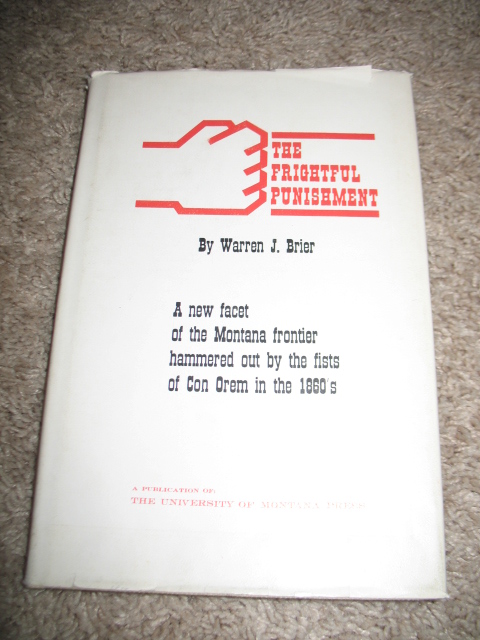
Note:  Shown here is the cover of a 1969 book by Warren J. Brier entitled “The Frightful Punishment:  A new facet of the Montana frontier hammered out by the fists of Con Orem in the 1860s,''  published by the University of Montana Press.  It is a good account of the saloonkeeper/pugilist’s life, with emphasis on his prize fights.  Much of the information provided here is derived from its pages, as is the photo of Jackson Street.  The 113-page book is still available from used book sources and I recommend it to anyone interested in learning more about the fabulous life of Con Orem.


Thursday, May 30, 2019

Whiskey Men with Multi-City Enterprises


Foreword:   Most whiskey men were willing to operate successfully one or at most two liquor stores in the same city, apparently not wishing to dissipate their time and talent in dashing among multiple locations.  For a few distillers and liquor dealers, however, building an “empire” of outlets was an attractive and attainable option.  The experiences of three such are recited briefly below. 


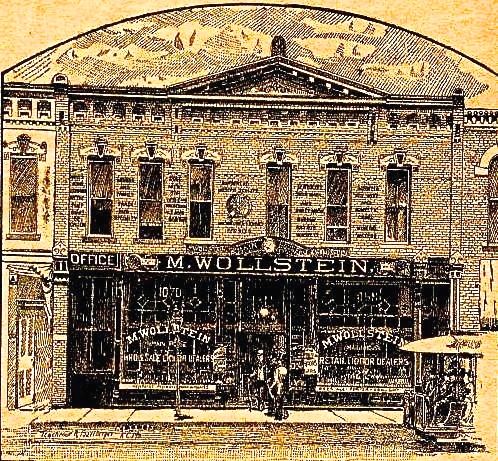
Before the concepts were common in American business, the M. Wollstein Company was a multifaceted conglomerate liquor dealership, as suggested above in an illustration that listed its various entities.  The management structure was presented in tree form, perhaps to resemble a sturdy oak.  Behind this multi-limbed enterprise was the mysterious figure of Theodore Wollstein. 


Throughout his life, Wollstein seemed to have avoided the U.S. Census taker.  He first surfaced in the public record operating a short-lived whiskey dealership in Chicago (1877-1878).  About 1880, he established a liquor business in Kansas City, Missouri, at 1070 Union Avenue that the company variously called “Main House” or “Station A.”  It is shown below.  The Wollstein liquor empire eventually would spread over four states.  

Ten in all, the additional stores were: M. Wollstein & Co., West Main Street, Sedalia, Missouri; M. Wollstein & Co., 1420 East 18th Street, Kansas City; H.  Brann & Co., 304 Main Street, Kansas City;  M. Glass & Co, 1625 W. Ninth Street, Kansas City;  M. Wollstein & Co., 222 North 16th Streets, Omaha; Chicago Liquor House, 222 16th Street, Omaha; M. Wollstein & Co., 522 South 13th, South Omaha; *M. Glass & Co., 224 North 10th Street, Lincoln, Nebraska; H. Brann & Co., 311 Larimer Street, Denver, Colorado;  M. Wollstein & Co., 535 Broadway,  Council Bluffs, Iowa.  

The Wollstein “tree” that looked so firm and healthy eventually suffered considerable damage  The company’s mail order sales were severely curtailed by Congressional action in 1913.  Five retail “limbs” were sawed off in 1916 as Colorado, Iowa and Nebraska all went “dry.”  During World War One and after, U.S. officials began hacking at the liquor empire trunk with accusations of German influence.  National Prohibition provided the final blow of the axe. The Wollstein empire “tree” toppled to the ground.  With its demise went all further traces of Theodore Wollstein, back into the mists of history. 

George H. Goodman, a whiskey man from Paducah, Kentucky, was described by a contemporary this way:  “He possess the power of scattering his energies without lessening their force.”   True words.  Goodman was amazing in his ability to keep his liquor business operating smoothly and profitably in no fewer than six widely scattered cities.  

In 1900 at the age of 24, Goodman borrowed $500 from his father to start a retail liquor business in Paducah.   As his enterprise became increasingly profitable, he branched out into mail order sales and began to open branch stores in a succession of cities.   They included Jackson, Tennessee; Evansville, Indiana;  Cairo, Illinois;  and Shreveport and New Orleans, Louisiana.  George called these “Branch Houses.”   At one point he also claimed to own the Early Times Distillery in Nelson County, Kentucky, but records fail to sustain the claim.  More likely he was buying all or most of the liquor produced at that facility to create his own brands of whiskey.  

Goodman’s multiple outlets were often recorded on the ceramic jugs he often used to hold his whiskey.  They display a variety of labels, in black and cobalt blue, that likely reflect the places from which they were shipped.  He also bottled his product in glass, once again with his far-flung houses mentioned.  The shot glass shown here lists Cairo, Paducah, Evansville and New Orleans.  

In his merchandising literature,  Goodman boasted that the combined business of his houses enabled him to place contracts with distilleries that insured the very lowest market prices. His many outlets, the folder claimed, allowed transport from one to three days earlier than his competition. A Goodman pamphlet, entitled “Our Success”  also asserted that in 1910 his firm realized a total of $800,000 in trade.  If true, the $500 from Goodman’s father  been had been multiplied 1,600 times in less than a decade.

In his later years, Goodman’s prominence was such that President Roosevelt named him as Kentucky State Administrator of the WPA, the Depression-era works organization.  He served in that position for at least the next four years.  He is shown here, second from left, front row, with a number of Democratic politicians.

A third multi-city liquor enterprise involved a family — the Sprinkles of whiskey.  Shown here with his wife, Martha, is the progenitor of three generations of whiskey men, Hugh Sprinkle of Liberty Township, Yadkin County, North Carolina.  Following his return from the Civil War Hugh distilled whiskey on his farm for decades, eventually taking two sons, Benjamin and Hugh C. Sprinkle into his operation.  Benjamin in turn passed the skills down to his three sons — Benjamin Jr., James T., and Henry L.   After North Carolina voted “dry” in 1909, the family spread out to several locations in the South.  

The H.L. Sprinkle Distilling Company -- named for Henry L. “Hence” Sprinkle —was incorporated in 1912 in the town of Girard (now Phoenix City),  located in Russell County, Alabama.  The purpose of the business, as recorded with the state was the: “manufacture, purchase & sale of whiskey.”  During this period the Sprinkles also operated a distillery in or near Pensacola, Florida and had a retail outlet in Jacksonville. 

As shown here, much of the Sprinkles' whiskey was sold in glass gallon jugs with the embossed motto, “Sprinkle Whiskey Wants Your Business.”  As shown here, the three cities appeared on each bottle.  After Alabama went dry,  the Sprinkles moved their Girard retail outlet to Monroe, Louisiana. That city subsequently was embossed on the company’s gallon jugs. 


With the passage of the Volstead Act in 1919,  the Sprinkles were forced to shut down their distillery and sales offices.  According to descendants, the family had a stock of liquor when America went dry and members booked passage on ships and took their whiskey to sell in countries abroad.

Note:  More complete vignettes on each of the whiskey outfits treated here can be found on this website.   Wollstein, December 3, 2014;  Goodman, May 5, 2012; and Sprinkle, April 22, 2014.