Showing posts with label Theodore Wollstein. Show all posts

Thursday, May 30, 2019

Whiskey Men with Multi-City Enterprises


Foreword:   Most whiskey men were willing to operate successfully one or at most two liquor stores in the same city, apparently not wishing to dissipate their time and talent in dashing among multiple locations.  For a few distillers and liquor dealers, however, building an “empire” of outlets was an attractive and attainable option.  The experiences of three such are recited briefly below. 


Before the concepts were common in American business, the M. Wollstein Company was a multifaceted conglomerate liquor dealership, as suggested above in an illustration that listed its various entities.  The management structure was presented in tree form, perhaps to resemble a sturdy oak.  Behind this multi-limbed enterprise was the mysterious figure of Theodore Wollstein. 


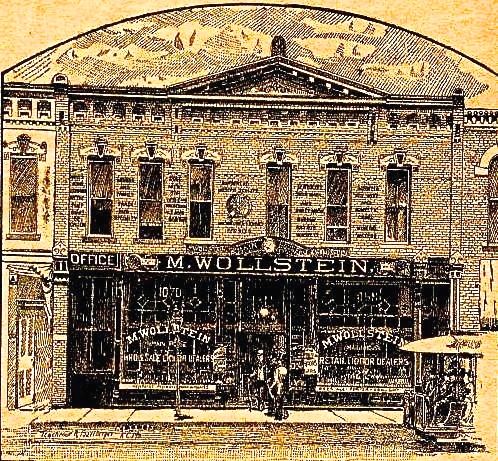
Throughout his life, Wollstein seemed to have avoided the U.S. Census taker.  He first surfaced in the public record operating a short-lived whiskey dealership in Chicago (1877-1878).  About 1880, he established a liquor business in Kansas City, Missouri, at 1070 Union Avenue that the company variously called “Main House” or “Station A.”  It is shown below.  The Wollstein liquor empire eventually would spread over four states.  
Ten in all, the additional stores were: M. Wollstein & Co., West Main Street, Sedalia, Missouri; M. Wollstein & Co., 1420 East 18th Street, Kansas City; H.  Brann & Co., 304 Main Street, Kansas City;  M. Glass & Co, 1625 W. Ninth Street, Kansas City;  M. Wollstein & Co., 222 North 16th Streets, Omaha; Chicago Liquor House, 222 16th Street, Omaha; M. Wollstein & Co., 522 South 13th, South Omaha; *M. Glass & Co., 224 North 10th Street, Lincoln, Nebraska; H. Brann & Co., 311 Larimer Street, Denver, Colorado;  M. Wollstein & Co., 535 Broadway,  Council Bluffs, Iowa.  

The Wollstein “tree” that looked so firm and healthy eventually suffered considerable damage  The company’s mail order sales were severely curtailed by Congressional action in 1913.  Five retail “limbs” were sawed off in 1916 as Colorado, Iowa and Nebraska all went “dry.”  During World War One and after, U.S. officials began hacking at the liquor empire trunk with accusations of German influence.  National Prohibition provided the final blow of the axe. The Wollstein empire “tree” toppled to the ground.  With its demise went all further traces of Theodore Wollstein, back into the mists of history. 

George H. Goodman, a whiskey man from Paducah, Kentucky, was described by a contemporary this way:  “He possess the power of scattering his energies without lessening their force.”   True words.  Goodman was amazing in his ability to keep his liquor business operating smoothly and profitably in no fewer than six widely scattered cities.  

In 1900 at the age of 24, Goodman borrowed $500 from his father to start a retail liquor business in Paducah.   As his enterprise became increasingly profitable, he branched out into mail order sales and began to open branch stores in a succession of cities.   They included Jackson, Tennessee; Evansville, Indiana;  Cairo, Illinois;  and Shreveport and New Orleans, Louisiana.  George called these “Branch Houses.”   At one point he also claimed to own the Early Times Distillery in Nelson County, Kentucky, but records fail to sustain the claim.  More likely he was buying all or most of the liquor produced at that facility to create his own brands of whiskey.  

Goodman’s multiple outlets were often recorded on the ceramic jugs he often used to hold his whiskey.  They display a variety of labels, in black and cobalt blue, that likely reflect the places from which they were shipped.  He also bottled his product in glass, once again with his far-flung houses mentioned.  The shot glass shown here lists Cairo, Paducah, Evansville and New Orleans.  

In his merchandising literature,  Goodman boasted that the combined business of his houses enabled him to place contracts with distilleries that insured the very lowest market prices. His many outlets, the folder claimed, allowed transport from one to three days earlier than his competition. A Goodman pamphlet, entitled “Our Success”  also asserted that in 1910 his firm realized a total of $800,000 in trade.  If true, the $500 from Goodman’s father  been had been multiplied 1,600 times in less than a decade.

In his later years, Goodman’s prominence was such that President Roosevelt named him as Kentucky State Administrator of the WPA, the Depression-era works organization.  He served in that position for at least the next four years.  He is shown here, second from left, front row, with a number of Democratic politicians.

A third multi-city liquor enterprise involved a family — the Sprinkles of whiskey.  Shown here with his wife, Martha, is the progenitor of three generations of whiskey men, Hugh Sprinkle of Liberty Township, Yadkin County, North Carolina.  Following his return from the Civil War Hugh distilled whiskey on his farm for decades, eventually taking two sons, Benjamin and Hugh C. Sprinkle into his operation.  Benjamin in turn passed the skills down to his three sons — Benjamin Jr., James T., and Henry L.   After North Carolina voted “dry” in 1909, the family spread out to several locations in the South.  

The H.L. Sprinkle Distilling Company -- named for Henry L. “Hence” Sprinkle —was incorporated in 1912 in the town of Girard (now Phoenix City),  located in Russell County, Alabama.  The purpose of the business, as recorded with the state was the: “manufacture, purchase & sale of whiskey.”  During this period the Sprinkles also operated a distillery in or near Pensacola, Florida and had a retail outlet in Jacksonville. 

As shown here, much of the Sprinkles' whiskey was sold in glass gallon jugs with the embossed motto, “Sprinkle Whiskey Wants Your Business.”  As shown here, the three cities appeared on each bottle.  After Alabama went dry,  the Sprinkles moved their Girard retail outlet to Monroe, Louisiana. That city subsequently was embossed on the company’s gallon jugs. 


With the passage of the Volstead Act in 1919,  the Sprinkles were forced to shut down their distillery and sales offices.  According to descendants, the family had a stock of liquor when America went dry and members booked passage on ships and took their whiskey to sell in countries abroad.

Note:  More complete vignettes on each of the whiskey outfits treated here can be found on this website.   Wollstein, December 3, 2014;  Goodman, May 5, 2012; and Sprinkle, April 22, 2014.


Wednesday, December 3, 2014

The M. Wollstein Liquor Tree — How It Grew and Fell

  
Before the concepts were common in American business, the M. Wollstein Company was a multifaceted conglomerate liquor dealership, as suggested above in an illustration that listed its various entities.  The management structure was presented in tree form, perhaps to resemble a sturdy oak.  Behind this multi-limbed enterprise appears to have been a man named Theodore Wollstein, who remains a mysterious figure.

Throughout his life, Theodore seemed to have avoided the U.S. Census taker.  He first surfaced in the public record operating a short-lived liquor dealership in Chicago (1877-1878).  About 1880, M. Wollstein Company, a whiskey wholesaler and retailer, was established in Kansas City, Missouri.  While I can find no M. Wollstein involved with this firm,  T. Wollstein was listed as proprietor on a company catalog, along with a partner,  J. G. Seligsohn.
M. Wollstein & Co. was established at 1070 Union Avenue, a location shown right that the firm variously called “Main House” or “Station A.”  There would be many other houses and stations in the Wollstein liquor empire, spread over four states.  Among them were:

*M. Wollstein & Co., West Main Street, Sedalia, Missouri
*M. Wollstein & Co.  1420 East 18th Street, Kansas City
*H  Brann & Co., 304 Main Street, Kansas City
*M. Glass & Co, 1625 W. Ninth Street, Kansas City
*M. Wollstein & Co., 222 North 16th Streets, Omaha
*Chicago Liquor House, 222 16th Street, Omaha
*M. Wollstein & Co., 522 South 13th, South Omaha
*M. Glass & Co., 224 North 10th Street, Lincoln, Nebraska
*H. Brann & Co., 311 Larimer Street, Denver, Colorado
*M. Wollstein & Co., 535 Broadway,  Council Bluffs, Iowa

The corporate structure of these 10 entities is not clear.  Each appears to have had an individual manager.  Several managers were identified, none of them named Wollstein.  According to the company advertising M.Wollstein & Co. sold a blizzard of brands, many of them nationally known.  To those the company added a number of proprietary labels, probably blended and compounded at their Main House address.  Those were  such whiskeys as “Cedar Point,” “Ambassador,” Wollstein’s Pure Rye,” “Wollstein’s Select,” “Wollstein’s Sour Mash,” and “Wollstein’s Special Reserve.”  Records indicate that of these, M. Wollstein & Co. trademarked only Ambassador Whiskey, registering the brand in 1915.

The company presented its whiskey in wholesale quantities using ceramic jugs.  Two shown here have the Union Street “Main House” address.  Those containers would have held a gallon or more of Wollstein’s whiskey to be served out at saloons and hotel bars.  Another jug shown here was issued for the Wollstein’s Omaha area outlets, listing each location on the label.  The company also issued a number of giveaway items to favored customers, in particular shot sizes, both in glass and in metal.  The tin cup shown below contained the names of the Omaha, South Omaha and Council Bluffs M. Wollstein stores.
Although his activities are far from clear, Theodore Wollstein continued to be present in the Wollstein liquor empire.  In 1892, he established a Kansas City establishment under his own name.  From 1892 to 1907 the T. Wollstein & Co. liquor dealership was listed in city directories. In December 1895, Theodore was granted a liquor license renewal for the M. Wollstein & Co. store at 522 South 13th Street.  A newspaper account later had him visiting Kansas City from his Chicago home, accompanied by his wife and two daughters, “Hermie and Gertie.”  Theodore was said to be looking after the Kansas City business block owned by M. Wollstein & Company and visiting the local manager, Sigmund Landsburg.  This was another indication that Theodore  was the chief executive officer running the Wollstein enterprises.


About 1905 a major corporate change occurred in the liquor dealership.  While maintaining the Union Street address, the company altered its name to the M. Wollstein Mercantile Company, as shown by the logo below.  The change may have resulted from increasing recognition that prohibitionary forces, through local (dry) option laws that allowed municipalities and counties to ban alcohol, were gradually squeezing the Wollstein retail outlets.  Wollstein Mercantile seems to have emphasized mail order sales.  Until after 1913 it was still legal to send liquor by mail into dry areas.

As the Anti-Saloon League and its allies marched forward, however, one by one individual states were making alcohol sales totally illegal.  At the stroke of midnight on January 1, 1916, Colorado enforced statewide prohibition through what were known as “Bone Dry” laws.  The Wollstein’s H. Brann store on Larimer Street in Denver shut its doors.  That same day the Iowa outlet followed suit.  The Wollstein’s liquor dealership in Council Bluffs was closed.  Nebraska as early as 1891 had passed a local option law that allowed municipalities to vote dry.  In 1915 the state legislature banned liquor sales altogether. On New Years Day 1916 the Wollstein empire also lost its outlets in Omaha and South Omaha.  Four stores shut down on a single date.

Ever resilient, however, Wollstein’s Nebraska operations moved to St. Joseph, Missouri, locating at Fourth and Felix Street.   For its opening day on May 19, 1917, a newspaper advertisement promised a souvenir to every visitor.  The Missouri based dealer also was pricing quarts of nationally name brand whiskey for as low as 95 cents.  Although Missouri remained friendly to liquor until National Prohibition in 1920, other states continued to battle against mail order sales.  In November 1917, according to newspaper accounts, George W. Ringo who lived in a secluded spot near the Platte River outside Springfield, Nebraska, was arrested by state agents after “a large amount of liquor was found about the place.”  The packages bore the name of M. Wollstein Mercantile of St. Joseph, Missouri. 


The heavy pressure of prohibitionist forces apparently caused Theodore Wollstein to sell out about this time.  The Union Street address disappeared from Kansas City directories in 1914 to be followed by a new one at 23-25 East 24th Street.  In 1919 M. Wollstein Mercantile listed another new address at 1414 Grand Avenue in Kansas City.  Its directors were listed as H. T. Kemper, a Kansas City banker, and H. F. Helm, owner of a local commission house. 


This Wollstein Merchantile Co. found itself under investigation by the U.S. Attorney General and the Department of Justice. The cause was alleged German “enemy interest” in the firm during World War I.  At the same time Wollstein Merchantile came under scrutiny by a congressional committee investigating undesirable German influences in wartime America. Those "Hun" interests were set at 36 percent of Wollstein’s authorized capital, a foreign investment of roughly $135,000 in today’s dollar.   By 1820, Kemper and Helm had resigned their posts, possibly under political pressure.  With the advent of National Prohibition that same year, M. Wollstein Mercantile Co., as the Germans would say, went kaput. 

The Wollstein “tree” that looked so firm and healthy, as illustrated to open this post, had suffered considerable damage.  The company’s mail order sales had been severely curtailed by Congressional action in 1913.  Five retail “limbs” had been sawed off in 1916 as Colorado, Iowa and Nebraska all went “dry.”  During World War One and after, U.S. government forces had began hacking at the company’s sturdy trunk with accusations of enemy influence.  National Prohibition provided the final blow of the axe. The Wollstein tree toppled to the ground.  With its demise went all further traces of Theodore Wollstein, back into the mists of history.

Note:  Deducing the timing and places of the various entities involved with the M. Wollstein interests was a difficult research effort.  Although this post is based on available records, my instinct is that there are corrections to be made. Particularly frustrating was ferreting out the ownership, including the role played by Theodore Wollstein.  My hope is that a Wollstein descendant will see this piece and help fill in the gaps.