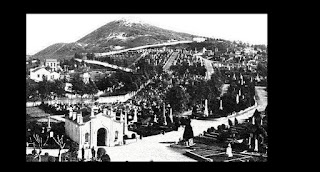
Foreword: Presented here are brief accounts of three whiskey men who died under mysterious circumstances. Two of their deaths were ruled accidental, although upon reexamination one might well have been suicide and the other a murder. The third was declared a suicide, and likely was so, but the rationale behind the act of self-destruction remains murky.

The net worth Porter gave the 1870 census taker was equivalent to over $1,000,000 today. In ensuing years he operated David Porter Company as an apparently successful liquor house and managed a portfolio of other investments. One press account called him “one of the most widely known of San Francisco merchants.” Late on the afternoon of January 17,1893, Porter arrived at the Mills Building, a major financial center, and took the elevator to the seventh floor. After visiting an office there, the liquor dealer returned to an elevator that stood next to a spiral staircase open to the ground floor lobby.
 Suddenly Porter pitched over the side. He crashed on the second floor, fracturing his skull, and died instantly as his body rolled down the stairs to the lobby. A coroner’s jury ruled it an accidental death. A San Francisco Examiner story speculated that when an elevator car was not at hand, Porter walked over to the bannister, looked down the seven stories, had a sudden attack of vertigo, tipped over the railing and plunged fifty feet. The newspaper termed it: “A fearful descent.”
Not long after Porter’s death, however, strong speculation arose that his fall might not have been accidental. Although his obituaries spoke of his wealth, Porter soon was revealed no longer a rich man. He apparently owed large amounts of money and was on the brink of bankruptcy. Despite appearances, Porter was no millionaire. In fact, he had died worse than penniless. Was his fall really an accident? There is reason for doubt.
*****
 On a Sunday afternoon in June 1913, Solomon H. “Sol” Dreyfuss was found dead of gunshot wounds lying in his office at the Paducah, Kentucky, liquor house of Dreyfuss & Weil. His hand was near a pistol he kept in his desk. The family claimed an accident; onlookers suspected suicide. No formal investigation ensued. Dreyfuss’s death certificate simply gave the cause as “gunshot wounds…manner unknown.” Questions remained. Suicide takes one shot, Dreyfuss had been shot twice — each potentially causing instant death. One shot entered the liquor dealer’s right temple. The other bullet pierced his skull back of the right ear. Looking at available evidence years later, Paducah police concluded Dreyfus was victim of a homicide. But who shot him and why?
 This whiskey man earlier had stirred considerable national controversy. A popular muckraking American journalist Will Irwin, writing in Collier’s Weekly in May 1908, blamed Dreyfuss and his partner for suggesting that their “Devil’s Island Endurance Gin” was an aphrodisiac. “The gin was cheap, its labels bore lascivious suggestions and were decorated with highly indecent portraiture of white women.” Such liquor, Irwin implied, could drive men to rape and murder. Could someone have decided to avenge this outrage? Or had Dreyfuss been the victim of a burglary gone violent. Was a family member involved?
 No such speculation seems immediately to have followed Sol’s death. Fingerprints were not lifted from the gun, the liquor dealer’s office was not searched for clues, no interrogations were conducted and no official police report was filed. The family’s insistence that Sol’s death was an accident was accepted by authorities and the case closed. That two shots had been fired seemed to concern no one. Years later Paducah police concluded Dreyfus had been murdered.
Solomon Dreyfuss was given a quick funeral and buried in Temple Israel Cemetery in nearby Lone Oak, Kentucky. His liquor house continued to function under the management of his son until 1919 when National Prohibition shut its doors. “Devils Island Endurance Gin” went out of existence never to be revived. With 1934 Repeal came laws that banned suggestive liquor advertising. What remains today is the unanswered question: Who shot Sol Dreyfuss?
*****
 After immigrating from Germany in 1868, Max Ullman spent most of the next dozen years traveling over Georgia, changing jobs and cities frequently, looking for a place big enough to achieve his ambitions. Shown here, he eventually found opportunity in the Brunswick, Georgia, liquor trade. He marketed his own brand of whiskey brought to him in barrels by land and sea, decanted the liquor into ceramic jugs and sold them to area saloons, hotels and restaurants.
 Ullman rapidly became rich. He parlayed that success into a handful of enterprises, including owning a bank, shown here. Having made a fortune, he met his undoing in the national financial panic of 1893, suffering heavy losses and faced bankruptcy.
 On May 18, 1893, Ullman walked to his office with a banker friend named Burbage, “chatting pleasantly,” He owed the man $15,000 but actually had no ability to pay the debt. When Burbage asked him for the money, Ullman replied “All right, wait a moment,” and stepped into an adjoining bathroom. The Atlanta Constitution told the rest of the story: “Burbage, waiting, heard a report which he thought was a chair falling. Finally when Ulllman did not return he went for him, and found his body sitting upright on a bench with a bullet hole in the center of his forehead and blood flowing in a rapid stream to a pool that had already formed below.”
The news of the apparent suicide spread rapidly and streets around the site were crowded with anxious citizens. Ullman’s financial institution was bankrupt, its liabilities hopelessly outweighing assets. Many with accounts, including the City of Brunswick, lost significant amounts of money. Ullman’s other business enterprises, including his liquor house, closed as the effects rippled through the community. Yet the mystery remained: Why had Ullman taken so drastic a step when his indebtedness to a friend seems relatively minor?
Note: More complete stories on each of these whiskey men can be found elsewhere on this website: David Porter, October 9, 2019; Sol Dreyfuss, June 6, 2021, and Max Ullman, November 17, 2020.