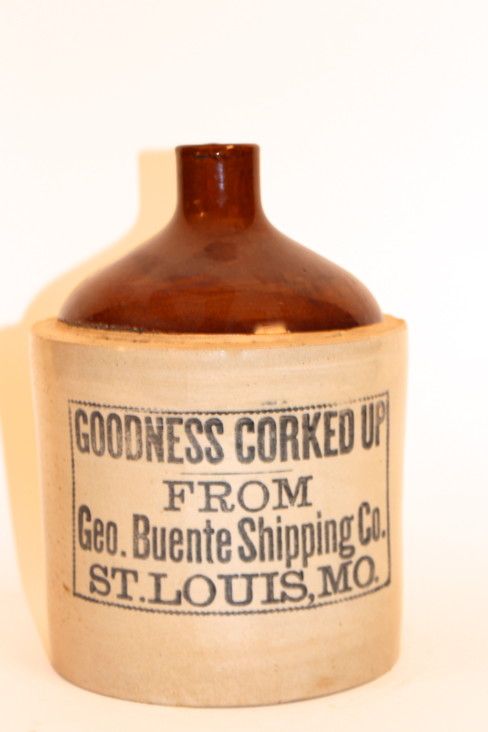
Foreword: The official U.S. Government view about selling whiskey to Native Americans was expressed in an 1833 report by the Commissioner of Indian Affairs to Congress: “The proneness of the Indian to the excessive use of ardent spirits with the too great facility of indulging that fatal propensity through the cupidity of our own citizens, not only impedes the progress of civilization, but tends inevitably to the degradation, misery, and extinction of the aboriginal race.” Here are the stories of three men who sold alcohol to indigenous peoples.
Buente, an immigrant from Germany, about 1881 opened a business in St. Louis,
 Missouri, he called Geo. Buente Shipping Company, selling a variety of wares in Indian country — including whiskey. Although under the jurisdiction of federal laws that declared the Oklahoma Indian Territory “dry,” the traffic in liquor there was a continuous flow. Buente was described by the Commissioner of Indian Affairs T. J. Morgan as “one of the largest whiskey shippers doing business in the Territory.”
The middle men were Indian traders, mainly white men who were authorized to buy and sell on Native American lands. They would order merchandise to be shipped by merchants like Buente in boxes or barrels marked to contain innocuous items like cooking pans and clothes pins, but bearing whiskey and other alcohol. Despite suspicion, Buente did not face legal sanctions until he made a particular shipment in 1889 to Atoka, Oklahoma, a Choctaw town and home base of many Indian traders. The town is shown below.

One of Buente’s large wooden crates carried a label claiming it contained “Queensware,” a type of British-produced crockery. Suspicious, local police seized it upon arrival in Atoka, pried the cask open and inside found enough liquor and other items to outfit a saloon. Buente was arrested and brought before a Federal court. He feigned ignorance of the law but nonetheless pled guilty to the charges. He was fined $500 (equivalent to more than $12,000 today) and court costs. Whether these events were enough to discourage him from sending liquor into Indian Territory again is unclear. Six years later Buente died in St. Louis.
 A page one headline in the Bismarck, North Dakota Tribune of December 29, 1907, shouted that a “Moorhead Firm Sold Booze to Indians.” The story continued that: “A sensation was created here today…that the head officers of the Pederson Mercantile company, the largest wholesale liquor dealers in northern Minnesota, doing business in Moorhead, Minn., were arrested Thursday by a United States marshal of this city charged…with selling liquor to Indians of the Turtle Mountain reservation.” Among those arrested was Ralph Pederson, president of the company, a leading Moorhead businessman and city councilman.

An immigrant from Norway, Pederson through his mercantile company was doing a brisk business shipping liquor into North Dakota. Protected by the Interstate Commerce clause of the Constitution, residents of that state legally could purchase alcohol by mail order from out-of-state businesses like Pederson Mercantile. As a result every day gallons of his spirits were being dispatched by rail and truck into North Dakota, much to the dismay and anger of local officials. It may well have been they who tipped off Federal authorities that Pederson had sold liquor to Native Americans at the Turtle Mountain Reservation — a crime.
Indicted by a federal grand jury, Pederson, his son as the company secretary, and the company treasurer were arraigned before a U.S. Commissioner in Moorhead on twelve counts. The trio made bail and awaited their appearance in court. Commented the Bismarck newspaper: “On account of the prominency of the parties the case will be watched with interest and promises to be a desperately fought legal battle.”
 In actuality, the trial appears to have ended with at most a slap on the wrist for the Pedersons. As one observer put it: “Getting juries to convict was also a problem. The seller of liquor was often a reputable businessman in the community. Regardless of what the law said about the competency of Indians as witnesses, prosecutors did not want to bring an action against a local businessman on the word of an Indian.” Although I have not found the final verdict in their case, Pederson and his company seems hardly to have suffered, continuing to sell alcohol locally and by mail order throughout this period and afterwards.
In subsequent years the federal ban on selling alcohol to Native Americans was discarded in favor of allowing each tribe make the decision on its own. Turtle Mountain Indians currently allow the sale of beer and other alcoholic beverages on the reservation following a process of licensing and supervision by the Tribal Council.
An immigrant from Ireland, Thomas Patrick McGovern settled in a small Montana town called Dupuyer on the edge of the Blackfeet Reservation. There in the 1890s he opened a drinking establishment he called “The Beaver Slide Saloon,” a reference to the slick, muddy trails that beavers made along the banks of Dupuyer Creek. McGovern’s letterhead promised “First-class wines, liquors and cigars always on hand.” Patronage from the reservation was welcome.

 Soon he would meet his future wife, Sophie, who was living with the Blackfeet. Born in 1872, she was the daughter of a French Canadian trader named Michele Longevin and an Indian woman named Mary (or Anna) Many White Horses. It is not clear how Tom and Sophie met. Interaction between the white and indigenous populations in that region of Montana was a common occurrence. After their marriage McGovern took up residence on the reservation and the couple raised their family there.
Meanwhile McGovern was prospering at his drinking establishment in Dupuyer. He regularly was selling beer and liquor to the Blackfeet with no fear of the law. Local lore describes how McGovern dealt with customers who turned drunk and rowdy in his saloon: “…The Beaver Slide Saloon went so far as to have a man-made "beaver slide" that extended from the back door to the creek. When the locals had a wee bit too much to drink, they were tossed down the slide and into the creek for a ‘sobering’ experience.” The Beaver Slide Saloon burned in December 1901 and was not rebuilt.

McGovern then appears to have been employed as an administrator on the reservation. In 1927 at age 64 he died there after 35 years of marriage to Sophie. A long way from his Irish birthplace, McGovern had found a home and family among a Native American tribe that had accepted him into their midst. It apparently mattered little that he was a saloonkeeper.
Note: Longer posts on each of the “whiskey men” featured here may be found elsewhere on this blog: George Buente, January 21, 2018; Ralph Pederson, March 13, 2020, and Thomas McGovern, February 22, 2020.
Note #2: A milestone: This blog -- "Those Pre-Prohibition Whiskey Men" -- having reach a million "hits" late last year has now surpassed 1.1 million. The number of "look-ins" averages between 300 and 400 per day. The interest has come from all over the world, according to Blogspot. The number of followers also has grown to 319, for which I am extremely grateful.