Foreword: Grover Cleveland was the 22nd and 24th President of the United States, the only man ever to be elected to two non-contiguous terms. While in American history he stands high in the mid-ranks of Chief Executives, it also should be noted that, while seldom taking an alcoholic drink, Cleveland was a favorite with whiskey men and a close friend of several. This post examines some of those relationships.
  When Alexander, (“Sandy”) Wood died, his funeral was attended by former U.S. President Grover Cleveland, just one of the well known figures who were Wood’s buddies and fishing companions during his lifetime and who at his death came to pay tribute in Boston to the memory of this immigrant Scots whiskey man. He is shown left.
 Born in Kelso, Scotland, Wood emigrated first to Canada and then to the United States, settling in Boston. About 1872, with a partner he established a liquor house at 100-102 Broadway, shown here, and began rectifying, that is, blending his own proprietary brands of whiskey, and met with considerable success at the trade and considerable wealth.
Throughout this time Wood was returning regularly to Canada during summers to fish. In 1873 he and friends purchased salmon fishing waters on the Southwest Miramichi River in New Brunswick. A man with an engaging and outgoing personality, Wood became acquainted with people of influence and would bring them fishing on his salmon-teeming river. Among them was the governor of Massachusetts and through him Wood got to know President Grover Cleveland, an avid fisherman. Cleveland often was in Wood’s distinguished group of anglers who would take meet in Boston and entrain together into Canada to fish.

The liquor dealer continued his fishing parties to New Brunswick virtually the rest of his life, dying in June 1899. Among those attending his memorial services was Grover Cleveland. In 1906 the former President wrote an essay “In Defense of Fishermen” in which he extolled “full-blooded fishermen whose title is clear and whose natural qualifications are undisputed.” My guess is he had Sandy Wood in mind when he penned those lines.
 Although Edward Smith and Christian Hanlen could not boast so close a relationship with Cleveland, they were part of his political advancement. After leaving his native Ireland in his teens, Edward Smith, shown right, spent the rest of his life in Rhode Island. He would find significant success there both in business and in politics. Operating under the name “Edward Smith, Importer and Wholesale Dealer in Wines and Liquors,” his most important spirits offerings were whiskeys. Some he sold under distiller labels; others he blended in his own facilities and put his label on them. Meanwhile Smith also was pursuing a career in politics. When Pawtucket was chartered as a Rhode Island city, Smith was elected as an alderman on the Democratic ticket. He held the office for six consecutive years,1886 to 1892, and was elected president of the aldermanic board in 1890. A delegate to the National Democratic Convention in 1884, Smith helped secure the presidential nomination for Grover Cleveland.
 Christian Hanlen was the owner/ manager of a wholesale liquor business called Hanlen Bros., located at 330 Market St. in Harrisburg, Pennsylvania. Hanlen advertised widely his rye whiskeys, brandies, gins, imported and domestic wine, ales and stouts. His involvement in Democratic Party politics came at a particularly crucial period. When Cleveland ran again in 1892, serious opposition to him erupted within the Democratic Party. Hanlen, however, was cited by the New York Times as a particularly ardent Cleveland supporter and elected to the nominating convention in Chicago, shown here, where Grover was elected on the first ballot.
  Perhaps no distiller either before or since has surpassed the career that Charles Tracey, shown left, crafted as president and treasurer of the Columbia Distillery Co., in Albany, New York. He was a four-term member of the U.S. House of Representatives, aide to five governors of New York, and a key advisor to President Grover Cleveland.
 Close to Cleveland when he was governor of New York, Tracey was a staunch defender of Eastern business interests during his eight years on the Hill, particularly of the whiskey industry. He became known as the chief spokesman for the “Gold Democrats,” a conservative faction of the party who, with President Cleveland, upheld the gold standard for currency against “free silver” advocates.A cartoon of the time characterized them as “Gold Bugs” and accused Cleveland of selling out the country. The bearded figure to the right of the President may well be Tracey.
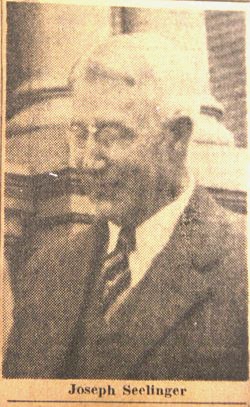
  Joseph “Joe” Seelinger was well known in Norfolk, Virginia, as a saloonkeeper and restauranteur. But his real claim to fame around town was as a favorite duck hunting companion of Grover Cleveland. Linked in life, the two almost were united in death as they narrowly escaped drowning in March, 1901, attempting to return from a day of shooting.
Joe was the proprietor of the Onyx Saloon, located in the heart of the city’s bustling commercial district. The Onyx featured an equally elaborately decorated restaurant on the second floor that became a favorite dining spot for the rich and socially prominent of Norfolk and the Tidewater. One writer said of the Onyx that it “became widely known throughout the city by fastidious diners with whom cost was not a factor. In the gay days of Norfolk his [Seelinger’s] place was the center of fashionable gatherings, especially around the holiday season.”

Meanwhile, the Onyx Saloon was making Joe, the genial saloonkeeper, very rich indeed. He was able to indulge his passion as a sportsman and duck hunter. The marshlands east of Norfolk were a favorite wintering grounds of millions of ducks of a wide range of species and hunting clubs proliferated. A prime location was held by the Back Bay Gunning Club of which Seelinger was president and treasurer. Enter Cleveland, a hunter with a passion for shooting ducks. Shown together in an illustration, he and Joe connected as frequent hunting partners in the waters off Norfolk.
 It was on one of those outings that the two almost lost their lives. Papers across America like the San Francisco Chronicle of March 1, 1901 headlined: “Grover Cleveland is Caught in Storm; Former President Narrowly Escapes Drowning While Duck Shooting.” Cleveland and Seelinger were far out on the water having shot 75 ducks and many geese and pigeons. The weather threatened. The former President refused to leave before nightfall and by then a full fledged storm had arisen. The boat was nearly swamped by high wind and waves. Apparently through Seelinger’s skill at the helm, after considerable time and in full darkness, the two were able to make shore.
The idea that these whiskey men all played greater or lesser roles in the life of Grover Cleveland should be no surprise. Through their liquor enterprises all of them had become wealthy and able to afford such luxuries as owning salmon waters and hunting lodges, heading political factions, and attending National Conventions.