Thursday, February 9, 2012

The "Peculiar" Whiskey of Napoleon Pichette


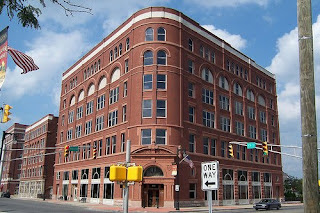
Sometime in 1908, a stranger entered a liquor store in Manchester, New Hampshire. It was located on Elm Street, a major retail thoroughfare, shown here. Without raising particular attention, he purchased several bottles of two house-labeled brands. The stranger left without fanfare but would be heard from again.


The liquor store was owned and operated by an individual with the colorful name of Napoleon Pichette. In the picture of his shop shown here, he may be the individual at left with his hand in his coat, a la Napoleon Bonaparte. Our Napoleon, while of French ancestry, was born in New Hampshire in 1874.

He grew up and was educated in Manchester. In 1904 he married a local girl, Bethilda Anna Marie Turcotte, whose father was a well-known merchant in town. Also of French ancestry, Bethilda was 11 years younger than Napoleon. They had two sons, Paul Alexi, born in 1905 and Jean Louis, 1907.  A daughter, Pauline, died in infancy. The family eventually lived at 258 Jewett St., corner of Hayward, one of only two houses in the city block. Pichette was not an uncommon name in Manchester. A 1901 directory lists 11 of them. Most were laborers or craftsmen. Napoleon was the only merchant among them, perhaps by virtue of having "married up.”

In an advertisement at the time,  Pichette and his partner called themselves “importers, wholesalers, retailers and bottlers,”  advertising wines , cordials and liquors.  The prime commodity, however, was whiskey.  Napoleon was a rectifier,  that is, someone who blended and then bottled various kinds of liquor.  Too 
often, however, rectifiers resorted to adding other ingredients, such as flavorings, presumably to improve the taste. In 1894 a doctor, describing conditions in New Hampshire to Federal authorities, reported: “Almost all the whisky and some drugs are adulterated.” Pichette’s rectified house brands were "Cavanaugh" and "Valley" whiskeys, the samples carried away by the stranger.

Enter government authorities. In 1906 the U.S. Congress had passed what became widely known as the Pure Food and Drug Act. It raised the consciousness of the Nation to the adulteration of food and beverages. While the Act did not forbid adding ingredients, it required that they be listed on the label. New Hampshire had similar laws and the agent purchasing the whiskey had been from the State Department of Agriculture, where food testing laboratories were located.


The results of the State tests were published in the Department’s 
1909 annual report. Pichette’s liquors were among those censored. Cavanaugh Whiskey had been found to be a “compound,” that is, a combination of ingredients. Much more serious, Valley Whiskey was tagged as “heavily watered, with a peculiar odor.” Obviously this was a “drink at your own risk” concoction. The report gave no idea of what, if any, fine Napoleon paid.

Pichette continued to be in business with enough volume to issue embossed bottles, as shown here. By the time of a 1916 city directory he was running the establishment alone but had added beer to his list of products. He also issued giveaway shot glasses. His flagship brand became “Superior Little Whiskey” with his own logo on the label. It cited specifically that this whiskey was in compliance with the National Food and Drug Act. The emphasis would suggest that Napoleon was attempting to resurrect his reputation after the State rebuke.

The Little Whiskey brand, however, has its own peculiarity.
 Pichette claimed a trademark but none shows up in federal records under his name. Rather, the brand had been registered with the government in 1905 by J. & A. Freiberg of Cincinnati. Was Napoleon now violating the trademark laws? Was he skirting them by adding the word “Superior” to his whiskey? There is no record of any court action against him by the Freibergs.

With the coming of National Prohibition, Napoleon Pichette was forced, as thousands of others, to shut down his business. He died in Manchester not long after, in 1925 at the age of 51. May we assume he never disclosed the source of the “peculiar odor” wafting from his whiskey?

Sunday, February 5, 2012

Morris Ullman Tossed a Black Cat to Cleveland

A young immigrant and former Confederate soldier came to a Northern city shortly after the Civil War to market a product named after a well known symbol for  bad luck. We might assume that his failure was swift and certain. But not if the Johnny Reb’ was Morris Ullman, the city Cleveland, and the product Black Cat Whiskey. Ullman and his family can be tracked through more than 50 years as they rose to wealth and business prominence in Northern Ohio.

A distant relative of the renown physicist Albert Einstein, Morris Ullman was born in 1835 in Baden-Wurtemberg, Germany, and emigrated to the United States in 1851 at the age of 16. According to newspaper accounts, he first settled in Alabama and then moved to Guilford County, North Carolina, where he became a naturalized citizen in 1857.

 In 1860, like hundreds of thousands other Southern boys, he joined the Confederate Army and served for the duration of the Civil War. The role of Jewish soldiers in the Confederate Army generally has been overlooked by historians. Shown here is a caricature of one from Jewish magazine More than 10,000 fought for the South. Gen. Robert E. Lee allowed his Jewish soldiers to observe all holy days. Northern generals, including William Sherman and Ulysses S. Grant, by contrast, issued orders making Hebrew observance difficult. 

 Morris came North after Lee’s surrender and settled initially in Franklin, Pennsylvania, about 50 miles northeast of Youngstown, Ohio. There he met his wife, Lenche, a year older than he. They married in 1866 and their son, Monroe, was born in Franklin later that year. Soon after, Morris and his new family moved to Cleveland. There he was reunited with an older brother who already may have been engaged in the liquor trade. 

 The company they founded dated its origins to 1866 but Ullman Brothers & Co. first showed up in Cleveland business directories three years later, in 1869, located at 69-71 Michigan St. in the Tower City area. From the beginning the Ullmans demonstrated a marketing flair. Shown here is a highly decorated etched shot glass with the “U” initial, designating the firm.   

In 1873 their 18-year-old cousin, Herman Einstein, emigrated from Germany to Cleveland and was hired by the Ullmans as a clerk, bookkeeper and salesman. Herman’s older brother, Leopold, had come to Cleveland earlier and also likely was in the whiskey business. After the untimely death of Morris’ brother in 1881, the two closely-related families merged their efforts and created Ullman, Einstein & Co. Herman and Leopold became partners in the firm with Morris Ullman as the managing partner. 

Almost immediately the company began to merchandise Black Cat Whiskey throughout Northern Ohio and beyond. The label featured the feline and declared the liquor to be “pure” and “old.” How old is open to question. Ullman-Einstein were not distillers. They obtained their product from a number of sources, probably in Maryland and Kentucky and mixed a number of lines of straight whiskey into a blend to achieve a consistent taste, then putting its label on the bottle.  However they arrived at the Black Cat blend, Morris and his partners advertised it widely. The company also featured the cat on a range of giveaway items, including back of the bar bottles and shot glasses. With its distinctive whiskers and eyes, it projected real personality. The feline was also featured on a giveaway inlaid cloisonné porcelain watch fob that also depicted the Cleveland municipal flag. 

 Outgrowing their Michigan Street quarters in 1892 the business moved to Sheriff Street, now known as 4th Street SE. The firm inhabited a building three stories high and more than a half block long. It stood across from Cleveland’s New Market House, a hub of the city’s mercantile trade. Although the Black Cat was the flagship of the company, Morris and his partners presented a wide variety of brands to its clientele. The firm also was assiduous in registering many of them with the Federal Government to prevent trademark infringement. In 1905, it registered “J. Gibbons,” “McGibben, “ “Union Springs” and “Euclid Club” whiskeys. In 1906, “Black Cat,” “D.T. Gilmore and Son,” “UECO,” “Old Nectar,” and “Wedding March.” In 1907, added“Brook Trout” and “Walnut Creek,” and finally in 1911, “Mor Lee.” No record exists of its the firm having registered other known Ullman-Einstein brands like “Elk Ridge,” “B.O.E.,” and “Adalyn.” The firm issued shot glasses for many of these whiskeys, most of them bearing the distinctive etched U-E monogram. A giveaway tip tray for Elk Ridge Whiskey featured a famous British painting of a stag. For the most part, Ullman-Einstein marketed its products in bottles but from time to time used ceramic jugs. 

Morris never forgot his Jewish roots and had a strong commitment to preserving his religious heritage. In 1873 he was listed as a board member of the Union of American Hebrew Congregations. He also was given special mention in the 1899 American Jewish Yearbook for his work on behalf of his fellow religionists. In 1904, U-E incorporated for the first time. Morris Ullman and Leopold Einstein were its principal executives. The next year the company name changed to Ullman-Einstein, the comma replaced by a hypen. 

In 1908 Morris died at age 73. The same year the firm moved to 657-659 Bolivar Av. SE. Four years later Leopold Einstein died and Herman Einstein succeeded him as president and treasurer. Both Jacob Einstein and Monroe Ullman, sons of the founders, became company officers. While they continued to pilot the liquor business effectively the end was near. Unlike those felines said to have nine lives, Ullman-Einstein’s Black Cat had only one. Prohibition in Ohio and in the Nation dealt the kitty a death blow. Ullman-Einstein went out of business in 1919, taking with it the Black Cat and all the other U-E brands. 

Ullman-Einstein products live on, however, in a multitude of collectible shot glasses, watch fobs, tip trays, bottles and jugs. They remind us of an immigrant boy who rose to prominence in his adopted country and community through hard work and imagination. For Morris Ullman the Black Cat he tossed across Cleveland’s path proved to be good luck for him and his family..

Thursday, February 2, 2012

Henry S. Hannis: The Millionaire Goes Mad

On May 20, 1886, a New York Times news story began: “Henry S. Hannis, the well known distiller, died this afternoon at the Norristown Asylum. He was one of the largest operators in whiskey in the United States, and just after the war was rated as one of the millionaires of Philadelphia, his native city.” Behind that paragraph is the story of an extraordinary life and a sad, untimely death.

His family was well established in Philadelphia when Henry Hannis was born in 1834. The ancestral founder was Andrew Harris, an Englishman who first emigrated to Barbados, then came to America and settled in the City of Brotherly Love. There is good reason to believe that Henry was orphaned at an early age. The 1850 census found him, age 16, living with a 14-year-old sister, Sarah, in the home of a family named Ross. We may assume that Mrs. Ross was an older sister who had taken them in. In that census, Henry curiously gave his occupation as “student of medicine.”

About 1850, he went to work for John Gibson, an immigrant from Northern Ireland. Gibson ran a successful liquor business in Philadelphia and in 1856 had purchased 40 acres of land on the east side of the Monongahela River, just to the south of Pittsburgh, and erected the Gibsonton Mills distillery. Gibson whiskey commanded a national customer base. Hannis worked his way up in the firm. A 1856 directory lists him as an accountant there and living at 603 S. 5th Street.

Sometime around 1855, Hannis married an woman of English descent whose name was Poole. They had three sons, one of whom, Herbert E. Hannis, was born in 1856 when Henry was 22 years old. Henry worked for John Gibson for more than a dozen years, with increasing responsibility. When he had accumulated sufficient funds, despite the tumult of the Civil War, he struck out on his own in 1863. For the next 15 years the growth of his firm must be considered phenomenal.


Establishing his headquarters in Philadelphia at 216-218 Front Street, he bought the Mount Vernon Distillery in Baltimore, located at the corner of Russell and West Ostend in the southwestern part of the city. It had been operated by a local partnership for about a decade when Hannis took over, enlarged and modernized it. There were three stills, one wood and two copper, all heated by steam. He built two four-story warehouses and one of a single story. The Baltimore distillery, which employed 14 workers, is shown above in a sketch drawn by an insurance surveyor.

Hannis soon changed the name to the Hannis Distilling Company, It produced Mount Vernon Rye that could be purchased by the barrel or in glass bottles. The company advertised it heavily, eventually in a distinctive square bottle, both in newspapers and through giveaway items such as signs to saloons.

In 1867, finding that the Baltimore facility could not provide sufficient whiskey for his market, Hannis ventured further afield. From John Quincy Adams Nadenboush, a former Confederate officer, he purchased a distillery near Martinsburg, West Virginia, for $25,000.  Shown below, it had been partially destroyed by Union soldiers during the Civil War, troops that drank all the stored whiskey. Hannis wasted no time in repairing the damage and as he had in Baltimore modernized and expanded the distillery. Calling the location “Hannisville,” he employed two stills, one copper and heated by open flame and another of wood heated by steam. He also built a new warehouse.


Hannis’ efforts soon drew recognition. At the 1876 Philadelphia Centennial Exposition, a key exhibit at the Agriculture Building was a model distillery, displaying the state of the whiskey-making in world-class terms. Selected for that honor was the updated Hannis distillery in Baltimore; its design was reproduced for the display. Hannis also took a first-place award for Mount Vernon Rye at the Exposition just as his whiskey would later win prizes at world fairs at New Orleans in 1885, Australia in 1887 and Chicago in 1893.

From Hannis’ two distilleries, in addition to Mt. Vernon Rye, came nine other brands including "Acme", "Acme X", "Hannis", "Hannis Copper Distilled Pure Rye", "Hannisville", "Hannisville Pure Rye", "Pure Rye Whiskey", "Tidal Wave", and "Victor." These labels also were merchandised through giveaways to customers, including fancy back of the bar bottles.

In Philadelphia, with a reputation as a city of millionaires, Hannis became recognized as a leading businessman and one of the richest in town. As a symbol of his growing reputation, the family moved to a new residence in a better part of Philadelphia at Broad and Passyunk Streets. Even so, his residence evidently was not ostentatious, described rather as “a plain pleasant house.”

The first setback Hannis experienced occurred in 1869. He had stored thousands of barrels of whiskey, all he could “lay his hands on in the country” according to accounts, in a Philadelphia bonded warehouse owned by Col. W. Patterson, located at Front and Lombard Streets. On August 4, the entire complex went up in flames with a loss of all Hannis’ whiskey. Damage was estimated at $2,000,000, twenty times that in today’s dollar.

Seemingly undeterred, Hannis reorganized his company and in 1871 built a warehouse with five stories and a basement at his Philadelphia headquarters on Front Street, extending the massive structure through to Dock St. He also opened a sales office in New York City. Son Herbert, after working with his father in Philadelphia, was sent to Martinsburg to supervise distilling operations there.


As the company continued to flourish, however, something seemed increasingly wrong with Henry. Perhaps, as suggested in a newspaper account, it was having his whiskey “swept away by the conflagration,” or perhaps the death of his wife. He began to have mental problems. By the early 1880’s his condition had grown so dire that he was declared mentally incompetent and confined to the Pennsylvania State Insane Asylum at Norristown, shown above.   Prominent Philadelphia businessmen were brought in to manage the whiskey empire he had built.


Millionaire Henry Hannis died in that state mental institution. He was buried at Laurel Hill Cemetery, shown here. It is a graveyard famous for being the resting place of many of Philadelphia’s rich and famous, one that features a special section nicknamed “Millionaire’s Row.” As his three sons stood by the side of his grave Hannis was interred in Section 17, Lots 134-137. He was only 52 years old.

The Hannis Distilling Company continued in business another 31 years, until 1917 and the coming of Prohibition. Herbert Hannis would spend the rest of his life in Martinsburg, managing the distillery there, until his premature death in 1906 at age 50. The Mount Vernon brand would survive Prohibition as a medicinal whiskey released through American Medicinal Spirits. Acquired by National Distillers after Repeal, Mount Vernon became one of that company’s flagship labels into the 1950s.


Thursday, January 26, 2012

Isaac Merkel & Sons: A Pack-Peddler’s Legacy


According to a historian of the Adirondacks area, near the end of the 19th Century one of the few jobs open for Jewish immigrants to northern New York was peddling. Isaac Merkel was among them, remembered as a pack-peddler who struck it rich, founding a thriving liquor business, a brewery and a major upstate department store.

Merkel was born in Hessen, Germany, about 1845. His father apparently was a shopkeeper where he received his early training. About 1867 he married Jenette, from Prussia and a year older than he. The couple almost immediately set out for the United States and settled in Plattsburgh, Clinton County, New York, not far from the Canadian border. 

Isaac found himself in immediate need of employment. Jenette was pregnant. When he arrived in the Adironack wilderness he found few compatible occupations. Peddling was the exception. If Isaac could not afford to open a store, he could carry it to others. We can imagine him on Sunday mornings, joining hundreds of other peddlers, waking up at dawn, shouldering a heavy knapsack and setting off on foot for a weeklong journey among the mountains and valleys. His route took him over poor country roads that were little more than cart paths to isolated Northern New York villages. As a peddler he would travel all day and sleep where he could find a warm place, often in summer camping out under the sky.

With his fellow peddlers Merkel would return home on Friday evening in time to attend Sabbath services. A synogogue had been established in 1861 to serve Plattsburgh’s Jewish population. By the time Isaac arrived, the congregation, after worshipping for years at temporary locations, had found a permanent home on Oak Street.

Meanwhile, Isaac was spurred on the by need to provide for a growing family. After the birth of his first son, Joseph, in 1868, other children were born regularly, at least three more sons and a daughter. Although a peddler’s life was hard there were opportunities to get ahead. Successful itinerants could buy a horse and wagon to carry their merchandise from town to town. We can assume Isaac was among them.

In time, Merkel’s intelligence and hard work paid off. In time he established a brewery, a liquor blending operation and distributorship, and ultimately a department store. The brewery was in Saranac Lake, one of the villages Isaac no doubt visited on his trading route. The brewery’s principal label was “Boss Lager,” sold in bottles and kegs. The company also produced other carbonated waters, some in bottles with elaborate applied labels as shown below.

As his sons grew to manhood, Isaac introduced them into his business. Two appear to have been particularly involved, David and Aaron. David is listed as his father’s partner in the whiskey business, Isaac Merkel & Sons. A 1913 Plattsburgh city directory lists them as “rectifiers and wholesale liquor dealers, bottlers and jobbers in cigars.” Their plant and office was at 56-50 Bridge St. and their retail store at 22-24 Bridge. Isaac was living at 32 Broad St. David was also a partner in a Plattsburgh pharmacy.


It was another, son, Aaron, that Isaac chose to be the symbol and name for his flagship whiskey brand. In 1905 the firm registered the trademark “Bachelor Rye” and submitted an elaborate logo that was described as follows: “A portrait of Aaron Merkel seated in an armchair at a table on which are a bottle of whiskey and a glass, enclosed in a rectangular frame and associated with the words ‘Bachelor Rye,’ and ornamental scrollwork on each side of the picture and an ornamental panel beneath, with an owl on the right side of the picture and a Chinese dragon above the words....”


This caricature of Merkel’s apparently unmarried son obviously 
was a source of mirth for the family. The bachelor’s picture trademark was etched on shot glasses. On the glasses, the bachelor seems unhappy with his state and drinking away his sorrow at being single. The firm also issued a paperweight in the name of Bachelor Rye. Other Merkel brands were "Clinton County Club", "Wedding Bouquet", and "Wedding Bouquet Pure Rye."

As his enterprises met with success, Isaac was increasingly being recognized as a business leader in the community. He was cited in a 1891 Plattsburg history for his success as a merchant. In 1910 he was listed as treasurer of the Clinton Telephone Company and in 1915 as a director of Mountain Home Telephone Company. In 1900 he was active as a court juror and in 1905 served as a member of the Board of Education in Plattsburgh. Nor would Merkel ever forget his Jewish heritage. In 1897 he was elected president of the same synagogue he had attended as a peddler. He also served as an officer in the Plattsburgh Chapter of the Independent Order of B'nai B'rith.


About 1910 Merkel founded Plattsburgh’s primary department store, managed by son David. Isaac eventually would sell the brewery to a local resident. After that he sold out-of-town beer through Isaac Merkel & Sons. That firm did business until 1920 when it was shut down by the advent of Prohibition. The department store was handed down from generation to generation within the Merkel family and survived until 1993 when chain store competition forced it to close its doors. Thus ended the legacy of Isaac Merkel, a Adirondacks pack-peddler who traveled a long, hard road to prosperity.

Monday, January 23, 2012

Herman’s Whiskey Started the Hulman Engines


Each year when the Indianapolis 500 about to begin, a voice calls out “Gentlemen, start your engines!” That voice, male or female, belongs to a member of the wealthy Hulman-George clan who own the Indianapolis Raceway. They owe much of their success to their ancestor, shown here, whose name was Herman Hulman.  Hulman’s life has been recounted in a number of publications as an entrepreneur of far-flung interests, a philanthropist, a loving husband, a doting father and grandfather, and a major force in the development of Terre Haute, Indiana.  This post, however, concentrates on the man whose whiskey trade in important ways made possible the Hulman dynasty. 

Shown here, Herman was born in 1831 in Lingen, Lower Saxony, a city of about 50,000 in Germany. Given the subsequent movement of Hulman children into the grocery business, his father almost assuredly was a storekeeper.  He was preceded as an immigrant into the U.S. by his brother, Francis, who set up a grocery in Terre Haute in 1851. Francis’ ad in a local newspaper that year featured his spiritous beverages. It bragged of the store’s assortment of domestic and foreign wines and liquors, including French brandies, Holland gin and port, Madeira and sweet Malaga wines. The ad also touted ”smooth as a sip” a Cincinnati-style blended whiskey. In 1854, Herman was importuned by his brother to leave Germany and his sweetheart, Antonia Riefenstal, to come to America and help in the grocery store. He arrived at age 23 and for three years served as a clerk for his brother. Four years later Francis, his wife and daughter were killed in a fire at sea in a ship returning from a trip to Germany. 

At age 28 Herman was left in charge of the grocery. Liquor was a major commodity. As the Civil War loomed, Herman faced personal and business problems. Personally he feared that Antonia could not make the voyage to the U.S. He also worried about obtaining sufficient goods for his grocery business, including receiving an adequate supply of whiskey from secessionist Kentucky. In 1862 Antonia finally arrived at the age of 29. He met her in New York and they were immediately married. It is said they enjoyed the sights of Manhattan from a borrowed buggy. They would have three children, a girl who died in infancy and two sons, Anton, born 1865, and Herman, born 1867. Not long after Herman Junior’s birth, the family moved to 657 Ohio Street on Terra Haute’s “Mansion Row.” The Hulman home had 16 rooms, including four bathrooms, and boasted multiple fireplaces with marble mantles. 

As the boys grew, Anton, with straight, pale brown hair, was depicted as studious and reserved, happy to putter for hours building a playhouse or a boat. Herman Junior, with wavy dark hair and a ready grin, was gregarious and very handsome. The postwar period continued to be highly favorable to Herman’s business interests. About 1869 he purchased the Alexander McGregor Distillery, the largest whiskey-making operation in Terre Haute and probably in Indiana. He hired a professional manager and with his help significantly enlarged its production capacity. Although Hulman briefly sold the distillery, in 1876 very soon he bought back a half-interest. 


In 1880 Terre Haute, by virtue of the distillery, was counted as the Nation’s fifth largest producer of distilled spirits. Over the years Hulman would be involved in five different enterprises involving the production and merchandising of alcohol. A principal enterprise was called Hulman and Beggs. With a partner, John Beggs, Herman launched a liquor wholesale house, erecting a building at Ninth and Cherry Streets in 1884. The structure also was illustrated on a etched shot glass issued for the company. Hulman and Beggs featured at least four brands, “Axtell,” “Low Land Spring,” “Traveler’s Joy,” and its flagship, “White Seal.” The only label Hulman registered with the government for a trademark was White Seal, in 1906.


He also commissioned artist Herm Michalairski to provide an attractive and somewhat erotic sign for saloons advertising White Seal Rye. The image was replicated on trade cards. A metal token also advertised the whiskey. Herman was ever the entrepreneur. He bought train car loads of cigars, thousands of barrels of coal oil, installed telephones connecting the distillery and the wholesale business, was an original stockholder in the Terre Haute Telephone Exchange and invested in railroads, the telegraph, water and sewage systems and gas and electric companies. In 1886 he joined his son Anton and another local as the managing partner of a large mercantile establishment known as Hulman and Company. He almost immediately determined to build a new building for it. 

A local historian says: ”Herman began looking for a site in 1888, and he found it at 9th and Wabash in 1892. `It was easy enough to plan the exterior, but to plan the interior and arrange the machinery and different departments from cellar to dome was a mental tax with which I never again want to be burdened,' Herman recalled. Finally after settling on plans, the building was opened in 1893. More than 5,000 people came out to see the Romanesque Revival-style building shown above.


 In addition to selling “White Seal Rye,” this firm also featured “Richelieu Club Whiskey.” Hulman employed more than 150 people in Terra Haute, including a large cohort of traveling salesmen. By this time Herman was a widower. His beloved Antonia had died in 1882 at the age of 49. A devout Catholic, in her memory he bought a building in Terre Haute and turned it into a hospital run by nuns. It was named “St. Anthony’s” in her honor. 

As Herman aged, he occasionally took brief timeouts from business to hunt and fish, along with riding his horses and playing with his granddaughter.   His sons were also on his mind. Herman Junior became a well known sportsman and a race driver. He once made a record-breaking run from Chicago to Terre Haute in 14 hours, driving a four cylinder Peerless automobile. Anton worked with his father and produced a son, Anton Jr., shown here with Grandfather Herman. The grandson, known as Tony, not only would further the business interests of the Hulman family, but in 1945 purchased the Indianapolis Motor Speedway from Eddie Rickenbacker for $750,000. The Hulman name would be forever linked with racing and today the track is still a family property. 

The man who started it all, Herman Hulman, died in 1912 and is buried next to Antonia and other family members in Woodlawn Cemetery. When he died, as one observer put it, he represented “wealth, incredible wealth.” Although his business empire was a large and diverse one, in many important and seminal ways it had been fueled by whiskey.


Thursday, January 19, 2012

Emanuel of Manhattan: Eising on the Cake

In dealing with the story of Emanuel Eising, prominent New York whiskey man, I must be forgiven the awful pun on his name.  His record remains, however, that of a merchant who provided customers with a range of attractive artifacts to sell his already popular brands of liquor and so, in effect, put “icing on the cake.” 

Eising was born in Wallerstein, Bavaria, Germany in 1836 to parents of Jewish heritage. His Mother, Babette Wertheimer, had been born in Manhattan but following her marriage to Henlein Eising, a German 18 years her elder, she moved back with her husband to Bavaria. The entire family likely re-entered the United States sometime in the 1840’s-1850’s and settled in New York City. Henlein died in Manhattan in 1862. 

In 1864 the young Emanuel married Augusta Carolina Blun, a New York resident. She was an immigrant from Prussia, born in Worms, Hesse, in 1845. Nine years younger than her husband, she would bear him seven children, four boys and three girls. 


By the 1870s, Emanuel was fully into the whiskey trade. In 1874 he ran afoul of the Internal Revenue service for nonpayment of liquor taxes. Despite this setback, he clearly was prospering. The 1880 census found him living in a large house in Manhattan with Augusta, their children, and three servants, including a German nurse, an Austrian cook, and an Irish maid. Emanuel Eising & Co. first shows up in New York business directories in 1880 with a location at 47049 Front Street. 

As a blender of whiskey, Eising needed a steady supply of distilled product which apparently proved difficult from time to time. Over the years, the firm would claim control of or interest in at least three distilleries. Among them were the Baltimore Distilling Co. of Baltimore, Maryland. Early letterheads state Eising was the sole proprietor; later he claimed only to be a stockholder. A trade card shown here also lists E. Eising as the sole agent of the Orient Distillery of Baltimore. Founded by a leading Maryland businessman, Edwin Walters, that distillery was an enormous facility. The back side of the card advertises Eising as a distiller and dealer of bourbon and rye whiskies. 


Eising may have led a consortia of wholesale whiskey dealers who purchased the Orient Distillery from Walters. Later, in 1913, Eising claimed a stake in the Commercial Distilling Co. of Terre Haute, Indiana. Whatever his source of supply, Eising used a series of brand names, including “Stag,” “Heart of Maryland,” “Marshall,” “Old Dominion,” and “Old Manor.” He also advertised as the source of “Caracas Bitters.” Although he registered Old Dominion with the government in 1893 and again in 1906, his flagship brands appear to have been Stag and Heart of Maryland. He trademarked Heart of Maryland in 1905 and Stag in 1907, the latter with the slogan: “Try a Horn.” 


For each brand he issued giveaways for favored saloon customers, including expensive reverse painted mirrors. The Stag mirror appears intended for installation on a barroom door. Eising also gave away back of the bar bottles and shot glasses for the two brands, as well as a bar top dice game in a paperweight that advertised Stag Whiskey. The reach of Eising’s liquor brands was reflected in a 1908 novel in which the narrator says of an Irish drover: “By the cock of his hat and the leer of his eye I could see he had imbibed some more Old Dominion Rye on the road and was on the warpath.” 


Eising’s son Harry upon reaching maturity was brought into the firm and assumed more and more of the management as his father aged. Records indicate that Harry was sent periodically to Baltimore to look after his father’s important distilling interests. In 1910 while living in New York City, Harry was named a director of the Merchants Fire Company of Baltimore, a business primarily devoted to providing fire insurance to distillers. Prior years had seen a number of Baltimore whiskey operations go up in smoke. 

In time Emanuel Eising was recognized as a pioneering businessman in New York City. This was epitomized in 1913 when he was among the honored guests for a memorial service for Isador and Ida Straus, co-owners of Macy’s Department Store, who had lost their lives during the sinking of the Titanic. Harry Eising and his wife also were among the guests. 

With the advent of Prohibition, Eising and his son -- despite all their hard work -- were forced to shut down their liquor business. Emanuel never saw the law repealed. In 1924 he died at the advanced age of 88. He is buried with his wife and other family members behind a large family monument with individual headstones in Salem Fields Cemetery, Brooklyn.