Wednesday, February 15, 2012

A Century of McHenrys' Pennsylvania Distilling


Note: As explained in an earlier post, if in doing research on a particular whiskey man or men, I find that a succinct narrative already has been adequately written, I will not try to replicate it. This is the case with the McHenry distilling family of Benton, Pennsylvania. 

 Robin Preston on his www.prepro.com website has summarized a longer story from the Benton News website and it is quoted below. To Robin’s narrative (shown within quotes) I have added information on the McHenry illustrations provided. 


“The Rohr McHenry Distilling Company was a major Benton and Columbia County employer during its heyday, operating for a full century from 1812 to 1912. “The McHenry Distillery was located about a mile and a half west of Benton and was built by John McHenry in 1812. 

The founder was known locally as "Hunter John" and was born September 13, 1785 in Fishing Creek Valley. Hunter John married Helena Cutter and they produced nine children. The youngest of these was a son, Rohr, born in Benton Township in 1829. 

“When his father died, Rohr McHenry took over the "Still House," as the McHenry homestead was known locally. Rohr was responsible for expanding the distillery into a serious commercial operation, the Rohr McHenry Distilling Co. The whiskey he produced became known locally as "Old Rohr."  

An ad in the local paper proclaimed that the company's "strictly pure rye whiskey was double distilled in a copper lined doubler, from thoroughly cleaned rye and pure spring water." The distillery produced 100 gallons a day.

Rohr and his wife Caroline had five children: George, Henrietta, Louisa, Charles, and John Geiser McHenry, the latter born in Benton on April 26, 1868. John G. was educated in Benton and after graduating from the Orangeville Academy he launched into a career as a farmer, manufacturer, banker, distiller and politician. It was John G. that stressed the date that the distillery had been established, using the familiar slogan "Born 1812." His interest in politics earned him three terms in Congress (D), beginning in 1906 and ending with his death in 1912. “Business boomed under John G.'s care, as did the local farming economy which was supplying the stills with rye for production of whiskey. 

The company advertised that "This whiskey is the product of selected Rye and Malt pure mountain spring water and scientific distilling with years of perfect aging in charred barrels in heated warehouses and coming direct from us it brings to you the finest & purest whiskey made, and costs you no more than the other brands". “John G. also established a peach orchard containing 30,000 peach trees on what he named "Pioneer Farms" with the intent of adding peach brandy to the McHenry production line. Peach trees take up to 15 years to reaching maturity, so the operation was part of the long-term vision for the business. The orchard and other farm crops, including rye, and a vineyard was cared for by Prof. M. E. Chubbuck from State College with the help of 40 or so employees. The farm also included a building for large-scale production of poultry. 

 “Disaster struck the company in March 1911 when fire destroyed the 10-storey bond house. It housed 17,000 barrels of maturing whiskey: only one was saved. Although much of the distillery plant itself was saved from the fire and production was later resumed, the financial blow caused by the loss all mature product was devastating and by 1912, rumors of insolvency were rampant. The company was forced into receivership at the end of the year and, on the night of foreclosure of Pioneer Farms, John G. died at age 46. “The distillery buildings were preserved as a museum but in 1962, a fire in the boiler house reduced it to ruins.” 

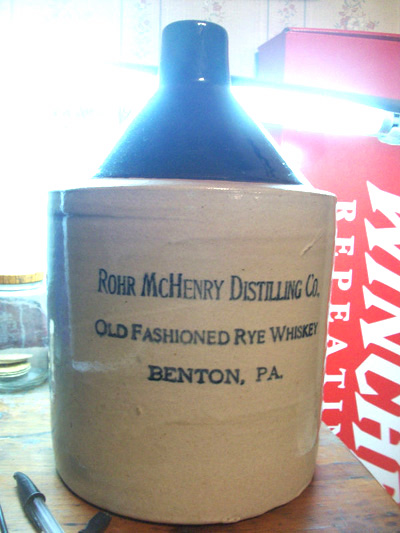
 The illustrations I have chosen to illustrate Robin Preston's vignette are: in order, a portrait of Rohr McHenry with wife Caroline; a photo of the very early McHenry distillery; a picture of John G. McHenry; a whiskey label, two examples of McHenry containers and three of the distillery’s giveaway items to saloons, including a shot glass, a tip tray and a back of the bar bottle. The final image is of the distillery at the height of its production.

Sunday, February 12, 2012

Chicago's Alexander Bauer: Spirits, Sex and Scams


The details of Alexander Bauer’s personal life are sketchy at best, but the liquor business he built in Chicago during the late 1880s was marked by three characteristics: spirits, sex and scams. They give us a clue as to who Bauer was and what he was up to. 

Spirits: The liquor company that Bauer founded in Chicago began, according to company literature in 1886 although it first shows up in city directories in 1893. A letterhead shows the steady progression over time for the expansion of the firm to a five story headquarters at 142-148 Huron Street. A paper sign issued by Bauer provides a colorful look at the purported activities at each level of the building. For its whiskeys the company used the brand names: "Dan Patch", "Old Rampart", "Sedgwick", "Sir John Canada Malt", and "Torrance AAA.” It packaged its liquor in bottles and, reaching out to Shafer & Vader Pottery in Germany, in attractive decanters with matching cups. It also advertised its cordials and liqueurs, including “Anchor Brand Peppermint Schnapps” and “Pineapple Rock and Rye.” 

Bauer issued a number of colorful items to saloons carrying his booze. A sign, shown here, was of a cowboy and an Indian threatening a Chinese gentleman who apparently had drawn four aces in a poker game. In the background is Sam Toughnut’s Saloon, where three Bauer beverages are advertised. 

Sex: While the wide variety of alcoholic potables featured by Bauer led to its growth, the company also understood that “sex sells.” Shown here is a trade card for its “XRay Pepsin Cola and Celery Bitters.” Parsing the image on each lobe of Bauer’s four leaf clover advances a story. It is told in the shoes of a man in cuffed pants and woman in high-button shoes who meet in lobe #1, go off together in lobe #2, are lying separately, apparently in bed, in lobe #3, and -- mercy! -- what is happening in lobe #4? Such a risque approach to merchandising alcoholic beverages was hardly unusual in the whiskey trade but Bauer took it to new racy levels . 

Further evidence is an ad for a mostly alcoholic drink called Dam-I-Ana, featuring a woman shown nude from the waist up in a “come hither” pose. It is named after an plant that was supposed to have Viagra-like effects in men. The full ad says, “If you appreciate me...” leaving the thought unfinished but implying the obvious. The next line says “Can’t.” Oh my, then surely Dam-I-Ana Invigorator is your drink! The bottle, shown here with a torn label, helpfully depicted a fully nude woman and a goat-headed satyr. Bauer did not believe in leaving much to the imagination. 

Scams: Yet even Bauer’s emphasis on the prurient pales against the outrageousness of his scams. As reported in an 1897 edition of the American Druggist and Pharmaceutical Record, Chicago law enforcement authorities conducted a raid on Bauer’s building at 142-148 Huron. The Chief Constable Eckart read his warrants to Bauer who was on the premises. Other officers stood guard in various departments. What they found was startling. The first seizure was a case of Hennessy brandy. Bauer admitted that it was not genuine but said he was not responsible for having it in his possession. In quick order the constables seized 16 cases of counterfeit Kummel and 4 cases of Benedictine. Then 240 embossed bottles of Angostura bitters were discovered along with phony wrappers. Another large lot o counterfeit labels was found in the basement. They were for James E. Pepper Whiskey, Gilka Kummel, and Boonekamp Bitters. 

It is clear that Bauer was taking old bottles, some of them the genuine article with names blown in the glass, refilling them, slapping on a faux label and selling them as the real mccoy. Whatever fine Bauer may have been assessed, it did not deter him and his cronies. Within a year following the raid, the company veered on another illegal course. His firm’s vice president, Tucker Hardy, set up a new and ostensibly separate company. The address, however, was the same as A. Bauer Company. Rather than refilling real bottles and counterfeiting labels, the Hardy Company was in the business of trademark rip-offs. Soon the building on Chicago’s Huron Street was churning out close look-alike labels of Benedictine and Chartreuse French liqueurs and, once again, Angostura Bitters. The only element distinguishing them from the real products was a small label indicating the Tucker Hardy Company. 

Predictably the manufacturers owning those trademarks soon struck back. In 1902 they hauled Alexander Bauer into the U.S. Circuit Court of the Northern District of Illinois. The judge in those cases, again predictably, found for the plaintiffs. Deciding to fight the verdict, Bauer took the case to the U.S. Court of Appeals. There the judges were not fooled that the Tucker Hardy Company was a separate entity, terming it a “department” of the Bauer firm. The Appeals Court upheld the earlier ruling and the fines levied on Bauer. 

Shortly after these verdicts, Bauer reorganized his company, incorporating with assets of $100,000.  The Tucker Hardy Company, nothing more than a facade anyway, disappeared from business directories. The company moved one last time to an even bigger building at 227-223 Huron and changed its name to the A. Bauer Distilling and Importing Company. Despite its shady past, Bauer had the hutzpah to claim on its letterhead: “For 20 years a square deal: the cause of our phenomenal growth.” 

Apparently determining that crime does pay until one gets caught, Bauer continued to counterfeit his products. This time he would run athwart the Food and Drug Act of 1906. That legislation required accurate labeling of food, drugs and beverages. In 1912 the Federal government hauled Bauer into court once again for shipping a consignment of bottles labeled “Sparkling Sauterne” from Illinois into Wisconsin. In a typical Bauer show of bravado, a sticker read: “Guaranteed by A. Bauer Dist. and Imp. Co., Chicago, Ill, under the F & D Act, June 30, 1906, Serial Number 5015.” After being examined by Federal authorities the sparkling sauterne was declared “adulterated and misbranded.” They charged, and the District Court agreed, that the purported sparkling sauterne was an imitation, consisting of a plain white wine, artificially carbonated. 

In a parallel case a similar judgment was made on bottles of Bauer’s “Sparkling Burgundy.” Again he fought the verdict and took it to the U.S. Court of Appeals. Again the judges concurred with the earlier ruling and directed Bauer to pay a fine of $100 and court costs, amounting to $73.06. With such gentle financial slaps on the wrist when caught cheating, no wonder Bauer’s company continued to thrive. It was, however, antics such as his that fueled the Prohibition movement that ultimately shut down his liquor business permanently in 1920. Because details of Alexander Bauer’s personal life are hidden in the fogs of time, it is impossible to know his fate but we can assume there might have been a measure of larceny involved.

Thursday, February 9, 2012

The "Peculiar" Whiskey of Napoleon Pichette


Sometime in 1908, a stranger entered a liquor store in Manchester, New Hampshire. It was located on Elm Street, a major retail thoroughfare, shown here. Without raising particular attention, he purchased several bottles of two house-labeled brands. The stranger left without fanfare but would be heard from again.


The liquor store was owned and operated by an individual with the colorful name of Napoleon Pichette. In the picture of his shop shown here, he may be the individual at left with his hand in his coat, a la Napoleon Bonaparte. Our Napoleon, while of French ancestry, was born in New Hampshire in 1874.

He grew up and was educated in Manchester. In 1904 he married a local girl, Bethilda Anna Marie Turcotte, whose father was a well-known merchant in town. Also of French ancestry, Bethilda was 11 years younger than Napoleon. They had two sons, Paul Alexi, born in 1905 and Jean Louis, 1907.  A daughter, Pauline, died in infancy. The family eventually lived at 258 Jewett St., corner of Hayward, one of only two houses in the city block. Pichette was not an uncommon name in Manchester. A 1901 directory lists 11 of them. Most were laborers or craftsmen. Napoleon was the only merchant among them, perhaps by virtue of having "married up.”

In an advertisement at the time,  Pichette and his partner called themselves “importers, wholesalers, retailers and bottlers,”  advertising wines , cordials and liquors.  The prime commodity, however, was whiskey.  Napoleon was a rectifier,  that is, someone who blended and then bottled various kinds of liquor.  Too 
often, however, rectifiers resorted to adding other ingredients, such as flavorings, presumably to improve the taste. In 1894 a doctor, describing conditions in New Hampshire to Federal authorities, reported: “Almost all the whisky and some drugs are adulterated.” Pichette’s rectified house brands were "Cavanaugh" and "Valley" whiskeys, the samples carried away by the stranger.

Enter government authorities. In 1906 the U.S. Congress had passed what became widely known as the Pure Food and Drug Act. It raised the consciousness of the Nation to the adulteration of food and beverages. While the Act did not forbid adding ingredients, it required that they be listed on the label. New Hampshire had similar laws and the agent purchasing the whiskey had been from the State Department of Agriculture, where food testing laboratories were located.


The results of the State tests were published in the Department’s 
1909 annual report. Pichette’s liquors were among those censored. Cavanaugh Whiskey had been found to be a “compound,” that is, a combination of ingredients. Much more serious, Valley Whiskey was tagged as “heavily watered, with a peculiar odor.” Obviously this was a “drink at your own risk” concoction. The report gave no idea of what, if any, fine Napoleon paid.

Pichette continued to be in business with enough volume to issue embossed bottles, as shown here. By the time of a 1916 city directory he was running the establishment alone but had added beer to his list of products. He also issued giveaway shot glasses. His flagship brand became “Superior Little Whiskey” with his own logo on the label. It cited specifically that this whiskey was in compliance with the National Food and Drug Act. The emphasis would suggest that Napoleon was attempting to resurrect his reputation after the State rebuke.

The Little Whiskey brand, however, has its own peculiarity.
 Pichette claimed a trademark but none shows up in federal records under his name. Rather, the brand had been registered with the government in 1905 by J. & A. Freiberg of Cincinnati. Was Napoleon now violating the trademark laws? Was he skirting them by adding the word “Superior” to his whiskey? There is no record of any court action against him by the Freibergs.

With the coming of National Prohibition, Napoleon Pichette was forced, as thousands of others, to shut down his business. He died in Manchester not long after, in 1925 at the age of 51. May we assume he never disclosed the source of the “peculiar odor” wafting from his whiskey?

Sunday, February 5, 2012

Morris Ullman Tossed a Black Cat to Cleveland

A young immigrant and former Confederate soldier came to a Northern city shortly after the Civil War to market a product named after a well known symbol for  bad luck. We might assume that his failure was swift and certain. But not if the Johnny Reb’ was Morris Ullman, the city Cleveland, and the product Black Cat Whiskey. Ullman and his family can be tracked through more than 50 years as they rose to wealth and business prominence in Northern Ohio.

A distant relative of the renown physicist Albert Einstein, Morris Ullman was born in 1835 in Baden-Wurtemberg, Germany, and emigrated to the United States in 1851 at the age of 16. According to newspaper accounts, he first settled in Alabama and then moved to Guilford County, North Carolina, where he became a naturalized citizen in 1857.

 In 1860, like hundreds of thousands other Southern boys, he joined the Confederate Army and served for the duration of the Civil War. The role of Jewish soldiers in the Confederate Army generally has been overlooked by historians. Shown here is a caricature of one from Jewish magazine More than 10,000 fought for the South. Gen. Robert E. Lee allowed his Jewish soldiers to observe all holy days. Northern generals, including William Sherman and Ulysses S. Grant, by contrast, issued orders making Hebrew observance difficult. 

 Morris came North after Lee’s surrender and settled initially in Franklin, Pennsylvania, about 50 miles northeast of Youngstown, Ohio. There he met his wife, Lenche, a year older than he. They married in 1866 and their son, Monroe, was born in Franklin later that year. Soon after, Morris and his new family moved to Cleveland. There he was reunited with an older brother who already may have been engaged in the liquor trade. 

 The company they founded dated its origins to 1866 but Ullman Brothers & Co. first showed up in Cleveland business directories three years later, in 1869, located at 69-71 Michigan St. in the Tower City area. From the beginning the Ullmans demonstrated a marketing flair. Shown here is a highly decorated etched shot glass with the “U” initial, designating the firm.   

In 1873 their 18-year-old cousin, Herman Einstein, emigrated from Germany to Cleveland and was hired by the Ullmans as a clerk, bookkeeper and salesman. Herman’s older brother, Leopold, had come to Cleveland earlier and also likely was in the whiskey business. After the untimely death of Morris’ brother in 1881, the two closely-related families merged their efforts and created Ullman, Einstein & Co. Herman and Leopold became partners in the firm with Morris Ullman as the managing partner. 

Almost immediately the company began to merchandise Black Cat Whiskey throughout Northern Ohio and beyond. The label featured the feline and declared the liquor to be “pure” and “old.” How old is open to question. Ullman-Einstein were not distillers. They obtained their product from a number of sources, probably in Maryland and Kentucky and mixed a number of lines of straight whiskey into a blend to achieve a consistent taste, then putting its label on the bottle.  However they arrived at the Black Cat blend, Morris and his partners advertised it widely. The company also featured the cat on a range of giveaway items, including back of the bar bottles and shot glasses. With its distinctive whiskers and eyes, it projected real personality. The feline was also featured on a giveaway inlaid cloisonné porcelain watch fob that also depicted the Cleveland municipal flag. 

 Outgrowing their Michigan Street quarters in 1892 the business moved to Sheriff Street, now known as 4th Street SE. The firm inhabited a building three stories high and more than a half block long. It stood across from Cleveland’s New Market House, a hub of the city’s mercantile trade. Although the Black Cat was the flagship of the company, Morris and his partners presented a wide variety of brands to its clientele. The firm also was assiduous in registering many of them with the Federal Government to prevent trademark infringement. In 1905, it registered “J. Gibbons,” “McGibben, “ “Union Springs” and “Euclid Club” whiskeys. In 1906, “Black Cat,” “D.T. Gilmore and Son,” “UECO,” “Old Nectar,” and “Wedding March.” In 1907, added“Brook Trout” and “Walnut Creek,” and finally in 1911, “Mor Lee.” No record exists of its the firm having registered other known Ullman-Einstein brands like “Elk Ridge,” “B.O.E.,” and “Adalyn.” The firm issued shot glasses for many of these whiskeys, most of them bearing the distinctive etched U-E monogram. A giveaway tip tray for Elk Ridge Whiskey featured a famous British painting of a stag. For the most part, Ullman-Einstein marketed its products in bottles but from time to time used ceramic jugs. 

Morris never forgot his Jewish roots and had a strong commitment to preserving his religious heritage. In 1873 he was listed as a board member of the Union of American Hebrew Congregations. He also was given special mention in the 1899 American Jewish Yearbook for his work on behalf of his fellow religionists. In 1904, U-E incorporated for the first time. Morris Ullman and Leopold Einstein were its principal executives. The next year the company name changed to Ullman-Einstein, the comma replaced by a hypen. 

In 1908 Morris died at age 73. The same year the firm moved to 657-659 Bolivar Av. SE. Four years later Leopold Einstein died and Herman Einstein succeeded him as president and treasurer. Both Jacob Einstein and Monroe Ullman, sons of the founders, became company officers. While they continued to pilot the liquor business effectively the end was near. Unlike those felines said to have nine lives, Ullman-Einstein’s Black Cat had only one. Prohibition in Ohio and in the Nation dealt the kitty a death blow. Ullman-Einstein went out of business in 1919, taking with it the Black Cat and all the other U-E brands. 

Ullman-Einstein products live on, however, in a multitude of collectible shot glasses, watch fobs, tip trays, bottles and jugs. They remind us of an immigrant boy who rose to prominence in his adopted country and community through hard work and imagination. For Morris Ullman the Black Cat he tossed across Cleveland’s path proved to be good luck for him and his family..

Thursday, February 2, 2012

Henry S. Hannis: The Millionaire Goes Mad

On May 20, 1886, a New York Times news story began: “Henry S. Hannis, the well known distiller, died this afternoon at the Norristown Asylum. He was one of the largest operators in whiskey in the United States, and just after the war was rated as one of the millionaires of Philadelphia, his native city.” Behind that paragraph is the story of an extraordinary life and a sad, untimely death.

His family was well established in Philadelphia when Henry Hannis was born in 1834. The ancestral founder was Andrew Harris, an Englishman who first emigrated to Barbados, then came to America and settled in the City of Brotherly Love. There is good reason to believe that Henry was orphaned at an early age. The 1850 census found him, age 16, living with a 14-year-old sister, Sarah, in the home of a family named Ross. We may assume that Mrs. Ross was an older sister who had taken them in. In that census, Henry curiously gave his occupation as “student of medicine.”

About 1850, he went to work for John Gibson, an immigrant from Northern Ireland. Gibson ran a successful liquor business in Philadelphia and in 1856 had purchased 40 acres of land on the east side of the Monongahela River, just to the south of Pittsburgh, and erected the Gibsonton Mills distillery. Gibson whiskey commanded a national customer base. Hannis worked his way up in the firm. A 1856 directory lists him as an accountant there and living at 603 S. 5th Street.

Sometime around 1855, Hannis married an woman of English descent whose name was Poole. They had three sons, one of whom, Herbert E. Hannis, was born in 1856 when Henry was 22 years old. Henry worked for John Gibson for more than a dozen years, with increasing responsibility. When he had accumulated sufficient funds, despite the tumult of the Civil War, he struck out on his own in 1863. For the next 15 years the growth of his firm must be considered phenomenal.


Establishing his headquarters in Philadelphia at 216-218 Front Street, he bought the Mount Vernon Distillery in Baltimore, located at the corner of Russell and West Ostend in the southwestern part of the city. It had been operated by a local partnership for about a decade when Hannis took over, enlarged and modernized it. There were three stills, one wood and two copper, all heated by steam. He built two four-story warehouses and one of a single story. The Baltimore distillery, which employed 14 workers, is shown above in a sketch drawn by an insurance surveyor.

Hannis soon changed the name to the Hannis Distilling Company, It produced Mount Vernon Rye that could be purchased by the barrel or in glass bottles. The company advertised it heavily, eventually in a distinctive square bottle, both in newspapers and through giveaway items such as signs to saloons.

In 1867, finding that the Baltimore facility could not provide sufficient whiskey for his market, Hannis ventured further afield. From John Quincy Adams Nadenboush, a former Confederate officer, he purchased a distillery near Martinsburg, West Virginia, for $25,000.  Shown below, it had been partially destroyed by Union soldiers during the Civil War, troops that drank all the stored whiskey. Hannis wasted no time in repairing the damage and as he had in Baltimore modernized and expanded the distillery. Calling the location “Hannisville,” he employed two stills, one copper and heated by open flame and another of wood heated by steam. He also built a new warehouse.


Hannis’ efforts soon drew recognition. At the 1876 Philadelphia Centennial Exposition, a key exhibit at the Agriculture Building was a model distillery, displaying the state of the whiskey-making in world-class terms. Selected for that honor was the updated Hannis distillery in Baltimore; its design was reproduced for the display. Hannis also took a first-place award for Mount Vernon Rye at the Exposition just as his whiskey would later win prizes at world fairs at New Orleans in 1885, Australia in 1887 and Chicago in 1893.

From Hannis’ two distilleries, in addition to Mt. Vernon Rye, came nine other brands including "Acme", "Acme X", "Hannis", "Hannis Copper Distilled Pure Rye", "Hannisville", "Hannisville Pure Rye", "Pure Rye Whiskey", "Tidal Wave", and "Victor." These labels also were merchandised through giveaways to customers, including fancy back of the bar bottles.

In Philadelphia, with a reputation as a city of millionaires, Hannis became recognized as a leading businessman and one of the richest in town. As a symbol of his growing reputation, the family moved to a new residence in a better part of Philadelphia at Broad and Passyunk Streets. Even so, his residence evidently was not ostentatious, described rather as “a plain pleasant house.”

The first setback Hannis experienced occurred in 1869. He had stored thousands of barrels of whiskey, all he could “lay his hands on in the country” according to accounts, in a Philadelphia bonded warehouse owned by Col. W. Patterson, located at Front and Lombard Streets. On August 4, the entire complex went up in flames with a loss of all Hannis’ whiskey. Damage was estimated at $2,000,000, twenty times that in today’s dollar.

Seemingly undeterred, Hannis reorganized his company and in 1871 built a warehouse with five stories and a basement at his Philadelphia headquarters on Front Street, extending the massive structure through to Dock St. He also opened a sales office in New York City. Son Herbert, after working with his father in Philadelphia, was sent to Martinsburg to supervise distilling operations there.


As the company continued to flourish, however, something seemed increasingly wrong with Henry. Perhaps, as suggested in a newspaper account, it was having his whiskey “swept away by the conflagration,” or perhaps the death of his wife. He began to have mental problems. By the early 1880’s his condition had grown so dire that he was declared mentally incompetent and confined to the Pennsylvania State Insane Asylum at Norristown, shown above.   Prominent Philadelphia businessmen were brought in to manage the whiskey empire he had built.


Millionaire Henry Hannis died in that state mental institution. He was buried at Laurel Hill Cemetery, shown here. It is a graveyard famous for being the resting place of many of Philadelphia’s rich and famous, one that features a special section nicknamed “Millionaire’s Row.” As his three sons stood by the side of his grave Hannis was interred in Section 17, Lots 134-137. He was only 52 years old.

The Hannis Distilling Company continued in business another 31 years, until 1917 and the coming of Prohibition. Herbert Hannis would spend the rest of his life in Martinsburg, managing the distillery there, until his premature death in 1906 at age 50. The Mount Vernon brand would survive Prohibition as a medicinal whiskey released through American Medicinal Spirits. Acquired by National Distillers after Repeal, Mount Vernon became one of that company’s flagship labels into the 1950s.


Thursday, January 26, 2012

Isaac Merkel & Sons: A Pack-Peddler’s Legacy


According to a historian of the Adirondacks area, near the end of the 19th Century one of the few jobs open for Jewish immigrants to northern New York was peddling. Isaac Merkel was among them, remembered as a pack-peddler who struck it rich, founding a thriving liquor business, a brewery and a major upstate department store.

Merkel was born in Hessen, Germany, about 1845. His father apparently was a shopkeeper where he received his early training. About 1867 he married Jenette, from Prussia and a year older than he. The couple almost immediately set out for the United States and settled in Plattsburgh, Clinton County, New York, not far from the Canadian border. 

Isaac found himself in immediate need of employment. Jenette was pregnant. When he arrived in the Adironack wilderness he found few compatible occupations. Peddling was the exception. If Isaac could not afford to open a store, he could carry it to others. We can imagine him on Sunday mornings, joining hundreds of other peddlers, waking up at dawn, shouldering a heavy knapsack and setting off on foot for a weeklong journey among the mountains and valleys. His route took him over poor country roads that were little more than cart paths to isolated Northern New York villages. As a peddler he would travel all day and sleep where he could find a warm place, often in summer camping out under the sky.

With his fellow peddlers Merkel would return home on Friday evening in time to attend Sabbath services. A synogogue had been established in 1861 to serve Plattsburgh’s Jewish population. By the time Isaac arrived, the congregation, after worshipping for years at temporary locations, had found a permanent home on Oak Street.

Meanwhile, Isaac was spurred on the by need to provide for a growing family. After the birth of his first son, Joseph, in 1868, other children were born regularly, at least three more sons and a daughter. Although a peddler’s life was hard there were opportunities to get ahead. Successful itinerants could buy a horse and wagon to carry their merchandise from town to town. We can assume Isaac was among them.

In time, Merkel’s intelligence and hard work paid off. In time he established a brewery, a liquor blending operation and distributorship, and ultimately a department store. The brewery was in Saranac Lake, one of the villages Isaac no doubt visited on his trading route. The brewery’s principal label was “Boss Lager,” sold in bottles and kegs. The company also produced other carbonated waters, some in bottles with elaborate applied labels as shown below.

As his sons grew to manhood, Isaac introduced them into his business. Two appear to have been particularly involved, David and Aaron. David is listed as his father’s partner in the whiskey business, Isaac Merkel & Sons. A 1913 Plattsburgh city directory lists them as “rectifiers and wholesale liquor dealers, bottlers and jobbers in cigars.” Their plant and office was at 56-50 Bridge St. and their retail store at 22-24 Bridge. Isaac was living at 32 Broad St. David was also a partner in a Plattsburgh pharmacy.


It was another, son, Aaron, that Isaac chose to be the symbol and name for his flagship whiskey brand. In 1905 the firm registered the trademark “Bachelor Rye” and submitted an elaborate logo that was described as follows: “A portrait of Aaron Merkel seated in an armchair at a table on which are a bottle of whiskey and a glass, enclosed in a rectangular frame and associated with the words ‘Bachelor Rye,’ and ornamental scrollwork on each side of the picture and an ornamental panel beneath, with an owl on the right side of the picture and a Chinese dragon above the words....


This caricature of Merkel’s apparently unmarried son obviously 
was a source of mirth for the family. The bachelor’s picture trademark was etched on shot glasses. On the glasses, the bachelor seems unhappy with his state and drinking away his sorrow at being single. The firm also issued a paperweight in the name of Bachelor Rye. Other Merkel brands were "Clinton County Club", "Wedding Bouquet", and "Wedding Bouquet Pure Rye."

As his enterprises met with success, Isaac was increasingly being recognized as a business leader in the community. He was cited in a 1891 Plattsburg history for his success as a merchant. In 1910 he was listed as treasurer of the Clinton Telephone Company and in 1915 as a director of Mountain Home Telephone Company. In 1900 he was active as a court juror and in 1905 served as a member of the Board of Education in Plattsburgh. Nor would Merkel ever forget his Jewish heritage. In 1897 he was elected president of the same synagogue he had attended as a peddler. He also served as an officer in the Plattsburgh Chapter of the Independent Order of B'nai B'rith.


About 1910 Merkel founded Plattsburgh’s primary department store, managed by son David. Isaac eventually would sell the brewery to a local resident. After that he sold out-of-town beer through Isaac Merkel & Sons. That firm did business until 1920 when it was shut down by the advent of Prohibition. The department store was handed down from generation to generation within the Merkel family and survived until 1993 when chain store competition forced it to close its doors. Thus ended the legacy of Isaac Merkel, a Adirondacks pack-peddler who traveled a long, hard road to prosperity.