Tuesday, June 2, 2020

The Bisis of Pittsburgh: Love, Liquor, and Linguini


Ernesto Bisi arrived on American shores in 1880 as an impoverished Italian immigrant with limited education.  After getting a start selling groceries and liquor in Pittsburgh, he went on to become the largest pasta producer in the United States.  But he did not do it alone.  Under highly unusual circumstances, Bisi in 1895 married Emilia Biagiotti Bonistalli, a woman who became the mother of his children and his partner in business.

Shown here, Bisi was born in Nivino, Italy, in 1858 into an Italian family struggling financially. According to a biographer: “The economic conditions of his family improved when he was about eight and his father became a highway repairman.”  His education likely ended about the sixth grade, usual for Italians born poor during the 1850s.  The eldest of seven brothers, Bisi saw a better future in the U.S. than in Italy, in 1880 crossing the Atlantic in steerage to New York City.

He settled in Gotham for four years, earning a living by selling fruit from a pushcart and as an accomplished musician, played the mandolin at local venues.  In 1884, for reason unclear, Bisi, still a bachelor, moved to Pittsburgh. There a city directory gave his occupation as salesman and musician. In Pittsburgh, he soon met Frank Bonistalli and his vivacious young wife, Emilia.

Bonistalli had immigrated from Italy almost two decades earlier just as the Civil War broke out.  Shown here in later life, he enlisted in the United States Navy and served until the end of hostilities, seeing combat as a seaman on the gunboat Kennebec under Admiral Farragut at the Battle of Mobile Bay.  After the war he operated a restaurant in New York City, in 1871 marrying Emilia, also an immigrant from Italy.  Over the next five years the couple would have three children.


In 1883, Bonistalli uprooted his family and moved to Pittsburgh where he opened a store selling fruit and pastries, a year later hiring the newly arrived Bisi.  Financially, it was a fortuitous move.  After one year the earnings of the store increased substantially.  Noting this progress, Ernesto requested that he be made a partner in the business.  Bonistalli agreed renaming the company  “E. (likely for Emilia) Bonistalli & Bisi,” located at No. 9 and No. 10 Diamond (later Market) Square, shown above. 

To their groceries, the partners added a full line of spiritous beverages, as shown here in 1893 and 1894 ads.  In addition to featuring Italian, French and California wines, E. Bonistalli & Bisi claimed “…A full stock of Guckenheimer, Silver Seal, Crystal Wedding and other whiskies.”  Many of the brands were Pennsylvania-made and would have resonated with the Pittsburgh clientele.  

As one biographer has put it:  “It was clear that Ernesto possessed a remarkable business sense.”  Within a few years the store registered gross sales of over $100,000 — a fortune in the late 1880s. Goods were sold in Pennsylvania, Ohio, Indiana, West Virginia and further west.  At 11 Penn Avenue Bisi also established a small factory for making pasta.  Employing ten workmen, the plant later was destroyed in a fire believed to have been arson.

All was not well, however, at Bonistalli & Bisi.  Emilia was the cause.  As a “silent partner” in the store she was constantly on the scene. She was 18 to possibly 26 years younger than her husband and virtually the same age as Bisi.  Noting that she had lived “a very adventurous life,”  a descendant has written:   “Our dear ancestor Emilia was able to maintain the fiction of her being younger than she really was all the way to her death.”

In addition to her business savvy, Emilia, shown here, was talented.  She spoke three languages in addition to Italian, was noted for a fine singing voice, and performed with the Pittsburgh Opera Society.  Now she found herself with an aging husband who in 1882 had claimed a veteran’s disability from the government, possibly the result of a stroke.  She could see the promise in Ernesto and the two became lovers.  Their liaison produced a son in 1891, baptized as a Bonistelli.  Four more years elapsed before Emilia sued for and in 1895 was granted a divorce from her husband.  Ernesto.  Emilia soon married, traveling to Hancock County, West Virginia, for a quickie ceremony.

That spelled the end of Bonistalli & Bisi. In its place were two entities.  The No. 10 Diamond Square store became a liquor house called Bisi & Caprini.  It was run by Carmelio Bisi, a younger brother whom Ernesto had brought from Italy in 1889 to assist him.  Now Carmelio with another Pittsburgh local were calling themselves “importing merchants of fine wines, liquors and cordials.”  Shown here are ceramic jugs bearing the company name.


This move allowed Ernesto and Emilia to concentrate on macaroni, spaghetti and linguini.  Together they established a large pasta factory at Fort Pitt, on the periphery of Pittsburgh.  Shown below is an illustration of the facility. Situated on fifteen acres of land, the plant employed 150 employees, all of whom were provided housing on the grounds.  A railroad spur led directly to the facility from which the pasta was sent all over America and even abroad. The Bisi United States Macaroni Factory eventually would be accounted the largest in the Nation. Ernesto was president; Emilia was secretary, in charge of all communications with suppliers and clients.


The 1900 federal census found the Bisi family living a large house in Fort Pitt. shown right.  Living with Ernesto and Emilia were three children, including Ralph five years old and Margaret, three.  A third child, Charles William, nine, apparently as a sop to propriety, was listed in the census as Ernesto’s stepson although Charles was in fact his own child.

Early in 1907, according to his obituary, Bisi at only 45 years old “was arranging his business affairs so as to permit him to enjoy the best part of his life.”  He  planned to leave in the following spring for Italy with Emilia and other family members to meet his aged father whom he had not seen in years.  Those plans crumbled in March.  Bisi attended a banquet of the Italian Chamber of Commerce in New York, of which he was a member, and there contracted a head cold.  After returning to Pittsburgh he worsened as the cold turned into pneumonia. Following an illness of three weeks, he died.

Termed “one of the most prominent Italians in the eastern part of the United States,”  Ernesto was given a lavish funeral.  Floral tributes and condolences poured in from all parts of the country.  A requiem high Mass was celebrated at St. Peter’s Catholic Church.  There were twenty honorary pall bearers, among them Count Babri, the Italian vice consul.  Active pall bearers were eight of Bisi’s employees.  He was buried in Calvary Cemetery where a tall obelisk was erected.  Carmelio, only 37, died three years later and was buried in the Bisi plot.  Emilia died in 1920, her headstone placed adjacent to Ernesto’s.
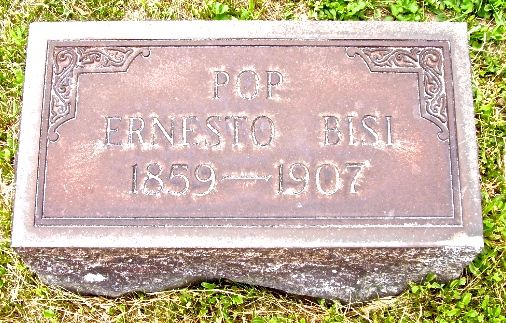

On the outside front wall of the United States Macaroni Factory was a large sign bearing the words, “Perseverance Wins.”  In a real sense the slogan epitomized the trajectory that had taken Ernesto Bisi, an impoverished, poorly educated immigrant to a rousing career in America.  Because of the opportunities presented, his own “remarkable business sense” and his marriage to Emilia, Ernesto Bisi became a wealthy industrialist and nationally recognized Italian-American leader.  

Note This post would not have been possible without the diligent assistance of Montserrat and Ernie Lehmann, Italian-speaking friends in Alexandria. Virginia, who translated and summarized a long biography of Ernesto Bisi that appeared in a Internet publication called Piacenza Antica, no author or date given.  Six of the photos come from the same site.  Newspaper obituaries also provided information on this remarkable Italian immigrant and his “adventurous” wife.




Thursday, May 28, 2020

An Outlaw & 5 At the Maverick Saloon

                             
Over its decades-long existence the Maverick Saloon could count six proprietors, five of them apparently law-abiding Montana citizens.  But my guess is that when patrons gathered around the bar at that legendary “watering hole,” the owner about whom the stories were spun endlessly was the Outlaw Lonnie Curry.


In the late 1890s the saloon, shown above, was constructed in Harlem, a town in Blaine County, Northeast Montana, located on the Milk River and adjacent to the Canadian border. The Fort Belknap Indian Reservation is just outside its limits. A postcard of Harlem's main street, unpaved and rutted, indicates the rustic pioneer nature of the town.


The man who built the saloon was George Bowles, a transplanted Kentuckian who had fought for the Union in the Civil War.  He went west initially as a stage coach driver and became a rancher.  Bowles was operating the drinking establishment under the name Club Saloon when in July 1899, Lorenzo Dow Logan, aka Lonnie Curry, one of the most dangerous outlaws in America, dropped into Harlem.   

A member of the notorious Wild Bunch and Curry/Logan bandit family, Lonnie was on the lam from a train robbery in Wyoming.   Shown here, Curry immediately rented a house in Harlem, declared the intention of settling down, and reunited with his wife Elfia and their two children.  This sequence likely was a ploy to establish an alibi if arrested for the train robbery.   Four days after he arrived Curry approached Bowles about buying a half interest in the Club Saloon.  

Given the gunslinger’s reputation, it clearly was an offer the proprietor could not refuse.  The drinking establishment was renamed the Bowles and Curry Saloon.  Lonnie became very active in the Harlem community and made friends of some of its leading citizens.  He began to wear suits and sprouted a mustache.  Like other townspeople he participated in the initial printing of a town newspaper, the Harlem Enterprise.  As one resident put it, the Curry became popular because of his willingness “to help a fellow out.”

Four months later a Curry cousin and fellow outlaw named Bob Lee arrived in Harlem, identifying himself as Lonnie’s brother, Robert.  On November 25 the two men concluded a deal with George Bowles making them the sole owners of the saloon.  Again, Bowles knew well enough when to get out.  The cousins called the saloon The Curry Brothers’ Place.  They immediately began to redecorate the interior in order to attract Harlem’s elite to their drinking establishment.  A talented fiddle player, Lonnie himself was a draw, often called upon to provide the entertainment. 

Curry’s high profile in Harlem led to his downfall.  As one author has speculated:  “Apparently the saloon wasn’t profitable, perhaps of too many drinks on the house and unpaid tabs.”  Dipping into the loot from the robbery, kept in a Harlem hotel safe, Lonnie tried to cash a $1,000 bank note, arousing suspicion.  Pinkerton detectives were soon on the trail. In January 1890 agents posing as itinerant cowboys came to town looking for the Currys.  

Alerted to their presence Lonnie gathered up Bob Lee and left Harlem.  Late that night the pair roused a local rancher named George Ringwald and sold him the saloon for $1,000 — $300 in cash and a promissory note for the balance.  They then rode south. With them went the proceeds from a community raffle, ending Lonnie’s good reputation with the people of Harlem.  Soon after Elfie and the children departed town.

Following a circuitous route that took him through Colorado, Lonnie eventually reached Dodson, Missouri, possibly the Curry/Logan home town.  There he hid out in a house with assorted aunts and cousins.  In February 1900, Pinkerton detectives tracked him there and surrounded the residence.  When Lonnie tried to escape, they shot him down — dead at 28 years old. 

Meanwhile back in Harlem, George Ringwald was now the proprietor of the drinking establishment.  My guess is that it was he who changed its name to Maverick Saloon.  Little information is available on Ringwald.  He owned a ranch outside Harlem and ran a general store near the Milk River Bridge south of town.


Fast forward to 1905.  Shown above is  a letterhead from the Maverick Saloon.  Now the proprietor was H. C. (Henry) Turner, a Harlem store owner with a progressive business approach visible in the elaborate letterhead he designed for the saloon.  In additional to adding a pool hall, he was selling wine, liquor and cigars at retail.

Likely using profits from the Maverick, Turner, described as an “enterprising merchant” created his own town in 1912, called Turner, a dozen miles from the Canadian border and 32 miles from Harlem.  He opened a general store and invited settlers to join him.  The front porch of the store is shown here with Turner’s wife (No. 5) holding a baby.  As Montana attracted more and more settlers, the town was booming. Turner eventually boasted a community center, bank, hardware and lumber stores, cafe and hotel, harness and blacksmith shops, pool hall and confectionary.  When a post office opened in 1917 Henry Turner was made postmaster.


About that time, the Maverick Saloon was sold to S. C. Rasmusson whose 1918 letterhead indicates that in addition to pouring whiskey over the bar he was selling liquor at both wholesale to other area saloons and at retail by jug or bottle to retail customers.  No information is available on Rasmusson, unfortunately, but he had only a short stint as proprietor of the Maverick until Montana went “dry” in 1919.  The bar tokens below can be attributed to one of the owners from the saloon’s pre-Prohibition days.  Tokens were banned by the national Repeal legislation in 1934.


That brings us to Roger Chase Reed, the man who revived the Maverick Saloon after the demise of Prohibition.  Reed was born in August 1885 at Devil’s Lake, North Dakota, the son of James and Emma Reed.  He is shown here in his sailor uniform, having served a dozen years in the U.S. Navy.  After leaving the service and farming for a number of years, Reed owned and operated the Maverick.  He died in 1948 and is buried in the Harlem cemetery.  No subsequent owner has come to light.

With time out for the “dry” years, the building that held the Maverick and predecessors stood for five decades, a phenomenal existence for an Old West drinking establishment.  Yet my guess is that even today when the residents of Harlem tell visitors about the history of the town, precedence is given to those six months when an outlaw ran the Maverick Saloon.

Note:   Although this post is gathered from a variety of sources, the principal one was County Histories of Montana: Thunderstorms and Tumbleweeds: 1887-1987 East Blaine County.  Much of the Curry saga is from that source as are the photos of the Maverick Saloon, Turner General Store and Robert Reed.


Sunday, May 24, 2020

The Society “Distiller” and the Crooked Cop

                   
Long before the name Hollywood became identified with the motion picture industry, New Yorkers were drinking a popular brand of whiskey by that name, as shown here on a 19th Century bar token.  The liquor was the product of William Maynard Fliess, a prominent New York businessman, government reformer and philanthropist whose fall from grace was intwined with his relationship to a New York police inspector known as  “Clubber” Williams.

Shown here, Fliess was born in German Prussia in 1833, the son of Dr. Jules Fliess, a physician who with his family immigrated to the United States and settled in Baltimore.  When a yellow fever epidemic broke out in Norfolk, Virginia, the doctor hurried to the scene to minister to the victims and ultimately died there of the disease.  William’s mother, Joan, a leading church-woman and charity benefactor, had the resources to send William to England where he studied for the law.


Upon his return, disinclined to follow a legal career, Fliess settled in New York City and, his biography claims,  “became a distiller.” That was an exaggeration.  In reality, he purchased a liquor dealership in Manhattan and was mixing raw spirits at the 47 Broadway address to create the blended “Hollywood Whiskey.”  He bottled his products in embossed amber quarts. Unlike most in the liquor trade Fliess took the trouble and expense of trademarking the Hollywood name in 1873 and claimed it had been used for the past 10 years.  During that period the German immigrant had become very rich from whiskey sales.

Fliess used his much of his wealth to fund enterprises in the Far West.  Said to be one earliest New York City money men to invest in mines, he became president of the California Mining and Water Company located in Utah.  Later he is said to have declined President Grant’s offer to make him territorial governor of that state.  Fliess also invested in railroad transportation, listed as president of the St. Joseph and Kansas line.  He established a reputation as a philanthropist, for thirty years annually hosting a Thanksgiving dinner for New York’s orphan newsboys. 

Orphan Thanksgiving

In Fliess’s day New York was ruled by the highly corrupt “Tammany Hall Ring,” run by the notorious Boss William Tweed.  In July 1871, an investigation and eventual prosecution was undertaken by a committee of seventy citizens, led by Samuel J. Tilden, later elected Governor of New York.  Fliess, considered one of New York City’s upright and progressive citizens, was chosen as a member and became chairman of its law committee, a singular honor.
  
Tweed subsequently was indicted in 1872 for forgery and grand larceny, and sentenced to prison, as were others in Tammany Hall.  The power of the ring was broken.  The resulting prestige appears to have vaulted Fliess into the upper echelons of New York society.  Advertised as “the only recognized fashionable society magazine in the City of New York,” Rider and Driver magazine in 1893 listed its “blue blood” stockholders, leading off with John Jacob Astor. Four names below was “William M. Fliess.”  A biographer called him:  “A thorough businessman, a good public speaker, an enthusiastic fisherman and an excellent rife shot.”

Enter Alexander S. Williams, a New York policeman who in 1887 had risen to the rank of inspector in charge of the West 13th Street Station in Manhattan. Because of his aggressive police methods including the liberal use of his night stick, the inspector was widely known as “Clubber" Williams.” 

Although hailed for having put down local gangs, he was not immune from the corruption then endemic in the New York police force.  William’s district included night clubs, gambling resorts and brothels.  He called it “The Tenderloin,” presumably for the perceived opportunities the area presented him for bribes.  The name stuck.  In time Williams would merit a song entitled “Czar of the Tenderloin.”

Fliess’ Hollywood Distilling Company was located on Broadway within the Tenderloin.  Just how and when the businessman might have met Williams is unclear.  Soon, however, the district’s police officials were taking great interest in the sale of Hollywood Whiskey.  Police captains and ward detectives were introducing company salesmen to the saloonkeepers of the precinct “with special recommendations of the excellence of the beverage offered, and of the high favor with which its sale is regarded at ‘headquarters’” (i.e, Inspector Williams).  With implied police protection for those who purchased it, many proprietors agreed.  “…The Hollywood Company is said to be in a highly prosperous condition, yielding large profits,” said an investigative report.

The report continued: “All those who have bought the Hollywood whiskey admit that it has turned out a good thing for them, for they have not been troubled by the police for violations of the excise laws.”  Other publicans who had their own proprietary blended whiskeys, the report continued, bought a few barrels of  Hollywood Whiskey simply to please the police, storing the barrels in the basement with no intention of using it.  The motto Fleiss put on a bar token seems prophetic:  "Don't tell a soul."

Alarmed as police “persuasion” benefiting Hollywood Whiskey spread across Manhattan, in 1888 a group of New York liquor house owners created a Wholesale Liquor Dealer’s Association for mutual protection against police interference.  The group petitioned the State Legislature with a detailed report entitled “The Police as Liquor Sellers.”  As a result the legislature eventually passed a law that barred cops from holding a commercial interest in or meddling with the sale of liquor.  Fear of police retaliation, unfortunately, made enforcement impossible.

In 1894, a New York state senator, named Clarence Lexow, shown here, was outraged by the many legitimate complaints about police and headed a legislative investigation of corruption within the NYPD.  One of the principal persons of interest to the Lexow Committee was “Clubber” Williams.  The committee heard testimony from accomplices that the Czar of the Tenderloin had received money from gambling house operators and brothel keepers as well as other sources. The inquiry found that that Williams' personal finances and properties included a house at Cos Cob, Connecticut, a yacht and other valuables —  well beyond the reach of a policeman’s salary.

Lexow had a particular interest in the relationship of Williams to the Hollywood Distilling Company and Fliess.  One report suggested that Fliess had given Williams a part ownership in his company.  Others believed it was just a standard case of bribery with Clubber filtering some of the money down to his foot soldiers in blue.  I can find no record of Fliess being called to testify.  A Mr. J. Kalt, representing the Hollywood Company, denied  to investigators any knowledge of a meeting at which the scheme allegedly was hatched.  

Williams, as expected, denied any wrongdoing but did admit receiving  $6,000 from "my friend" William Fliess.   In today's dollar that would amount to $132,000. But "Clubber" denied it had anything to do with promoting Hollywood Whiskey, as had been charged. The police inspector eventually was removed from his position but never went to jail.

With the Lexow Committee hearings meriting daily stories in all of New York’s newspapers, Fliess’s reputation as a businessman, anti-corruption leader, and member of New York high society clearly was besmirched.  But why would such a man stoop to deal with Clubber Williams, a known shady character?  My belief is that the liquor dealer was in financial distress, possibly over the collapse of his Western investments.  The St. Joseph and Kansas Railroad, it appears, was never built.  Moreover, investments in mining frequently went bust.  Fueling his need for money may well have been the cost of keeping up with the Astors and other “blue bloods” both socially and in philanthropy.  So Fliess had swung to the dark side.

Less than a decade later, William Maynard Fliess was dead, his cause of his death in 1904 at the age of 71 is not available from Internet sources. Details of his life during that time period are scanty.  He was able to keep the Hollywood Company in business despite the police scandal, but almost nothing else about him appears in the public record, including his place of interment.  Although Fliess’s has biographical material on ancestry.com, a descendant has taken much of it private, unavailable for general viewing.  The last New York City directory entry for the Hollywood Company was 1910.  At that time a son, William M. Fliess Jr., was president.

Notes:  This post is gathered from a variety of sources.  The most important are the biography of Fliess in the 1896 Cyclopedia of America Biography and the transcript of the Lexow Committee that encompasses five large volumes.  Key passages about the relationship betweem Fliess and Williams unfortunately are found in volumes not currently available on the Internet.


Tuesday, May 19, 2020

Whiskey Men Who Loved Animals


Foreword:  A number of whiskey men —distillers and liquor dealers — during their working years also showed a bent toward animal husbandry.  Most commonly distillers had pens associated with their whiskey-making, feeding their spent mash to cattle being fattened for the dinner table.  Others seemed to have had more affection for their animals.  Here are brief stories of three such men.

As hard as it may be to believe, the young man with the cigar shown here talking to a rooster and surrounded by newly hatched chicks had an earlier, highly successful career as a distiller and liquor dealer in Kansas City, Missouri. His name was Ernest Kellerstrass, a man who truly loved chickens.

Kellerstrass, still in his 30s, showed extraordinary initiative.  About 1899 he established his company and located his main office in Kansas City, selling stock in the Kellerstrass Distilling Company at $10 a share.  He also bought a distillery in Paradise, Clay County, Missouri, that had been founded about a decade earlier. Through his distillery he was able to insure a secure supply of raw whiskey for his brands.  With success he created a separate sales depot across Missouri in St. Louis.  As shown below on his letterhead,  Kellerstrass emphasized his access to railway express to send his goods west from Kansas City and east from St. Louis.


Inexplicably, in 1904 and at the height of his success, Kellerstrass, still short of 40 years old, sold out his distillery and mail order liquor empire to a syndicate from St. Louis.  Meanwhile, Kellerstrass with wife and family retired to his chicken ranch outside of town.  He built new chicken houses according to his own design and began to breed a superior kind of poultry.  The eggs from the Kellerstrass Farm became known region-wide for their freshness and quality.  Shown below is truckload of his eggs on their way to consumers.  

Soon many in America would know about Kellerstrass and his chickens. In 1910, after only a few years in business,  he self-published a book called “The Kellerstrass Way of Raising Poultry” and charged $1 for it.  The picture that began this article, showing the author talking to a rooster, was on the cover.   

Clearly very proud of the progress he had made with his chickens, the book is full of advice to poultry raisers.  Kellerstrass introduced the volume by saying:  “It has been constant aim in writing this book to use common sense, and to give the public as much good practical advice as I possibly could,  and remember, that this book was written by a man who is out working with his chickens ever day.

Milton L. Eppstein, shown here in 1914, had two evident passions in life, good whiskey and Jersey milk cows. He managed to combine the two into a Fort Worth, Texas, liquor business that exhibited both financial success and a distinctive bovine flavor. In short, he succeeded in mixing whiskey and cream. 

When Eppstein selected a flagship brand, he looked to his hobby for inspiration. He had fallen in love with the Jersey cow, a breed known for its docile disposition, lovely eyes, and high butterfat cream. His stock farm became known as one of the finest in the Southwest. It was no surprise then when Milton named his select whiskey, “Jersey Cream.”  


Eppstein’s bovine passion was most evident in a pair of freestanding metal signs advertising Jersey Cream, cut in the form of a cow and calf. The cow stood almost four feet tall and the calf was two feet.  So notable were Eppstein’s metal cows that they were taken by members of the Fort Worth Ad Club to Toronto upon the occasion of the 14th North American convention of advertising men. As a result, Milton was twitted in a contemporary publication for being the owner of a herd of iron cows and “sacred bovines.” A 1914 caricature showed him at his favorite pastime.  

Nevertheless, time was running out for Milton and his Jersey Cream Whiskey. In 1916 Texas voted statewide Prohibition and L. Eppstein & Son became history. Eppstein retired to New York City, listed as living on Seventh Avenue by the 1920 Census. Death came five years later, while Eppstein was on a visit to Fort Worth, likely to visit his beloved herd of Jersey cows.

In 1903, with a partner, Henry Figge opened a wholesale liquor house at 353 East Water Street in Milwaukee, Wisconsin.  Figge’s company quickly met with success.  His flagship brand was Custom House Rye, with a label that featured the very elegant Milwaukee building.  Dating from 1855, it had been constructed by the U.S Department of the Treasury after the design of the noted architect Ammi Burnham Young.  The building still stands.

Figge’s animal interests involved both canine and porcine. Known as a dog fancier, the 1905 Field Dog Stud Book listed him as owning a champion beagle named “Foster Rye,” likely named by him for rye whiskey.  Registered as a “black, white and tan,” Foster Rye had a long pedigree.  Its sire was “Bellman”, out of “Florist” and “Bashful”;  its dam was “Staley’s Rubber” out of “Staley" and “Sailor’s Ranney.”


Seemingly ever restless, Figge, now with considerable wealth, retired from the liquor trade entirely in 1914 and bought a large farm on Cold Spring Road in Milwaukee County not far from the village of Hales Corners.  There he raised Poland China hogs.  The oldest American breed of swine, Poland China hogs are typically black, sometimes with white patches, and are known for their large size  For a dozen years Figge was known throughout the Upper Midwest for his prize-winning pigs.  In 1926, perhaps in declining health, he sold his farm and moved back to Milwaukee where shortly after he died.

Note:  Fuller biographies of each of these whiskey men can be found on this blog at the following dates:  Earnest Kellerstrass, July 6, 2013;  Milton Eppstein, March 4, 2012, and Henry Figge, June 27, 2015.