The Hellmans were not the kind of folks to back down from conflict. Brothers Louis and Isaac Hellman while both in their teens had the courage to undertake a long ocean voyage to America in search of opportunity. They were born in the Kingdom of Bavaria, Louis in 1830, Isaac in 1833. After their arrival during the 1840s, they headed for St. Louis, a city with a strong Germanic population. They found employment, likely in the liquor trade, learned English and saved their money.
In 1863 the brothers took a risky step, with a partner, opening their own liquor business in St. Louis in the midst of the Civil War when Missouri was enduring a neighbor-against-neighbor intrastate war within the larger national conflict. Within a year the partner had departed and the company became I & L M Hellman, originally located at 6 Pine Street, later moving to 112 Pine Street. The company would claim that virtually from its founding it had produced “according to their own formula a blended whiskey…designated as ‘Crow’ or ‘Old Crow’ whiskey and branded and stamped upon barrels, keys, boxes, and bottles….” For reasons unknown, however, the Hellmans never trademarked the brand.

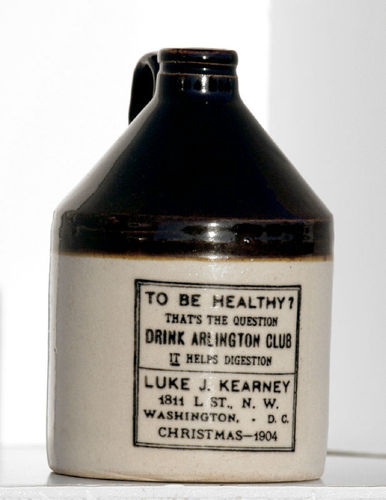
 In fact, the Hellmans never saw fit to trademark any of the many brands they were producing under their own labels as “rectifiers,” that is, blenders of raw whiskey to achieve particular taste, color, and smoothness. Among those whiskeys were: "Arlington Club Bourbon,” ”Arlington Club Rye,” "Arnold's Bourbon,” "Arnold's Rye,” "Elk Spring Bourbon,” "Elk Spring Rye,” "Gold Seal Rye,” “Hellman,” "Hellman's Cedar Grove Bourbon,” "Home Place B’b’n," "Home Place Rye,” "O. V. F. Bourbon,” "Porter Bourbon.” and "Silver Spring Rye.” The Hellmans also featured a line of alcoholic tonics including “Congress Bitters” and “Kudros.” As containers they used an array of attractive green and amber bottles.

After about only about four years in the business, Isaac Hellman died in 1867, age 31. Married, he left behind three children under eight years old. Louis then brought a relative, likely a nephew, named Abraham into the company. This Hellman had been born in Maryland in 1845 and migrated to St. Louis. He and Louis guided the fortunes of the Hellman liquor house for more than a decade.
 As a major rectifying outfit, the Hellmans almost certainly had problems obtaining a steady supply of “raw” whiskey for their blending activities. Competition for Kentucky product was fierce. Then a solution appeared in the form of the Rock Springs Distillery, located on the Ohio River a mile from Owensboro, Kentucky. By 1892, according to insurance underwriter records, the distillery property held a still house — frame with a shingle roof — three warehouses and cattle pens located about 50 feet from an iron-clad boiler house.
Working a deal with the owners of Rock Springs, the Hellmans’ obtained assured supplies of whiskey for blending. From 1904 until 1907 the St. Louis liquor dealers contracted for the entire distillery production. Those supplies allowed the family to go into high gear producing “Hellman’s Celebrated Old Crow” whiskey blend and brought them to the sharp attention of the W. A. Gaines Company of Frankfort. That distiller whose straight bourbon whiskey perpetuated the name of James Crow, widely considered the “father” of Kentucky bourbon, had gained national recognition with “Old Crow.” Gaines trademarked the name and a figure of a black crow in 1882, 1898, and again in 1904.
 Meanwhile Louis Hellman had died in 1901, age 71, and his younger brother, Moritz Hellman, also a Bavarian immigrant, had joined Abraham in running the liquor business. The name changed to A. M. Hellman & Co. The Hellmans found themselves hailed into Federal Circuit Court in Missouri by Gaines in June 1907 on the grounds that the Hellmans' use of “Old Crow” constituted unfair competition and jeopardized Gaines’ established trade and good will for its whiskey.

The Hellmans' defense was a creative one. They claimed that Gaines had known about their use of “Old Crow” since 1896 and had “acquiesced” in it. They also bashed Gaines’ straight bourbon Old Crow as “a whiskey containing a large and dangerous percentage of fusel oil, a deadly poison, and a large percentage of other dangerous and deleterious impurities…unwholesome and impure….” They contrasted it with a rectified product like their own…”blending and vatting for the purpose of removing such dangerous and deleterious impurities.”
 The Federal judge was buying none of this nor was he impressed by the Hellman claim to have produced Crow whiskeys since 1863, asking “Where were they so used?” On the other hand the judge credited the history provided by Gaines that they were the anointed descendants of James Crow and had produced “Old Crow” since 1867.
 Abraham died about 1904, age approximately 59, but Moritz pushed on to buy an interest in the Rock Spring Distillery and changed the name of his St. Louis liquor house to Hellman Distilling Company. Recognizing that so long as the matter was being battled in the courts, the company could continue to profit from the sales of their Celebrated Old Crow brand, Moritz filed an appeal of the circuit court decision with the Federal Court of Appeals in Missouri.
This time the Hellmans found a panel of judges who were sympathetic to their arguments. To the contention by Gaines that the offending words, Old Crow, had rarely been used by the St. Louis firm prior to the early 1900s, the Court ruled that “the right to use could not be measured by the extent to which the Hellman’s employed it, whether more or less frequently.” The final ruling reversed the lower court and found the Hellmans not guilty of either trademark infringement or unfair competition.

That decision sent Gaines back into court attempting to stop the Hellmans, and in various venues the case seemed to drag on forever. In 1912 Moritz, age 61, died and management of Hellman Distilling Company fell into the hands of other family members. In 1909 Gaines re-registered its Old Crow and subsequently asked for an injunction against the Rock Springs Distillery that was making Hellman’s Old Crow. Still a third federal court, disagreeing with the Missouri judges, granted the Gaines injunction.
That court put great stock in the testimony of William Mida, who ran the Bureau of Registration for brands and trademarks, considered authoritative in the industry. Mida testified that “Old Crow” always and everywhere had been considered a Gaines brand. The judges dismissed the argument that a trademark belonged to the Hellmans by prior appropriation, questioning the extent of earlier use of Old Crow by the St. Louis firm. This time the Kentucky distillery, backed by the Hellmans, appealed.
The dispute over the use of Old Crow in 1918 finally rested with the United States Supreme Court. The Supremes denied a petition by Hellman Distilling Company to intervene and ruled that the Rock Spring Distillery — and by inference the Hellmans — had acted “in fraud of the Gaines Company rights and in infringement of its trademark” in selling a whiskey the court termed “spurious.”

Although the battle was over, Gaines’ victory was hollow. While the Kentucky distiller had spent most of a decade fighting them, the Hellmans during that period were continuing to profit by selling their “Celebrated Old Crow.” Moreover, National Prohibition was just on the horizon when all whiskey was summarily banned for 14 years. Recently someone unearthed a bottle of Hellman’s Old Crow, still in its wrapper and bearing a stained label, shown above. It carries a 1917 tax stamp, suggesting that it may have been one of the last bottles the Hellman’s sold.
Note: I have posted material on W. A. Gaines Co. in a September 2011 vignette on Edson Bradley, a top company manager; and January 2016 on Charles Knecht, a Gaines antagonist. William Mida was profiled in February 2014.