Showing posts with label Edmund Dexter. Show all posts

Friday, May 26, 2017

Joseph Mersman and “The Whiskey Merchant’s Diary”

 Foreword:  It is likely that the world would never have heard of Joseph J. Mersman if Dr.  Linda A. Fisher, a public health physician, had not been doing research for a lecture on the 1849 St. Louis cholera epidemic and came across Mersman’s diary account at the Missouri Historical Society where it had laid “undiscovered” for years.  She found the whiskey merchant’s story intriguing and eventually edited it with annotations and put it into book form, published in 2007 by the Ohio University Press.   As a result, the day to day activities and thoughts of the German-born St. Louis rectifier and liquor house owner have enjoyed a wider audience.

In July 1824 Joseph, shown right, was born in Borringhausen, a small town in the German Duchy of Oldenburg,  the son of Friedrich and Catharina Maria (Polhschneider) Messmann.   When he was eight an older sister and brother emigrated to the United States.  The next year his mother died and Friedrich packed up Joseph and three other children and sailed from Bremen to Baltimore.  They settled in a German settlement in Northwestern Ohio today called Minster.   What little education Mersman received in the U.S. he achieved there, but by by the age of 13 had his first job, working as a water boy on the Miami and Ohio Canal.

About that time the family had moved to a much larger Germanic town, Cincinnati.  There Joseph at age 15 was introduced to the liquor trade, working as an apprentice with Edmund Dexter, a wholesaler who taught him how to rectify whiskey and other elements of the business. Dexter is shown left.  [See my post on Dexter, November 2015.]  About this time the family began using “Mersman” as their surname.

In November 1847 when he was about 23 years old Joseph Mersman began his diary, documenting his work in the whiskey house and other aspects of his daily life.  Shown below is a sample of his handwriting and a transcription.  He often described the day to day fluctuations in the amount of Dexter’s liquor trade.  On November 19th, for example, Mersman noted that while business was slow in the store he had “plenty to do” because Dexter was conducting a vigorous mail order business and shipping extensively.  Several weeks later he reported:  “Business very good, our Commercial transactions cannot but prove to be very satisfactory to Mr. Dexter.”

In January 1849 Mersman completed his apprenticeship with Edmund Dexter.  From his elder he had become practiced in keeping records, so important to keeping federal inspectors happy, as well as managing inventory, salesmanship, and supervising employees.  So comfortable was Dexter with the young German immigrant that the owner had trusted him to run the business while he took a seven week vacation on the East Coast.  Mersman knew full well the profits that could be made in the liquor trade..  

Now free to strike out on his own, Mersman had saved his money for just such an opportunity.  He soon moved to St. Louis, Missouri, and at 25 years of age established a whiskey and tobacco business with John C. Nulsen.  Nulsen, shown right in middle age, was the younger brother of the partner of Mersman’s older brother in a Cincinnati tobacco firm.  This suggests that family money may have helped the younger siblings get established as “Nulsen & Mersman Co.”

Mersman’s arrival in the Missouri city could hardly have come at a worse time.  Shown above from a Mississippi levee view, St. Louis was racked with community-wide cholera outbreaks in 1849 and again in 1853.   Rather than flee the city as many did, Joseph stayed and recorded the terrible effects of the epidemic.  A map of downtown St. Louis locates Nulsen & Mersman (E) amidst landmarks and the cholera hospitals.

Despite these trials, the company did well.  St. Louis boasted hundreds of saloons and other establishments selling alcohol that a wholesale house could supply.  A continuing concern for Mersman was low water in the Mississippi River that made it difficult to receive shipments of whiskey.  Believing that a substantial rain event had raised the river, he risked a major purchase:  “…So I bot 146 Bbls whiskey 17 1/4 (cents).  There cannot be a loss at this figure.”  Assuming 40 gallons in each barrel, he spent about $6.90 per barrel or a total of $1,036.  Shortly thereafter he became discouraged when the price of raw whiskey fell slightly.  Given his ability to sell a quart bottle of rectified whiskey for as much as 80 cents, however, he likely still made money.

In 1850, Mersman found a wife in the person of Claudine Creuzbauer, a sister of  John Nulsen’s wife.  An immigrant from Baden, Germany, she was 21 when they married in 1851;  Joseph was 26.  Their first child, a boy they named Joseph, was born 13 months later.  A touching photograph of mother and son is shown here.  The couple would go on to have eight children.  In his diary Mersman recorded his enjoyment of his growing family, noting that he was becoming “quite domesticated.”  He ensconced his them in a large home on Chouteau Avenue, St. Louis, shown below.   

In March 1855, Mersman abandoned his diary only to take it up again in 1862 after the outbreak of the Civil War.  Despite Missouri being a hotbed of Confederate sentiment and conflict,  Nulsen & Mersman thrived.  Having signed loyalty oaths to the Union, the partners were able to obtain lucrative contracts with the Union Army to provide whiskey for the troops.  In 1863, according to Dr. Fisher, each partner netted $20,000, the equivalent today of about a half million dollars.  An 1863 ad touted three Nulsen and Mersman brands, “Copper Distilled”  “Superior Double Rectified,” and “Celebrated Congress Whiskey.”

Merman’s sentiments lay with the North and for a time he served as quartermaster of a “home guard” unit stationed in St. Louis.  The war years also brought sorrow.  Joseph penned two entries in 1864 — one on the death in Cincinnati of his father, Friedrich, where he rued his inability to travel to the funeral, and a second just five months later when his sixth child, a boy, died shortly after birth.  That was Mersman’s last diary entry.

As time had worn on, Mersman was moving away from the liquor trade and into other pursuits.  In February 1864 with a group of other, mostly German, businessmen he helped form the Fourth National Bank of St. Louis, capitalized at $160,000 — equivalent to $4 million today.  Indicating the place he had now achieved in the city’s business circles, Mersman was elected the first president of the bank.  The next year he became a naturalized citizen.

Even as his long climb up the economic ladder was reaching the real prosperity, Mersman began to develop eye problems, possibly a secondary symptom of the syphilis he had contracted as a youth.  He resigned from the presidency of the Fourth National Bank and gradually reduced his involvement in Nulsen & Mersman.  In 1867 after 28 years in the liquor trade he and his partner dissolved their company.  In 1868 and 1869, city directories have Peper, Rassfield & Co. at the same location running a wholesale liquor business.  By 1872 Nulsen was back on the scene, initially with Rassfield, and after 1876 as a sole proprietor.

Meanwhile, Mersman was being characterized as a “capitalist,” that is, an investor in enterprises.  A major investment was with Nulsen’s son-in-law who used the funds to expand his St. Louis-based grain businesses.  As a result Joseph became a partner in the firm Orthwein & Mersman.  He retired from that company in 1880.  By that time, according to the federal census that year, Mersman eyesight had declined to the point that he was recorded as blind.  He lived another 12 years, dying in St. Louis in March of 1892, of “paralysis.”  Dr. Fisher believes it may have been another indication of advanced syphilis.  Mersman was buried at the Hillcrest Abbey Crematory and Mausoleum in the columbarium shown above.

Dr. Fisher sees Mersman’s diary as “a record of a man transforming himself from an impoverished, unschooled newcomer into a successful, skilled merchant…a path many took in the mid-nineteenth century.”  All that is true but seen from a slightly different perspective, his story also demonstrates how the liquor trade in particular hastened the economic and social rise of immigrants who understood — as Joseph Mersman clearly did — the riches to be made.

Note:  Dr. Fisher’s 378-page book provides considerably more material than simply the Mersman diary entries. She has done an impressive amount of research designed to put this whiskey man into the perspective of his times and provides biographical detail and insights not found in the pages of the diary.   


Wednesday, June 8, 2016

John McCloskie and His Patented Whiskey Jug

It may be a stretch to call John McCloskie a “whiskey man” in the parlance of this blog.  But as the father of one of America’s most unusual and imaginative liquor containers,  McCloskie deserves at least brief mention in pre-Prohibition whiskey history.

The end of the 19th Century ushered in whole new lines of everyday products.  The trend was away from displaying generic goods in barrels, large jars, bins and sacks in country store fashion and headlong into preparing individual consumer units in tins, cartons, and jugs and bottles made of ceramic and glass.   Nowhere was this truer than in the whiskey trade.


In prior days the customer often brought a container to the tavern, got his booze and went home.  Increasingly whiskey now was being sold in smaller packages, many of them made of stoneware or porcelain.  This trend posed a problem for potters.    Accustomed to making jugs in two to five gallon size, they now had to cater to a market for smaller containers.  Required in greater numbers and because each item was of less value, more efficient production was required.  The traditional way of firing a kiln, shown above, sharply limited the number of jugs that could be produced at any one time.

This problem bothered John McCloskie, a man with an inventive mind, born in Massillon, Ohio, in 1833.  His career path led him to become a potter (“turner’) at the Champion Stoneware Company in Massillon.  Working with two colleagues McCloskie devised a way in which a kiln could be filled only with jugs and successfully fired.  Essentially he invented a new kind of kiln “furniture” in the form of fire-resistant clay tiles.  They could be built like Legos to form individual cells into which four or more jugs would fit.   The key to the tiles was their interlocking capabilities and a hole in the center to allow the fire and heat to enter and circulate.

Enthusiastic about his invention, and desiring to profit by its use by other potters, McCloskie on March 27,1891, filed for a patent from the U.S. Patent and Trademark Office.  In his application he stated:  “The convenience and economy of this plan of constructing kilns for burning jugs will be fully appreciated by those familiar with the difficulties heretofore encountered in the production of jugs.”   McCloskie’s patent, No. 457,465, was issued by the federal government on August 11, 1891. 

The Patent Office illustration of jugs in McCloskie’s kiln was somewhat off the mark.  The jugs shown in his kiln with his furniture look nothing like the containers that ultimately were manufactured under his patent.  It is unclear whether the artist made a mistake or the inventor later decided that his kiln could best be used if the jugs made in it were not the traditional round or ovoid shapes, but had flattened sides.   

A product of the early machine age, McCloskie’s stoneware containers were not thrown on a potter’s wheel as was traditional.  Rather, each half was formed in a mold and then the two halves joined, capped by a handle, neck and spout.  The process permitted an embossed design on one or both sides of the vessel and, as desired, a label space for the whiskey.   McCloskie took credit for the shape as part of his invention and required that each jug include the date of his August 11, 1891 patent, as shown below. 

Unlike other inventors, McCloskie was able to put his idea into actual production.  Although Massillon had a pottery or two, it appears that he moved to nearby Akron, a major center of ceramics manufacturing.   Although the jugs produced do not have any pottery mark indicating the source, my supposition is that he was able to get an Akron company to make and market his containers.

McCloskie’s jugs found a ready market down the Ohio River in Butler, Kentucky, a cross-roads village about 25 miles from Cincinnati.  It was there that the “Old Dexter” brand of bourbon was produced.  Marketed by Edmund Dexter as early as 1860, the brand was purchased by Owen J. Carpenter about 1890.   Carpenter ordered a number of the unusual jugs.  One side had a flower motif in the center, surrounded by a legend that reads, “Old Dexter Distilling Company…Butler Kentucky”  The other said “The Old Dexter Jug Whiskey” and the trademark date. 

The four grooves in each side have suggested to some that when drained of its contents, the jug was meant to be turned on its side and used as an ashtray.  On the other hand, the indentations may be an accommodation to McCloskie’s kiln furniture since they would have helped allow the salt-glazing during firing.  Sometimes a special design was put into the jug as in the "harvest" design shown here.  My surmise is that on the reverse side a paper label identified the liquor house that issued it. 


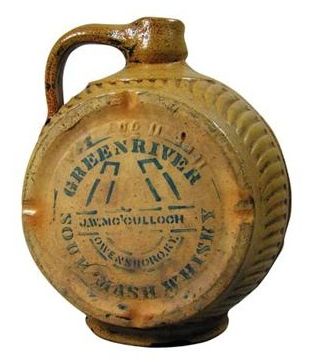
A few other distillers and whiskey wholesalers also found the jugs were an eye-attracting marketing package because McCloskie’s stoneware allowed them to print their message in several ways, either in indelible raised letters or in a printed formats.  Among distillers making use of them, shown here, were John McCulloch from Owensboro, Kentucky,  Hilmar Ehrmann of Lousville, and Patrick J. Harris of St. Louis.
McCloskie died in 1922 at the age of 89 and was buried in Akron’s Lakewood Cemetery; his gravestone is shown below.  In 1920 Prohibition closed all the Nation’s distilleries and completely ended the market for his jugs.   

Although McCloskie must have been proud of the use that had been made of his invention, he also must have recognized that his kiln idea and flat-sided jugs had not been generally adopted.  Moreover, salt-glazed stoneware had its own problems.  The haphazard distribution of salt in the kiln too frequently resulted in unevenness in glazing.  Ultimately John McCloskie’s format for jugs faded into antiquity, leaving behind only a modest but interesting set of whiskey containers for future generations to contemplate.   

Note:  Prior posts on this blog have featured three whiskey men who used McCloskie’s jug:  John McCulloch, April 2014; Edmund Dexter and Owen Carpenter, November 2015;  and Hilmar  Ehrmann, April 2016.


Thursday, November 26, 2015

Searching Out the “Old Dexter Whiskey” Three


The unusual stoneware jug shown above once held a nationally known whiskey named “Old Dexter.”  Three men were responsible for giving it to America.  Two of them were named Dexter, — Edmund J. and Edmund J. Jr.   The third was Owen J. Carpenter.  All three operated in and around Cincinnati before National Prohibition.

Edmund Dexter — The Founder.   Shown left with a flowing white beard is Edmund Dexter in whose memory “Old Dexter” was named.   He created a thriving liquor business in Cincinnati, perhaps as early as 1826, just twenty- three years after Ohio became a state.  An immigrant and a Unitarian in religion, Dexter had been born in England in 1801.  The exact year of his arrival is unclear but his first residency was in New York City.  From there he moved to Cincinnati where he may have been involved in the liquor trade working for one of the many local dealers.

When Dexter established his own liquor business is not clear.  A 1870s ad would indicate a beginning as early 1828.  Certainly by 1839, he was was well established and thriving, accord to historical records.   In 1829, Dexter married Mary Ann Dellinger, a New York-born woman several years younger than he.  They would have five sons:   Charles, born in 1830;  Edmund Jr., 1835; George and Julius, 1840, and Adolphus, 1844.  As his boys matured, Dexter brought them into the liquor business, eventually calling it Edmund Dexter & Sons. 
 
Dexter was a rectifier, not a distiller.  He bought barrels of raw whiskey from numerous sources in Ohio and Kentucky,  blended it on the premises of his 49-51 Sycamore St. store, put it into kegs or jugs and supplied saloons, restaurants, grocery stores, and other places selling liquor.  Brands names associated with Dexter whiskey included “Arlington,”  Homesdale Rye,” “Quaker Seal,” “Target Rye,” and “Old A. Keller.”  The company’s flagship brand was “Dexter’s Whiskey,”  prominent in its advertising.   His customers seem to have been in the South and West, including cities like New Orleans and St. Louis, as well as in the vicinity of Cincinnati.

By 1939, Dexter’s enterprise was accounted one of Cincinnati’s leading wholesale liquor house.  Local media said of him:  “He had been in America long enough, and had been financially successful enough, to have developed contacts all the way to Washington, D.C.”  This comment referred to his ability to get Congress in 1850 to pass a bill providing him with financial relief for a shipment of his brandy that had been lost while he was on the hook for warehouse charges in New Orleans.

The 1860 census which asked about personal wealth indicated that Dexter, in today’s terms, was a millionaire several times over.   The symbol of that affluence was his mansion at the corner of Fourth Street and Broadway.  Shown here,it is said to have been a premier showcase in Cincinnati.  There Dexter was able to host such notables of the time as Charles Dickens in 1842 and the Prince of Wales (later King Edward VII) in 1860.

This estimable whiskey man, despite his notable long white beard, was not destined for a long life and died at the age of 61 in July 1862.  He was buried in Cincinnati’s Spring Grove Cemetery.  The memorials to him were many, including this: “One supreme good fortune attended him in his death.  There were no animosities, no jealousies, no wounded vanities of the human heart, excited by his life, to find burial in his grave…His equable temper gave a uniform kindliness in his bearing to all.”

Edmund Dexter Jr. — The Inheritor.  Although all of Edmund Senior’s boys took a hand in the liquor business, the reins of management after the father’s death came to the second born, Edmund Jr.  At the time he was 27 years old and newly married to Emma Rowescroft, the daughter of Charles Rowecroft, a lawyer and for many years the British consul in Cincinnati.  Several of his brothers were also on hand to help with the company their father had built.

Although Edmund Jr. continued to call the firm, Edmund Dexter & Sons, he is credited with altering the name of the flagship brand from “Dexter” to “Old Dexter,” in honor of his father.  With his brothers he also spearheaded another memorial — this time  funding a family mausoleum  The Dexters hired a renowned Cincinnati architect James Keys Wilson to design and build a magnificent Gothic Revival monument in Spring Grove Cemetery. Said to be modeled after England’s Chichester Cathedral, it was complete with flying buttresses, catacombs, and a marble-lined chapel.

Shown above, the sandstone structure still stands.   From the outset it was a local attraction.  On its inaugural day in 1870 the family allowed the public to see inside before the mausoleum was closed off forever.   According to news stories of the time, thousands of Cincinnati residents in buggies swarmed to the cemetery for a glimpse.  Not long after Edmund Senior was re-interred there. Today four generations of Dexters lie inside.

For eighteen years Edmund Jr. successfully guided the fortunes of the family liquor firm, building its reputation and expanding its customer base.  Recognized for his business acumen, he was elected Vice-President of the Cincinnati Chamber of Commerce in 1874 and re-elected in 1875.  He might have been in line to chair that important group when in March 1879, he died at only 44 years of age.

By this time, Edmund’s brothers were embarked on their own careers.  The eldest, Charles, was a gentleman farmer and a published poet.   Julius, embarked in politics and business, became so rich that he stopped accepting compensation for his work during the last 20 years of his life.  George and Adolphus also were wealthy in their own right.  Accordingly, the Dexters determined to shut down the Sycamore Street store and in 1880 sell the rights to their nationally known brands of whiskey, including “Old Dexter.”  

Owen J. Carpenter — The Innovator.  The man to whom the Dexters’ sold, Owen Carpenter, was a Kentuckian through and through.  Born in Boone County in 1854, his ancestry is said to have numbered among its members “some of the most valuable and interesting of the Blue Grass pioneers.”

With origins in Virginia his kinfolk were ministers and farmers, the latter including his father, Caleb Carpenter.  His mother was Zeurilda (nee Utz) Carpenter. Owen received a “common school” education and was about 18 when Caleb pulled up stakes in Boone County and moved to Covington to open a wholesale liquor business.

About 1872, Owen joined his father in the trade, working beside him until Caleb’s death in 1879.  At that point he joined with his brother, David, in a whiskey dealership located at 129 Pike Street in Covington.  In 1886, David Carpenter departed, leaving Owen the sole proprietor.  The same year the company moved to 15 West Seventh Street.

In 1883, at the age of 29, Owen found a wife.  His bride was Martha “Mattie” Adams, a native of Missouri who had been brought as a infant to Versailles, Kentucky, at the time of the Civil War.   Her father was William W. Adams, a prominent livestock trader in Lexington.   Owen and Mattie would have two sons, William A.  and Owen C.  The latter tragically died at the age of seven.
Carpenter was not content with simply running a liquor store.  He desired a steadier supply of raw whiskey for his blends, chiefly Old Dexter and Carteret Club, both which he trademarked in 1906.  As a result, he sought a distillery.  The one he found, shown above, was close at hand to Covington, designated in Federal records as RD#22, 6th District. It was located two miles south of Butler Depot, Kentucky, on Butler Pike at Flower Creek.

 Insurance records compiled in 1892 suggest that the distillery was of frame construction with a shingle roof that stood forty feet from a sawmill.  The property also included one bonded warehouse, also frame and shingle roofed, located 100 feet south of the still. By 1890 the name had been changed to “The Old Dexter Distillery” and the Covington office listed for the distillery was Owen Carpenter’s address. The extent of his investment in the facility, however, is not clear.  By the mid-1890s the distillery was mashing 24 bushels a day and had warehouse capacity for 450 barrels, expanded to 600 barrels by 1910.  Carpenter had found steady flow of product for Old Dexter whiskey.

He also was innovating a container for his flagship brand.  As shown above and here, Carpenter pioneered a unusual looking salt glaze stoneware jug.  One side has a flower motif in the center, surrounded by a legend that reads, “Old Dexter Distilling Company…Butler Kentucky.”  The other says “The Old Dexter Jug Whiskey” and notes that the design was trademarked on Aug. 11, 1893.  There are four grooves in each side that have suggested to some that when drained of its contents, the jug was to be turned on its side and used as an ashtray.

These jug must have been produced by the thousands and are quite commonly found for sale at bottle shows and online auction sites.  Less commonly seen are Carpenter’s labeled bottles of Old Dexter Rye and Old Dexter Bourbon.  The elaborate label illustration depicted a Kentucky scene with barrels and glass embossing that read “Warranted…Perfectly Pure.”  The bourbon also merited a shot glass from Carpenter.

As the forces of Prohibition began to tighten in Kentucky and elsewhere, Carpenter expanded his business savvy to other endeavors, turning to real estate development.  A commentator below suggests that he had sold the distillery by 1897.

Carpenter became known as the “Father of Fort Mitchell,” a suburbanhousing community that was said to “boast of some of the finest residences in this section of the country.”  He had bought the land, platted it, and arranged for trolley transit from the development to Covington.  He also was an organizer and later president of the Kenton Water Company that built another suburban development called Latonia.

About 1917, with statewide prohibition in Kentucky,  Carpenter was forced to shutter his store and the Old Dexter Distillery at Butler was shut down.  Carpenter continued with his real estate enterprises until retiring.  During that period he saw the advent of National Prohibition, its repeal in 1934, and the return of whiskey-making and selling in Kentucky.  In 1944 Carpenter, age 90, died at Fort Mitchell, the community he had innovated, and was buried at adjacent Highland Cemetery.  His gravestone is shown here.