Showing posts with label Jokichi Takamine. Show all posts

Monday, June 22, 2020

Whiskey Men of Science

                                              
Foreword:   Making good whiskey is both an art and a science.  Subtle changes in the chemistry of the distilling process can mean the difference between a good bourbon and rotgut.  Few of the men and women involved in making whiskey before 1920 had any scientific training but through experience and onsite experimentation often achieved good results.  A handful of whiskey men approached the process from a more scientific perspective.  Three of them are briefly profiled here, none of whom in the final analysis, succeeded.

David D. Cattanach of Pawtucket, Rhode Island, was a true “polymath,” that is, someone whose expertise spans a significant number of different fields, allowing the individual to solve problems that others can’t.  Born in Scotland in 1835, he emigrated to the United States about 1855, already having invented and sold an improved method for making gunpowder.  He first made his name on these shores as a stained glass artist and decorator of churches.  

Cattanach never stopped inventing.  Among his innovations was an improved furnace that reputedly would give the same amount of heat with one-third of the coal required by ordinary furnaces.  It also consumed its own smoke, something environmentalists today would applaud.  He also invented processes for refining and treating oils and in May, 1776, with other investors spearheaded a new company in Rhode Island called the “Chattan Oil and Paint Works” for the manufacture of paints and varnishes.

Then Cattanach turned his attention to making a whiskey that, he claimed, would be unlike other spirits that were “injurious…because of acids and alkalines.”  The U.S. Patent and Trademark Office in 1885 awarded him two patents.  One was for an “apparatus for the manufacture and distillation of alcohol, hydrocarbons, and acetic acid, and for aging and refining liquors.” The illustration he submitted with the application is shown here.  A second patent was for the process involved in employing the distilling apparatus. 
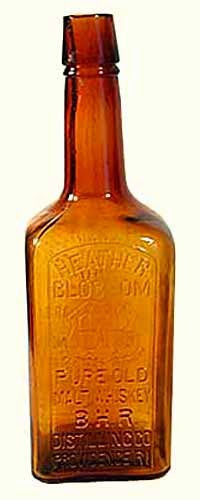
Perhaps unable to sell his system to established distillers, Cattanach determined to employ it himself.  In 1895, with other investors, he formed the Beverly Hill Road Distilling Co., capitalizing it at $100,000 and naming its principal product “Heather Blossom.”  The inventor advertised the product heavily to physicians:  One such ad read: “The B.H.R. Distilling Co. calls attention to their Heather Blossom pure malt Whiskeys, Brandies, Wines, etc., which through its new system of distillation by phyisco-chemical means, are rendered chemically pure, and are of reliable and uniform quality and adapted to the requirements of the Medical Faculty in its demand for a pure and nutritive stimulant.” 

Despite Cattanach’s efforts things did not go well for the Beverage Hill Road enterprise.  Perhaps the distilling process gave an off-taste to his whiskey.   Whatever the reason, only three years after it opened the company summarily shut down. Heather Blossom Whiskey disappeared forever. 

“The Cushing Medical Supply Company,” and its proprietor, Dr. Ira Barrows Cushing,  in their very names carry a certain expectation of authenticity and worthiness.  That is, until one discovers that the “medicine” mainly supplied by Cushing was whiskey that he mixed up in his Boston headquarters, presumably using the “Cushing Process for Purifying Alcoholic Liquors,” that he invented and patented in 1892. 

Shown here is the Rube Goldberg-like contraption that Cushing assembled for a “process of and apparatus for purifying and maturing liquors or distilled spirits.”  His patent application explanation of how it worked ran to more than three highly technical and abstruse pages.  An example of his description: “My present invention consists in commingling a suitable quantity of oxygen gas with the atmospheric air employed for treating the liquor, whereby the air which is disseminated through the liquor is energized or rendered more active for the purpose of rapidly oxidizing the fusel-oils into their avoring-acids and the process of maturing the liquor thus accelerated and rendered more perfect than heretofore.”   Whatever the examiner understood of “energized…atmospheric air,” “avoring acids,” and the rest, on November 1, 1892, the United States Patent Office issued Cushing Patent No. 485,984. 


A homeopathic doctor, Cushing had practiced in several Massachusetts towns before opening his “medical supply house” in Boston.  Along with other patent medicine nostrums he offered a variety of whiskey brands, many of them with “Cushing” in the title, e.g. “The Cushing Process Old Rye Whiskey.”  He continued to emphasize the importance of his “discovery” of the Cushing Process, telling a biographer: “It utilizes nature’s own means, and consists of forcing heated atmospheric air — which is first purified according to Professor Tyndall’s method of destroying germs of animalcule — through the liquors, thoroughly oxidizing the fusel oils and eliminating the poisons.”

Throughout his years selling alcoholic liquids from Boston, Cushing continued working as a homeopathic doctor.  He is recorded as being the “examining surgeon” for several Boston area charitable organizations and a member of both the Boston Medical Society and the Gynecological Society.  At the age of 61 Dr. Cushing was diagnosed with an advanced case of colon cancer.  An operation ensued but sepsis occurred and in August, 1908 he died. The Cushing Medical Supply Company appears to have survived for three more years under different management but went bankrupt and along with the doctor’s whiskeys  disappeared about 1912.  

It may seem like a stretch to call a Japanese pioneer of biotechnology, credited with the first isolation of adrenalin, a “whiskey man.”  Nonetheless, for several pivotal years in his life, Jokichi Takamine, a true scientist,  was financed for his research into a less expensive method of whiskey production by the Peoria, Illinois-based “Whiskey Trust.”
Born in Japan in 1854, Takamine came to the U.S. in 1884, married an American woman, and in rapid success had two sons.   He sought employment in America and decided to pursue his interest in distilling.  The key was adapting the methods of brewing Japanese sake (rice wine) to making whiskey.  In Peoria, Takamine sparked interest in one of the most important liquor executives in the Nation. He was Joseph Greenhut, the head of the Distilling and Cattle Feeding Company, a monopoly controlling dozens of distilleries in the Midwest and known popularly as “The Whiskey Trust.” 


After meeting Jokichi in person Greenhut was sufficiently impressed to give the Japanese scientist a contract to allow him to set up a research laboratory.  This facility, given heavy security by the Trust, was located inside the malt house of the Woolner Grove Distillery, along the river on the south side of Peoria.  Takamine called his lab “The White House.”  In 1891 word got out what Takamine was up to:  His use of rice rather than malt in the distilling  process would be simpler and faster, resulting in a lower cost for whiskey — Trust whiskey.

Hampered by arson at his original distillery, thought to have been set by malt workers, Takamine finally was able to put his distilling methods to the test.  He manufactured a lower cost whiskey which Jokichi called “Bonzai,” a greeting given to the Emperor of Japan meaning, “May you live ten thousand years!”  Under pressure from dissident distillers and experiencing financial problems, in 1894 the Whiskey Trust ousted Greenhut and broke off its relationship with Takamine.  It took Bonzai whiskey off the market and reverted entirely to creating its whiskey from malt.

Disappointed and broke, the Japanese scientist turned to the pharmaceutical business, inventing a remedy for indigestion that made him a multi-millionaire. He continued to be active as a scientist, including credited as the first person to isolate adrenalin.  He also started new biotechnical enterprises in Japan and the United States.  Takamine is remembered in the Nation’s Capitol for donating 3,020 Japanese cherry trees in 1912 to decorate the Tidal Basin.  Their blooming annually brings thousands to Washington.

Note:  More complete biographies of each of these men may be found elsewhere on this post:  David Cattanach, November 14, 2013;  Dr. Ira Barrows Cushing, October 9, 2017, and Jokichi Takamine,  August 5, 2018.


Sunday, August 5, 2018

Jokichi Takamine: Scientist to the Whiskey Trust

        
It may seem like a stretch to call a Japanese pioneer of biotechology, credited with the first isolation of adrenalin, a “whiskey man.”  Nonetheless, for several pivotal years in his life, Jokichi Takamine was being financed for his research into a cheaper method of whiskey production by the Peoria-based Distilling and Cattle Feeding Company, also known as “The Whiskey Trust.”


Takamine was born on November 3, 1854, in the small town of Takaoka in Toyama Prefecture on the west coast of Japan.  As shown here, it was a picturesque spot with views of both mountains and ocean.  His birth came shortly after Commodore Matthew Peary’s expedition had opened Japan to the West.  Eager to know “foreign science” better the government sent him to the University of Glasgow where he learned English and studied agriculture. He then returned to work in Japan.

When the New Orleans Cotton Exposition occurred in 1884, Takamine seemed the logical person to represent Japan as its commissioner.  While there he rented an apartment in the French Quarter and met his landlord’s daughter, Caroline Field Hitch, shown here.  They fell in love and, with her father’s blessing, were married.  Returning to Japan with his bride, Takamine was put in charge of a fertilizer works near Tokyo.

The couple produced two sons during that period but all was not well.  In Japan the blonde, blue-eyed Caroline drew stares wherever she went and was plagued by a mother-in-law who disapproved of her independent American ways.  She begged to return to the U.S.  To save his marriage, Takamine sought employment in America and decided to pursue an interest in distilling.  The key was adapting the methods of brewing Japanese sake (rice wine) to making whiskey.

Central to distilling (and brewing beer) is an enzyme called diastase that breaks down starches into sugars that then can be transformed by yeast into alcohol.  In the West the enzyme is obtained from malt made by germinating barley.  In Japan, Takamine knew, the enzyme,called koji, is derived from a fungus grown on rice and is far more active and less expensive to prepare than malt.  He saw commercial opportunities for the process in the American liquor business and wrote letters of solicitation to major distilling outfits.

In Peoria, Illinois, Takamine sparked interest in one of the most important liquor executives in the Nation.  Shown here is Joseph Greenhut, the head of the Distilling and Cattle Feeding Company, the monopoly controlling dozens of distilleries in the Midwest and known popularly as “The Whiskey Trust.”   “Come to America,” Greenhut is said to have written to the Japanese scientist, “and we will see what can be done.”  With financial help from Caroline’s father, the family departed Japan for Illinois.  Here the story can be continued as illustrated with pictures from a Japanese "manga"  (comic book) that covered this chapter of Takamine’s life.


After meeting Joichi in person Greenhut was sufficiently impressed to give the Japanese scientist a contract to allow him to set up a research laboratory.  This facility, given heavy security by the Trust, was located inside the malt house of the Woolner Grove Distillery, along the river on the south side of Peoria.  Takamine called his lab “The White House.”

The Woolner brothers, Adolph, Sam and Ignatius, were emigres from Hungary, who had arrived in the U.S. about 1871 and purchased a distillery, one of several they came to own over time.  The Woolners were enthusiastic founding members of the Whiskey Trust.  Adolph served as a vice president of the monopoly until his death in 1891.  It was natural that Greenhut would trust the Woolners, his faithful acolytes, with Takamine’s secret research.


In the end the effort was not revealed by competition espionage but by a news release from the Trust itself in February 1891.  The Chicago Tribune featured a story that predicted that through the use of Takamine’s koji diastase the distilling  process would be made simpler and faster, resulting in a lower cost for whiskey. Skeptics of the Trust believed that Greenhut had used the Japanese scientist’s work and announcements about his success as a way of manipulating the stock price of the Distilling and Cattle Feeding Company.  It also would have heartened those distillers who had signed onto the combine in the hope of quick and easy profits.

Meanwhile back at his White House laboratory, Takamine was pressing ahead and eventually found a way to make his process operational.  The Manhattan Distillery, a Woolner Peoria property was converted to his use.  Shortly after the Japanese scientist’s equipment was installed the building caught fire, one of suspicious origin.  The manga places the blame on malt manufacturers and their workers who prepared the traditional distillery enzymes from barley malt.  They had expressed strong objections to Takamine’s koji method, fearing for their jobs. The Peoria newspaper noted that the blaze was confined to “a small frame tower and under favorable circumstances could easily have been extinguished.”  The first hose to arrive with firefighters was not long enough to reach from the nearest hydrant.  When a longer one arrived, no water flowed from the hydrant and firemen watch the building burn to the ground.

Undeterred, Takamine rebuilt and after three years of effort finally got a distillery using his koji method up and running.  Eventually he was mashing 3,000 bushels of corn per day.  He manufactured a lower cost whiskey which Jokichi called “Bonzai,” a greeting given to the Emperor of Japan meaning, “May you live ten thousand years!”   As shown here, a massive explosion and fire later destroyed much of the Woolner’s Peoria distillery.  

In 1894 the Whiskey Trust, now under pressure from dissident distillers and  experiencing financial problems, broke off its relationship with Takamine.  It took Bonzai brand whiskey off the market and reverted entirely to creating the essential enzymes from malt.  While continuing to advocate koji over malt, Takamine himself suffered financially in legal battles with the Trust and his money ran out.  Wife Caroline was forced to sell her art collection and the couple had to ask their families for money to survive.

In his best-selling book, “Proof:  The Science of Booze,”  science writer Adam Rogers speculates that the whiskey-making world would look considerably different if Takamine’s ideas had prevailed.  The cumbersome malting process would be unnecessary, he contends, and different grains might have been brought into the mix.  “The Asian markets for whiskey that are so lucrative today might have cropped up 150 years sooner….” Rogers contends.

Takamine’s failure in the whiskey trade turned him to the pharmaceutical business.  He named his diastase extract “Taka-Diastase” and advertised it as a remedy for indigestion.  The product was so successful that the large Detroit drug firm Parke-Davis took over its manufacture and marketing.  In time Jokichi became several times a millionaire.  He and Caroline built a mansion in New York City as he continued to be active as a scientist, including isolating adrenalin.  He also started new biotechnical enterprises in Japan and the United States.  Takamine is remembered in the Nation’s Capitol for donating 3,020 Japanese cherry trees in 1912 to decorate the Tidal Basin.  Their blooming annually brings thousands to Washington.


Troubled by liver problems for much his life, Takamine found his symptoms growing worse as he entered his 68th year.  After fighting the disease for more than six months, he died in July 1922.  The Japanese scientist was buried in New York’s Woodlawn Cemetery in the mausoleum shown here. 

Caroline, who re-married four years after Takamine’s death, died at the age of 88 in 1954 and is buried with him.   Appropriately for a man who himself was a bridge between America and Japan, the mausoleum features a stained glass window depicting Mount Fuji and the flags of both countries.   

Note:  More details about the malting process can be found in my post of November 22, 2017 that features Frederick Lutz, “Master Maltster of Louisville.”