Showing posts with label Jorantha Semmes. Show all posts

Saturday, July 22, 2017

Whiskey Men in Love

                     
Foreword:   This is the fourth in a series of posts that examines the activities of whiskey men that previously have been profiled on the blog, grouping them for analysis under various headings.  In this case the common thread in their life stories was their love life. The love of a woman eventually led each man in a different direction.

Romantic Love:  As Louis Hossley came home each day from his liquor house a figure of cupid like one shown right, greeted him on a newell post at the bottom of the stairs to the second floor.  It has been placed there by his wife, Annie, to grace the couple’s mansion in Canton, Mississippi, a house she called “Heart’s Content.”

Whether it was love at first sight, we do not know, but a photograph taken of Louis and Annie not long after their 1898 marriage shows the couple in close, romantic encounter.  He was 23 at their nuptials and she was 20.  Annie clearly is a beauty, her figure shapely, her face comely and her dress stylish.  Louis’ clothes are formal, his hair tidy and his appearance of a young man “on the way up.”

Louis was the son of a widow with no family resources and the couple’s early years found them apparently unable to own their own home.  The 1890 Census found them living with Annie’s brother, John Wohner, and his family.  John ran a saloon called Wohner’s Corner on Canton’s town square.  Beginning by working for Wohner,  Hosseley eventually took over the business and successfully expanded to wholesaling whiskey throughout Central Mississippi.


In 1911his newly-acquired wealth allowed Hosseley to buy for his wife a two and a half story Greek Revival mansion on a half acre lot with landscaped gardens.  The centerpiece of this luxurious dwelling was a grand mahogany staircase rising from a central hallway.  There Annie had placed the statue of Cupid, likely a symbol of the romance that characterized the Hosseleys’ union.  

When Mississippi went “dry,” Hosseley was forced to shut down his saloon and liquor business but had gained sufficient wealth and prestige in Canton as to be  relatively unconcerned.  He went into finance and became president of a Canton bank.  He also served as mayor of the city.  “Heart’s Content” became the social center of the town’s elite.  

Not blessed with children, the Hosseleys lived there together until Louis died in 1936 at 60 years old. When Annie passed away twenty years later the couple were reunited, their grave markers laying side by side.  Heart’s Content still stands and is rented out upon occasion as a wedding site. Thus, the Hosseleys’ love story is kept alive in Canton, Mississippi.

Practical Love:  Benedict Joseph (B. J.) Semmes literally had been born into whiskey-making.  But it was not until he had wooed and won the love of his life, the daughter of a New York congressman, that with her support he was able to steer Semmes distilling through many crises into business success and prosperity.

Sprung from a family that had run distilleries in the District of Columbia since 1823, Semmes courted  19-year-old Jorantha Jordan for 18 months before she consented to marry him.  During this period, he came to appreciate her intelligence, writing her:  “…You have an inquiring mind — speak precisely — act readily, and are not Dull at figures.”  The couple is shown here in a fuzzy photograph.

Benedict was later to test all those qualities in Jorantha when in 1859 he saw brighter horizons westward and moved the family to Memphis, Tennessee, eventually opening a liquor house there.  Before the store could earn significant profits, however, the Civil War erupted.  Semmes enlisted and marched off, leaving the business to his wife.

While he was away, Jorantha — now caring for six children — showed considerable commercial initiative.  In 1863 she reported to her absent husband that she had earned a profit of $150 by bottling and selling whiskey and brandy to supplement the Semmes family income.  By the end of the war, however, she was forced by the fighting in Tennessee to flee to Mississippi.

The liquor house reputedly had been burned out during the war, with no insurance.  With Jorantha’s help, however, Semmes was able to recoup quickly.  One observer has said:  “The early success of Semmes & Company rested in part upon the…activities of the…family, particularly the labor of his wife.”  In ensuing years Semmes owned and operated a major Tennessee distillery and wholesale liquor house, one that included mail order sales.

After 52 years of marriage, Benedict Semmes died in 1902, Jorantha still by his side.   She lived on another 23 years, passing in 1925.  Today in Memphis’ Calvary Cemetery their gravestones lie side by side, as shown below.


Impetuous Love:  Samuel Taylor Suit was a school drop-out who gain wealth and power as a Kentucky and Maryland distiller.  Friend of American presidents, he built a mansion on an estate outside Washington, D.C., where a town called Suitland now is named for him.  “Love” was Suit’s Achilles heel.  Said to be “tenderhearted and kind,” Sam had a definite weakness for the ladies.  

Shown here as a youth, Suit found his first love, Sarah, when he was about 25 and she was still a teenager.  She bore him one child and then after only a few months as his wife, she died.  Deeply affected by her passing he moved to New York where he met the daughter of a wealthy insurance executive.  She was Aurelia, a woman eleven years his junior, known more for her needlework than her looks.  After twenty years of marriage marked by discord and one child, they divorced.

In 1878 when Suit was in his mid-40s, he met and fell in love with 17-year-old Rosa Pelham, the daughter of a congressman, shown here.  Because of the age difference she initially rejected him.  Five years later they encountered each other near what is now Berkeley Springs, West Virginia.   At this time Suit was being drawn away from Suitland and his distillery by prospects of developing a health spa at that location.

When Rosa mentioned that she had always wanted to live in a castle, Suit immediately pledged to build her one if she would marry him.   She agreed and three days later they were wed in Washington, D.C.   Not long after Suit began construction of Rosa’s 13-room castle on a ridge overlooking the Berkeley Springs baths.  Built to a one-half scale of Berkeley Castle in England, the project took almost five years to complete.  In the meantime, the couple had three children.


Suit never took up occupancy in the castle, dying in 1888 at the age of 56.  Rosa was left a very wealthy 28-year-old widow with three small children, living in a castle.  Although she had many suitors she never remarried, reputedly because of a stipulation in Suit’s will that if she did she would lose everything he had bestowed on her.  That did not prevent her from spending many nights with her suitors.  One night, following an argument, one of them fell or was pushed from the castle roof to his death.  He is said to have cursed the heiress and haunted the castle.  Rosa eventually lost both her money and her mind.  In the 1920s she was evicted from the castle, went West with a son, and died there.  Suit’s castle still stands prominently on the highway leading to Berkeley Springs, a testament to impetuous love.

Homocidal Love:  Stanley Cooney was part of a family that operated J. Cooney & Company, wholesale liquor house in Nashville, Tennessee.  About 1887 he met Mary Isabelle Wheeler, the daughter of a politically prominent Texas family.  A talented artist, as a teenager she was sent to the Columbia Female Institute, located not far from Nashville.  

Stanley and Mary met there, fell in love, and were married in 1888.  He was 28 and she was 21.  After a year of living in Nashville while her husband sold liquor, Mary became homesick and persuaded her spouse to relocate to Texas and open a business there.  The town they selected was New Birmingham, a boom town based on iron ore smelting, a place had attracted a number of millionaires and seemed destined to become a major Texas city.

No millionaire was more closely associated with “The Iron City,” as New Birmingham was called, than William Harrison Hammond, a former Confederate general, shown here. Hammond's was a major booster of the town's economic prospects and his wife was the sister of the iron works owner.


How the General and Stanley Cooney chanced to be acquainted has gone unrecorded.  Despite being remembered as “notably quiet and gentlemanly in his demeanor,” Cooney was neither when he encountered Hamman.  Blinded by anger, he used both barrels of his gun to shoot down the former Confederate in the street.

Cooney’s motive was said to be that Hamman had defamed the character of his beloved wife.  Some whispered, however, that it was the General’s wife, perhaps jealous of her social status, who had traduced Mary.   Caught with the gun in his hand, Cooney was arrested, quickly convicted of manslaughter and sentenced to prison.  Meanwhile Hamman was buried.

Two years later, likely with help from Mary’s politically potent Wheeler family, Stanley was pardoned and released from jail.  The news appears to have unhinged the Widow Hamman.  “In a fit of outrage and grief,” as it is told, she ran through the streets of New Birmingham screaming to the heavens to ”leave no stick or stone standing” in the town.  Her curse proved prophetic as economic conditions worsen and New Birmingham slowly died, becoming a ghost town with  just a plaque today indicating where it had once thrived.

Meanwhile, Stanley and Mary spared no time getting back to Tennessee.  The 1910 census found the couple back in Nashville where Stanley was working in the liquor house as if nothing had happened.  Mary was launched on her career as landscape artist.  Her works, like the the painting below, called “The Old Farm House,” are still featured by Southwestern art galleries.

Here we have met four whiskey men, learned four stories of their strong attractions for a woman, and encountered four very different outcomes.  Love is like that, I guess.

Note:  More elaborate vignettes on each of the four men featured here may be found elsewhere on this blog:  Louis Hosseley, April 12, 2016; B. J. Semmes, May 11, 2015;  S.T. Suit, August 4, 2011, and Stanley Cooney,  April 22, 2015.


Tragic Love

Monday, May 11, 2015

B. J. Semmes and Jorantha: Love and Whiskey in Difficult Times

Benedict Joseph (B. J.) Semmes literally had been born into whiskey-making. But it was not until he had wooed and won the love of his life, Jorantha, the daughter of a New York congressman, that with her support he was able to steer Semmes distilling through many crises and maintain a whiskey dynasty down to three generations.
Semmes was born in 1823 in Georgetown, by then part of the District of Columbia, the son of Raphael and Matilda Semmes.  One relative had been the proprietor of the City Club Tavern in Georgetown and later Rhodes Tavern in Washington proper.  Four years before Benedict’s birth Semmes family members had begun making whiskey on a commercial basis.  In 1894 he told a U.S. Senate committee investigating the Whiskey Trust:  “We began business in 1819 in Washington, D.C., and built the first brick storehouse on south side of Pennsylvania Avenue, between the Capitol and the Treasury Department, and built the Yannissee Distillery in 1823 on Yannissee Creek, Maryland, within sight of the dome of the Capitol.”   The Semmes clan called their whiskey “Yannissee.”

Benedict’s youth apparently was unremarkable, growing up in a reasonably affluent D.C. family and educated in local schools.  He may well have worked in the Semmes liquor business from an early age.  At the age of 24, he met Jorantha Jordan, a New Yorker, when she accompanied her father Lawrence Pallette Jordan, a congressman, to a session of the House of Representatives.  Jorantha was 19.  With frequent letters between Washington and New York, their courtship lasted 18 months, complicated because of her initial reluctance to convert to his Catholicism.  During this period he came to appreciate her business skills, writing her:  “…You have an enquiring mind—speak precisely—act readily, and are not Dull at figures.”

In late 1849 or early 1850 they were married and Jorantha settled into the role of housewife and eventually mother.  The fuzzy photo shown here likely is that of the young couple. Their first child, Julia, was born in late 1850, followed by two boys, Joseph Malcolm in 1852 and Raphael Eustice in 1855.  Semmes supported the family by working in a District of Columbia store, recorded as a “wholesale merchant.” 

By 1859, however, he had seen brighter horizons westward and decided that Memphis, Tennessee, a fast growing community on the Mississippi river, held opportunities that the Nation’s Capital did not.  After a friend secured a $3,000 line of credit for him, Semmes traveled there by himself and opened a dry goods store.   Reputedly after having the building blessed by a local priest, he called for Jorantha and the children to join him.  

Semmes' venture into dry goods may have been short lived.  His letters to Jorantha had noted that business was slow.   By 1860, business directory listings indicate that the B. J. Semmes Company primarily was selling liquor.  Before the store could reap significant profits, however, the Civil War erupted.  ln March 1862,  Benedict enlisted as a sergeant in Company L, 154th Tennessee Regiment, leaving the store management to Jorantha.   Wounded only a month later at the Battle of Shiloh, Benedict went home to recuperate and helped his wife sell off the stock.  Upon returning to action, he was commissioned as a captain in the Army of Tennessee and later assigned as chief of the army's commissary. 

While he was away, Jorantha — now caring for six children — was showing considerable business initiative.  In 1863 she reported to her absent husband that she had earned a profit of $150 by bottling and selling whiskey and brandy to supplement the Semmes family income.  The older boys had helped her.  By the end of the war, however, she was forced by the fighting in Tennessee to remove the family to Corinth, Mississippi.  Promoted briefly to major,  Semmes surrendered with the Confederate Army in April 1865.  Author Frank Byrne says:  “In a matter of weeks Semmes returned to Memphis where Benedict reopened Semmes & Company, a wine and liquor firm….The early success of Semmes & Company rested in part upon the wartime activities of Semmes family, particularly the labor of his wife.”

This post-war period was one of bitterness in Southern towns like Memphis. In testimony to the U.S. Senate seeking protective legislation, Semmes maintained that he could not produce financial records from 1866 to 1883, as requested by the committee, as “Gen. Sherman burned our books on his ‘March to the Sea” so that we only have complete records since 1866” — likely a stretch since Sherman is recorded as having started that march from Atlanta, not Memphis.  Semmes also complained that:  “Our distillery was burned, without insurance, during the war.”   He did not make the location of that facility explicit.

Whatever damage had been done, with the support of Jorantha,  Benedict recouped quickly. After spending three years at an address at 234 Second Street, he moved to larger quarters at 297 Main Street. As a whiskey blender and compounder, Semmes featured a number of proprietary brands.   They included “Jo Blackburn,” and “Tennessee Club.”  Most important, he had carried the “Yannissee" name with him from Washington DC to Memphis and made it his flagship whiskey label.  He advertised it as shown right with a strange set of letters that have been widely misunderstood.  They are in the Coptic script and spell out “Memph,” the name of the ancient Egyptian town from which Memphis was derived.  Semmes trademarked the Coptic symbols and gave some of his ads Egyptian themes.

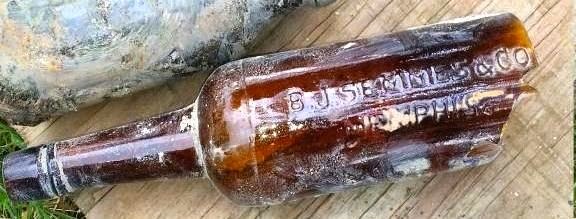
Semmes was packaging his whiskey both in ceramic and glass.  Shown here is a gallon jug that likely was meant for his wholesale trade.  It has a typical Bristol glaze off-white  body and Albany slip brown top with his name stenciled on the front in large letters.  His retail customers could received their Yannissee whiskey in dark amber quart bottles.  Two variations are shown below, the second one broken, uncovered by digger.

In his 1894 Senate testimony, Semmes stated that he was renting Charles Nelson’s Greenbriar Distillery, shown below, 22 miles from Nashville, and running it as the Yannissee Distillery for such time as he required each year. “…We never produce each year over 2,500 barrels or less than 600 barrels.”  In 1893 and 1894, however, “owing to depression in business and the recent financial panic,” Semmes had shut the distillery down and made not a single barrel.  Moreover, in 1890 he had exported 500 barrels of whiskey from the U.S. to Germany to avoid taxes amounting to $20,000 ($500,000 equivalent today). In effect, he was testifying in favor of reforms that became the Bottled-in-Bonding Act of 1897.
Semmes disclosed that in addition to distilling whiskey, he was buying wine and liquor both in the United States and abroad, including other national whiskey brands, in order to meet customer demand in Memphis and its environs.  Those products provided the company little benefit, he contended, because he was forced to compete on cost with dealers in other cities for the same brands.  Although Semmes did not state it specifically, his mail order sales would have been particularly affected.  Apparently comfortable with his trademarks, he added:  “Of course our own brands of domestic goods are ours and under our control.”

The whiskey dealer took the opportunity of his Senate testimony to rail against protectionist policies that shielded the manufacturers of Northern states, Alabama, and Louisiana.  He noted that the suit of clothes he was wearing while writing his testimony had cost him $65.  A friend  had showed him a similar suit bought in Canada that cost only $20.  Semmes may have been thinking of his own brood when he complained of the expense protectionism imposed on him and others “to support and educate a large family in elegant luxury.”

Throughout the challenges their liquor business faced, Jorantha continued to be consulted by Benedict on business matters.  Moreover, as his sons Joseph and Raphael reached maturity, both were taken into the firm and eventually into management positions.  An 1897 letterhead from B. J. Semmes & Co. listed all three men.  The letterhead also boasted that  after chemical analysis Yannissee brand whiskey had been awarded a U.S. Marine Hospital contract for medicinal whiskey.  The Semmes claimed to carry the largest stock of old Tennessee sour mash whiskeys in the state.  The company was continuing to prosper.

In 1902, Benedict Semmes died at age 77.  While his family gathered around his grave site he was interred at Calvary Cemetery in Memphis.  Jorantha would join him when she died in 1925. Their attractive marble headstones are shown here.  Joseph and Raphael kept the liquor business going, for a short period establishing an adjunct store in St. Louis, Missouri.  In 1910 they moved their Memphis operations to 50 N. Second St. and then to 14 N. Front Street.   With the onset of state prohibition in Tennessee, B. J. Semmes and Company was forced to close in 1915.

That event wrote the final chapter on this liquor dynasty and its Yannissee whiskey.  Company letterheads and advertising always cited 1819 as the date of its founding.  The Semmes family had kept making and selling liquor through the Civil War, Reconstruction, the financial “panic” of the late 1800s, harsh taxation, high tariffs, and the Whiskey Trust.   Benedict himself summed up the Semmes history in his Senate testimony:  “We have never failed or burned out during three generations of our family….”

Note:  The relationship between Benedict Semmes and his wife Jorantha, particularly as it relates to business matters, was featured by Frank J. Byrne in his 2006 book, Becoming Bourgeous:  Merchant Culture in the South, 1920-1865.  Byrne drew his material from letters exchanged by the couple from in 1848 to 1865 that are among the Benedict J. Semmes papers archived at the University of North Carolina at Chapel Hill.  I have drawn from Byrne’s book as well as other sources, particularly Semmes' 1894 written testimony to the Senate Finance Committee.