Malcolm Crichton and Henry (H. L.) Mencken, though they likely never met, forged an enduring bond between themselves because of Monticello Maryland Rye. Crichton created it and Mencken, the “Sage of Baltimore” gave it national recognition by championing it as a superior brand of whiskey.
 One of America’s best known wrlters, Mencken claimed the family physician “believed and taught that a shot of Maryland whiskey was the best preventive of pneumonia in the R months.” That directive was firmly held by Mencken’s father, Augustus, a cigar manufacturer. When the senior Mencken sent out for whiskey he demanded Monticello.
His famous son recounted: “His…bill file shows that on December 27, 1893, he paid…$4 dollars for a gallon of Monticello whiskey….Before every meal, including breakfast, he ducked into the cupboard in the dining room and poured a substantial hooker of rye, and when he emerged he was always sucking in a great whiff of air to cool off his tonsils. He regarded this appetizer as necessary to his well-being. He said it was the best medicine he had ever found for toning up the stomach.”
 The man responsible for this elixir was Malcolm Crichton (pronounced “Cri-ton”). Born in Illinois about 1840, he was the son of Janet M. and William Crichton, a Scottish-born wholesale grocer who relocated the family to Maryland in 1848. His father appears to have been something of a taskmaster. A Baltimore friend told an anecdote about Malcolm and his brother being driven to school by William: “He wore riding breeches and held a fine whip in his hand. I heard him tell [the schoolmaster] to keep his sons in order and not to spare the rod. ‘Send for me,’ he added, shaking his whip, ‘if you need any help.’”
‘
Malcolm began his career prior to and during the Civil War working for his father in the grain and fertilizer business on Baltimore’s waterfront. An 1863 city directory listed Wm. Crichton & Son as grain, flour and guano dealers and commission merchants. The father was also listed as president of the Corn and Flour Exchange. After the war, Malcolm left his father’ employ and struck out on his own. For someone familiar with grain it seemingly was only a short step to distilling. At the age of 25 Crichton was recorded in city directories engaged in making whiskey at a site near Holliday and Bath Streets in Baltimore.
 In the meantime Crichton met and fell in love with Antoinette Kennedy, the daughter of John Kennedy of Hagerstown, Maryland, and through her mother related to the influential McPherson clan of Baltimore. They married on June 15, 1865. The couple would have six children, William, Nettie, Malcolm, McPherson, James and Mary Elizabeth. Two of them are shown here, reading one of several children’s books Antoinette wrote and published.

 Clearly an enterprising young man, Crichton took over a defunct distillery once run by Joseph White. He rebuilt the facility and began producing the whiskey he called “Monticello Rye.” Baltimore already had its Mount Vernon Rye — named after George Washington’s home. That may have inspired Crichton to appropriate the name of Thomas Jefferson’s home for his whiskey. A serving tray and his ads fully exploited the connection. Crichton also claimed in his advertising, without proof, that the date of origin for this brand was 1789 — half a century before his birth.
 Calamity struck on July 24,1868. That was the date of the Jones Falls Flood, Baltimore’s greatest natural disaster of the 19th Century. The water rose to twelve feet downtown, shown here in an artist’s depiction. Among the casualties was the Monticello Distillery, washed away by the rushing waters. Crichton lost little time before rebuilding, this time aided financially by Charles E. Dickey, the owner of a meter manufacturing company.
 The location at 136 Holliday would be the home of the M. Crichton & Company plant for the next twenty years. A Sanborn insurance map shows the extent of the facility on two sides of Holliday Street. In 1880 Crichton moved his sales and management offices to 57 Second Street in Baltimore, later moving them to the Fireman’s Building at the northeast corner of South and Second Streets.

 Jim Bready, the historian of Baltimore whiskey, has written that the rebuilt Monticello Distillery was not far from City Hall. In summer when the windows were open, there being no air conditioning in those days, the aromas of the whiskey-making would waft through municipal offices — obviously fomenting thirst among the clerks. Bready also noted that Mencken, like others of his time was fond of standing at the bar, the “Sage of Baltimore” said, to “toss the bartender for drinks.” Monticello Distilling obliged the practice by issuing a token that could be flipped to see who paid.

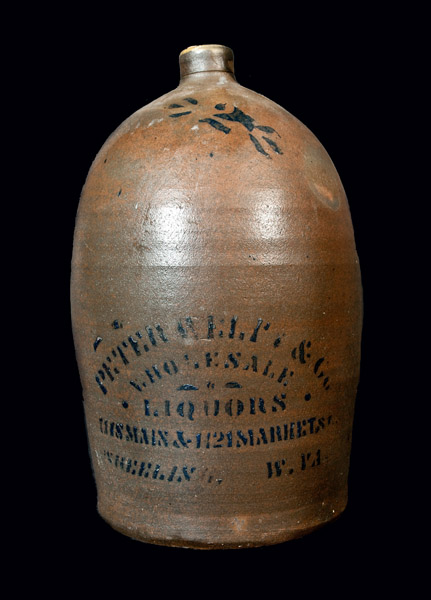
 Before long, Crichton had built his distillery into one of Maryland’s largest, gauged by the taxable value of the spirits produced. In 1900, for example, Malcolm’s facility produced a taxable $228,788 in product, roughly equivalent to $5.6 million today. In Maryland he was second only to the Hannis and Sherwood distilleries. Monticello Rye not only had a loyal customer base in Maryland but also reached liquor dealers such as Peter Welty in Wheeling, West Virginia, and Loeb-Lion-Felix in New Orleans. In 1881, likely concerned about brand infringement, Crichton trademarked the name.
Unfortunately, Malcolm Crichton had little time to enjoy the success and prosperity his Monticello Rye had engendered, dying in 1890 at the early age of 50. The Baltimore Sun carried details of his demise: “About a year ago Mr. Crichton had an attack of erysipelas in the face. Under the care of Dr. Silas Baldwin, he recovered. Two weeks ago Mr. Crichton was attacked with erysipelas in the food and Dr. Baldwin was again summoned. Gangrene developed and at Dr. Baldwin’s request Dr. Alan P. Smith was made consulting physician. Shortly after 3 o’clock yesterday afternoon Mr. Crichton rose from his chair and attempted to walk across the room. He fell after making a few steps and soon died.”
 Because of the artistic efforts of his son, James, we are fortunate to have a small portrait of Malcolm Crichton in middle age. He seems not to have lost the intensity seen in the face of the younger Malcolm, shown above. With his family gathered at his graveside, he was buried in Baltimore’s Green Mount Cemetery.
When Malcolm died, it appears that none of his sons were interested or equipped to take over for him. The distillery was sold to Baltimore brothers, Bernard and Jacob B. Cahn. Bernard earlier had been in the liquor business as a partner in Cahn, Belt Co. [See my post on this firm August 2013.] The Cahns continued successfully to run the Monticello Distillery and market the brand for almost 30 years, until shut down by National Prohibition. During Prohibition Monticello Rye was one of those whiskeys that could be bought for “medicinal purposes” with a prescription at drug stores. With Repeal, the brand under new ownership continued to survive into the 1940s.

Shown here drinking a beer at the stroke of midnight ushering in 1934 and Repeal, Henry Mencken was enthusiastic about the demise of National Prohibition. Later he came to see Repeal as something of a mixed blessing. Now, Mencken raged in print, Monticello Rye cost $3 to $3.50 a quart — not the $4 a gallon his father had paid.