Showing posts with label Wyatt Earp. Show all posts

Monday, February 10, 2020

The Two Sides of Tombstone’s Milton Joyce


Milton Edward Joyce, proprietor of the Oriental Saloon in Tombstone, Arizona, has been called “one tough old bird” and, as above, pictured as a mean-eyed Western gunslinger.  Most often cited is Joyce’s violent clash in 1888 with the notorious “Doc” Holliday. “…That’s just one small slice of this remarkable man’s life” argues one observer, noting that the characterization ignores Joyce’s civic and business contributions.  Both depictions are valid.  There were two sides to Milton Joyce.

Born in New York in 1847, Joyce arrived in California in 1862 at the age of fifteen. He was recorded in the 1870 Census working as a blacksmith in San Mateo, California, twenty miles from San Francisco.  By 1880 he had moved to Cochese County, Arizona, when silver was discovered there, initially recorded as a miner living in Tombstone.  Founded in 1879 this boomtown quickly attracted a mix of those digging for treasure and gamblers, scam artists and gunslingers looking to take it from them.  

A proliferation of drinking establishments marked Tombstone — more than fifty for a population of 3,000.  Having accrued some money from mining, Joyce opened a his own richly furnished 
saloon, shown here, on Allen Street and called it  “The “Oriental.” It was hailed by the Tombstone Epitaph, the local paper, as the most elegant saloon, “this side of the Golden Gate.” 

The Oriental boasted twenty eight gas chandeliers that, as the reporter rhapsodized, made the barroom “sparkle like a December iceling in the sunshine.”   The bar was carved, furnished in gilt and capped with a highly polished top. The saloon had two rooms, the main bar and behind it a club room furnished with plush carpets and ivory ornamentation.  There Joyce leased out gambling concessions, including briefly to Wyatt Earp, right.

For all the glitz and glitter, however, the Oriental Saloon was still located in a rowdy and sometimes dangerous Western town.  Gunfights on the main drag, Allen Street, were frequent.  Joyce would gain his tough guy reputation by taking on the notorious dentist cum gunman, John Henry “Doc” Holliday, left.  Lectured by Joyce for starting a row in the Oriental, the drunken Holliday stormed out of the saloon, looking for a gun. Finding one, he returned and opened fire.  Unsteady in his aim the Georgia-born dentist sprayed bullets around the barroom, striking a bartender in his right foot, tearing off his big toe.  Joyce, who was carrying a six-gun, fired back but missed.  Joyce then attacked Holliday with the butt of the gun and beat him senseless.  Only then did the saloonkeeper realize he had been hit by a shot in the hand and was bleeding copiously.Local police authorities rushed to the scene and escorted Joyce to medical help.

For a while it appeared that the saloon keeper might lose his hand.  Meanwhile, surviving his pistol-whipping by Joyce, Doc Holliday was arrested by Deputy Marshall Wyatt Earp on a complaint filed by Joyce.  He was held in the Tombstone jail on $200 bond which he paid and was released.   The Arizona Weekly Citizen covered the story but mistakenly called him “Hoyle.”  A matter of months’ later, after the famed “Gunfight at OK Corral,” everybody in the state knew who Doc Holliday was.

On October 12, 1880, Holliday appeared in court in the custody of the town marshal.  None of the prosecution witnesses appeared in court. The defendant offered a plea of guilty to assault and battery. It was accepted and the charge of assault with a deadly weapon was dismissed. Holliday was fined $20 and costs of $11.25.”  In the same period the Epitaph was reporting regularly on Joyce’s condition, noting on October 24:  “During the past day or two inflammation set in on M.E. Joyce’s wounded hand and at one time it looked as though amputation would have to be resorted to in order to save life. Yesterday, however, showed a change for the better, and chances of saving the hand are much improved.” In the end Joyce had a complete recovery.

At the restored Oriental saloon Milton Joyce today is depicted as a hard-eyed gunslinger surrounded by cleavage-baring, high-skirted dancing girls.  That fanciful image is balanced by the “other” Joyce.  The only photograph I can find is of a man with gentle Irish eyes and a benign expression, shown below.  This is the Milton Joyce who is said to have advanced community benefits wherever he lived.


In 1881, the appointed Governor of Arizona, John C. Fremont, the famed explorer, first Presidential candidate of the Republican Party, and former Civil War general, was called upon to create a Board of Supervisors for Cochise County.  Fremont selected Joyce as one of three members.  The saloonkeeper subsequently was named its chairman.

Among Joyce’s first acts was to advocate strongly for a new county courthouse.  Through his efforts a county-backed bond issue of $500 for its construction was authorized.  Shown here the bond was signed by Joyce.  A town landmark when completed in 1882, the court house, shown below, has been restored as a historical site.  During his years in Arizona, Joyce also invested in land, mining and other businesses.


The Oriental saloon burned in the Tombstone conflagration of 1881, spreading so quickly that Joyce was not able to save anything, watching hopelessly as his carved bar, chandeliers, and plush carpets went up in flames.  Although the building was quickly reconstructed on site, the next year saw the Oriental once more threatened by fire but saved.  By this time Joyce appears to have become increasing disenchanted with his life in Tombstone.  When an opportunity arose in 1883 to join a group of local residents on a prospecting expedition to find gold in Baja Calfornia, he joined.

The expedition turned out to be a “fool’s errand.” The group took a train south to the Sonoran port of Guaymas in Mexico, sailed across the Gulf of California, then tracked inland to the deserts of Baja, near Mission Santa Gertrudis.  This “gold rush” was doomed virtually from the beginning as the strikes quickly petered out.  The Tombstone party, like others lured by the prospect of riches, not only failed to find gold but suffered from extreme heat and lack of water.

The expedition brought Joyce back to California, however, where it may have rekindled memories of his early day in the San Francisco area.  In 1884, he sold the Oriental and headed back to the Golden Gate.  Reported as having “accrued a fortune” in Arizona, Joyce with a partner opened a saloon and billiard parlor on the ground floor of the swank Baldwin Hotel downtown.  Shown here, the hotel was owned by Comstock Lode millionaire Elias “Lucky” Baldwin.  Apparently noting the profitability of Joyce’s enterprise, Baldwin after four years decided to take charge of the property himself.

Joyce and his partner promptly opened a new establishment and named it Cafe Royal.  The Daily Alta newspaper called it “the finest saloon and billiard hall on the Coast.”  About the same time, the bachelor Milton met, wooed and married a woman 14 years younger than himself.  She was Louise Mockler, a native Californian of German ancestry. 
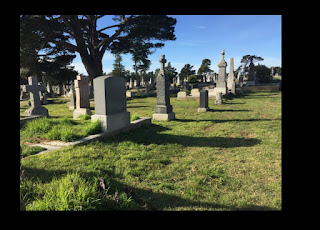
Their wedded life was short.  Married in February, Joyce died of tuberculosis at his home on Van Ness Avenue the following November.  He was only 42 years old.  He may have known he had a fatal disease at the time of his nuptials.  Joyce was given the funeral rites of the Catholic Church and buried in Holy Cross Cemetery in nearby Colma.  Joyce left his ample estate to his widow, Louise.  She remarried five years later.

Joyce’s San Francisco obituaries emphasized his wealth and contributions to the public weal including memberships in the Knights Templar, Odd Fellows, and Knights of Pythias.  There he was remembered, not as a Western “tough old bird,” but as a civic minded, successful entrepreneur, popular with his patrons and the local business community alike.  His showdown with Doc Holliday was left unmentioned.

Not so in Tombstone.  After Joyce sold the Oriental, it operated as a saloon for the next 30 years until Arizona went “dry” in 1914.  The building became a drug store and later was occupied by a series of tenants.  Tombstone was rescued from being a “ghost town” when the 1881 gunfight became a mainstay of Western lore.  Numerous dramatic, fictional, and documentary works have been produced about the event.  With more than 400,000 tourists visiting the town annually, the building has been restored as a saloon under its original name. There, for the edification of visitors, Milton Joyce is depicted as a gun-toting tough guy who once pistol whipped Doc Holliday almost to the point of death.


Friday, November 22, 2019

Tex Rickard: From Barkeep to Boxing Boss


With its label in tatters the whiskey bottle shown right would have little interest except for the name in the smallest print:  “Tex Rickard,” an artifact from one of his early drinking establishments.  Born in Kansas City in January 1870, George Lewis “Tex” Rickard parlayed operating saloons into a career promoting boxing matches that made him famous throughout the United States and, indeed, the world.

While a  toddler, Rickard and his family moved to Texas, where soon after his father died.  Forced to truncate his education to help with family finances, at eleven years old he went to work as a cowboy on the Texas frontier and took part in several long cattle drives.  By the age of 23, having indicated unusual abilities and earned the nickname “Tex,” Rickard, shown right as a youth, was elected town marshall of Henrietta, Texas.  He married in 1894 and had a child but both his wife and baby died within a year.

Perhaps grieving over his losses and drawn by the discovery of gold in Alaska in November 1895, Rickard headed for the gold fields of Alaska where he and a partner staked and later sold a valuable claim.  He used the funds to open a saloon, gambling hall and hotel in Dawson City, Canada, that he called “The Northern,”  a name he subsequently gave to several of his saloons.

Possibly suffering from the deaths of his wife and child and a second failed marriage,  in Dawson Rickard began to drink and gamble heavily.  It cost him his share of the saloon and he was forced to work as a poker dealer and bartender in the Monte Carlo Saloon. It was there Tex with a partner first began to promote boxing matches.  But gold still beckoned.  In the spring of 1899, reputedly with only $35 to his name, Rickard headed to Nome, Alaska, where a strike had been reported. 


Apparently with borrowed funds, Rickard opened a saloon and gambling house in Nome.  By the fall of 1899 he had cleared $90,000 ($2.2 million equivalent today).  By the following year, as nugget-bearing miners continued to drink and gamble at his establishment, he was $100,000 to the good and within five years was worth a half million.  Possibly because “The Northern” was already the name of a Nome saloon, Rickard may have called his “The Southern.”  The cabinet card above is of an Alaska saloon of that name with Rickard’s name prominently displayed.

One author has commented:  “Physically, Tex Rickard was a most engaging person, a tall man with small twinkling eyes set into a bland, smooth-skinned face. He had the gamblers’ thin-tipped trap mouth, an infectious, boyish smile and an impish expression.”  

In Nome, Rickard met and became a lifelong friend of Wyatt Earp, who for a time owned a competing saloon.  Earp, shown here, was a boxing fan and previously had been hired to referee matches.  Their relationship may have whetted Tex’s appetite for the boxing game.  Later Rickard would hire Wyatt’s brother, Virgil, as a bartender and then saw that he was made a deputy sheriff just before that Earp brother died of pneumonia. 

As had happened in Dawson, the gold soon ran out in Nome.  Rickard, who had invested most of his riches in mining properties lost most of his wealth and saw the client flow at his saloon and gambling hall slow to a trickle.  This time Tex looked south to Goldfield, Nevada, 247 miles southeast of Carson City.  Gold had been discovered in the vicinity in 1903 and the site had become a boomtown.  The yellow stuff was making prospectors rich overnight and, as usual, looking for a place to spend their cash.

By now a thoroughly experienced proprietor, Rickard in 1904 knew just what Goldfield spenders needed.  In 1904 he packed up and moved to Nevada.  Together with two partners, he opened the Northern Saloon.  

It was the most elaborate of any of his watering holes, featuring 12 bartenders, 14 gaming tables, and 24 dealers.  According to its bookkeeper, Tex’s place made $30,000 monthly from the tables and $12,000 monthly from liquor.   A photograph from the University of Nevada, Reno, shows the interior of the Northern.  It is teeming with customers, one of them gambling one-on-one with a dealer.

Wealthy once again,  Rickard built the most impressive brick house in Goldfield, one that still stands.  Shown below, the dwelling boasted lead glass windows and a white picket fence.  Tex furnished it lavishly with oriental carpets, expensive wallpaper and fine decoration.  It boasted the only lawn in Goldfield and neighbors were said to have turned out to watch whenever Rickard cut the grass.


According to one possibly apocryphal account, the house lacked a kitchen because the saloonkeeper lived there alone and took all his meals out.  At the time, however, Tex had wed again.  She was Edith May Haig of Sacramento, California, and the couple had one daughter who died in 1907. They were married until Edith’s death but it is possible she did not accompany him to Goldfield — or deign to cook.

By this time Rickard had achieved some recognition as a fight promoter.  As shown here, he sponsored minor bouts held in the town square next to the Northern Saloon.  Tex, however, had his sights on bigger goals.  In December 1909, Rickard and a partner won the right to stage the world heavyweight championship fight between James J. Jeffries and Jack Johnson, billed as “The Fight of the Century.”  Although Rickard had planned to hold the fight on July 4, 1910 in San Francisco, opposition caused him to move it to Reno, Nevada.  The bout gained national attention and brought recognition to  Rickard as a fight promoter.  Tex and his partner made a profit of about $120,000 on the fight, won by a knockout by Johnson.

Despite the rich return of the Jeffries-Jackson bout, Rickard announced to the press that he was “through with the business of prize fighting.”  He sold the Northern and his house in Goldfield and sailed to Latin America. There he acquired land in Paraguay, managing huge a cattle ranch for five years.  Once again his investment proved faulty, the cattle business failed, and Rickard is estimated to have lost about a million dollars.

By the time of his return to the United States in 1916, Rickard had revised his thinking about the fight game.  That same year he promoted a heavyweight bout between Jess Willard, the “The Pottawatomie Giant” and Frank Moran in New York City at Madison Square Garden.  He followed in 1919 by with the famous bout in Toledo, Ohio, between Willard and Jack Dempsey, shown here, and promoted the 1927 rematch at Soldiers Field in Chicago. The second match brought in the first $2-plus million gate and was the first to feature a $1 million purse.  Rickard made money on both fights.  His biggest payday, $550,000, resulted in 1921 from matching Dempsey against George Carpentier, “The Idol of France” in Jersey City, New Jersey. 

By now firmly ensconced in New York City, a rich man and a world renowned fight promoter, Rickard continued to build his legend.  His trademarks were a soft, light-colored fedora hat, the snap brim turned down, a straight gold-headed malacca cane and a cigar. In 1926 he promoted the Jack Dempsey-Gene Tunney fight in Philadelphia.  The bout attracted a world record crowd of 135,000 and earned $1,895,000. By now fabulously wealthy, Rickard also founded and owned the New York Rangers hockey team and built the third version of Madison Square Garden in Manhattan.

In 1925, Rickard’s wife of 23 years, Edith Mae, died in New York.  Earlier Tex had met Maxine Hodges, a former actress 33 years his junior. The couple married on October 7, 1926, in Lewisburg, West Virginia. On June 7, 1927, the couple's daughter, Maxine, was born.  Tex had little time left to enjoy his new baby.  In December 1928 while he was in Miami arranging a boxing match he was felled by an appendix attack.  Complications occurred during the course of an apparently botched operation and Rickard died on January 5, 1929, at the age of 59.  His body was returned to New York and he was buried at Woodlawn Cemetery in the Bronx.  


Sportswriter Davis J. Walsh memorialized him:  "Rickard  wasn't merely associated with boxing; he was boxing itself. He took it out of the back rooms and  dropped it into the laps of millionaires. He established a monopoly  by cornering its star performers. He made it the biggest money business of all professional sports.…”   My analysis of Rickard’s career suggests that his years as a saloonkeeper were crucial to his success.  Blessed with a genial personality and the ability to understand what his customers wanted, Tex applied the lessons he learned behind the bar to a much larger stage and found they worked for him there as well.


Monday, May 6, 2019

J.W. Swart and His Arizona "Bar Room"


Violence swirled like dust in a windstorm around Jacob W. Swart’s “Bar Room” in Charleston, Arizona Territory.  Located six miles from infamous Tombstone, Arizona, site of the “Gunfight at the OK Corral,” Swart’s watering hole was a favorite hangout of gunslingers and outlaws.  His distant relative (see below) believes that the bearded man standing in the doorway of the saloon wearing a white hat is Swart.

The name is Dutch, derived from the word for “black” and the family settled on American soil in New York State during the 1700s.  Jacob likely was born in 1823 in Dryden, Tompkins County, the eldest child of Elizabeth (nee Winnie) and John Duffie Swart. Census data variously recorded the father’s occupation as laborer or “shingle weaver,” that is, working in a wood mill making shingles for houses.

When Jacob, the eldest child, was just an infant, the family moved to Albany where a brother and two sisters were born.  The 1850 census found him at age 27 still living at home and likely working as a farm laborer.  Later in that decade Swart left his family and moved West, recorded living in Arizona by 1867.  Along the way he appears to have learned something about guns and perhaps about operating a saloon.  In 1879 the Pima County, Arizona, newspaper reported a payment of $11.44 to Swart as a quarterly fee for his services as deputy sheriff.  Such jobs often were awarded to those handy with a six-shooter.


Not long after, Swart moved to Charleston, Arizona, about sixty miles east of Pima.  Shown above as it looked in the late 1880s, Charleston was founded in 1879 as a milling site for the silver mines around Tombstone.  Because water was essential to recovering the silver and Tombstone was desert, the town, located six miles away on the San Pedro River, was chosen for the factories and the ore was hauled there.  The mills held heavy pistons that rose and fell, breaking down ore. The operators then combined the pulverized ore with water and chemicals including mercury to release the precious metal.

People seeking work in the mills poured into town.  At its zenith in the mid-1880s Charleston boasted four general stores, a meat market, drug store, two restaurants, two laundries, two hotels, several boarding houses and an estimated thirteen to fifteen saloons.  One of the earliest drinking establishments was owned by Frank Stillwell, a noted gunslinger, outlaw and businessman who also owned an interest in silver mines, two livery stables, a wholesale liquor business,  and a saloon.  In 1881 he sold the saloon to Swart.  A year later Stillwell, left, was dead, shot at close range by Marshall Wyatt Earp in revenge for the killing of his brother, Morgan.

In the years following Swart’s proprietorship of the saloon, it became known as a handout for a loose group of outlaws known as the “Cowboys.”  The photograph shown here is believed to depict a number of those desperadoes, several of whom subsequently would be involved in the notorious 1881 gunfight at the OK Corral in Tombstone, an epic clash that has been dramatized repeatedly in motion pictures and other media.
  

Jeff Swart, a distant relative of Jacob Swart, has spent years analyzing the photo of the saloon and believes it is a group picture of the Cowboys.  He believes that the shot was taken in 1881 by Charles O. Farcoit, an itinerant photographer in the Southwest, not long before the Tombstone shoot-out.  Among those gathered at Swart’s place for the photo, says Jeff, were:  

*Ike Clanton:   Joseph Isaac Clanton was a member of the Clanton-McLaury gang that confronted the three Earps and Doc Holiday in Tombstone.  Reputedly unarmed, he fled the gunfight scene in which his younger brother, Billy, was killed.  Shown here, Ike later filed murder charges against the quartet, but after an 30-day court inquiry, the judge ruled that the lawmen had acted within their authority.  Six years later Ike was killed attempting to flee from a lawman seeking to arrest him for cattle rustling.

*Tom McLaury:  McLaury and his brother Frank owned a ranch outside Tombstone and had ongoing conflicts with Marshall Earp and his brothers over the McLaurys’ cattle rustling and other offenses.  They frequently had threatened the Earps and both were at the OK Corral on that October day.  Both were killed in the virtual seconds of gunfire that ensued.

*William Brocius:  Better known as “Curly Bill,” Brocius was a gunman, rustler and known murderer. One observer called him “Arizona’s most famous outlaw.”  Brocius had numerous run-ins with the Earps and was linked to the killing of Morgan Earp.  An Earp-led posse unexpectedly encountered him with other Cowboys at present day Mescal Springs, Arizona, in March 1882.  During the ensuing shootout Wyatt Earp killed Curly Bill.

*Pete Spence.”  Born Elliot Larkin Ferguson, Spence was a hanger-on of the Clantons and McLaurys.  Suspected of stealing mules and robbing a stagecoach, he nonetheless was hired by an Arizona town as deputy sheriff.  On the job he pistol-whipped and killed a man, resulting in a sentence of 18 months in jail.  Despite his fierce demeanor here, Spence retired from crime to raising goats and running supplies to Arizona towns by mule train.  He died in bed in 1914.


The sign that hung above the door to J.D. Swart’s Bar Room, pricing drinks at 12 and 1/2 cents deserves some explanation.  His customers would know that the reference was to a “bit.”  The “bit” was a unit of common currency derived from the early tradition of cutting a Spanish milled dollar into eight pie-shaped pieces or bits, each worth 12 and 1/2 cents.  “Two bits” made a quarter as that coin sometimes is called today. 

In addition to running his drinking establishment, Jacob engaged in family life.  During the early 1870s he had married an Hispanic woman named Sacramento who had been born in the Mexican state of Sonora.  Fourteen years his junior, she apparently had been married before.  The 1880 census indicated that her son was living with the Swarts in Charleston, along with her brother and a niece.  The couple had three children of their own:  John, 7, likely named after his grandfather;  Charles, 5; and Peter, a baby of 10 months.   Jacob, age 52, was listed in the census as “keeping saloon.”

The violence that marked this part of Arizona did not leave Swart untouched.  During the mid-1880s, the saloonkeeper had an altercation with a man named Chambers, a manager at one of the Charleston mills.  Swart shot and killed him.  In the West of those days if the dead man was armed and shot in the front, the verdict almost inevitably was “not guilty” and the shooter was not jailed.  In this case Swart found himself facing Justice of the Peace James Burnett, a man known for assessing large fines for infractions and pocketing the money.  Likely reckoning Swart a rich man, Burnett fined him $1,000, equivalent to $22,000 today.  Rather than pay up, Swart hustled out of Charleston just ahead of a posse sent to arrest him.


Jacob, presumably with his family following, moved 300 miles west to Yuma, Arizona, on the Colorado River near the California border.   Yuma was a far different place from Charleston and Tombstone.  City Historian Tina Clark has called Yuma a “precious river town.”  It was the first stop in Arizona for trains and steamboats coming from urban centers like Los Angeles and San Francisco.  Tastes in Yuma were more refined and life was calmer.

There Swart opened a new watering hole he called “The Identical Saloon” at the corner of Main and Second Streets.  In a 1891 advertisement, one that misspelled his name, he boasted of always having on hand “First-class Whiskies, Wines and Brandies” as well as “Choice Key West Cigars.”  Jacob clearly had taken his drinking establishment up a notch on the elegance scale.  Noting his “Cosy Club-rooms” suggests that he was entertaining gambling or perhaps something more intimate.  At that point the trail goes cold on Swart.  I have been unable to track his final years or his place of burial.

The fate of Charleston, however, is well known. When the silver mines in Tombstone flooded in 1886, the mills were forced to shut down and the town declined sharply in population.  That blow was followed by a major earthquake that struck in May 1887.  It left the town’s adobe structures in ruins and sealed its fate.  By 1889 Charleston had become a ghost town, as it remains today.

Although the population of Tombstone also declined sharply, it remained the seat of Cochise County and beginning in the 20th Century began to flourish economically on tourism and the sale of Western clothing and memorabilia.  Annually some 450,000 visitors are drawn to the town by its history of violence, particularly the gunfight at the OK Corral.

Note:  Although this post was gathered from many sources, key was a post by Jeff Swart on his blog on February 2, 2014.  He has done some excellent genealogical work on his family and apparently ferreting out the identities of the men in the photo of Swart’s Charleston Bar Room.  My efforts to reach Jeff online have proved unsuccessful.  Photos of the four outlaws are from Wikipedia.